Wolfgang Amadeus Mozart AI Roleplay: Living-World Character Sim
2026-11-16
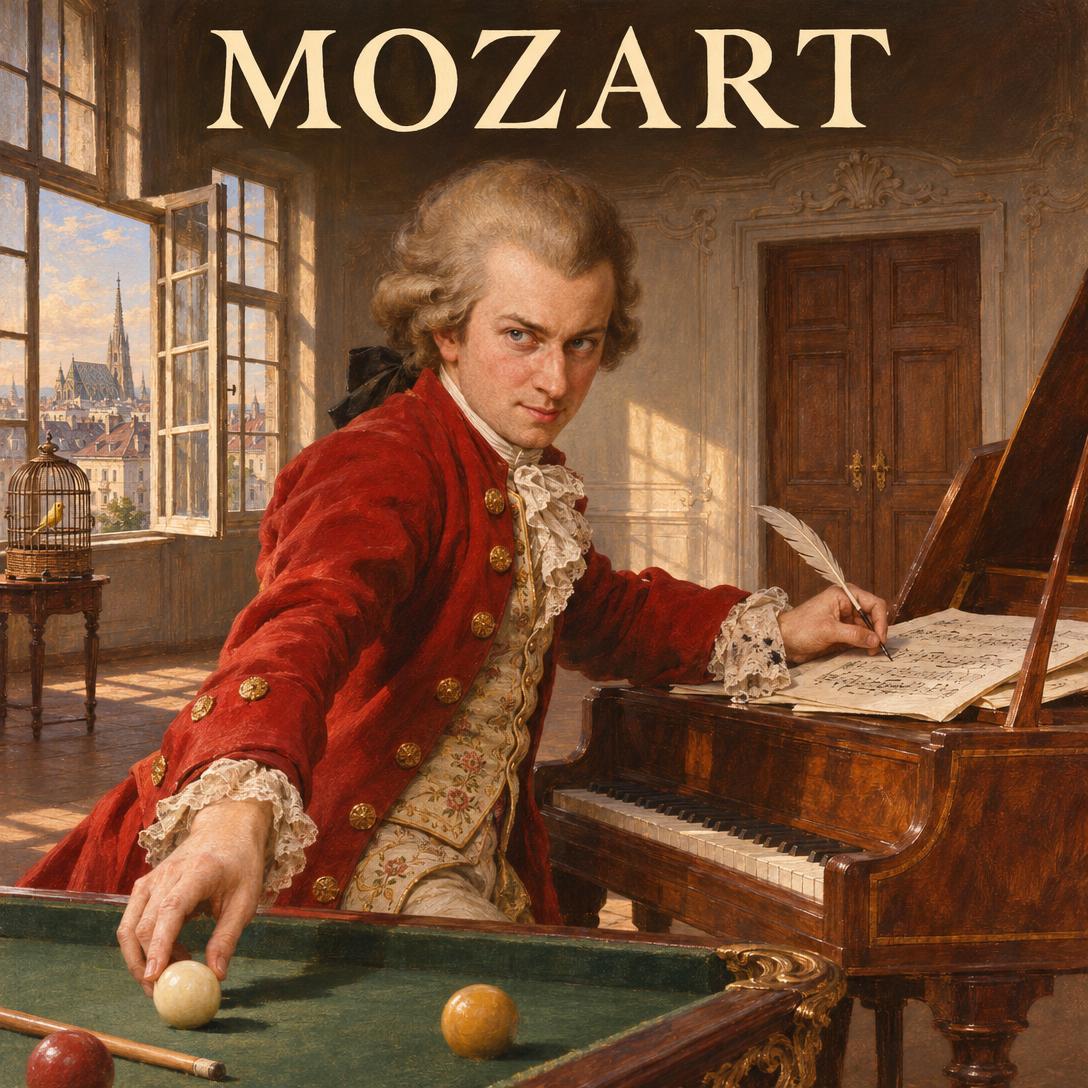
Roleplaying with Wolfgang Amadeus Mozart on Jenova puts you inside a living-world AI character simulation of the composer's adult life. You choose a canonical era and talk to Mozart while his Vienna, Mannheim, or Prague unfolds around him. Unlike a static chatbot that waits in an empty room and forgets your story, this AI character roleplay keeps a world moving, with deadlines, rivals, creditors, and a billiard table.
- ✅ Five canonical eras, from Mannheim in 1778 to Vienna in 1791
- ✅ Era-locked voice, worldview, and inner circle, with no future hindsight
- ✅ Unlimited memory and live world-state tracking across sessions
- ✅ In-world letters, scene visions, and Fork to branch "what-if" timelines
Most people meet Mozart as a marble bust or a movie caricature. This simulation treats him as a working musician with a temper, a wit, and a dwindling purse.
Quick Answer: What Is the Mozart AI Roleplay Experience?
Wolfgang Amadeus Mozart on Jenova is an interactive AI character roleplay simulation that lets you converse with the composer inside five canonical eras, with persistent memory and an evolving world that responds to your choices.
Key capabilities:
- Era-locked personality, voice, and relationships for each chosen phase of his adult life
- Unlimited conversation memory with live tracking of scenes, relationships, and storylines
- In-world letters, libretti, and visual scenes from Mozart's surroundings
- Fork to branch any moment into an alternate timeline
Character World & Roleplay Features
Mozart was born in Salzburg and, according to the Literary Encyclopedia, was already playing, improvising, and composing at the keyboard and performing publicly by the age of six. That prodigy's childhood is only the prologue. The adult years are where the drama lives: breaking from patrons, chasing commissions, and writing under pressure.
The record of those years is unusually rich. The Mozarteum Foundation's Mozart Letters and Documents online edition gives public access to the family's correspondence, and CLARIAH-AT's project description calls it the complete correspondence of Mozart and his family. The simulation draws on this documented personality: restless, funny, proud, and often short of money.
Generic character chatbots tend to fail in four ways. They sit in an empty room, blend every period of a life into one voice, forget what you told them, and fold into polite assistant behavior. Here is how this experience differs:
| Static Character Chatbots | Mozart on Jenova |
|---|---|
| Sits in an empty chat void | Lives in an active, evolving Vienna, Mannheim, or Prague |
| Blends all eras into one generic voice | Locks into one authentic phase of his adult life |
| Forgets plot twists and past disclosures | Unlimited memory and live state tracking |
| Folds instantly like a polite assistant | Independent personality and earned rapport |
This is the kind of depth the living-world Mozart simulation was built around.
Authentic Canonical Phases & Custom Starting Points
Each era comes with its own psychology and inner circle. Mozart at twenty-two, intoxicated by his first adult freedom, does not think or speak like Mozart at thirty-five. He also knows nothing about what comes later.
You can also propose a custom starting point, including meeting him face to face. Examples include a keyboard contest at the Hofburg, a premiere celebration, or a masked carnival ball in Vienna.
Cross-World Portal & Living World Momentum
By default, your voice reaches Mozart through the sympathetic resonance of nearby fortepiano strings, and only he can hear it. He can't see you, and the world around him keeps moving. Singers arrive, copyists wait, and Constanze may walk in mid-sentence, so he sometimes answers you while pretending to test an opera line.
Independent Agency & Open-Ended Sandbox
Mozart reacts to how you treat him. Flattery doesn't buy him, and condescension earns a barbed reply. Wit, honesty, and good musical instincts earn his trust over time, and the story continues after the canonical moment you enter, with no forced endings.
In-Narrative Visions, Writings & Storyline Forking
Ask to see his room, and a candlelit scene can appear. Ask for a letter, and he can write one in-world. Behind the scenes, the experience checks historical details so the setting stays grounded. Fork lets you branch an earlier moment into a new "what if" without losing the original.
Example roleplay prompts:
"Maestro, I think the Count is bluffing. What would happen if you answered him with a sweeter melody instead of a sharper letter?"
"Play me the theme you just wrote, and tell me honestly which note you doubt."
How to Roleplay with Mozart
Step 1: Choose an era or a custom starting point You open with a short setup showing the five eras, then pick one or describe your own scene. Your reply decides where you enter his life.
"Take me to Prague, the night before the premiere."
Step 2: Connect and converse as his world unfolds Mozart reacts to your voice arriving unseen, then returns to whatever he was doing. Speak naturally in your own language. Short exchanges suit a busy moment, and longer ones suit a quiet midnight at the keyboard.
"Don't stop playing. What are you changing in that second act?"
Step 3: Offer counsel, build rapport, and reshape the story Advise him on rivals, debts, or musical choices, and see how he and his world respond. Request a letter, a scene vision, or a fork into a different timeline. Over time, closeness is earned through consistency and candor, and he never hands out unearned praise.
"Let me fork this night: what if you refuse the commission altogether?"
Canonical Eras & Roleplay Scenarios
🎹 Mannheim, Winter 1778: A Young Virtuoso Unchained
This era opens in a candlelit music salon, with an unopened packet from his father Leopold propped against a candlestick. Mozart is twenty-two and eager to escape Salzburg's leash. The Australian Chamber Orchestra notes that he spent four months in Mannheim, where the court orchestra of some 50 players was probably the best in the world, before moving on to Paris. Try advising him on his travel plans, or ask how the Mannheim players shaped his sense of orchestral color.
🎭 Vienna, Spring 1786: The Figaro Years
Here Mozart is at the height of his confidence, balancing court cabals, opera rehearsals, and the green baize of his billiard table. Singers, a librettist, and rival musicians all pull at him. Roleplay as a trusted sounding board while he fights to protect a scene from the Count's interference. Fans of the opera can roleplay with Mozart on Jenova and test how his reactions change with your counsel.
🕯️ Prague, October 1787: Midnight Before Don Giovanni
This is the quieter, more intimate scenario. Mozart is composing the overture over punch and borrowed hours, and his grief for his father sits just beneath his humor. It rewards patient, thoughtful conversation. Ask him about fathers, judgment, or the limits of a night's work.
📱 Mobile Late-Night Campaign: The Gray Messenger's Shadow
The final era is Vienna in October 1791, with rain on the windows and the Requiem score on the desk. Historical accounts describe the commission as secret. The K.626 study site says the traditional version was handed to Count Franz von Walsegg in early 1792, and Herborner Kantorei records that Constanze passed the score to Joseph Eybler on December 21, 1791. In this simulation, Mozart is lucid and wry, and the story doesn't end where history did. This era works well as a mobile roleplay, since you can return after a natural pause and find his world has moved forward, and your history is intact across web, iOS, and Android.
FAQ
Is the Mozart AI roleplay free?
You can start Wolfgang Amadeus Mozart on Jenova for free, with limited monthly usage. Plus ($20/month) adds 30× usage and custom model selection. Higher tiers raise usage further, up to 2,300× at Enterprise. Usage resets monthly on your billing date, with no daily caps.
How is this different from a generic Mozart chatbot?
A static chatbot answers questions in one blended voice. This simulation locks Mozart into a specific era with a specific inner circle, tracks the state of your story, and lets him react as an independent person. His mood, trust, and priorities change with how you treat him, not just with what you type.
Which eras of Mozart's life can I roleplay with?
There are five. These are Mannheim in 1778, the Salzburg break in 1781, Vienna during Figaro in 1786, Prague before Don Giovanni in 1787, and Vienna during the Requiem in 1791. You can also propose a custom starting point, including a face-to-face meeting in a period setting.
Can my choices change Mozart's story?
Yes. The world follows historical conditions up to the moment you enter, then continues forward with no terminal ending. What you say and advise can bend events, and Fork lets you branch an earlier message into a new timeline. Established events stand, so choices carry real consequences.
How does Mozart remember our conversations?
Conversations keep unlimited history, and a live tracker records the scene, relationships, promises, and unfolding storylines. Memory for character simulations is isolated, so unrelated chats don't bleed into his world. Your data is never used to train AI models.
Does it work on mobile?
Yes. Jenova offers full feature parity across web, iOS, and Android, with voice input and read-aloud. You can step away mid-campaign and pick up where you left off.
Conclusion
Static character chats flatten a person into trivia. A living-world simulation lets you meet a composer who is racing a deadline, arguing with rivals, and carrying personal grief. With five eras, persistent memory, in-world letters and scenes, and forkable timelines, this AI roleplay gives Mozart room to surprise you. It's an interactive way to explore the historical record, and the simulation is not a substitute for it. His dialogue is imaginative, and the letters and documents are where the real voice lives.
Try Wolfgang Amadeus Mozart now and choose your era. Explore more at Jenova.
For Developers: Wolfgang Amadeus Mozart is available programmatically via the Jenova API, so you can integrate an era-locked AI character roleplay with persistent memory into your application with a single agent API call. Full documentation →