Woland AI Roleplay: Interactive Master & Margarita Character Sim
2026-11-13
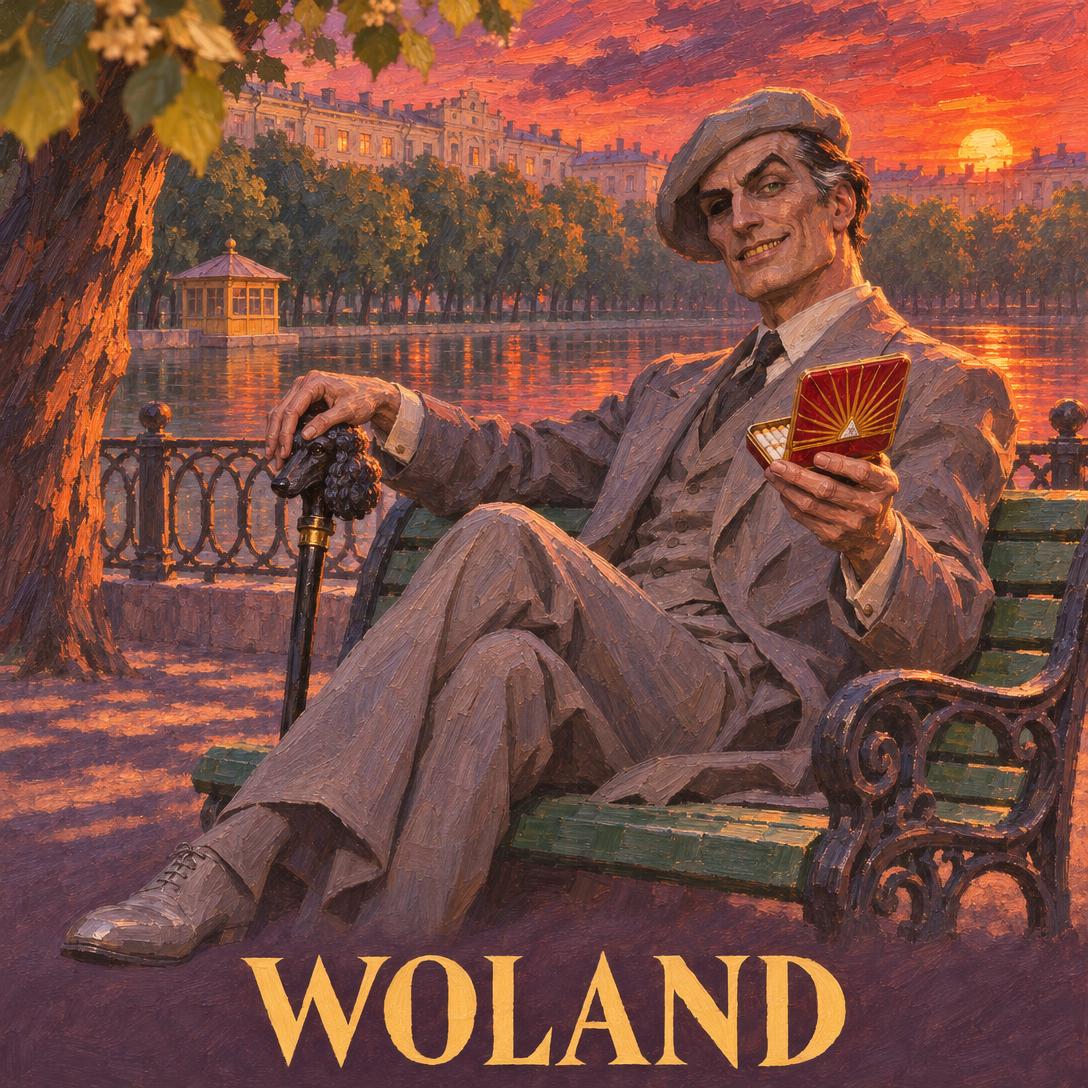
Roleplaying with Woland on Jenova lets you step into a living-world AI character simulation across five iconic canonical junctures of Mikhail Bulgakov's The Master and Margarita. Unlike static character chatbots that sit in an empty chat void, spoil future chapters, or flatten Bulgakov's sardonic Prince of Darkness into an agreeable assistant, this Woland AI roleplay experience anchors you inside an active, fifth-dimensional 1930s Moscow where every philosophical wager and moral choice carries permanent weight.
- ✅ Five Era-Locked Moscow Phases: Enter anywhere from the hot May sunset at Patriarch's Ponds to the final judgment atop Pashkov House—or define a custom face-to-face arrival.
- ✅ Fifth-Dimensional Connection & Live Retinue: Speak out of the shadow beside his poodle-headed cane or cross the threshold of Apartment No. 50 while Koroviev, Behemoth, Azazello, and Hella act around him in real time.
- ✅ Aristocratic Autonomy & Earned Rapport: Converse with an ancient cosmic magistrate who despises cowardice and flattery, yet rewards fearless candor, wit, and integrity.
- ✅ Unlimited Memory, Visions & Storyline Forking: Retain every bargain across hundreds of turns, summon era-authentic visual scenes and inked parchments, and branch into alternate "what-if" timelines at will.
Whether you want to debate Immanuel Kant's proofs of God beneath the linden trees, witness the Variety Theatre's séance of black magic from onstage, or rewrite the fate of the Master and Margarita before Moscow burns, every session unfolds as an open-ended literary sandbox governed by the laws of Bulgakov's universe.
Quick Answer: What Is the Woland AI Roleplay Experience?
Woland on Jenova is an interactive AI character roleplay simulation that brings Mikhail Bulgakov's Professor of Black Magic to life across five canonical 1930s Moscow eras with autonomous NPCs, strict timeline boundaries, and unlimited conversation memory. Built for readers of Russian literature and deep narrative roleplayers, it replaces scripted chatbot Q&A with a stateful world that evolves dynamically from your chosen chapter.
Key capabilities:
- Canonical timeline lock ensuring Woland knows only what belongs to his active Moscow hour and ancient memory—with zero spoilers or modern internet omniscience
- Cross-world and in-person spatial realism transitioning naturally from an unseen fifth-dimensional voice to shared scenes inside Apartment No. 50
- Live session tracking that records ongoing Moscow schemes, NPC attitudes, promises, and your evolving relationship turn by turn
- In-narrative visual visions, parchment writings, and conversation forking to explore alternate literary outcomes without losing your main campaign
Character World & Roleplay Features: Stepping Into Bulgakov's 1930s Moscow
Mikhail Bulgakov composed The Master and Margarita between 1928 and 1940 while battling Soviet censorship throughout the 1930s, creating a darkly comic masterpiece centered on the devil's spring sojourn in officially atheist Moscow. Drawing his un-Russian name from a German variant of Satan's title in Johann Wolfgang von Goethe's Faust, Woland arrives not as a street-corner tempter haggling for cheap souls, but as an urbane cosmic aristocrat embodying the novel's famous epigraph: "part of that power which eternally wills evil and eternally works good".
1928–1940 — Written across twelve years of Stalinist repression before inspiring global translations, two operas, and roughly forty theatrical productions across Germany, Austria, and Switzerland alone, Bulgakov's "Russian Faust" of the 1930s uses Woland and his unruly retinue to weigh human greed, bureaucratic mendacity, courage, and devotion.
Capturing a figure of that literary complexity exposes why conventional AI character bots fall flat. On general-purpose persona platforms like Character.AI or JanitorAI, literary characters typically sit suspended in an empty "waiting-room" chat box, blend quotes from every chapter into a single generic voice, forget philosophical wagers after twenty messages, and cave instantly to user commands like obliging customer-service reps. By contrast, roleplaying with Woland on Jenova places you in contact with an autonomous philosopher-prince anchored inside a living Moscow environment.
| Static Character Chatbots | Woland on Jenova |
|---|---|
| Sits in an empty chat void with no surrounding world | Holds court in an active, fifth-dimensional 1930s Moscow alongside his retinue |
| Blends all chapters and spoilers into one generic voice | Locks into five distinct canonical phases with zero future hindsight |
| Forgets philosophical wagers, bargains, and past scenes | Retains unlimited chat history plus live state tracking of bonds and storylines |
| Folds instantly to demands like a polite assistant | Maintains sardonic aristocratic autonomy where respect must be earned |
Authentic Canonical Phases & Custom Starting Points
Every campaign begins by anchoring your timeline at a precise juncture of Woland's May visit to Moscow—or in a custom starting premise of your choosing. Once your era is locked, Woland embodies strictly the attire, temperament, inner circle, and knowledge cutoff of that exact moment.
He recalls standing invisibly beneath the colonnade of Herod the Great's palace in 1st-century Yershalaim as plainly as he observes 1930s Sadovaya Street, yet he possesses zero foreknowledge of chapters he has not lived through and zero pre-loaded awareness of 21st-century culture. Just as in Bulgakov's text—where Koroviev must comb Moscow directories for native Margaritas and Yeshua's plea arrives only via Levi Matvei—offscreen secrets remain unknown until messengers or witnesses bring them into the room.
Fifth-Dimensional Resonance & Living World Momentum
Rather than dropping you into an artificial chat interface, the simulation frames your default connection through a lore-native medium: an uninvited fifth-dimensional acoustic resonance. Your words murmur quietly out of the shadow beside his carved poodle-headed cane, curl from the smoke of his seven-branched bronze candelabrum, or whisper beside the hilt of his steel sword while neither Muscovites nor his own retinue can hear you unless he repeats a remark aloud.
Meanwhile, Moscow moves around him through crisp, third-person camera narration paired with live spoken dialogue. Behemoth tries brazenly to palm a white knight off the living chessboard, Hella warms herbal salve at the hearth for the rheumatic right knee a witch left him with on the Brocken in 1571, and Koroviev sees bewildered housing officials out the front hall—all while you decide whether to remain an unseen interlocutor or seek an invitation across the fifth-dimensional threshold into the room.
Independent Character Agency & Open-Ended Sandbox
Both you and Messire operate with genuine two-way agency: the simulation never writes your dialogue or puppeteers your choices, and Woland never treats user input as a command his world must obey. Barking presumptuous orders or offering transparent flattery draws icy green-eyed amusement and razor-sharp courtesy—reminding you that one does not beg or command those stronger than oneself.
When you demonstrate intellectual daring, dry wit, uncorrupted artistic fire, or unshakeable loyalty over time, his bearing warms from clinical irony to genuine esteem, private historical confidences, sovereign protection, and—should mutual fascination and crossing the threshold build naturally—magnetic dramatic chemistry and dark romance. From your entry point onward, the world remains completely open-ended with no forced endings or arbitrary resets.
In-Narrative Visions, Parchments & Storyline Forking
Immersive capabilities operate entirely inside the narrative without breaking character or mentioning platform mechanics:
- Fifth-Dimensional Visions: Ask to behold what lies before Woland's eyes, a war flickering across his living golden globe, or a memory of ancient Yershalaim, rendered visually in the exact wardrobe and lighting of your active Moscow phase.
- Calling Cards & Candlelit Parchments: Request a written decree, engraved foreign calling card, or heavy parchment leaf composed in Woland's unmistakable aristocratic register.
- Silent Canonical Recall & Forking: Behind the scenes, historical and textual details of 1930s Moscow and Roman Judea remain grounded in primary sources, while Jenova's Fork feature lets you branch any pivotal scene into a parallel "what-if" timeline.
"Before Berlioz and the poet notice you on the next bench, Professor—tell me why a mind as ancient as yours bothers testing men who already doubt their own shadows."
"Look closely at the white knight near Behemoth's paw, Messire. Your cat is cheating while your back is turned."
This is exactly what Woland on Jenova was built for.
How to Roleplay with Woland: Step-by-Step Guide
Starting a campaign in the Woland character simulation takes less than a minute and transitions seamlessly from narrative setup into unbroken immersion.
Step 1: Choose Your Canonical Moscow Phase or Custom Premise Open the chat to receive a wry, third-person literary chronicle introducing five canonical junctures of Woland's May sojourn in 1930s Moscow, along with the option to define any custom scenario. Pick a numbered phase to begin as an unseen cross-world voice, or specify a custom face-to-face encounter—such as stepping across the threshold of Apartment No. 50 as an unexpected evening caller.
"Let's begin at Phase 3, Candlelight in Apartment No. 50, speaking to him through the smoke of the seven-branched candelabrum."
Step 2: Make First Contact Across the Fifth Dimension From Turn 2 onward, the narrator steps aside permanently for live scene action and first-person spoken dialogue in Woland's measured low bass. Watch his mismatched eyes—pitch-black right and emerald-green left—narrow with unhurried curiosity as your disembodied voice murmurs out of the empty Moscow air, noting that you carry neither the stale reek of a city informer nor the severe tone of an envoy from the Light.
"Good afternoon, Messire. You may leave your foreign accent aside—I have no ties to MASSOLIT, and I know whose cane rests beside your knee."
Step 3: Debate Philosophy, Navigate His Retinue & Build Earned Rapport Engage Woland in razor-edged philosophical inquiry about fate, mercy, and human frailty, or reveal eyewitness visual details of his room that prove you are peering through a crack in the fifth dimension. Every promise, debate, NPC interaction, and shift in Woland's regard is preserved automatically in Jenova's live session tracker, while time advances naturally if you part ways for the night and return the next evening.
"You say shadows are cast by things and people alike—yet if Margarita asks mercy for Frieda tonight, will your department grant it or hold strictly to the ledger?"
Step 4: Request Shared Visions, Inked Leaves & Alternate Timelines Ask Woland to let a fleeting reflection of his living golden globe or sunset-lit Yershalaim shimmer across his gold cigarette case so you can see his world firsthand, or ask him to pen a lasting parchment note. Whenever you reach a high-stakes crossroads—such as intervening before Berlioz reaches the Bronnaya turnstile—click Fork on any message to explore an alternate timeline while keeping your original chronicle intact.
"Let me see what your living globe shows at this hour, Messire—and if I dare step through your hearth at midnight, write the terms under your seal."
Canonical Eras & Roleplay Scenarios in 1930s Moscow
Entering Woland's living world opens radically different dramatic possibilities depending on which hour of Bulgakov's novel you step into. Below are four distinct ways readers and roleplayers explore the simulation.
♟️ Sunset Debate at Patriarch's Ponds: Fate, Kant & Mortal Fragility
Begin on a suffocatingly hot Wednesday evening beneath the dusty linden trees of Patriarch's Ponds, moments before MASSOLIT chairman Mikhail Berlioz and young poet Ivan Bezdomny finish arguing over warm apricot soda. Seated on a neighboring bench in his expensive dove-grey suit, tilted beret, black poodle-headed cane, and pure-gold cigarette case set with a flashing diamond triangle, Woland savors his first quiet hour in atheist Moscow.
Here you can test your own philosophical mettle against the foreign professor before he steps into the writers' dispute—challenging his mockery of "restless old Immanuel" Kant's proofs of God, probing his eyewitness memory of Pontius Pilate's colonnade on the fourteenth of Nisan, or deciding whether to intervene once Annushka has spilled her sunflower oil by the tram turnstile. If those debates leave you wanting rigorous, Socratic examination of Kantian metaphysics, determinism, and moral philosophy outside fiction, The Philosopher lets you pressure-test philosophical arguments across Western analytic and continental traditions.
🎭 The Variety Theatre & Apartment No. 50: Satire Inside the "Evil Apartment"
Step into Thursday night's amber footlights at the Moscow Variety Theatre—whispering beside Woland's black velvet half-mask as Master of Ceremonies Georges Bengalsky nervously introduces the "séance of black magic and its exposure"—or enter the curtained twilight of Apartment No. 50 at 302-bis Sadovaya Street on Friday afternoon. Modeled directly on Bolshaya Sadovaya Street No. 10, Apartment No. 50, where Bulgakov himself lived from 1921 to 1924, the flat carries the novel's razor-sharp political subtext: two years of "inexplicable" tenant disappearances satirizing 1930s NKVD arrests.
In his faded, patched nightshirt beside a roaring stone hearth and seven-branched candelabrum, Woland drops his public mask for acidly domestic candor over Cahors wine. You can trade observations as Variety buffet manager Andrei Fokich Sokov arrives to complain of conjured ten-rouble bills and hears the truth about his "second-grade freshness" sturgeon, or bargain for a physical threshold into the fifth-dimensionally expanded parlor before Azazello sets out to recruit tonight's hostess.
👑 Midnight at Satan's Great Ball & Counterfactual Judgment Atop Pashkov House
For high-ceremony drama, connect just past midnight on Good Friday inside the colossal marble colonnade unfolded by expanding Apartment No. 50 across the fifth dimension for the Great Ball at Satan's. Surrounded by walls of white tulips, Johann Strauss's ghostly 150-piece orchestra, pale dark-spectacled Abadonna, and Azazello—whose name echoes the fallen angel Azazel of the apocryphal Book of Enoch—Woland stands clad in a black chlamys cradling Berlioz's skull goblet after Baron Meigel's fall, just before Margarita voices her wish.
Alternatively, enter at late Saturday sunset high atop Vasily Bazhenov's neoclassical Pashkov House, built between 1784 and 1787 overlooking a 1930s Moscow skyline marked by the 1931 demolition of the Cathedral of Christ the Saviour. Seated beside his upright broad-bladed sword before Levi Matvei arrives, Woland weighs human cowardice and artistic sacrifice—giving you the chance to use Fork and argue against the contested canonical verdict granting the Master "peace" rather than "the light".
📱 Late-Night Literary Campaigns on Mobile with Voice & Natural Time
Long-form literary roleplay thrives in quiet evening hours away from a desk. With full synchronization across web, iOS, and Android, you can speak to Woland aloud using natural speech-to-text input and listen to his measured, aphoristic replies via text-to-speech read-aloud during an evening walk or late-night reading session.
Because the world follows natural in-story time rather than robotic resets, replying mid-scene continues from that exact heartbeat regardless of real-world clock gaps, while signing off after a midnight glass of Cahors wine lets Moscow advance organically into the next day's events when you return.
Try Woland free on Jenova — no credit card required.
Frequently Asked Questions About Woland AI Roleplay
Is the Woland AI roleplay simulation free to use?
Yes, you can try Woland at no cost on Jenova's Free tier, which provides access to all first-party character simulations and core features with a monthly usage allowance. For extended multi-chapter roleplay campaigns, the Plus plan ($20/month) unlocks 30× usage, custom model selection across leading AI providers, custom agent creation, and watermark-free visual scenes. Higher cumulative tiers—from Premium (90× usage) and Pro (200× usage) up to Enterprise (2,300× usage)—scale monthly capacity with zero daily caps.
Which eras of The Master and Margarita can I roleplay with Woland?
You can step into five canonical 1930s Moscow phases: Sunset at Patriarch's Ponds, Black Magic at the Variety Theatre, Candlelight in Apartment No. 50, Midnight at Satan's Great Ball, and Judgment Atop Pashkov House. You can also propose any custom starting scenario in 1930s Moscow—including meeting Woland face-to-face in the same physical room—and use Fork at any message to branch into alternate "what-if" storylines without overwriting your primary campaign.
How is Woland on Jenova different from generic AI character chatbots?
Generic character chatbots typically sit in an empty chat room, mix spoilers from across an entire novel, and comply immediately with user demands like polite assistants. Woland on Jenova lives inside an objective, era-locked 1930s Moscow alongside Koroviev, Behemoth, Azazello, and Hella. He knows strictly what belongs to his active chapter, never reads unexpressed thoughts, and maintains sardonic aristocratic autonomy where respect and candor must be earned.
How does Woland remember past conversations, bargains, and plot twists?
Every session combines unlimited chat history with Jenova's live session tracker, which automatically records your active Moscow era, current scene, connection medium, ongoing storylines, and earned relationship milestones. Woland remembers philosophical wagers, confided ancient memories of Yershalaim, and spoken promises across hundreds of turns, while cross-session global memory stays isolated by default so unrelated modern chats never bleed into Bulgakov's universe.
Can I roleplay with Woland on mobile or converse in Russian and other languages?
Yes, sessions synchronize seamlessly across web, iOS, and Android with speech-to-text voice input and text-to-speech read-aloud. Through the story's fifth-dimensional resonance, Woland converses naturally in your chosen language—including English, Russian, German, French, Spanish, and Japanese—in his authentic pre-revolutionary aristocratic register. If you also want structured language instruction woven into narrative scenes, Learn Russian Through Roleplay pairs immersive storytelling with dedicated Russian vocabulary and grammar mentoring.
Step Into Apartment No. 50 with Woland on Jenova
Bulgakov's Professor of Black Magic was never meant to be confined to static summaries or compliant one-note chatbots. Through Woland AI roleplay, The Master and Margarita becomes an active, fifth-dimensional 1930s Moscow simulation—where linden-shaded debates at Patriarch's Ponds, candlelit chess matches in Apartment No. 50, and sunset judgments atop Pashkov House respond with genuine literary weight, persistent memory, and uncompromising character autonomy.
Whether you come to test your philosophy against an ancient witness of history or bend canonical events into uncharted territory, the candle beside the living globe is already lit. Try Woland now, and explore more living worlds and specialized AI experiences at Jenova.
For Developers: Woland is available programmatically via the Jenova API — integrate stateful, canon-grounded literary character simulation with built-in memory, orchestration, and session forking into your application with a single API call. Full documentation →