What Is the Best AI for Exploring What-If Scenarios?
2026-08-27
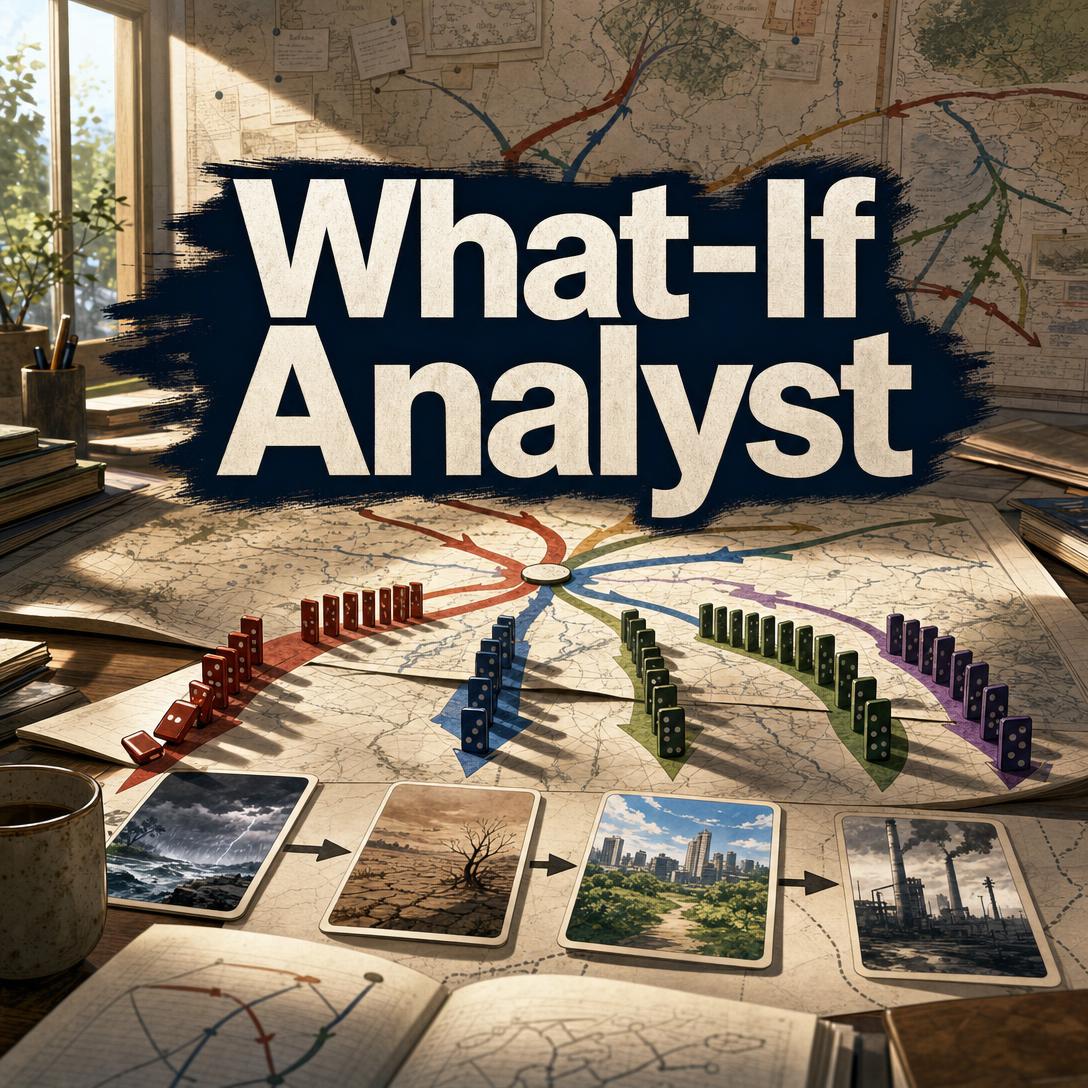
How Do AI What-If Tools Compare on Causal Depth Versus Connected Planning Models?
Conversational counterfactual agents are stronger when the task is tracing hidden assumptions and later-order effects; enterprise planners are stronger when the task is stress-testing numbers inside a live business model. In 2026, that split is the practical difference between Jenova's What-If Analyst and platforms such as Anaplan, Pigment, Abacum, and Workday.
Key factors that separate useful what-if analysis from fluent guessing or spreadsheet swaps:
✅ Causal depth — first-order effects are easy; second- and third-order consequences, breakpoints, and stakeholder counter-moves are where answers usually fail.
✅ Assumption hygiene — a good analyst names what the premise already takes for granted, including framing bias and the planning fallacy.
✅ Uncertainty handling — not every path is equally likely, and some hypotheticals are too underdetermined to score with fake precision.
✅ Connected data versus transferable reasoning — finance platforms model churn, cost, and headcount; a general what-if partner has to work in geopolitics, personal decisions, science, and fiction as well.
✅ Decision bridge — stakes-laden questions need watch-for signals and reversibility tests, not only a vivid story.
To compare these tools fairly, it helps to separate connected planning (changing drivers in a model) from counterfactual reasoning (asking what else has to be true, what breaks, and whether you asked the wrong question).
Why Has Counterfactual Reasoning Become Central to AI-Assisted Decisions in 2026?
Counterfactual reasoning has moved from a psychology topic to a core AI evaluation criterion because prediction without “what would have happened otherwise” does not match how people judge cause, blame, or choice. Stanford scholar Tobias Gerstenberg argues that humans regularly go beyond what they saw and imagine how events could have unfolded differently — and that AI systems need that same capacity if their “why” answers are going to make sense to us.
Cognitive neuroscience treats counterfactual thought as a hallmark of human reasoning: the ability to leave the immediate scene and inhabit an alternative that did not occur. In AI, counterfactual methods are now discussed as a way to generalize large-language-model reasoning, and as a way to estimate how changing a variable would change an outcome.
The business side of the same shift is scenario planning. Generative systems can now draft many scenarios in minutes and refresh them as conditions change. AI-enhanced planning already shows up in finance, HR, sales, supply chain, and product teams. That speed is useful — and easy to over-trust.
Decision making under deep uncertainty (DMDU) exists precisely because experts often cannot agree on the future. RAND’s framing is blunt: “predict-then-act” invites overconfidence. The more productive move is to seek strategies that stay workable across many plausible futures, not optimal for one forecast. AI what-if tools inherit that tension. They can be a “prosthesis for the imagination”, or they can launder a single narrative as if it were analysis.
What Should You Look for in an AI What-If Analyst?
You should evaluate an AI what-if tool on seven dimensions — a Consequence Stack — rather than on how confident or cinematic the answer sounds. Fluent prose is not evidence that the model checked assumptions, weighted paths, or looked for disconfirming facts.
The Consequence Stack used in this comparison:
- Premise hygiene — Does it surface what the scenario already assumes, including the user’s framing?
- Order of effects — Does it distinguish immediate results from second- and third-order knock-ons?
- Breakpoints — Does it name variables that would flip the outcome?
- Likelihood weighting — Does it treat paths as unequally plausible, or collapse to one story?
- Disconfirmers — Does it say what evidence would change the answer?
- Reversibility and timing — Can the move be tested small and undone, and do effects arrive slowly or all at once?
- Question integrity — Will it tell you that you asked the wrong question?
This stack is stricter than classic AI decision support. An AI decision support system typically combines enterprise data, models, and business rules to recommend an action. That architecture is powerful inside a known process. It is a weak fit for an open hypothetical such as “what if I take the role in another country” or “what if this alliance fractures.”
Empirical work on human scenario planning is a useful benchmark. Meissner and Wulf found that full scenario planning reduced framing bias and improved decision quality relative to SWOT, Porter’s five forces, and value-chain analysis, in an experiment with 252 graduate management students. Partial scenario work did not produce the same debiasing effect. The implication for AI tools is direct: a single optimistic branch is not scenario analysis.
Also weigh domain fit. A connected financial model cannot tell you whether a personal decision is reversible. A conversational analyst cannot replace a live driver-based P&L. Gartner’s Decision Intelligence Platforms category is the enterprise version of this problem; consumer and cross-domain what-ifs sit outside it.
How Do Jenova, Anaplan, Pigment, Abacum, and Workday Handle Hypotheticals Differently?
They occupy two different jobs: Jenova’s What-If Analyst is a cross-domain reasoning partner, while Anaplan, Pigment, Abacum, and Workday are business planning systems that run what-if cases against operational and financial models. Treating them as interchangeable is the most common buying error in this category.
| Feature / Dimension | Anaplan | Jenova What-If Analyst | Pigment | Abacum | Workday |
|---|---|---|---|---|---|
| Primary job | Connected planning across units and models | Open-ended counterfactual reasoning | Cross-team business scenario modeling | Finance-native what-if and stress tests | GenAI scenarios inside an enterprise suite |
| Causal depth | Strong on model drivers; limited on unstructured later-order effects | First- through third-order effects, breakpoints, analogues | Strong on business variables such as churn | Strong on financial outcomes | Fast generation and refresh of planning scenarios |
| Assumption and bias checks | Depends on model design and process | Explicit premise challenges and bias flags | Process-dependent | Process-dependent | Process-dependent |
| Live business data | Built to connect functions and models | Search-grounded facts, not ERP-connected plans | Finance, HR, sales, supply chain, product | Planning and financial scenarios | Enterprise planning context |
| Domain range | Corporate planning | Business, geopolitics, personal decisions, science, history, fiction, philosophy | Business operations | Finance teams | Workday-centric organizations |
| Uncertainty handling | Scenario comparison inside models | Likelihood tiers, qualitative confidence, “analysis breaks here” | Dynamic forecasts and comparisons | Compare outcomes and stress-test plans | Generate, simulate, and refresh scenarios |
| Pricing (as of 2026) | Unverified | Free tier with limited monthly usage; Plus $20/mo (30×); higher tiers $50–$500/mo | Unverified | Unverified | Unverified |
| Best for | Multi-function enterprise planning | Exploratory and decision-adjacent what-ifs across domains | Cross-functional business scenarios | Finance what-ifs and plan stress tests | Firms already running planning in Workday |
Jenova What-If Analyst
Jenova is built for the question that does not already live in a spreadsheet: a career fork, a geopolitical shock, a product bet, a scientific hypothetical, or a fictional premise. It is designed to follow a single premise further than the user stated it — including the branch the user did not want to look at.
Strengths include transferable structure (assumptions, causal orders, breakpoints, confidence, disconfirmers), willingness to reframe a biased question, and a decision close when stakes are real: what signal would tell you which branch is happening, and whether the move is reversible enough to test small. It can search for surrounding facts rather than treating the hypothetical as a closed word game. On the Jenova platform it also keeps long-running scenario context across sessions, which matters when a what-if turns into a tree rather than a one-shot answer.
Limitations are equally concrete. It is not a connected planning system and does not ingest live ERP, HR, or financial models the way Anaplan or Pigment do. It cannot schedule a weekly revisit, watch a threshold in the background, or fire alerts. For medical, legal, or financial decisions it can reason in detail, but that output is informational, not licensed advice. Casual questions get short takes; users who want a full multi-branch memo have to ask at that depth.
Anaplan
Anaplan is an AI-driven scenario planning and analysis platform meant to connect decision-making across business units, functions, and models. That is a genuine strength if your what-if is “what if conversion drops 8% and supply lead times stretch.”
The limitation is scope. Anaplan is not trying to tell you whether you asked the wrong life question, or how a second-order political reaction might swamp a first-order market move. Implementation and model design determine quality; the software will not, by itself, catch a framing error in the executive prompt that created the scenario.
Pigment
Pigment’s AI planning is already positioned for finance, HR, sales, supply chain, and product teams modeling variables such as churn. That breadth inside the firm is a real advantage over a chat window with no shared drivers.
It still assumes the useful uncertainty is mostly numerical and organizational. If the binding constraint is a hidden assumption, a stakeholder’s incentive to defect, or a historical analogue from another industry, a conversational Consequence Stack is the better instrument.
Abacum
Abacum is explicitly AI-native scenario planning for dynamic what-ifs, financial outcome comparison, and plan stress-testing. Finance teams that need to put numbers next to each other will find that shape familiar and useful.
It is not a general reasoning partner. Personal, scientific, historical, and geopolitical hypotheticals are out of product scope, and even inside finance it will not automatically challenge whether “grow faster” is the wrong question.
Workday
Workday describes generative AI as a way to create a wide range of scenarios quickly, simulate how they may unfold, and refresh them as conditions evolve. For companies already living in that suite, speed-to-scenario is the feature.
Speed is also the risk. A 2026 discussion in the naturalistic decision-making community argues that AI decision support often fails to improve decision quality in practice. Generating more scenarios is not the same as improving the decision if uncertainty, incentives, and framing stay invisible.
Independent roundups now treat AI scenario planning as a crowded software class; Epicflow’s 2026 guide lists major tools for testing alternatives and tracing consequences. The category is real. The job-to-be-done still splits between model-connected planning and question-level reasoning.
How Does Mapping Second- and Third-Order Effects Change a What-If Answer?
It changes the answer from a prediction of the next event into a map of the system that event would disturb. Most weak what-if replies stop at the first domino — the obvious win, loss, or headline — and never ask who moves next, what takes time, or where the chain breaks.
Counterfactual reasoning is, at root, comparison of fact with alternative scenarios. That comparison is empty if it only restates the premise. A first-order take on “what if we cut prices 20%” is “volume rises.” A second-order take includes competitor matching, margin compression, and customer anchoring. A third-order take includes channel conflict, brand position, and whether the firm can ever raise prices again. The useful output is often the breakpoint: the condition under which the optimistic path dies.
Jenova’s analysis is built to treat those layers as the default job, then match depth to the question. A casual curiosity should not receive a 1,500-word tree. A high-stakes, irreversible move should. Enterprise planners do a version of this inside a model: change a driver, read the output. They rarely, unless a human designs it in, represent an unmodeled political backlash or a cognitive bias in the sponsor’s framing.
Gerstenberg’s work also flags a trap AI tools can fall into: causal selection. In principle a counterfactual can run back to the Big Bang. Humans pick a pragmatic subset of causes. A usable what-if analyst has to do the same — name the causes that would actually change a decision — and say when the rest is noise.
When Should an AI Challenge the What-If Question You Asked?
It should challenge the question when the framing is doing hidden work: when you have anchored on one option, smuggled in a goal, or asked about a symptom instead of the decision you are avoiding. Answering a bad question with great rigor is still a bad analysis.
Classic contaminants include anchoring, confirmation bias, and optimism about time and cost. Scenario methods were shown to reduce framing bias only when the full process was used, not when people sampled a piece of it. An AI that always “yes, ands” the user’s premise is closer to partial scenario theater than to that full process.
In practice, the challenge often looks like one of these moves:
- Inverse — “What if we do nothing?” may be more informative than “what if we launch.”
- Upstream — the real uncertainty is not the tactic but the constraint that made the tactic feel mandatory.
- Compound versus sequential — “what if X and Y together” is a different object from “what if X, then Y.”
- Reversibility — if the cost of being wrong is low and the move can be undone, exhaustive analysis is delay; if it cannot be undone, a vivid first-order story is negligence.
Jenova is designed to make that challenge part of the product, not a personality quirk. That is also a limitation for users who want affirmation. If you need a sounding board while you think out loud, a good analyst should switch registers and ask what outcome you are hoping for — not force a framework onto grief, indecision, or exploratory talk. If you then ask for analysis, the full stack should come back.
Enterprise scenario tools almost never do this question-level work. They will faithfully model the wrong plan. That is not a defect in Anaplan or Pigment; it is a boundary. The human (or a reasoning agent) still has to audit the prompt that entered the model.
How Do You Get Better Results From an AI What-If Analyst?
You get better results by stating the premise, the stakes, the locked assumptions, and whether you want a concise take or a full branch map — then inviting the tool to attack the question. Vague “what if things go badly” prompts produce vague weather.
For Jenova’s What-If Analyst, a tight start looks like this:
- Open the agent at jenova.ai/a/what-if-analyst.
- Give the premise with constraints and what a good answer would change:
"What if we delay the launch six months after a competitor ships? Budget is $4M already spent, switching costs are high, and I need to know whether this is reversible. Challenge my framing."
- If the first reply surfaces a better question, answer that question rather than forcing the original wording.
- Fork explicitly when you want a comparison, not two separate essays:
"Compare what if we delay versus what if we ship a reduced scope in 90 days. Side-by-side on reversibility, competitor response, and cash runway."
- Ask for disconfirmers and watch-for signals when the what-if is decision-adjacent:
"What evidence in the next 30 days would tell me the pessimistic branch is materializing?"
Grounding matters. AI decision-support research describes systems that sift large volumes of data to support human decisions. A general what-if still needs facts, but the search target should be the components of the hypothetical (physiology under lower gravity, sovereign-debt contagion, competitor pricing history), not the raw sentence “what if X.” Users who need a literature-grade factual base can pair the analyst with Deep Research. Historical counterfactuals often sit closer to Alternate Historian. Conceptual or ethical hypotheticals may be a better fit for The Philosopher.
For Pigment, Anaplan, Abacum, or Workday, the equivalent hygiene is model hygiene: name the drivers, the time horizon, and which scenarios are stress tests versus base case. Do not treat a generated scenario pack as a decision. Ask what is not in the model — customer trust, regulator response, key-person risk — and run those through a reasoning agent or a human review.
Jenova pricing, for reference, is usage-tiered on the platform: free with limited monthly usage; Plus at $20/month for 30× usage, then higher allowances at $50, $100, $200, and $500 per month. There are no daily caps; unused analysis does not roll over as a substitute for a connected planning license you may still need.
What Do Decision-Science Researchers Say About AI Counterfactual Reasoning?
Researchers treat counterfactuals as central to human causal judgment, and they are cautious about AI systems that simulate alternatives without showing uncertainty. The consensus is not “more scenarios are better.” It is that imagined alternatives only help when they are structured, weighted, and honest about what cannot be known.
"When people assign cause or responsibility, they are not only describing what happened. They are running a simulation of what would have happened if a particular factor had been absent. If an AI says A caused B, humans will hear that as ‘if A had not occurred, B would not have occurred.’ If the system cannot actually do that kind of reasoning, the explanation will sound right and still be misaligned with how we think."
"The danger is not that simulations exist. It is that a single vivid simulation hides the distribution. In a legal or high-stakes setting you can construct many endings. Without uncertainty attached, ‘seeing is believing’ takes over. The same failure mode shows up in strategy offsites: one polished what-if deck becomes the future."
"Scenario planning earned its keep at firms such as Royal Dutch Shell by changing mental models, not by calling the oil price. Later experiments found that the method can reduce framing bias and raise decision quality — but only when people run the process, not a fragment of it. An AI that always completes the user’s story is offering the fragment."
"Deep uncertainty is the normal case. Robustness across many futures beats optimality on a best-guess. The practical design brief for a what-if agent is therefore unglamorous: name assumptions, separate orders of effect, weight paths, and say when the question is the problem."
— Jenova Product Team, AI agent design (8 years building domain-specific reasoning agents)
That reading lines up with Gerstenberg’s caution that counterfactual simulations used to assign fault can mislead unless uncertainty is part of the testimony. It also lines up with RAND’s warning that experts who pretend to know the future breed brittle policy. Citeable what-if tools will look more like those research programs and less like autocomplete with a scenario label.
Which AI What-If Approach Fits Personal Decisions Versus Corporate Planning?
Use a conversational Consequence Stack for personal, political, scientific, and poorly structured strategic questions; use a connected planning platform when the hypothetical is a change in drivers the organization already measures. Most people need the first more often than they admit, and the second whenever money is already in a model.
Choose Jenova’s What-If Analyst when:
- The premise is open-ended: career, relocation, product direction, alliance politics, technology shock, or a serious thought experiment.
- You suspect the question is wrong, anchored, or protecting a decision already made.
- You need later-order effects, stakeholder counter-moves, reversibility, and watch-for signals more than a driver tree.
- The work may span sessions and should remember which branches you already closed.
Choose Anaplan, Pigment, Abacum, or Workday when:
- The what-if is a planning case: headcount, churn, price, supply, or revenue mix.
- Multiple teams must share one model rather than a chat transcript.
- Refreshing scenarios as actuals move is the point, as Workday describes for generative planning.
- You already have (or can staff) model owners who will challenge inputs the software will not.
Use both when the corporate question is only half-numerical. Example: “what if we enter this market” needs Pigment- or Anaplan-style economics and a reasoning pass on regulator response, talent, and whether “enter” is the real decision. Shell-style scenario practice was never only a spreadsheet. Over a third of U.K. companies in the research Meissner and Wulf cite reported using scenario planning; the method spread because turbulence made single-point forecasts look precise and fail.
A final boundary: some hypotheticals have too many unknown unknowns. A trustworthy analyst says so, instead of minting probabilities. Uncertainty in model-based decisions comes from parameters, structure, methods, and heterogeneity, and it cannot be eliminated. The same is true in conversation. The high-quality output is sometimes “here is why this what-if cannot be scored,” plus the two or three facts that would make it scorable later.
References
- The Decision Lab — Planning fallacy
- Stanford HAI — Humans use counterfactuals to reason about causality; implications for AI
- PubMed Central — Cognitive neuroscience of human counterfactual reasoning
- arXiv — On the Eligibility of LLMs for Counterfactual Reasoning (May 2025)
- The Decision Lab — Counterfactual reasoning in AI
- Workday Blog — How generative AI is reinventing scenario planning
- Pigment — AI-driven scenario planning across finance, HR, sales, and supply chain
- RAND Pardee Center — Decision making under deep uncertainty (DMDU)
- SPD Technology — Definition of AI decision support systems
- Meissner and Wulf, Technological Forecasting and Social Change — Cognitive benefits of scenario planning, framing bias, and decision quality
- Gartner — Decision Intelligence Platforms reviews
- Anaplan — AI-driven scenario planning across business units and models
- Abacum — AI-native what-if scenarios, outcome comparison, and plan stress tests
- Workday — Generative AI scenario planning overview
- Naturalistic Decision Making Association — Why AI-based decision support systems often fail to improve decision quality (January 2026)
- Epicflow — Top scenario planning tools in 2026
- Communications of the ACM — Integrating counterfactual reasoning into AI decision-making
- ScienceDirect — AI-based decision support systems in Industry 4.0
- LSA Global — Cognitive biases that affect strategic planning
- Harvard Center for Health Decision Science — Uncertainty in model-based decision making