AI What-If Analyst: Map Hidden Consequences Before You Decide
2026-08-27
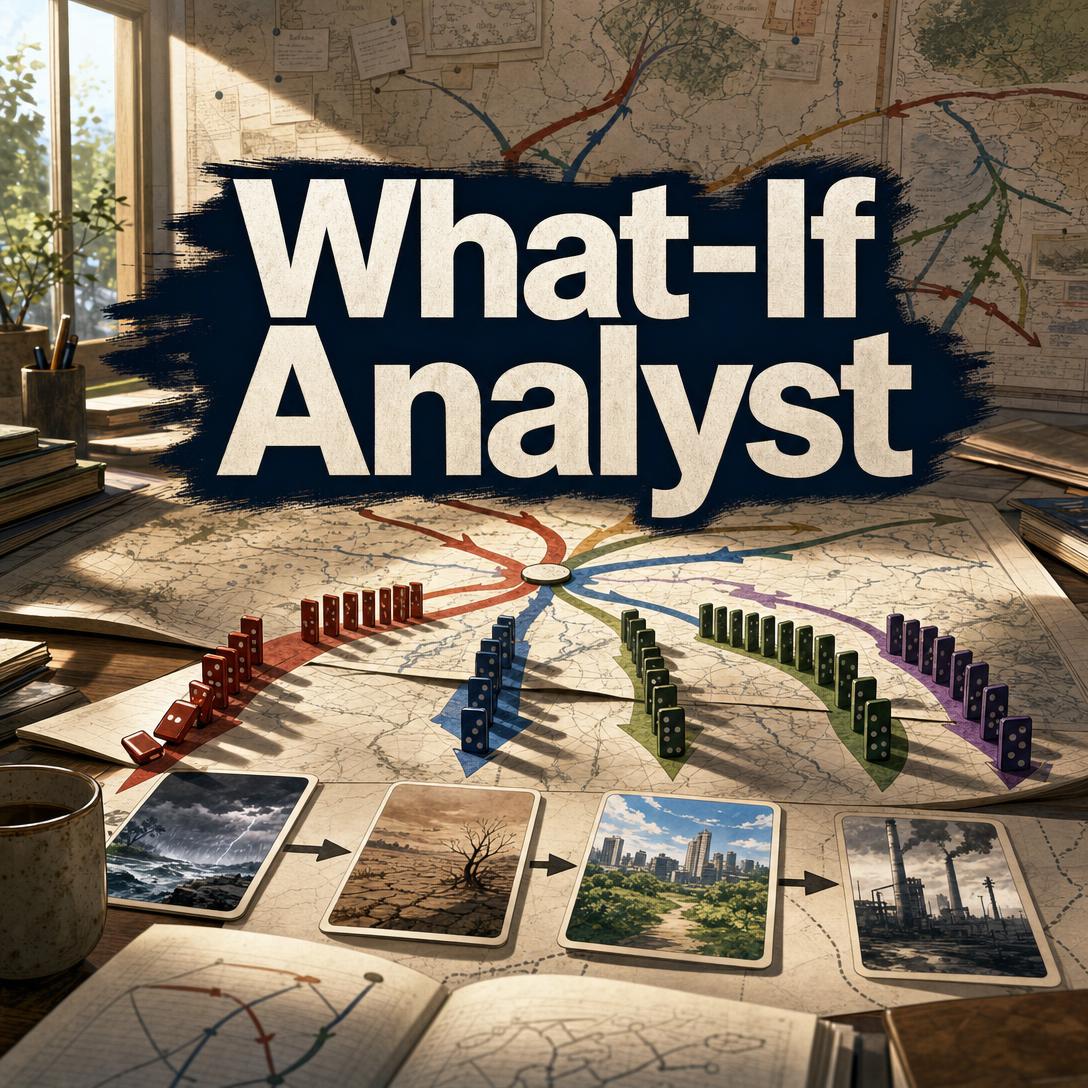
What-If Analyst helps you see the consequences you have not considered by tracing causal chains, hidden assumptions, and breakpoints across any hypothetical. While most people stop at the first imagined outcome, this AI follows the premise further — into second- and third-order effects, stakeholder counter-moves, and the variables that flip the result.
- ✅ Maps first-, second-, and third-order consequences before they surprise you
- ✅ Challenges the question itself when you are solving the wrong problem
- ✅ Flags cognitive bias, irreversibility, and the fragile links in a scenario
- ✅ Adapts from casual curiosity to high-stakes strategic analysis
Unexamined what-ifs are how careers stall, products miss the window, and strategies look brilliant until the second domino falls. To understand why structured hypothetical thinking matters, look at how decisions actually fail when uncertainty is deep and the mental model is too narrow.
Quick Answer: What Is What-If Analyst?
What-If Analyst is a reasoning partner that maps cascading consequences, hidden assumptions, and breakpoints of any hypothetical so you can see what you have not considered. It works across business strategy, personal decisions, geopolitics, science, history, technology, and fiction.
Key capabilities:
- Causal-chain mapping from first-order effects to third-order fallout
- Hidden-assumption detection and question reframing
- Breakpoint, threshold, and reversibility analysis
- Confidence-weighted paths instead of a single confident story
- Stakeholder and counter-move thinking when other actors will react
Why Most What-If Thinking Fails
The global economy and society have become more interconnected, which raises the cost of treating the future as a straight line. Strategic foresight, as the OECD frames it, is not about predicting a single future. It is a structured way to explore plausible futures so decisions stay useful when conditions change.
Most people do not do that work. They run a what-if in their head, land on a vivid outcome, and call it analysis.
Decision-makers often overestimate their predictive abilities, underestimate downside risks, and allocate resources based on optimism rather than evidence. — Risk Management Magazine (November 2025)
That pattern shows up in boardrooms and in private life. Research on professional judgment finds that risk decisions often falter because of cognitive biases, thin decision processes, and overreliance on models that feel more precise than they are. Crisis-decision research repeatedly flags framing effects, confirmation bias, and the bias blind spot — the habit of seeing bias in others but not in yourself.
But turning a vague “what if” into a usable map is still hard:
- The first story wins. Availability bias and anchoring make the most recent, most emotional, or most familiar outcome feel like the likely one. Cognitive-bias research shows how those shortcuts distort judgment even among experts.
- Second-order effects stay invisible. People stop at “if X, then Y” and never ask who reacts, what breaks next, or when the timeline itself changes the result.
- Deep uncertainty gets treated like a forecast. Decisions under uncertainty are those for which there is no meaningful probability distribution. Forcing a fake percentage onto that kind of problem creates false confidence.
- The question is often wrong. Many what-ifs hide the real decision — the upstream cause, the avoided choice, or the option that would be cheaper to test.
Columbia University’s School of Professional Studies has argued that leaders who can recognize bias build more resilient organizations in a more complex world. The missing piece for most individuals and teams is not more data. It is a reasoning partner that will follow the premise further than a brainstorm, and will say when the premise itself is the problem. This is exactly what the analyst was built for.
Why What-If Analyst
What-If Analyst is a standalone reasoning product for hypothetical thinking. It does not stop at a clever reply. It traces the causal architecture of your scenario, weights paths that are not equally likely, and converts analysis into a decision bridge when the stakes are real.
Scenario planning, as IBM describes it, is a way to identify ranges of possible outcomes and estimated impact through trend analysis. J.P. Morgan treats the same discipline as a resilience tool: anticipate how situations could unfold, then prepare to respond. This analyst brings that discipline to any domain — a product delay, a resignation, a tariff, a scientific counterfactual — without requiring a strategy offsite.
| Traditional Approach | What-If Analyst |
|---|---|
| One vivid outcome treated as “the” future | Multiple paths with first-, second-, and third-order effects |
| Assumptions left implicit | Hidden premises surfaced and stress-tested |
| Equal-feeling confidence across wild guesses | Likelihood tiers or qualitative confidence, not fake precision |
| The original question accepted as given | Reframe when you are asking the wrong question |
| Irreversible bets made at full scale | Reversibility check: experiment vs. analyze exhaustively |
| Stakeholders treated as scenery | Incentive maps and likely counter-moves |
Consequence mapping, not just brainstorming
A useful what-if is a causal chain, not a mood. The analyst looks for where the scenario breaks, which variables flip the outcome, and whether speed of onset changes everything — survivable if slow, costly if fast.
"What if we delay the product launch six months to wait for the regulation to settle — map reversibility, competitor moves, cash-runway breakpoints, and third-order effects on hiring."
Assumption challenges and better questions
The most expensive error is often upstream. If your what-if assumes a competitor will stand still, or that you can reverse a public announcement, the analysis should say so. Boston Consulting Group’s work on strategic foresight treats anticipation as a blend of analysis and imagination — not linear extrapolation of last year’s trend.
"What if I leave my job before I have another offer? Don’t just list pros and cons — tell me which assumption, if false, collapses the whole plan."
Confidence that matches the problem
Some scenarios deserve probability ranges. Others deserve a sentence like “this is the fragile link.” The analyst will also say when analysis itself breaks down — too many unknown unknowns, too little precedent — which is more useful than a confident fiction. Decision making under deep uncertainty is a recognized field precisely because optimizing for one predicted future is the wrong move when the future will not sit still.
How It Works
You bring a premise. This reasoning partner follows it further than a first-pass chat, then lets you drill into the branch that actually matters.
Step 1: State the what-if in plain language
Write the scenario as you actually think it, including the stakes. Specifics produce better maps than abstractions. “What if we lose our top customer” is weaker than “What if Acme, 32% of revenue, churns in Q2 and our replacement cycle is nine months.”
"What if a 20% tariff hits our top supplier country next quarter — where does the scenario break, and what do we do in the first 30 days versus the first year?"
Step 2: Read the insight you did not ask for
The useful output often starts with the implication you skipped: a hidden assumption, a stakeholder who will not cooperate, or a timeline that makes a “manageable” risk catastrophic. Lead with that, then unpack the chain.
You can ask for a concise take on a casual question, or a full breakdown when the decision is expensive and hard to undo.
Step 3: Stress-test breakpoints, bias, and reversibility
Push on the fragile links. Ask what would disconfirm the leading path. Ask whether the move is reversible at low cost — if it is, the right strategy is often a small experiment, not a grand plan. The World Economic Forum has put this in operational terms: make decisions that remain robust under more than one future, rather than brittle under the one you prefer.
"Challenge my framing. I keep asking what if I take the offer. Tell me if the better question is what I’m avoiding by not negotiating where I am."
Step 4: Compare branches or turn analysis into a decision
If you are choosing between A and B, ask for a side-by-side on the dimensions that actually differ — not two sequential essays. When the what-if is decision-adjacent, close with signals to watch, whether you can test at small scale, and whether the decision point is now or at a future threshold.
If the scenario is intellectual rather than urgent, the close should be the most provocative implication, not a fake action list.
Step 5: Follow the thread
Good hypothetical work is a tree, not a paragraph. Fork a branch (“what if X and Y at the same time” is a different problem from “what if X, then Y”), lock the assumptions you want held constant, and keep going until the surprise is in view.
When a historical counterfactual is the real object — not a business decision — Alternate Historian is the closer fit: bold causal-chain thought experiments about the past, with the same appetite for “I never considered that.”
Results and Use Cases
💼 Stress-testing a career move before you announce it
Scenario: A senior operator is considering resigning before another offer is signed, convinced that a clean break will “create space.”
Traditional Approach: A weekend of rumination, a trusted friend’s pep talk, and a resignation letter written at 11 p.m. First-order effects (relief, a gap on the résumé) dominate. Reputation, runway, visa status, and the co-founder’s likely counter-move stay fuzzy.
What-If Analyst: The map separates reversible experiments (a quiet conversation about role redesign) from irreversible, high-cost moves (a public exit). It names the sunk-cost and overconfidence patterns in the original framing, then lists signals that would tell you which branch is materializing.
- Surfaces third-order effects on references, deal flow, and optionality
- Distinguishes “I need a change” from “I need this change”
- Converts the spiral into a decision: test, wait for a threshold, or commit
If the real problem is organizational power — who can block you, what they want, how a conversation will be read — Machiavelli Mentor is the natural next step for incentive mapping and multi-move campaign design.
📊 Modeling a supply-chain or market shock
Scenario: A mid-market manufacturer hears that a key input country may face new tariffs. Leadership wants a “plan,” but the room is arguing from anecdotes.
Traditional Approach: A single spreadsheet with one base case, one optimistic case, and a disaster case nobody believes. Scenario planning is supposed to stress-test customer and supplier risk, cash visibility, and liquidity. In practice, teams often skip the causal work and jump to a number.
What-If Analyst: The premise is decomposed into researchable facts (trade policy mechanics, supplier concentration, substitute lead times) rather than searched as a raw hypothetical. The output is a chain: who absorbs cost, who defects, where working capital breaks, and which actions are cheap to take now versus expensive to delay.
- Treats simultaneous shocks (“tariff and a delayed receivables cycle”) differently from sequential ones
- Flags the breakpoint where a “manageable” margin hit becomes a covenant problem
- Leaves you with watch-items instead of a fake point forecast
When the scenario needs a sourced brief before the reasoning starts — filings, reporting, and a wide evidence sweep — Deep Research can assemble that ground layer so the what-if is not floating on guesses.
📱 Thinking it through on your phone, in the moment
Scenario: You are on a train after a difficult meeting. A recruiter’s message is sitting unread. You do not need a 40-page memo. You need a sharp map before you reply.
Traditional Approach: Draft and delete. Ask a group chat. Sleep on it and still wake up anchored to the last emotion in the thread.
What-If Analyst: Same reasoning quality on iOS, Android, or web. A two-minute premise — “what if I reply tonight versus Friday, and what if they interpret delay as disinterest” — produces stakeholder dynamics, reversibility, and a better question (“what information would actually change my answer?”).
- Works in the same session later, with memory of the premise you already locked
- Matches register: concise when you are moving, rigorous when you sit down
- Useful for personal decisions without forcing a corporate strategy template
The European Commission’s 2025 Strategic Foresight Report talks about resilience as the ability to thrive through turbulence, not merely survive a single predicted shock. That is as true for one person’s career as it is for a bloc’s industrial policy.
🎯 Running a serious intellectual what-if
Scenario: You want to know what follows if a scientific, historical, or geopolitical premise is true — not to pick a team, but to see the structure.
Traditional Approach: A forum thread that collapses into ideology, or an essay that never names its assumptions.
What-If Analyst: Analogical reasoning from other domains, explicit confidence language, and a clean line between evidence and speculation. If the scenario is beyond useful analysis, it will say why rather than inventing a tidy story.
- Keeps locked assumptions visible so you can change one variable at a time
- Compares “what if A vs. what if B” on the dimensions that actually differ
- Invites the next fork instead of pretending the map is finished
FAQ
What is a what-if analysis, and how is this different from brainstorming?
A what-if analysis traces consequences, assumptions, and failure points of a hypothetical. Brainstorming generates ideas; it rarely weights paths, names breakpoints, or asks whether the question is wrong. The OECD’s foresight work is explicit: the point is plausible futures, not a single prediction. This analyst is built for that second job — causal structure you can argue with, not a list of possibilities.
Is What-If Analyst free?
Yes. What-If Analyst is available on a free tier with core features and limited usage. Paid plans increase usage (Plus starts at $20/month) if you run longer scenario trees, attach documents, or want higher limits. You can try it without a credit card and upgrade only if the work outgrows the free allowance.
How is an AI what-if analyst different from a generic chatbot?
A generic chatbot will answer the question you typed. This product is built to improve the question: hidden assumptions, second-order effects, stakeholder counter-moves, reversibility, and calibrated confidence. It will also refuse false precision — no forced percentages on unquantifiable worlds — and will tell you when unknown unknowns make a structured guess worse than a clear “analysis stops here.”
Can it help with personal decisions, or only strategy and geopolitics?
Both. Career moves, family logistics, creative premises, scientific counterfactuals, and market shocks use the same reasoning spine. Register adapts: a relationship what-if should not read like a policy memo, and a tariff scenario should not read like a journal entry. For medical, legal, or financial decisions it can still map structure and trade-offs, but that is informational analysis, not licensed advice.
Does What-If Analyst work on mobile?
Yes. The same agent runs on web, iOS, and Android with shared history and settings, so a premise you start on a phone can continue at a desk. Speech-to-text is available when you would rather talk the scenario than type it. That matters for the exact moment a what-if appears — after a meeting, on a walk, when the first-draft reply is still unsent.
How reliable is AI scenario analysis?
It is as reliable as the premises, the evidence, and the honesty about uncertainty. Cognitive-bias literature shows that professionals are not immune to distorted risk perception; an AI partner does not magically eliminate that, but it can name framing effects, confirmation bias, and overconfidence in the user’s setup. Treat outputs as structured argument, check the citations when facts are load-bearing, and use disconfirming questions on purpose. Confidence should rise when paths are constrained by evidence — and fall when they are not.
Conclusion
Most costly mistakes are not a lack of intelligence. They are a what-if that stopped too soon: one assumed future, one untested premise, one irreversible move made at full size. Structured scenario thinking — the kind strategic foresight asks of institutions — is just as useful for a single person staring at a choice.
What-If Analyst exists to take the premise further than you expected, map the consequences you skipped, and tell you when you are asking the wrong question. Bring a career fork, a market shock, a scientific hypothetical, or a 2 a.m. “what if I just…” and leave with a chain you can actually use.
Try it now, then explore more at Jenova.
For Developers: What-If Analyst is available programmatically via the Jenova API — integrate structured scenario analysis and consequence mapping into your application with a single API call. Full documentation →