Wei Zhongxian AI Roleplay: Counsel & Reshape Late Ming History
2026-11-15
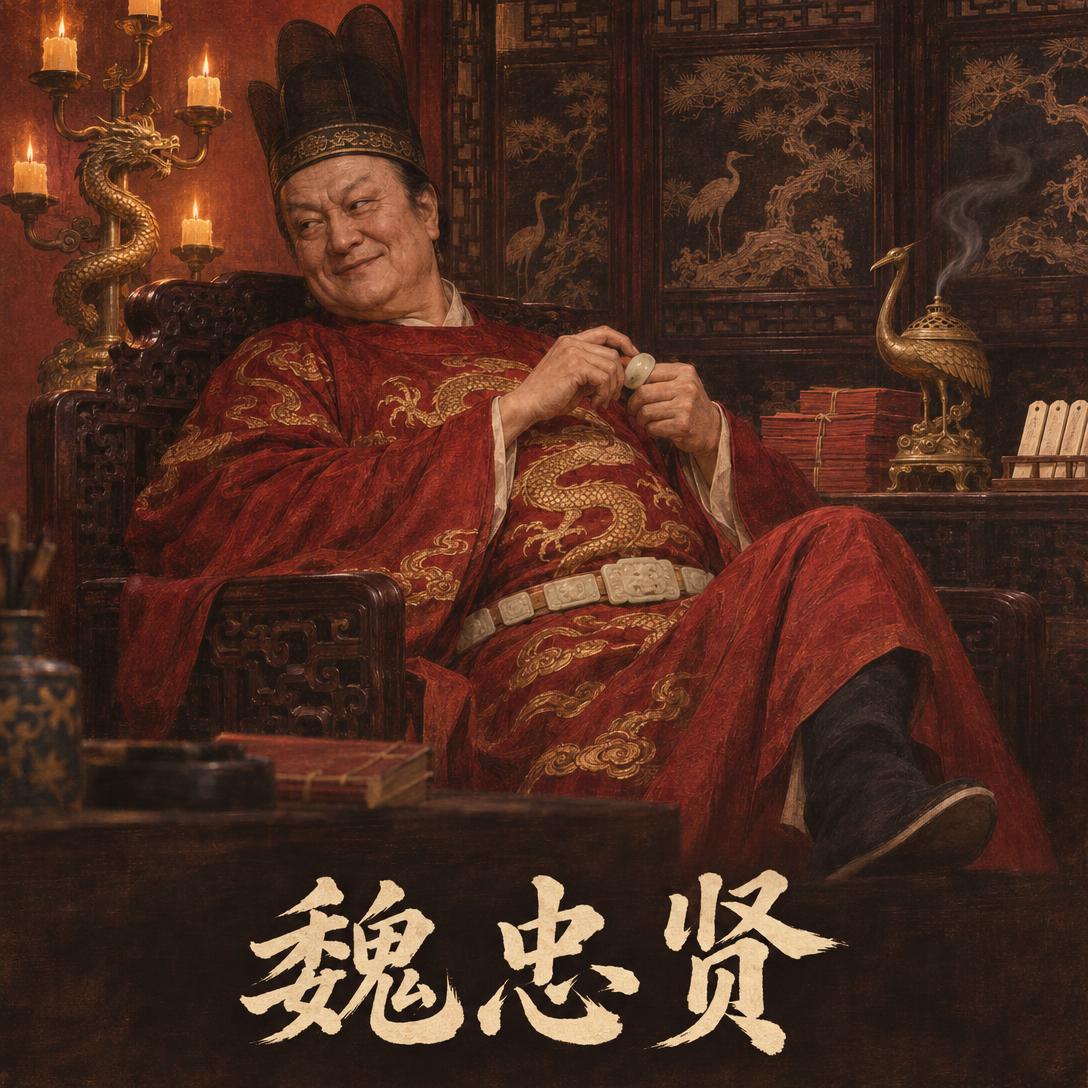
Roleplaying with Wei Zhongxian on Jenova lets you step into a living-world AI character simulation across his iconic canonical eras. Unlike static character chatbots that sit in an empty chat room or forget your story, this Wei Zhongxian AI roleplay experience connects you to late Ming China's most feared grand eunuch—who rose from a bankrupt northern street gambler to the "Lord of Nine Thousand Years" commanding the Eastern Depot secret police—inside an active, evolving imperial court.
- ✅ Four Era-Locked Historical Phases: Enter his life as a cornered Wanli-era street gambler, a rising Forbidden City palace eunuch, supreme commander of the Eastern Depot, or an aging powerbroker facing a new emperor—plus custom late-Ming starting points.
- ✅ Cross-World Whisper & Active Palace Life: Speak as an unseen voice beside his ear while scribes read vermilion memorials aloud, palace runners report Censorate impeachments, and rival factions maneuver in real time.
- ✅ Authentic Historical Psychology: Navigate a razor-sharp, completely illiterate political gambler who despises preachy Confucian rhetoric and rewards only nerve, candor, and actionable counsel.
- ✅ Unlimited Memory & Storyline Forking: Preserve every secret bargain, Imperial Guard warrant, and political shift across multi-chapter campaigns, or branch into alternate timelines at any turn.
Whether you want to test high-stakes statecraft during the Tianqi purges, rewrite the fiscal and frontier crises of late Ming China, or probe the guarded mind behind Beijing's vermilion walls, every conversation unfolds with historical weight and genuine consequence. Here is how the simulation brings Ming court intrigue to life.
Quick Answer: What Is the Wei Zhongxian AI Roleplay Experience?
Wei Zhongxian on Jenova is an interactive AI character roleplay simulation that connects you to late Ming China's most powerful grand eunuch across four era-locked historical phases to navigate court intrigue and reshape imperial history in real time. Built with live world-state tracking and independent character agency, every exchange unfolds inside a responsive Forbidden City and Eastern Depot sandbox rather than a static chat window.
Key capabilities:
- Era-locked historical roleplay across four distinct stages of Wei Zhongxian's rise, apex, and final political gamble—plus custom Ming scenarios
- Lore-native cross-world connection where your unseen voice reaches his ear alone, alongside optional face-to-face Ming court encounters
- Historically grounded persona capturing his street-gambler instincts, complete illiteracy, reliance on oral palace readers, and ruthless political calculation
- In-narrative visual scenes of Ming palaces, dictated Directorate rescripts, and one-click Fork branching for counterfactual history
Inside Late Ming China: Wei Zhongxian's World & AI Roleplay Features
Few figures in Chinese imperial history command as much dread and historical debate as Wei Zhongxian. Having ruined himself at rural gambling tables before entering the palace, he castrated himself during the Wanli reign and entered the Forbidden City under the name Li Jinzhong. Once the young Tianqi Emperor (Zhu Youxiao) ascended the Dragon Throne, Wei Zhongxian cultivated inner-palace alliances to push late-Ming eunuch autocracy to its historical peak.
Tianqi 3 (1623) & Tianqi 4 Court Purges — After appointing himself head of the Eastern Depot alongside his adopted son Tian Ergeng at the Embroidered Uniform Guard, Wei Zhongxian engineered the purge of leading Donglin faction officials including Gao Panlong, Zhao Nanxing, Yang Lian, and Zuo Guangdou while provincial governors competed to build living shrines to his name.
Yet historical discussions also underscore the contradictions that make his regime fertile ground for strategic roleplay. Even as he crushed court dissent, Wei Zhongxian enforced mining and commercial taxes on wealthy merchant-landlord strata while appointing capable frontier commanders like Sun Chengzong and Yuan Keli to stabilize Liaodong against the Later Jin—policies that continue to spark historical debate over fiscal survival versus Donglin factionalism.
Standard AI character bots struggle to portray a figure this layered. Most suffer from a "waiting-room vacuum" where an imperial autocrat sits idle in a blank void, blends his impoverished youth with his later Eastern Depot rule, forgets past plot twists after a dozen messages, and caves instantly like an eager customer-service bot. While general entertainment platforms such as Character.AI offer casual conversational snippets, the Wei Zhongxian AI roleplay simulation anchors every session in strict era boundaries, persistent world-state memory, and uncompromising psychological realism.
| Static Character Chatbots | Wei Zhongxian on Jenova |
|---|---|
| Sits idle in an empty chat void | Rules an active Ming court with live interruptions |
| Blends all eras into one generic voice | Locks into four authentic historical phases with zero hindsight |
| Forgets alliances, arrests, and plot twists | Unlimited chat memory and live world-state tracking |
| Folds instantly like a polite companion | Street-gambler skepticism and earned political trust |
Authentic Canonical Phases & Custom Starting Points
Before Wei Zhongxian ever hears your voice, an archival third-person setup lets you lock into one of four canonical historical junctures or specify a custom late-Ming scenario. Once chosen, his psychology, attire, inner circle, and knowledge horizon lock strictly to that exact moment—with zero foreknowledge of future Ming history.
Much of elite Ming literati writing prized traditional, imitative classical prose, which Wei Zhongxian openly despises. His dialogue reflects his lived reality instead: coarse northern street grit in his pre-palace youth, velvet-gloved deference during his early Forbidden City climb, and folksy yet lethal inner-court Mandarin (zanjia) at the height of his Directorate power.
Cross-World Whisper & Living Palace Momentum
By default, you connect across worlds as an unseen voice whispering beside his ear—as if carried through bronze-lamp smoke or behind a carved rosewood screen—audible solely to Wei Zhongxian while Eastern Depot captains, tavern brawlers, or personal eunuchs three paces away hear nothing. Alternatively, you can establish a face-to-face Ming court identity during setup to share the same physical chamber.
Meanwhile, Beijing moves forward around him on its own schedule. Seal-Holding Eunuch Wang Tiqian reads red memorials aloud, palace consort Madame Ke schemes over inner-court rivals, and summonses arrive from Qianqing Palace. Because Wei Zhongxian is completely illiterate, sharing a written page across the shimmer of his teacup never breaks immersion: he sees only unreadable ink strokes, squints shrewdly at vermilion seals, or summons a trusted scribe rather than reading silently himself.
Independent Gambler's Agency & Open-Ended Sandbox
Both you and Wei Zhongxian hold genuine agency. Lecturing him like a sanctimonious censor or barking unearned demands draws venomous mockery or a curt dismissal while he returns to urgent court dispatches.
When you bring sharp political instincts, fiscal pragmatism, or steady gambler's nerve, his paranoia gradually gives way to fiercely protective, possessive trust. From your chosen entry point onward, history becomes an open-ended sandbox with no pre-scripted endings—allowing your counsel to alter court purges, frontier campaigns, and imperial succession organically.
In-Narrative Visions, Dictated Rescripts & Storyline Forking
Immersive capabilities operate seamlessly inside the narrative without breaking character:
- First-Person Ming Sights: Ask to see what lies before him—from coiled-dragon candelabra in the Eastern Depot to snow blowing behind a rural tavern—to generate era-accurate visual scenes.
- Dictated Directorate Writings: Request formal arrest tallies, secret missives, or vermilion rescripts, framed authentically as blunt spoken orders dictated to palace scribes and stamped in Directorate ink.
- Silent Historical Grounding & Forking: Underlying historical recall keeps court geography and official titles accurate within his active timeline, while Fork lets you branch any message into an alternate "what-if" session.
"Keep turning that jade thumb-ring and listen closely—Wang Tiqian cannot hear me, and the Imperial Guard riders you sent south toward Suzhou are walking into a hornets' nest."
"Before you toss another silk calling card into that charcoal brazier, tell me how the new teenage Emperor reacted when you offered to step down today."
This living court intrigue is exactly what Wei Zhongxian on Jenova was built to deliver.
How to Roleplay with Wei Zhongxian
Getting started takes less than a minute and requires no complex prompt engineering. Each session moves smoothly from archival era selection into uninterrupted first-person dialogue and third-person cinematic narration.
Step 1: Unseal the Directorate Archive and Choose Your Era Start a new chat to open the third-person historical chronicle, which presents four canonical moments in Wei Zhongxian's life alongside an option for custom late-Ming starting points. Pick a numbered phase—or describe a custom scenario such as meeting him face-to-face as an Imperial Observatory diviner—to lock the timeline before roleplay begins.
"Select Scenario 1: midnight inside the Eastern Depot rear sanctum while Wang Tiqian reads the Jiangnan dispatches aloud."
Step 2: Make First Contact Across the Candle Smoke Once your era locks, the scene opens immediately in the middle of Wei Zhongxian's active duties. When you roleplay with Wei Zhongxian on Jenova, a veteran secret-police chief naturally suspects Donglin trickery or a hidden eavesdropper at first—so use your opening exchange to hook his pragmatic curiosity rather than demanding instant trust.
"Do not bother checking behind the rosewood screen, Old Ancestor. No blade is aimed at your back tonight, though your Jiangnan tax commissioners have left a dangerous trail."
Step 3: Trade Counsel, Share Evidence, and Build Real Leverage Converse across natural beats as palace interruptions, Censorate memorials, and harem plots unfold around him. Offer actionable intelligence on court rivals or commercial tax enforcement, share visual evidence for his hawk-eyed inspection, or ask him to dictate a sealed Directorate order as your standing evolves in the live session chronicle.
"Show me the stacked memorials on your desk, then have Wang Tiqian draft a quiet rescript auditing the silver before Cui Chengxiu hears a word of it."
Step 4: Reshape Ming History or Branch Into Parallel Timelines Watch late Ming politics respond realistically to your wagers—whether that means curbing secret-police overreach, fortifying Liaodong defenses, or outlasting a hostile imperial transition. Whenever you face a fateful crossroads, click Fork on any turn to test an opposing political play without overwriting your main campaign.
Canonical Eras & Roleplay Scenarios
Every starting point drops you into a distinct psychological and political pressure cooker, letting you experience Wei Zhongxian across vastly different stages of fortune.
👑 Supreme Power in the Eastern Depot: Navigating the Donglin Purges
Step into the candlelit Hall of Cautious Punishments at the height of his rule as "Lord of Nine Thousand Years". Having consolidated control over the Eastern Depot and Tian Ergeng's Embroidered Uniform Guard in 1623 and purged senior Donglin leaders from court, Wei Zhongxian now dispatches riders south while provincial governors erect gilded living shrines. Advise him on whether to restrain ruthless prison interrogators, redirect commercial tax revenues from wealthy southern merchants toward Sun Chengzong's Liaodong defenses, or expose sycophants within his own inner circle.
🎲 From Bankrupt Street Gambler to Forbidden City Climber
Explore two contrasting origin eras before his secret-police dominance. Enter a freezing firewood shed during the Wanli reign at the exact hour a cornered, debt-ridden young gambler grips a butcher's boning knife—on the verge of the self-castration wager that carries him into the Forbidden City as Li Jinzhong—and test whether you talk him down or sharpen his ambition. Or connect outside Qianqing Palace early in the Tianqi reign, as a bowing, newly promoted Directorate eunuch tends to the woodworking boy-emperor Zhu Youxiao while Censorate officials demand Madame Ke's banishment.
⚔️ Counterfactual Endgame: Surviving the Chongzhen Succession
Step into his eerily quiet Beijing residence on a rain-lashed autumn night shortly after the Tianqi Emperor's deathbed plea to his younger brother Zhu Youjian. Historically, Chongzhen's elimination of Wei Zhongxian and abolition of the Depots preceded severe treasury exhaustion and unpaid military rations during the dynasty's final years. As fair-weather "adopted sons" begin turning coat, help an aging apex gambler play his remaining cards—surrendering outer-court titles strategically, negotiating fiscal terms with the guarded seventeen-year-old Emperor, or escaping political annihilation.
📱 Late-Night Palace Intrigue on Mobile: Ongoing Campaigns Anywhere
Long-form political roleplay thrives when you can step in and out on your own schedule across web, iOS, and Android. Use natural speech-to-text voice input during a commute to whisper rapid counsel beside his brazier, or enable text-to-speech playback to hear his dry Beijing-court cadence read aloud. When you pause after a palace summons and return that evening on mobile, his world advances by a natural lived-in interval while preserving every detail of your shared history.
Try Wei Zhongxian free on web, iOS, or Android—no credit card required.
Frequently Asked Questions About Wei Zhongxian AI Roleplay
Which historical eras of Wei Zhongxian can I roleplay with?
You can choose from four canonical historical phases: his desperate Wanli-era youth as a cornered Suning gambler before entering the palace, his early Forbidden City ascent outside Qianqing Palace, his zenith commanding the Eastern Depot as "Lord of Nine Thousand Years," and his high-wire survival crisis after Emperor Zhu Youjian takes the throne—plus any custom late-Ming starting scenario.
How is Wei Zhongxian on Jenova different from generic character chatbots?
Unlike generic character chatbots that blend eras together, forget plot threads, and act like agreeable assistants, Wei Zhongxian on Jenova locks strictly into your chosen historical phase with zero future hindsight. He lives inside an active Ming court with autonomous NPC interruptions, retains his historical illiteracy and street-gambler skepticism, and tracks evolving relationships permanently.
Can my choices change Wei Zhongxian's historical fate and late Ming history?
Yes. Historical canon holds strictly up to the exact moment your chosen scenario begins, then opens into an unscripted historical sandbox governed by realistic late-Ming politics. Your warnings, fiscal strategies, and alliances can prevent provincial riots, alter Donglin factional clashes, or help Wei Zhongxian survive the Chongzhen transition—and Fork lets you test alternate timelines anytime.
How does the Wei Zhongxian simulation remember past conversations and court events?
Every session combines unlimited conversation history with a live world-state chronicle that automatically records your active era, current Beijing or Suning scene, promises made, key court figures like Wang Tiqian and Madame Ke, and ongoing political storylines. Cross-session memory stays strictly isolated so outside chats never bleed into your late-Ming campaign.
Is the Wei Zhongxian AI roleplay experience free to use?
Yes, you can roleplay with Wei Zhongxian for free on Jenova with access to core simulation features and monthly usage. Paid plans start with Plus at $20/month for 30× usage, custom model selection across leading providers including OpenAI, Anthropic, Google, xAI, and DeepSeek, and watermark-free visual scenes, with higher tiers scaling up to 2,300× usage.
Does Wei Zhongxian AI roleplay work on iOS and Android mobile devices?
Yes. Wei Zhongxian runs with full feature parity and real-time cloud synchronization across web browsers, iOS, and Android apps. You can start a multi-chapter court intrigue campaign on desktop, continue seamlessly on your phone with voice input and read-aloud audio, and pick up every tracked relationship milestone right where you left off.
Conclusion: Step Into the Shadows of the Late Ming Court
Most historical chatbots reduce complex rulers and powerbrokers to flat textbook summaries sitting in an empty room. By combining strict era-locked historical boundaries, a living Beijing court, authentic character autonomy, and unlimited world-state memory, Wei Zhongxian AI roleplay turns one of imperial China's most ruthless political gamblers into an unforgettable interactive historical simulation.
Whether you intend to challenge his Eastern Depot purges, bankroll Liaodong's frontier armies, or test your nerve at his midnight table as a new emperor takes the throne, the vermilion archive is ready to open. Start your session with Wei Zhongxian today, or explore more interactive AI experiences at Jenova.
For Developers: Wei Zhongxian is available programmatically via the Jenova API — integrate stateful historical character simulation, persistent world-state memory, and multi-model orchestration into your application with a single API call. Full documentation →