AI Webtoon Maker: Create Vertical-Scroll Comics from Text (April 2026)
2026-04-27
Article Classification: Type B — Use-Case Article Hero Agent: Webtoon Creator
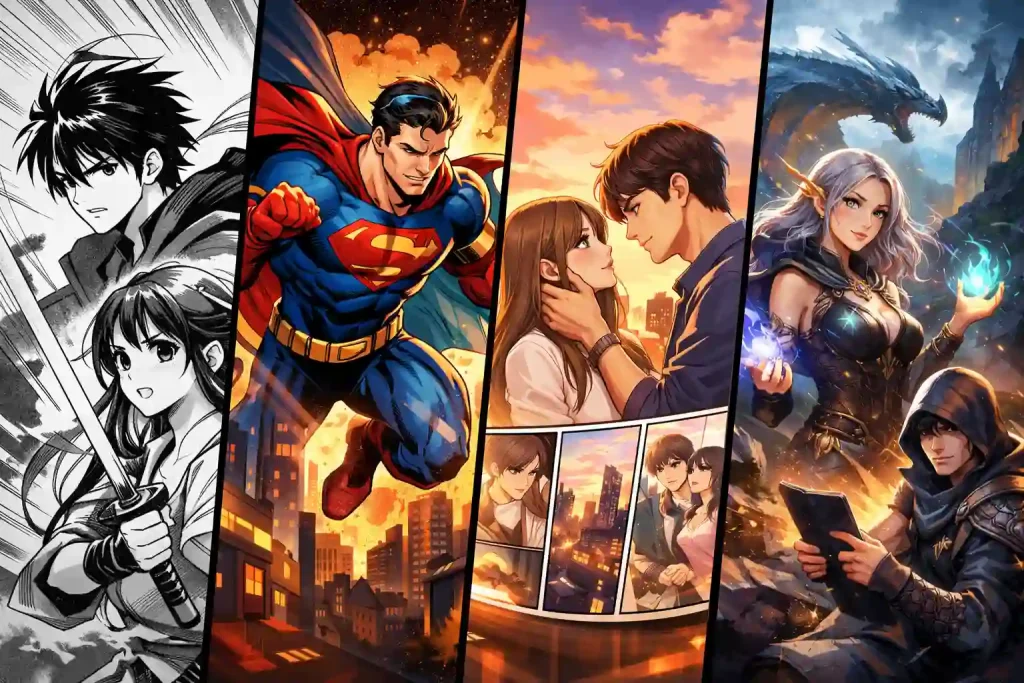
The webtoon industry is no longer a niche corner of Korean digital publishing — it's an [$8.76 billion global market in 2026](https://www.fortunebusinessinsights.com/webcomics-market-105731), projected to reach $14.73 billion by 2034. Platforms like LINE Webtoon count over 150 million monthly active users. Netflix adaptations of webtoons like Sweet Home and All of Us Are Dead have tripled readership within weeks of trailer drops. The audience is massive, hungry, and global.
But creating webtoons has remained painfully exclusive. The vertical-scroll format demands a unique visual grammar — panel width variation, scroll rhythm pacing, "thumb stop" moments — that takes years to master. Professional production costs $700–$8,000+ per episode. And the industry's weekly release cadence has pushed creator depression rates to four times the national average in South Korea.
In 2026, AI webtoon makers have fundamentally rewritten who gets to tell stories in this format. Jenova's Webtoon Creator leads this shift — a specialized vertical-scroll storytelling engine that converts scripts and narrative outlines into full-color, scroll-optimized webtoon episodes with character consistency, platform-ready exports, and persistent memory that tracks your project across sessions and seasons.
This guide covers how AI webtoon creation works, the real barriers it eliminates, how to produce professional episodes from your first session, and where this explosive market is heading.
Quick Answer: What Is an AI Webtoon Maker?
An AI webtoon maker is a tool that uses artificial intelligence to generate full-color, vertically scrolling comic episodes from text descriptions — optimized for mobile-first reading on platforms like LINE Webtoon, Tapas, and Lezhin.
- 📱 Mobile-first vertical panels — scroll-optimized layouts with strategic pacing generated from script with Webtoon Creator
- 🎨 Full-color consistency — maintain character appearances, color palettes, and art styles across hundreds of episodes
- 🪝 Episode architecture — built-in cliffhanger mechanics, "thumb stop" moments, and engagement hooks
- ⚡ Platform-ready exports — output formatted for LINE Webtoon Canvas, Tapas, Lezhin, and multi-platform distribution
The Problem: Why Most Webtoon Projects Die Before Episode 10
The webcomics market is projected to grow at 6.72% CAGR through 2034, with Asia Pacific commanding 48.69% market share and North America contributing $2.12 billion in 2025](https://www.fortunebusinessinsights.com/webcomics-market-105731). Some forecasts project the broader webtoons market reaching [$60.25 billion by 2031 at a 33.1% CAGR. The demand is undeniable. But the supply side is brutal.
💸 Crushing Production Economics
Professional webtoon production costs $700–$8,000+ per episode depending on quality and complexity. One Webtoon Originals creator reported on Reddit taking home just $450 per episode after paying assistants — and spending over 900 unpaid hours on season outlining alone. For independent creators without publisher backing, these economics are project-ending before the first episode goes live.
😰 The Burnout Pandemic
The webtoon industry's high-frequency serialization model is destroying creators. According to a Korean survey reported by Comics Beat:
28.7% of webtoon writers have depression — compared to a national average of 7.7%.
A PMC/NIH study on webtoon writer working conditions found average working times of 9.9 hours per day, 5.7 days per week, stretching to 11.8 hours on deadline days. Creators were "exposed to long working hours, high labor intensity, limited labor discretion, negative comments from readers, and had a high prevalence of depressive symptoms."
Concerns around creator-driven labor issues, including unfair payments and burnout, are some of the biggest obstacles standing in the industry's way — and no amount of audience growth fixes the human toll of weekly full-color production.
📱 The Vertical-Scroll Learning Curve
Webtoons aren't comics rotated 90 degrees. The format demands a fundamentally different visual grammar:
- Panel width variation affects emotional impact — full-width for revelations, narrow for rapid exchanges
- Vertical white space controls pacing — large gaps for dramatic pauses, small gaps for quick continuation
- "Thumb stop" moments must be strategically placed to make readers naturally pause mid-scroll
- Action choreography is particularly challenging — vertical scrolling comics are inherently vulnerable to horizontal movement
Mastering this grammar takes years. Most aspiring creators never get past the learning curve.
🔄 Character Consistency Across Serialization
A webtoon series can run 100+ episodes over multiple seasons. Characters must look identical across every panel — same proportions, same costume details, same color palette — for potentially years of production. Professional studios solve this with dedicated teams, detailed style guides, and rigorous quality control. Independent creators rarely have access to any of these resources.
Why Webtoon Creator Changes Everything
This is exactly what Webtoon Creator was built for — turning writers into webtoon publishers without the burnout, the five-figure budgets, or the years of format-specific training.
| Traditional Approach | Webtoon Creator on Jenova |
|---|---|
| $700–$8,000+ per episode for production | Unlimited episode generation on subscription |
| Years mastering vertical scroll techniques | Guided creation with scroll rhythm optimization |
| 9.9-hour average workdays, chronic burnout | Sustainable workflow — episodes in hours, not weeks |
| Manual character consistency tracking | Automatic reference system with character versioning |
| Separate workflows per platform | Built-in presets for LINE Webtoon, Tapas, Lezhin |
| Limited art style flexibility | Six professional art style templates |
How Webtoon Creator Works Differently
Unlike general-purpose image generators that produce disconnected panels, Webtoon Creator operates as a complete vertical-scroll storytelling engine — purpose-built for the format's unique demands:
- Scroll Rhythm Mapping — Before generating any episode, the system plans "thumb stop" moments, vertical white space placement, and panel width variations. It understands that 50–100px gaps mean quick continuation while 400px+ gaps signal dramatic pauses or time skips
- Character Reference Sheets — Lock in every character's appearance, expressions, clothing, and proportions once. The AI loads these references with every subsequent beat generation, maintaining visual identity across your entire series
- Six Art Style Templates — Romance/Drama (soft cel-shading, pastel palettes), Action/Fantasy (bold colors, dynamic effects), Horror/Thriller (high contrast, atmospheric shadows), Comedy/Gag (simplified designs, exaggerated expressions), Slice-of-Life (warm colors, gentle tones), and Stylized/Artistic (painterly, sketchy, minimalist)
- Persistent Project State — Cross-session memory tracks plot threads, character arcs, costume changes, scars, relationship dynamics, and visual references. Episode 87 maintains perfect continuity with Episode 1
- Multi-Model Intelligence — Access to GPT-5.4, Claude Opus 4.6, Gemini 3.1 Pro Preview, and others ensures you're always using the strongest model for each task — narrative structure from one, visual prompting from another
Example Prompts
"Create a character reference sheet for Ji-woo, 22-year-old female lead of a romance webtoon. Long black hair with subtle auburn highlights, round glasses, oversized cardigan over a white blouse. Show front view, three-quarter, side profile, and three expression variants: shy smile, surprised, and quietly crying. Romance/Drama style template, soft color palette."
"Generate Episode 3, Beat 2: Ji-woo discovers the handwritten letter tucked inside the library book. Start with a medium shot of her opening the book at her usual café table. Transition to close-up on the letter — elegant handwriting, slightly faded ink. Her expression shifts from curiosity to recognition. End with a thumb-stop panel: full-width close-up of her eyes, tears forming. Vertical scroll format, strategic scroll pause before the reveal."
"Continue the action/fantasy series from Episode 14. The dragon siege on Ashenvale begins. Kael draws his sword on the ramparts — wide establishing shot showing the scale of the approaching swarm. Rapid narrow panels for the first clash. Full-width impact panel for the moment the eastern wall falls. End on cliffhanger: Kael's mentor is hit. Freeze on his expression — pure disbelief."
While tools like ChatGPT and Midjourney can generate individual comic-style images, they lack the scroll rhythm intelligence, character locking, beat-by-beat continuity, and platform-specific export formatting that serialized webtoon production demands. Webtoon Creator handles the entire pipeline within a single conversation that remembers everything.
Related Agents You'll Also Like
Comic Creator
For creators working in Western comic traditions — superhero, noir, indie, horror, and graphic novel formats. Comic Creator handles traditional page layouts, bold panel compositions, and dynamic action choreography optimized for print and digital distribution. Ideal when your project targets Western audiences or requires non-vertical formats.
- 📐 Traditional page layouts with dynamic panel composition
- 🎨 Western art styles from noir to superhero to indie
- 📚 Sequential storytelling across graphic novel-length projects
Manga Creator
Purpose-built for Japanese comic traditions — shonen, shojo, seinen, and slice-of-life. Manga Creator supports right-to-left panel sequencing, authentic manga rhythm, screentone aesthetics, and serialized pacing across multi-chapter arcs. Perfect for creators publishing on Pixiv, Comic Walker, or building long-form manga.
- 📖 Right-to-left flow with authentic emotional beat pacing
- 🖊️ B&W with screentone or full-color manga aesthetics
- 🔁 Plot memory tracking across 200+ pages
Creative Fiction Writer
Before a single panel is generated, the story needs to be airtight. Creative Fiction Writer develops character arcs, dialogue systems, narrative structure, world-building, and plot pacing — feeding directly into Webtoon Creator for visual execution.
- 📝 Character arc development and dialogue craft
- 🔬 Genre-specific research and convention expertise
- ✏️ Editorial polish and draft refinement
How It Works: From Concept to Published Episode
Step 1: Define Your Webtoon's Foundation
Start by telling Webtoon Creator what you're building. Provide your title, genre, tone, target episode count, episode length (panels per episode), and character descriptions including physical appearance, personality traits, relationships, and speech patterns.
"I'm creating a romance/thriller webtoon called 'Midnight Letters.' Set in modern-day Seoul. A quiet librarian, Ji-woo, begins finding handwritten letters hidden inside returned library books — love letters addressed to someone with her exact name, written decades ago. As she investigates, she discovers her family's connection to a buried tragedy. Tone: warm and intimate with a creeping undercurrent of dread. Target: 50 episodes, 40-50 panels per episode. Romance/Drama style with Horror/Thriller accents for flashback sequences."
Step 2: Generate Character Reference Sheets
Before producing story episodes, lock your characters visually. Request reference sheets showing front, side, three-quarter views, and expression variants. These become the visual anchors that maintain consistency across every subsequent episode.
"Generate reference sheets for all three main characters. Ji-woo: 22, glasses, long dark hair, warm but guarded expression. Seo-jin: 27, the mysterious regular at the café, sharp features, always wears a dark coat. Halmoni (grandmother): 78, kind eyes with a burden behind them, silver hair in a loose bun. Show neutral poses and three expression variants each."
Step 3: Plan Each Episode
For each episode, the AI creates a structured plan — beginning, middle, end, and cliffhanger hook. It breaks the episode into 5–10 beat sequences, maps scroll rhythm (identifying thumb stop moments and vertical spacing), and plans panel width variations.
Step 4: Generate Beat-by-Beat
For each beat, Webtoon Creator scripts the panel sequence, writes dialogue matching each character's established voice, plans scroll rhythm, generates the beat with all character references loaded, and reviews output against quality criteria before presenting results. Each beat includes searchable metadata for easy navigation across long projects.
Step 5: Iterate and Refine
Request adjustments — composition changes, expression tweaks, color temperature shifts, pacing modifications. The AI remembers your entire project context, so revisions are informed by everything that came before. Asking for a flashback sequence in Episode 30 will reference character appearances and plot details established in Episode 1.
Step 6: Export for Your Platform
The tool includes built-in presets for major platforms:
- LINE Webtoon Canvas — 800px wide, 1280px max per slice
- Tapas — Flexible sizing, up to 940px wide
- Lezhin — Longer episodes, premium formatting
- General multi-platform — Optimized for cross-posting
Results & Use Cases
📱 Weekly Romance Serialization
Scenario: A writer wants to launch a weekly romance webtoon on Tapas with consistent art, episode hooks, and mobile-optimized format.
Traditional Approach: Draw or commission 30–50 vertical panels per episode. Manually maintain style consistency. Spend 20–40 hours per episode — or pay $700–$8,000 to a studio.
With Webtoon Creator: Script each episode, generate vertical-scroll pages with built-in cliffhanger mechanics and consistent full-color art. Produce an episode in a single sitting. Maintain a weekly cadence without sacrificing sleep.
📊 100+ Episode Fantasy Epic
Scenario: An aspiring creator is developing a serialized fantasy series targeting LINE Webtoon with complex world-building, multiple character arcs, and seasonal story structures.
Traditional Approach: Requires dedicated assistants, extensive style guides, and months of production per season. Character consistency across 100+ episodes demands professional-level project management.
With Webtoon Creator: Persistent project state tracking across sessions handles character reference versioning for visual evolution (scars, costume changes, aging), landmark moment tagging for narrative callbacks, and automatic continuity maintenance across episodes and seasons.
🎓 Educational Vertical Content
Scenario: A science educator wants to create a 12-episode vertical-scroll series explaining climate change to high school students using cartoon characters and visual metaphors.
Traditional Approach: License stock illustrations or spend weeks learning vertical-scroll design tools and digital coloring workflows.
With Webtoon Creator: Describe the educational narrative, character designs, and panel-by-panel learning objectives. Receive scroll-optimized episodes ready for classroom distribution or web publishing.
💼 Cross-Platform Simultaneous Publishing
Scenario: A creator wants to publish the same series simultaneously on LINE Webtoon, Tapas, and Lezhin — each with different technical specifications.
Traditional Approach: Create separate exports with different sizing, panel slicing, and formatting for each platform. Essentially three production workflows.
With Webtoon Creator: Built-in platform presets with correct specifications for each service. Automatic panel sizing. Consistent quality across all export formats from a single source.
FAQ
What is an AI webtoon maker, and how does it work?
An AI webtoon maker converts text descriptions, scripts, or uploaded references into full-color, vertically scrolling comic episodes using artificial intelligence. Jenova's Webtoon Creator combines large language models for script interpretation with image generation models for visual rendering, plus persistent memory and scroll rhythm optimization to produce episodes that match the unique grammar of mobile-first vertical storytelling.
How much does AI webtoon creation cost compared to traditional production?
Traditional webtoon production costs $700–$8,000+ per episode, with many independent creators earning as little as $450 per episode after expenses. Jenova offers plans starting at $20/month with access to Webtoon Creator and all other agents. A free tier is available to get started — no credit card required.
Can AI maintain character consistency across a long-running webtoon series?
Yes. This is the single most critical capability for serialized webtoon production. Webtoon Creator uses character reference sheets and persistent cross-session memory to lock visual details — proportions, clothing, hairstyle, color palette — and maintain recognition across hundreds of episodes. The system also supports character versioning for planned visual evolution like scars, costume changes, or aging.
What platforms can I publish AI-generated webtoons on?
Webtoon Creator includes built-in export presets for LINE Webtoon Canvas (800px wide, 1280px max per slice), Tapas (flexible sizing, up to 940px wide), Lezhin (longer episodes, premium formatting), and general multi-platform use. Output is formatted to each platform's technical specifications.
How big is the webtoon market in 2026?
The global webcomics market was valued at $8.17 billion in 2025 and is projected to reach $8.76 billion in 2026, growing at a 6.72% CAGR to $14.73 billion by 2034. Some industry forecasts project the broader webtoons market reaching [$60.25 billion by 2031](https://www.jenova.ai/en/resources/best-ai-for-webtoon-creation) at a 33.1% CAGR, driven by mobile reading adoption and cross-media adaptations.
Do I need drawing skills to make a webtoon with AI?
No. AI webtoon makers are designed for narrative-first creators — writers, educators, content marketers, hobbyists — who want to produce visual stories through text description and scripting. You describe what should happen in each panel and define the emotional beats; the AI handles illustration, composition, scroll pacing, and styling.
Conclusion
The numbers tell a clear story: a global webcomics market worth $8.76 billion in 2026, over 150 million monthly active users on the leading platform alone, and an insatiable audience demand driven by cross-media adaptations and mobile-first reading habits. The audience exists. The distribution platforms exist. What's been missing is an accessible way for writers to become webtoon creators without the burnout, the five-figure budgets, or the years of format-specific artistic training.
Webtoon Creator closes that gap. Scroll rhythm optimization that understands the grammar of vertical storytelling. Character reference systems that maintain visual identity across hundreds of episodes. Persistent project memory that tracks your plot, characters, and style across sessions and seasons. Six professional art style templates matched to major webtoon traditions. And platform-ready exports for LINE Webtoon, Tapas, Lezhin, and beyond.
Pair it with Manga Creator for Japanese-format projects, Comic Creator for Western sequential art, or Creative Fiction Writer to sharpen your narrative before a single panel is drawn.
Try Webtoon Creator free — no credit card required. Or explore the full agent library at Jenova.