AI Webtoon Generator: Create Mobile-First Vertical Comics with AI (March 2026)
2026-03-25
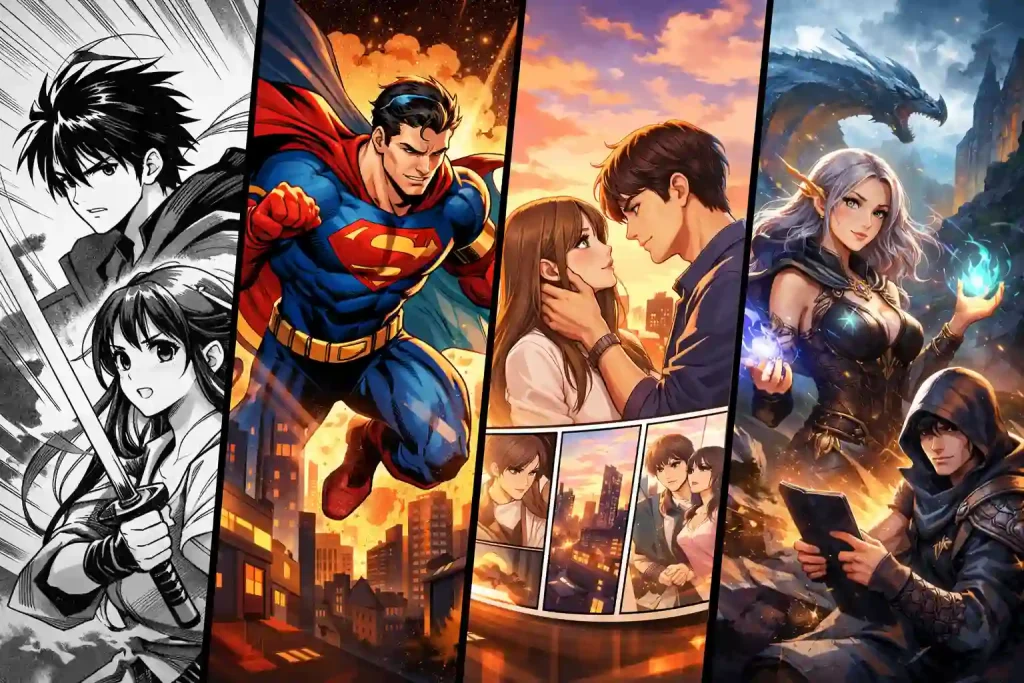
The AI webtoon generator has arrived at a pivotal moment in 2026. The global webtoon market is worth USD 14.44 billion and is projected to reach USD 60.25 billion by 2031 at a 33.1% CAGR (Mordor Intelligence). Meanwhile, 74.2% of webtoon reading time occurs on mobile phones, and four incumbents — Naver Webtoon, Kakao Entertainment, Line Webtoon, and Tapas Media — collectively control 67.5% of global revenue (Mordor Intelligence).
The demand for new content is insatiable. Yet the barriers to creating webtoons — mastering vertical scroll pacing, maintaining full-color character consistency across hundreds of episodes, and surviving the grueling weekly release schedule — have historically locked out independent creators.
Jenova's Webtoon Creator is a dedicated AI webtoon generator built specifically for vertical scroll storytelling. It understands the unique grammar of mobile-first sequential art — scroll rhythm, "thumb stop" moments, panel width variation — and maintains character consistency across entire series using professional reference sheet methodology.
Quick Answer: What Is an AI Webtoon Generator?
An AI webtoon generator is a specialized tool that transforms story concepts and scripts into professional, mobile-optimized vertical scroll comics — including character designs, full-color panels, scroll-aware pacing, and platform-ready exports — without requiring drawing skills.
- Vertical scroll optimization with strategic white space, panel width variation, and "thumb stop" placement — Webtoon Creator handles the unique grammar of mobile-first storytelling
- Character consistency systems maintain identical appearances across hundreds of episodes via reference sheets and style exemplars
- Full-color production with six professional art style templates matching major webtoon traditions (Romance/Drama, Action/Fantasy, Horror/Thriller, and more)
- Platform-ready exports formatted for LINE Webtoon, Tapas, Lezhin, and other major platforms
The Problem: Why Webtoon Creation Remains Out of Reach
Despite explosive market growth, aspiring webtoon creators face barriers unique to the vertical scroll format that go far beyond traditional comic production challenges.
💰 Prohibitive Production Economics
Professional webtoon creation remains financially crushing for independent creators:
Publishers pay $700–$8,000+ per episode depending on quality and complexity. Yet many Webtoon Originals creators take home only $450 per episode after paying assistants — and spend hundreds of unpaid hours on editorial planning.
According to Mordor Intelligence, a mid-tier studio that spent USD 60,000 on a single pilot in 2024 is now reserving USD 200,000 for its next flagship launch — costs that are completely inaccessible to solo creators.
😰 The Creator Burnout Crisis
The webtoon industry's weekly serialization model creates severe health consequences. A Korean survey reported by Comics Beat found that 28.7% of webtoon writers have depression — compared to the national average of 7.7%. An NIH study on webtoon writer working conditions documented average working times of 9.9 hours per day, 5.7 days per week, extending to 11.8 hours on deadline days.
📱 The Vertical Scroll Learning Curve
Webtoons are not simply comics displayed vertically — they are a fundamentally different storytelling medium. Panel width variation affects emotional impact, vertical white space controls pacing, and "thumb stop" moments must be strategically placed. Traditional webtoon creation takes 8–12 hours per episode, with the full-color requirement (unlike black-and-white manga) adding significant production time (Anifusion).
This is exactly what the Webtoon Creator was built for.
Why Webtoon Creator Is the AI Webtoon Generator You Need
While general image generators like Midjourney produce stunning individual panels, they lack every feature necessary for webtoon production — no vertical scroll layouts, no character management, no speech bubbles, no story tracking, no platform-specific exports (COMICPAD; Skywork).
The Webtoon Creator takes a fundamentally different approach: it implements the same structured methodology used by professional webtoon studios, powered by AI execution.
| Feature | Traditional Approach | Webtoon Creator AI |
|---|---|---|
| Cost | $700–$8,000+ per episode | Unlimited generation with subscription |
| Skills required | Years mastering vertical scroll techniques | Story-first workflow — no drawing needed |
| Production time | 8–12 hours per episode | Episodes generated in a fraction of the time |
| Character consistency | Manual tracking with style guides and teams | Automatic reference sheet system |
| Scroll optimization | Learned through trial and error | Built-in scroll rhythm mapping |
| Platform formatting | Separate workflows per platform | Presets for LINE Webtoon, Tapas, Lezhin |
| Burnout risk | 70+ hour weeks, depression rates 4× national average | Sustainable workflow without health sacrifice |
How It Solves Each Pain Point
Production Economics → Subscription Access. Instead of per-episode studio fees, Jenova provides access to frontier AI models including GPT-5.4, Claude Opus 4.6, and Gemini 3.1 Pro Preview — enabling unlimited iterations and complete episodes at a fraction of traditional costs.
Creator Burnout → Beat-by-Beat Generation. The AI webtoon generator produces episodes through a structured beat-by-beat workflow with quality gates. Each generated beat undergoes automatic review for character consistency, scroll flow, and narrative coherence — you only see results that meet professional standards.
Vertical Scroll Mastery → Scroll Rhythm Mapping. Before generating any episode, the system plans "thumb stop" moments, vertical white space placement for dramatic beats, and panel width variations. This is the core grammar of vertical scroll storytelling — automated.
Character Consistency → Reference Sheet Architecture. Every project begins with establishing visual anchors. The AI webtoon generator creates style exemplars and character reference sheets before any story beats, ensuring consistency from the first panel to the last — even across 100+ episodes.
Competitor Context
While Dashtoon offers strong character consistency and a built-in publishing pipeline (scoring 8.6/10 in COMICPAD's independent testing), it primarily locks free creators into publishing exclusively on its platform. Midjourney produces the highest quality standalone images but has zero comic-specific features — no panels, no speech bubbles, no story tracking (Skywork). Jenova's Webtoon Creator provides format specialization with multi-model access and no platform lock-in.
Related Agents You'll Also Like
Comic Creator — Western Comic Book Art
For creators working in traditional Western comic formats alongside their webtoon projects:
- Bold Visual Style Templates: Superhero, Noir, Indie, Franco-Belgian, Cartoon, Realistic
- Character Reference Sheets for visual consistency across entire projects
- Dynamic panel layouts with authentic Western comic reading rhythm
- Long-form production from single issues to 200+ page graphic novels
Manga Creator — Japanese Visual Storytelling
For creators who want manga-style aesthetics with Japanese visual conventions:
- Five Professional Styles: Shonen, Shoujo, Seinen, Slice-of-Life, Chibi
- Screentone integration for authentic manga atmosphere
- Plot memory engine for long-form serialized production
Creative Fiction Writer — Story Development Partner
Develop your narrative foundation before visual production begins:
- Deep research integration for authentic world-building
- Character arc development and dialogue refinement
- Plot structure and pacing guidance
Try the Webtoon Creator free — no credit card required.
How It Works: From Story Concept to Published Episode
Step 1: Define Your Webtoon Concept and Characters
Start by describing your story concept, genre, and main characters to the Webtoon Creator. Choose from six professional art style templates — Romance/Drama, Action/Fantasy, Horror/Thriller, and more — each calibrated to match major webtoon traditions.
"I want to create a romance webtoon set in a modern Seoul coffee shop. The protagonist is Yuna — early 20s, warm brown eyes, shoulder-length black hair with a single blonde streak. She's a barista who discovers she can taste people's emotions in their coffee orders. The love interest is Jae-won — tall, reserved, always orders black coffee that tastes like loneliness."
Step 2: Generate Character Reference Sheets
Before any story panels are created, the AI webtoon generator produces character reference sheets — neutral-pose illustrations with labeled features that anchor every subsequent generation. This is the critical step that prevents the character inconsistency plaguing most AI art projects.
The system generates style exemplars alongside character references, ensuring both character identity and art style remain locked across your entire series.
Step 3: Plan Scroll Rhythm and Episode Structure
For each episode, the Webtoon Creator maps the scroll rhythm:
- "Thumb stop" placement at 2–3 key emotional beats per episode
- Vertical white space allocation — small gaps (50–100px) for quick continuation, large gaps (400px+) for dramatic pauses and revelations
- Panel width variation — full-width for maximum impact moments, narrow panels for rapid exchanges and intimacy
"Episode 1: Yuna's morning routine — she opens the shop alone. First customer is a regular whose coffee tastes like anxiety today. Then Jae-won walks in for the first time. His black coffee tastes like nothing she's ever experienced — a vast, quiet sadness. Thumb stop: the moment she tastes his order. Episode hook: she drops the cup."
Step 4: Generate, Review, and Refine
The AI generates each beat with all character references loaded, then reviews output against quality criteria — character consistency, scroll flow, narrative coherence, and style adherence. Request adjustments to any element: composition, lighting, expression, dialogue placement.
Step 5: Export and Publish
Export completed episodes in platform-ready formats:
- LINE Webtoon Canvas: 800px wide, 1280px max per slice
- Tapas: Flexible sizing with optimized formatting
- Lezhin: Longer episode format with appropriate specifications
- General multi-platform: Standard image formats for social media and personal websites
Results & Use Cases
📱 Weekly Serialization Without Burnout
Scenario: Maintaining a weekly webtoon release schedule as a solo creator
Traditional Approach: 70+ hour weeks, chronic health issues, depression rates 4× the national average. Average working time of 9.9 hours per day, 5.7 days per week (PMC/NIH).
With the Webtoon Creator: Dramatically reduced production time per episode. Consistent output quality without manual redrawing. Sustainable workflow that doesn't require sacrificing sleep or health. Build episode buffers during productive periods to maintain schedule consistency.
💼 Cross-Platform Publishing
Scenario: Publishing the same webtoon across LINE Webtoon, Tapas, and Lezhin simultaneously
Traditional Approach: Separate formatting workflows for each platform's specifications, requiring additional hours of reformatting per episode.
With AI webtoon generation: Built-in platform presets handle correct specifications automatically. Export once in each format. Consistent quality across all platforms. According to Mordor Intelligence, AI-assisted translation is now shortening localization from weeks to hours — enabling simultaneous global launches that cut piracy and protect opening-week revenue.
📊 IP Development and Adaptation Pipeline
Scenario: Creating a webtoon as the foundation for a broader IP (animation, live-action, merchandise)
According to Mordor Intelligence, Netflix adaptations of webtoons like Sweet Home and All of Us Are Dead have "tripled Webtoon readership within eight weeks" of trailer drops. WEBTOON Entertainment is targeting 2026 double-digit revenue growth through its Disney partnership and AI-driven user expansion (Seeking Alpha).
With the Webtoon Creator, produce professional-quality visual IP that can serve as proof-of-concept for adaptation pitches — with consistent character designs that translate directly to animation and live-action reference.
🎓 Educational and Brand Content
Scenario: Transforming complex information into engaging vertical scroll narratives
Educators can convert dense lesson plans into visually engaging webtoon-format content optimized for students' mobile devices. Marketers can create branded webtoon series — the vertical scroll format is perfectly suited for social media and mobile-first marketing campaigns. Develop your narrative with the Creative Fiction Writer before visual production begins.
🌍 Global Market Entry
Scenario: A non-Korean creator entering the webtoon market for the first time
The webtoon market is no longer Korea-exclusive. North America controls 18.65% of market share with higher ARPU ($6.90 per user vs. South Korea's $4.20), and the Middle East and Africa record the fastest regional growth rate (Mordor Intelligence). With AI tools eliminating the traditional barriers of artistic training and production budgets, creators worldwide can participate in this explosive growth.
FAQ
Is an AI webtoon generator free to use?
The Webtoon Creator is available through Jenova with free access to core features and limited usage. For extended creation sessions and higher usage limits, paid plans start at $20/month. Most independent creators find the Plus or Premium tiers sufficient for maintaining a regular weekly release schedule.
How does the AI maintain character consistency across 100+ episodes?
The system uses a reference image architecture. Before generating story beats, you create character reference sheets showing each character in neutral poses with labeled features. These references are loaded with every subsequent beat generation, ensuring visual consistency across your entire project. This approach has largely solved the consistency problem that plagued earlier AI tools — according to Neolemon's 2026 analysis, "A year or two ago, if you asked for the 'best AI character generator for consistent characters,' the honest answer would have been: 'None.' Now we have multiple excellent answers to that question" (Jenova Research).
What webtoon platforms can I publish on?
The Webtoon Creator includes built-in presets for LINE Webtoon Canvas (800px wide, 1280px max per slice), Tapas (flexible sizing), Lezhin (longer episodes), and general multi-platform use. Jenova allows commercial use of generated content with no platform lock-in — you own your work and can publish anywhere.
What genres work best with an AI webtoon generator?
All major webtoon genres are supported through six style templates. Romance, fantasy, action, horror, slice-of-life, and comedy projects all benefit from the structured workflow. According to market data, romance dominates the U.S. webtoon market with over 38% share, while sci-fi is projected to expand at a 36.2% CAGR between 2026–2031 (Mordor Intelligence).
How is an AI webtoon generator different from Midjourney or other image generators?
A dedicated AI webtoon generator like Jenova's Webtoon Creator offers an end-to-end vertical scroll storytelling workflow — scroll rhythm mapping, character management, panel width variation, dialogue integration, platform-specific exports, and persistent project state. General image generators like Midjourney only create individual images. You must then use separate software to assemble them into vertical scroll format, add lettering, and create mobile-optimized layouts — with no character consistency between panels (COMICPAD).
What AI models power webtoon generation on Jenova?
Jenova provides unified access to frontier AI models including GPT-5.4 (OpenAI), Claude Opus 4.6 (Anthropic), and Gemini 3.1 Pro Preview (Google) — plus models from xAI and DeepSeek. No vendor lock-in; switch between models based on your task or preference.
Conclusion
The webtoon market's trajectory — from USD 14.44 billion in 2026 to a projected USD 60.25 billion by 2031 (Mordor Intelligence) — represents one of the fastest-growing content markets in the world. What once required professional studios, years of artistic training, and $700–$8,000 per episode is now accessible to anyone with a story to tell.
The technical barriers have fallen. Character consistency is solved. Scroll rhythm is automated. Platform formatting is built in. The only remaining challenge is the creative one: What story do you want to scroll through?
Start with the Webtoon Creator for mobile-first vertical storytelling. Expand to the Comic Creator for Western formats or the Manga Creator for Japanese-style aesthetics. Develop your narrative with the Creative Fiction Writer before visual production begins.
Explore the full agent library at Jenova.