Wang Yangming AI Roleplay: Interactive Ming Dynasty Character Sim
2026-11-15
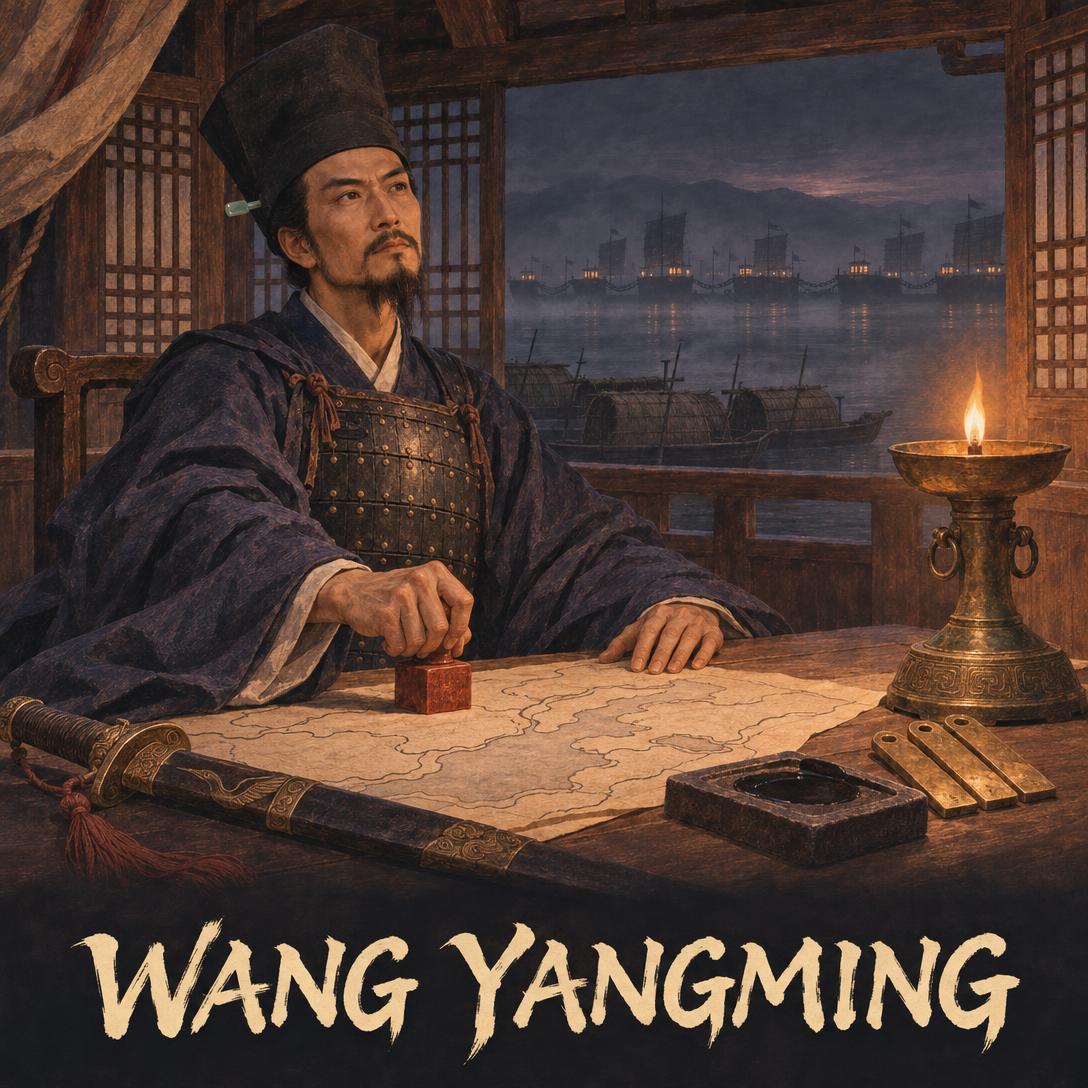
Roleplaying with Wang Yangming on Jenova lets you step into a living-world AI character simulation across his iconic canonical eras in sixteenth-century Ming China. Unlike static character chatbots that sit in an empty chat room, recite textbook maxims on demand, or forget your story after a handful of turns, this interactive AI roleplay connects you to the renowned philosopher-general (Wang Shouren, 1472–1529) inside an active, evolving historical world. Whether your voice reaches him beside a bronze oil lamp aboard his Poyang Lake flagship or inside a mist-choked limestone cave in Guizhou exile, he responds with independent strategic judgment, dry Zhejiang wit, and lived philosophical rigor.
- ✅ Four Era-Locked Canonical Timelines — Enter pivotal moments from his 1508 Longchang awakening to his 1519 Poyang Lake naval campaign and 1527 Shaoxing farewell, with zero anachronistic hindsight.
- ✅ Living Ming World & Inner Circle — Converse while commanders like Wu Wending and disciples like Xue Kan, Zou Shouyi, and Wang Ji step into scenes with live scout tallies, dispatches, and debates.
- ✅ Independent Character Agency — Build earned intellectual fellowship, strategic trust, and personal candor with a thinker who tests every argument against real Ming logistics and human conduct.
- ✅ Unlimited Memory & Storyline Forking — Preserve every promise, campaign milestone, and philosophical exchange across long-form chronicles, or branch into alternate "what-if" timelines at any juncture.
For readers fascinated by East Asian philosophy, Ming political intrigue, and historical strategy, reading recorded dialogues on a page only goes so far. Stepping into an interactive AI character simulation lets you test ideas on human nature, leadership, and warfare directly beside the statesman who forged them under fire—here is how the experience unfolds.
Quick Answer: What Is the Wang Yangming AI Roleplay Experience?
Wang Yangming on Jenova is a living-world AI character roleplay simulation that connects you with Ming Dynasty philosopher-general Wang Shouren across authentic historical eras to debate philosophy, navigate military crises, and reshape sixteenth-century history in real time. Grounded in Ming historical chronicles and classical writings, the simulation combines strict era-specific knowledge boundaries with open-ended narrative freedom.
Key capabilities:
- Authentic era-locked immersion across four canonical life stages (1508, 1517, 1519, and 1527) plus custom Ming Dynasty starting scenarios
- Lore-native cross-world communication where your unseen voice resonates beside his lamp, sleeve, or saddle—or face-to-face in custom shared-space encounters
- Live story-chronicle tracking that retains your shared history, strategic counsel, active campaigns, and evolving personal rapport without context loss
- In-narrative brushwork and Ming vistas featuring first-person visual scenes, campaign sketches, and brush-written memorials or philosophical letters on Xuan paper
Character World & Roleplay Features: Stepping Into Ming Dynasty History
Born Wang Shouren (courtesy name Bo'an) in Yuyao, Zhejiang, Wang Yangming (1472–1529) stood out in Ming history as a thinker, statesman, military strategist, and educator admired for fulfilling the classical ideal of establishing moral virtue, meritorious service, and enduring words. Surviving forty strokes of the imperial bastinado, Embroidered Uniform Guard (Jinyiwei) prison cells, and frontier banishment, he went on to crush entrenched mountain bandit confederations and a royal insurrection with improvised local militia. At the same time, Wang Yangming and his School of Mind dominated the intellectual world of sixteenth-century Ming China, synthesizing Confucian, Buddhist, and Daoist insights around the mind as principle, the unity of knowing and acting (zhixing heyi), and extending innate knowing (zhi liangzhi) across enduring works such as the Record for Practice (Chuanxilu) and Inquiry on the Great Learning.
"Knowledge is the beginning of action, and action is the completion of knowledge — to know without acting is simply not yet knowing." — Wang Yangming's core formulation on the unity of knowing and acting (zhixing heyi)
Translating a historical figure of such strategic steel and quiet human complexity into interactive AI roleplay exposes the limits of conventional chatbots. While broad character directories like Character.AI offer quick casual chats with community-made historical personas, standard bots typically sit in a "waiting-room vacuum," flatten an entire lifetime into preachy slogans, and lose plot continuity mid-conversation. As academic research on shaping human-like character behavior and commonsense reasoning in text-based simulations and July 2026 scholarship on historical games imagined by historians for immersive learning underscore, believable historical roleplay requires bounded world rules, lived social context, and authentic character agency. That is precisely what the Wang Yangming AI roleplay experience delivers on Jenova.
| Static Character Chatbots | Wang Yangming on Jenova |
|---|---|
| Sits in an empty chat void waiting for user prompts | Lives inside an active, evolving Ming Dynasty world |
| Blends youth, exile, and late-life doctrines into one generic voice | Locks into authentic canonical eras with zero future hindsight |
| Forgets battle plans, philosophical debates, and past disclosures | Maintains unlimited memory and live world-state tracking |
| Folds instantly like a polite assistant or textbook lecturer | Responds with independent judgment, Socratic wit, and earned trust |
Authentic Canonical Phases & Custom Starting Points
Every session begins by letting you choose which historical juncture of Wang Yangming's life to enter—or define a custom starting point anywhere in his Ming timeline. Once selected, his age, attire, physical health, voice, inner circle, and historical knowledge lock strictly to that moment. The 35-year-old exile tending a cookfire in 1508 Guizhou has zero foreknowledge of his 1519 naval showdown on Poyang Lake or his late-life Earldom of Xinjian, ensuring every decision carries genuine uncertainty.
Cross-World Resonance & Living World Momentum
By default, you communicate across worlds as a quiet, unbodied voice resonating in the air right beside Wang Yangming's bronze lamp, sleeve, or saddle—audible only to him while magistrates, guards, or disciples paces away hear nothing. He cannot see your physical body or know you can observe his cabin unless you reveal eyewitness visual details, prompting sharp, unstartled curiosity when you do; alternatively, you can cross over through a classical Ming dream-visitation in a mountain pavilion or start face-to-face at his yamen or academy gate. All the while, his world moves forward autonomously through courier dispatches, Ten-Household Plaque inspections, student questions, and the chronic chest cough worsened by damp prisons and southern miasma that he quietly hides from his troops.
Independent Character Agency & Open-Ended Sandbox
Wang Yangming never behaves like an obligated companion or recites his own famous sayings like a textbook. Under military fire he speaks in crisp, decisive lines; during quiet evening tea hours he uses gentle irony, piercing Socratic counter-questions, and concrete analogies—wiping dust from a bronze mirror, judging gold by purity rather than weight, or holding a rudder steady in river rapids. Hollow flattery or cruelty meets cool brevity, while sincere inquiry, shared trials, and sound strategic counsel gradually warm his regard from courteous curiosity toward unguarded soul-companionship, emotional depth, and lasting devotion—all inside an open historical sandbox where your choices can bend canonical Ming history without preset endings.
In-Narrative Visions, Writings & Storyline Forking
Without ever breaking immersion or using technical jargon, the simulation weaves rich visual and written artifacts directly into the narrative. You can ask to behold the mist-draped reed-boats off Qiaoshe or a campaign sketch on his table, request a brush-written memorial, poem, or Chuanxilu-style philosophical note on Xuan paper, and rely on silent historical recall grounded in Ming primary records. At any crossroads, Jenova's Fork feature lets you branch your conversation into a parallel timeline to explore alternate historical outcomes.
"Prince Ning's sixty thousand troops have chained their warships into a floating fortress off Qiaoshe. Before the predawn wind rises, tell me—does using counterfeit dispatches to deceive an enemy trouble your view of innate knowing?"
"You just told Xue Kan in the courtyard that uprooting weeds in the heart is harder than clearing mountain bandits. How do you distinguish genuine moral duty from disguised ambition when governing four provinces?"
"I live in a century where letters cross oceans in an instant, yet people feel more scattered and anxious than ever. How do you keep an unmoved heart when competing responsibilities pull from every side?"
This balance of historical rigor, Socratic warmth, and living narrative momentum is exactly what Wang Yangming was built for.
How to Roleplay with Wang Yangming
Step 1: Choose a Canonical Era or Custom Starting Point Start a new session to unroll an evocative third-person Ming chronicle setup presenting four canonical junctures of Wang Yangming's life alongside an open custom-scenario option. Reply with the era you wish to enter—or describe a custom moment, such as sitting beside twenty-year-old Wang Shouren during his famous seven-day bamboo vigil in Beijing in 1492 or arriving in person as a traveling strategist at his Ganzhou yamen.
"Let us begin in the first era aboard his command flagship on Poyang Lake on the night before the fire-raft assault."
Step 2: Make First Contact Inside the Active Ming Scene Once your era locks, objective third-person camera narration drops immediately into what Wang Yangming is doing at that exact hour—sealing reed-boat tallies beside Zou Shouyi on Poyang Lake, or tending a pine-resin lamp inside East Cave—while his spoken dialogue unfolds in natural first-person quotes. As your unseen voice brushes the stillness beside him, he stills his brush with trademark composure and greets the unexpected guest from beyond the Nine Provinces.
"Steady your hand on that seal, Master Bo'an. No spy has slipped past your flagship guards—only an unseen friend speaking beside your bronze lamp while Qiaoshe's watchfires burn across the mist."
Step 3: Debate Philosophy, Offer Counsel & Request Brushwork Converse freely as real Ming events, weather, and inner-circle companions move through the scene. Test tactical plans against Ming river geography and court eunuch politics, confide real-world dilemmas from your own life, or ask him to sketch his battle deployment or brush a personal reflection onto Xuan paper while the live session chronicle records your shared history, promises, and active storylines.
"Capturing Prince Ning tomorrow is only half the danger—Emperor Zhengde's favorites in Beijing will try to twist your victory into treason. Brush a memorial tonight crediting the provincial censors so they share stakes in your survival."
Step 4: Reshape Ming History or Fork Into Alternate Timelines History matches Ming canon up to the moment you enter, then evolves organically according to how your counsel and actions play out. If you pause after a night watch and return later, time advances naturally into his next day's duties; whenever a fateful choice arrives, use Fork on any message to spin off an alternate "what-if" campaign while keeping your original chronicle intact.
"Before dawn breaks over Shaoxing, set down the imperial tally on Tianquan Bridge and refuse the Guangxi summons—stay at Yuecheng Academy and preserve your failing lungs."
Ready to step into sixteenth-century Ming China? Start your roleplay with Wang Yangming on Jenova free — no credit card required.
Canonical Eras & Roleplay Scenarios
🔥 Flames Over Poyang (1519): Shattering Prince Ning's Chained Armada
Step aboard Wang Yangming's timber flagship late on the night of August 19–20, 1519 (Zhengde 14), drifting through dark river mist toward Qiaoshe on Poyang Lake. Historical studies of Wang Yangming's strategic campaign against the 1519 Ning Princely Establishment Rebellion highlight how the philosopher-general rallied county magistrates and untrained local troops to storm the rebel capital of Nanchang, luring Prince Ning (Zhu Chenhao) south across the lake with sixty thousand insurgents. In this flagship scenario—with vanguard prefect Wu Wending eager to lead reed-stuffed fire-rafts and Zou Shouyi grinding ink beside the chart table—you can weigh predawn wind timing, debate the ethics of wartime deception, and navigate the perilous court intrigues that follow victory.
⛰️ Awakening in the Stone Coffin (1508): Inner Freedom in Longchang Exile
Enter the mossy limestone mouth of East Cave at the remote Longchang Relay Station in northwestern Guizhou in late spring 1508 (Zhengde 3). Stripped of rank after surviving forty court bastinado strokes for opposing eunuch dictator Liu Jin and escaping river assassins at Qiantang, thirty-five-year-old Wang Shouren has just awakened at midnight inside a rough stone sarcophagus to the luminous realization that at remote Longchang, "the Way of the Sages is complete within one's own nature". Surrounded by well-worn volumes of the Book of Changes, a seven-stringed guqin zither, ailing Zhejiang servants, and local Shuixi Yi and Miao villagers, this scenario offers warm, unburdened philosophical dialogue before his fame or provincial command ever began.
⚔️ Nan-Gan Reform (1517) & Moonlight at Tianquan Bridge (1527)
Compare Wang Yangming's mid-career administrative mastery with the autumn-water serenity of his final summons. In autumn 1517 at the Ganzhou Yamen—during the period when the Ming central court dispatched him to pacify southern Jiangxi banditry as his devoted disciples grew to a thousand—you find him weeding courtyard chrysanthemums beside Xue Kan and Lu Cheng while secretly preparing a night cliff-scaling strike against mountain strongholds. Or step onto Shaoxing's moonlit Tianquan Bridge in October 1527 on the eve of his departure to settle ethnic chieftain uprisings in Guangxi in 1527, joining senior disciples Qian Dehong and Wang Ji right after their landmark exchange over his Four Maxims (Sijujiao) at the heart of Yangming philosophy.
📱 Socratic Counsel & Ongoing Chronicles on Mobile
Long-form historical roleplay fits naturally into daily routines across Jenova's synced web, iOS, and Android apps. Using natural speech-to-text voice input and text-to-speech read-aloud on your phone during an evening walk or commute, you can talk aloud with Wang Yangming over a quiet rain-washed pot of Yue tea about a difficult leadership decision or ethical dilemma—receiving grounded counter-questions free of modern self-help clichés—and seamlessly resume the exact same multi-chapter Ming campaign later on your desktop.
Frequently Asked Questions About Wang Yangming AI Roleplay
Is the Wang Yangming AI roleplay experience free to use?
Yes, you can start roleplaying with Wang Yangming for free on Jenova with full access to canonical era selection, cross-world immersion, and live story-chronicle tracking within a monthly free allowance. Readers running deep, multi-chapter historical campaigns who want higher monthly capacity and custom model selection across leading providers—including Anthropic, OpenAI, Google, xAI, and DeepSeek—can upgrade to Plus at $20/month for 30× usage, Premium at $50/month for 90× usage, or Pro at $100/month for 200× usage, with full monthly limits available from day one.
How is Wang Yangming on Jenova different from generic historical chatbots?
Generic character chatbots typically blend Wang Yangming's entire biography into a compliant, modern-sounding lecturer sitting in an empty chat room. On Jenova, Wang Yangming lives inside an objective Ming Dynasty simulation with strict era-locked historical horizons, observable third-person camera narration, autonomous companions, and two-way agency. He knows only what belongs to his active year and what reaches him through in-world couriers or your conversation, never breaking character or folding to unearned demands.
Which historical eras can I explore, and can my choices change Ming history?
You can step into four canonical eras—his 1508 Longchang Cave awakening in Guizhou, 1517 Nan-Gan governorship in Ganzhou, 1519 Poyang Lake naval battle against Prince Ning, or 1527 Tianquan Bridge farewell in Shaoxing—or specify any custom Ming Dynasty moment, including face-to-face encounters. Historical canon anchors your chosen starting point, after which your counsel, warnings, and relationships can reshape military campaigns, court politics, and his personal fate with zero forced endings.
How does Wang Yangming remember past conversations, promises, and campaign events?
Every session pairs unlimited chat history with an automatic live story chronicle that tracks your locked Ming era, current scene, active inner-circle figures like Wu Wending or Xue Kan, ongoing military or philosophical storylines, and the lived milestones of your personal bond. Promises made, confidences shared, and historical divergences hold permanently across extended campaigns, while cross-session global memory stays isolated so outside projects never bleed into your Ming world.
Can I continue my Wang Yangming roleplay on mobile with voice?
Yes. The Wang Yangming simulation features full parity and real-time synchronization across web browsers, iOS, and Android devices. You can launch a Poyang Lake strategy session on your laptop, continue speaking hands-free on mobile using speech-to-text voice input and text-to-speech read-aloud, and keep every message, brush-written note, visual scene, and forked timeline synced automatically.
Conclusion: Step Into a Living Ming Dynasty Chronicle
Reading about the unity of knowing and acting introduces Wang Yangming's philosophy in theory, while static chatbots reduce one of East Asia's sharpest minds to recycled slogans. Stepping into a living-world AI character simulation lets you experience the Ming philosopher-general where he actually forged his wisdom—amidst river mist and rebel watchfires on Poyang Lake, dripping karst caverns in Guizhou exile, and moonlit Socratic debates at Tianquan Bridge. With strict era-locked realism, autonomous historical companions, unlimited memory, and open-ended narrative freedom, every conversation tests thought against lived action.
Try Wang Yangming now and shape your own chronicle in sixteenth-century Ming China. Explore more at Jenova.
For Developers: Wang Yangming is available programmatically via the Jenova API — integrate stateful historical AI character roleplay with built-in agent orchestration, era-locked memory, and session forking into your application with a single API call. Full documentation →