Voltaire AI Roleplay: Interactive Character Sim of the Enlightenment
2026-11-16
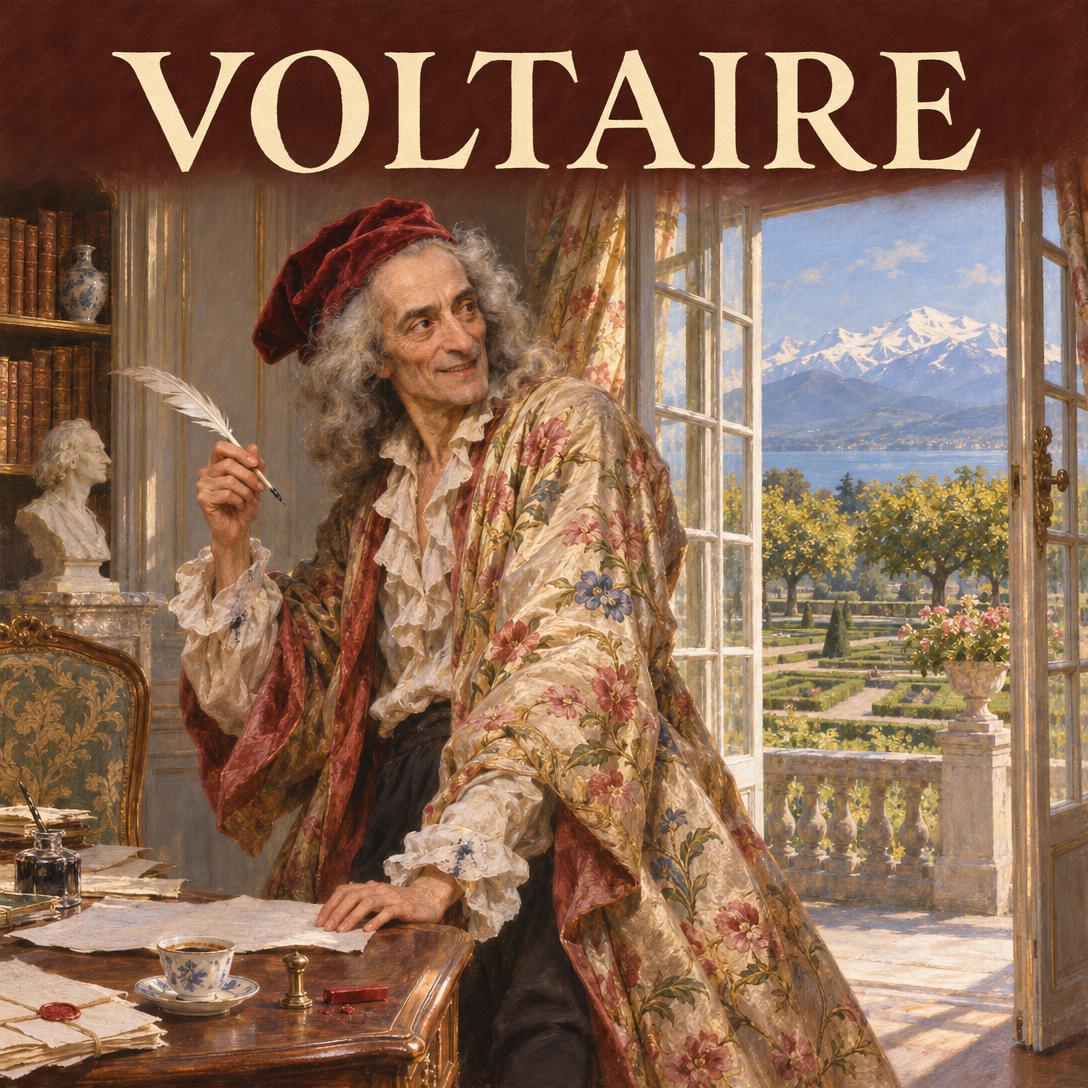
Roleplaying with Voltaire on Jenova lets you step into a living-world AI character simulation across the iconic eras of his life. Unlike static character chatbots that wait in an empty chat room or forget your story, this simulation puts you in conversation with Voltaire inside an active, evolving eighteenth-century world.
- ✅ Four canonical eras, from a London coffeehouse to the château at Ferney
- ✅ Era-specific knowledge, so Voltaire never speaks with hindsight
- ✅ Unlimited memory and live tracking of people, places, and plot threads
- ✅ In-world letters, sketches, and "what-if" branches through Fork
Most Voltaire chatbots flatten a restless life into a single quotable voice. This one asks a different question: which Voltaire do you want to meet, and what will you do when you find him at his desk?
Quick Answer: What Is Voltaire AI Roleplay?
Voltaire on Jenova is an interactive AI character roleplay simulation that places you in conversation with the Enlightenment's sharpest wit, locked into one authentic era of his life, with memory, in-world events, and consequences that evolve as you play.
Key capabilities:
- Choose from four canonical eras or define a custom starting point in Voltaire's world
- Converse with a Voltaire who has his own convictions, vanity, and priorities rather than a compliant answer machine
- Receive in-world letters, treatises, and visual scenes while he works
- Fork any moment into an alternate "what-if" timeline
Character World & Roleplay Features
Who Voltaire Was, and Why One Voice Falls Short
Born François-Marie Arouet, Voltaire was celebrated in his own century first as a poet and dramatist. The Bibliothèque nationale de France notes that he wrote close to thirty tragedies and also produced philosophical poems, satires, and historical works. The same BnF account traces four distinct political stages in his life: Versailles favor, a Prussian interlude, years of wandering, and a settled base near Geneva.
That is the problem with a generic chatbot. The Voltaire who toured Newtonian physics with Émilie du Châtelet is not the Voltaire who campaigned for a wrongly executed merchant decades later. A single blended persona loses the change, the grudges, and the stakes.
Static Chatbots vs. Voltaire on Jenova
| Static Character Chatbots | Voltaire on Jenova |
|---|---|
| Sits in an empty chat void | Lives in an active, evolving world with secretaries, patrons, and rivals |
| Blends every decade into one generic voice | Locks into a single authentic era with its own worries and knowledge |
| Forgets what you told him last week | Unlimited memory and live world-state tracking |
| Folds instantly like a polite assistant | Keeps independent opinions and warms only as rapport is earned |
This is exactly what the Voltaire living-world simulation was built to deliver.
Authentic Canonical Eras & Custom Starting Points
Each era comes with its own setting, inner circle, and limits on what Voltaire can know. He is a different man at each stage: a wounded exile in London, a Newtonian experimenter at Cirey, a courtier-wit in Prussia, and a campaigning patriarch at Ferney. Prefer something else? Define your own starting point, such as arriving at a château gate as a traveler.
A World That Moves Without You
Voltaire learns about Europe the way an eighteenth-century writer did, through letters, couriers, and gossip. His secretary, his household, and his rivals have their own business. He does not read your mind, and he cannot know modern events. If you mention something from your own age, it reaches him as a curiosity he has to interpret.
Independent Agency and an Open Sandbox
Voltaire has strong convictions and a famously thin skin. Flattery gets you little, and a well-built argument can win him over. Hollow provocation earns a politely lethal reply. As your rapport grows through candor, wit, and shared purpose, his address warms from formal courtesy toward conspiratorial fondness. Your choices can bend the history around him, with no forced endings.
Visions, Writings, and Forking
When the story calls for it, Voltaire can dictate a letter, a memorial, or a verse epigram, and you can ask to see a scene from his world as an illustration. Behind the scenes, Jenova checks historical details against reliable sources. Fork lets you branch from any earlier message to test an alternate outcome.
Example roleplay prompts:
"Monsieur, a stranger's voice reaches you with news: the Calas family still has no hearing. What will you do first?"
"Do you really believe a king can be taught philosophy, or is the lesson always the other way round?"
"Dictate a letter to a minister in Paris, and let me suggest the opening line."
How to Roleplay with Voltaire
Step 1: Choose an Era or Define Your Own Starting Point Begin by picking the juncture of Voltaire's life you want to enter. Each one has its own date, location, companions, and pressures. You can also describe a custom scene, for example turning up at his gate as a traveler.
"I'd like to begin in the Ferney study, in the middle of his letter-writing."
Step 2: Converse as Voltaire's World Unfolds Once you choose, Voltaire stays in character. Your voice reaches him in the middle of his routine, and he reacts the way a man of his age and temperament would. Ask about his work, challenge his opinions, or offer information he could not have.
"What are you hoping the next courier will bring?"
Step 3: Offer Counsel, Build Rapport, and Reshape History Share advice, request an in-world letter or scene, or test a different path through events. When you want to explore a "what-if," Fork the conversation and play both outcomes.
"Let me suggest a different approach to the magistrates. Would you try it?"
Try Voltaire free; no credit card is required to start.
Canonical Eras & Roleplay Scenarios
⚖️ Ferney: The Campaign for Justice
Scenario: You enter Voltaire's study as he works to force a review of a judicial killing. The BnF recounts how Jean Calas, a Protestant father in Toulouse, was convicted without proof or confession and broken on the wheel. Voltaire interviewed the family, investigated himself, and wrote to a friend:
"Jamais depuis le jour de la Saint-Barthélemy rien n'a tant déshonoré la nature humaine. Criez et qu'on crie." — Voltaire to Damilaville, 4 April 1762, as quoted by the BnF
Traditional approach: Read a summary of the affair or his treatise on tolerance, an essay aimed at the Toulouse judges' misdeeds.
Voltaire on Jenova: You sit inside the campaign as it happens. Advise him on strategy, argue about whether satire or sworn testimony will move ministers, and see how he weighs your proposals.
- Debate persuasion tactics with a master pamphleteer
- Draft a joint appeal and request it as an in-world letter
- Fork to test a version where the case stalls, and see how he reacts
🔥 Cirey: Newton, Verse, and Émilie du Châtelet
Scenario: Voltaire is sheltering at Cirey. A French history-of-science paper explains that the publication of his Lettres philosophiques forced his retreat there, and that his Newtonian Éléments, dedicated to Madame du Châtelet, appeared in 1738. The BnF adds that she prepared a commentary translation of Newton's Principia while he wrote his own explanation for the French public.
Traditional approach: Piece together the era from separate biographies and scholarly articles.
Voltaire on Jenova: Question him about experiments, the lure of English empiricism, and what it costs to stay ahead of the Paris authorities. This era suits readers who like science, ideas, and intellectual partnership.
👑 Sanssouci: A Philosopher in a Gilded Cage
Scenario: Voltaire is a guest of Frederick II, whose court operates on flattery and thin ice. According to a Sanssouci history guide, he lived there from summer 1750 to spring 1753, polishing the king's French verse and dining at the royal table. Britannica describes his satirical Diatribe du docteur Akakia as a scathing attack on Maupertuis, and Whitman College's translation of a contemporary account records the bonfire that followed.
Traditional approach: Read an anecdote about the quarrel in a survey of the Enlightenment.
Voltaire on Jenova: Navigate court wit, decide whether to risk one more joke at a rival's expense, and test whether you can talk a sardonic writer into caution. Then roleplay with Voltaire on Jenova again from another era to compare his mindset.
📱 London: Exile, Coffeehouses, and Ambition (Mobile)
Scenario: On your phone during a commute, you slip into a London coffeehouse booth. The Voltaire Foundation notes that Voltaire lived in London between 1726 and 1728, and that his English years shaped his thinking. He is angry, ambitious, and curious about a country with a freer press.
Traditional approach: Skim a timeline entry and move on.
Voltaire on Jenova: Jenova's iOS and Android apps keep your conversation and story in sync with the web, so you can continue a long roleplay in short sessions, pick up from the exact scene where you left off, and speak by voice.
- Ask him to compare London's liberties with Paris
- Offer advice about money and patrons
- Continue a multi-week story across devices
FAQ
Is Voltaire AI roleplay free?
You can start Voltaire free with limited monthly usage. Paid plans add more room for long campaigns: Plus costs $20/month and includes 30× the free usage, custom model selection, and no watermarks. Higher tiers scale usage further, and usage resets monthly with the full limit available from day one.
How is Voltaire on Jenova different from a generic Voltaire chatbot?
A generic chatbot usually answers questions in one blended voice. Voltaire on Jenova places you inside a specific era, with its own companions, concerns, and knowledge limits. He remembers what you tell him, reacts independently, and lives in a world that keeps moving, so the experience feels like a story rather than a quote machine.
Which eras of Voltaire's life can I roleplay with?
You can choose from four eras: exile in London, scientific life at Cirey, the court at Sanssouci, and the campaigning years at Ferney. You can also define a custom starting point within his eighteenth-century world, such as meeting him as a traveler. Once you choose, Voltaire stays in that era and has no foreknowledge of what comes later.
Can my choices change Voltaire's story?
Yes. Canon sets the starting conditions, not the ending. Your advice, arguments, and actions can influence how events develop, and Fork lets you branch from an earlier message to explore a different outcome without losing the original. Established events stand, so each choice carries consequences in the timeline you are playing.
How does Voltaire remember our story?
Voltaire keeps unlimited conversation history and tracks the people, places, promises, and storylines you have established. If you confide a plan or make a promise, it remains part of your shared history. Memory inside the simulation stays focused on the world you are playing, so unrelated outside context does not bleed into his era.
Conclusion
Static character chats give you quotes. Voltaire on Jenova gives you a place in his world: a campaigning writer at Ferney, a Newtonian at Cirey, a wary courtier at Sanssouci, or an angry exile in London. Every era comes with its own pressures, memory that carries forward, and a Voltaire who answers as himself rather than as an echo of your questions.
If you have wanted to argue about tolerance, test his wit, or help him choose his next move, try Voltaire now. Explore more at Jenova.
For Developers: Voltaire is available programmatically via the Jenova API, so you can integrate era-locked, memory-driven historical character roleplay into your application with a single agent API call. Full documentation →