AI Voice Chat Room: Talk to AI Agents in Real Time (May 2026)
2026-05-17
Voice is eating the internet — again. The voice-based AI companion market hit $4.39 billion in 2025 and is projected to rocket to [$42.8 billion by 2033 at a 31.4% CAGR](https://www.grandviewresearch.com/industry-analysis/voice-based-ai-companion-market-report), while voice AI overall is growing 2.4× faster than text-based chatbots (67% YoY vs. 28%). In January 2026 alone, voice AI startups raised $1.23 billion in a single month. The message from capital markets, consumer behavior, and technology benchmarks is unanimous: people don't just want to type to AI — they want to talk to it.
An AI voice chat room takes this a step further. Instead of a one-dimensional voice assistant that answers questions and goes silent, it creates a persistent conversational space where you engage with specialized AI agents through natural speech — learning a language through immersive roleplay, rehearsing a job interview with a coach who pushes back, receiving real-time meditation guidance, or running a live investigation in a mystery game. Jenova makes this possible across its entire agent library. With built-in text-to-speech on every AI response and voice-to-text input, agents like the Roleplay Game Master, Interview Coach, and Learn Japanese Through Roleplay transform from text conversations into living voice chat rooms — persistent, adaptive, and available 24/7.
Quick Answer: What Is an AI Voice Chat Room?
An AI voice chat room is a real-time conversational space where you interact with one or more AI agents using natural speech — receiving spoken responses, coaching, narration, or dialogue rather than reading text on a screen.
- Voice-driven roleplay and gaming with persistent characters and narrative memory — try the Roleplay Game Master
- Immersive language learning through spoken conversation in your target language — explore agents like Learn Japanese Through Roleplay
- Coaching and practice sessions where you speak your answers and receive spoken feedback — such as the Interview Coach
- Guided experiences in meditation, therapy, and wellness delivered through natural voice — via agents like the Meditation Guide
The Problem: Why Text-Only AI Falls Short
The AI revolution of 2023–2025 was overwhelmingly text-based. Users typed prompts, read responses, and scrolled through walls of text. For many use cases — research, writing, analysis — that's fine. But for an entire category of high-value interactions, text is the wrong medium. And the data proves users know it.
🗣️ Humans Prefer Voice for Complex, Emotional, and Time-Sensitive Interactions
74% of customers prefer voice for urgent or complex issues, and voice AI scores 4.1/5 in satisfaction compared to 3.8/5 for chatbots. — Salesforce, State of the Connected Customer, 2025 (via AInora)
Voice communication is richer than text by every measurable dimension. It carries tone, emotion, pacing, hesitation, and emphasis — signals that text strips away entirely. When the interaction is emotionally charged (therapy, relationship coaching), performance-based (interview practice, public speaking), or immersive (roleplay, language learning), forcing it into text creates an artificial bottleneck. You wouldn't practice a job interview by typing your answers. You wouldn't learn to speak Japanese by reading silently.
📉 The Engagement Ceiling of Text-Based AI
The AI companion app market surged 700% between 2022 and mid-2025, according to the American Psychological Association — but the vast majority of those apps are text-only. The result is an engagement pattern that mirrors the meditation app crisis: rapid adoption followed by rapid abandonment. Users download, experiment, and leave — because reading AI responses on a screen doesn't feel like a relationship, a session, or an experience. It feels like scrolling.
Voice changes the retention equation. When an AI agent speaks to you — with appropriate tone, pacing, and personality — the interaction shifts from "using a tool" to "having a conversation." That shift is precisely why voice AI resolves 74% of inquiries without human escalation compared to 68% for chatbots: voice conversations allow for more natural clarification, follow-up, and emotional processing.
🎮 The Rise of Voice-First Social Experiences
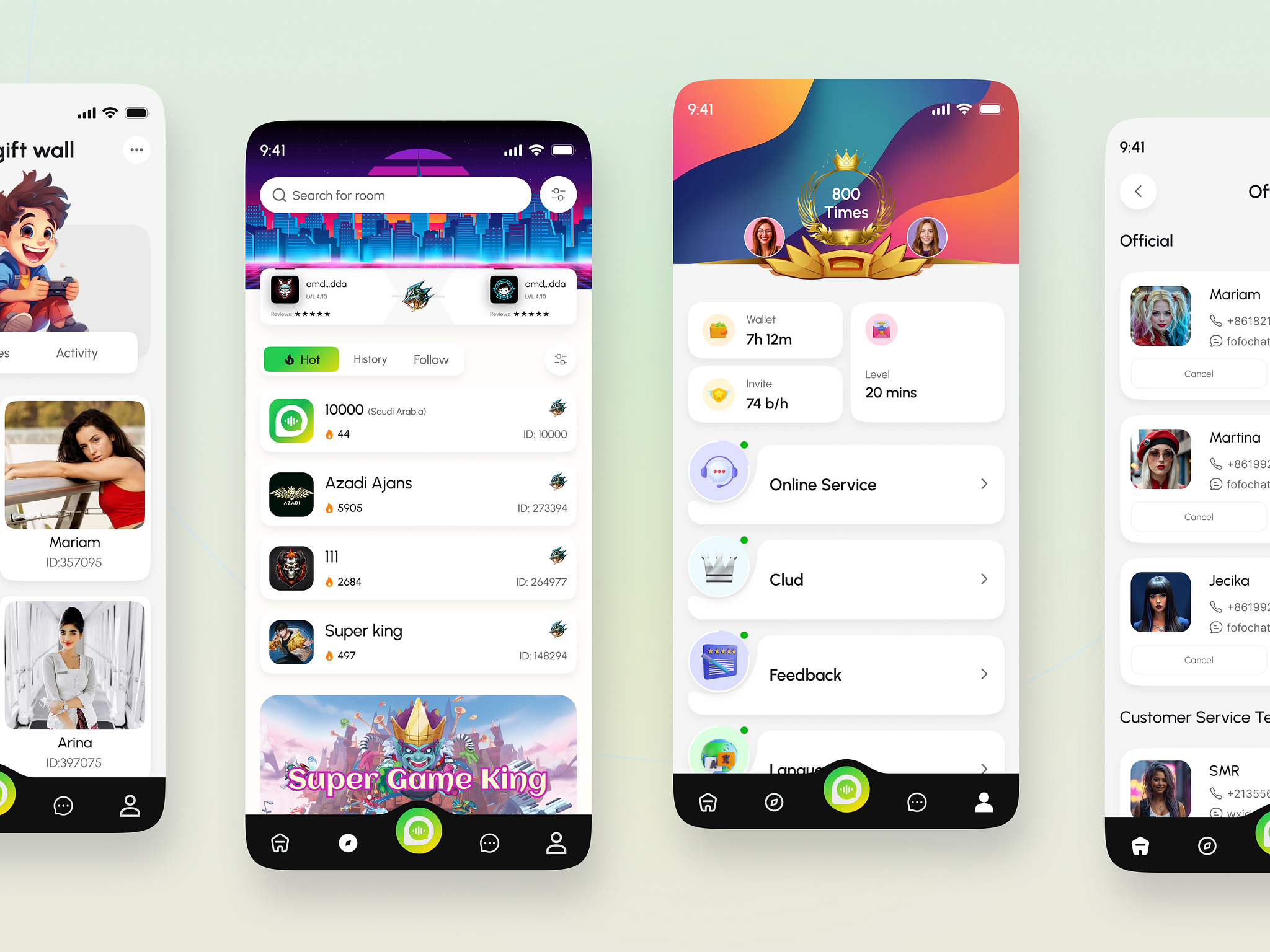
The screenshot at the top of this article tells the story visually: voice chat rooms with live participants, room listings, user levels, and social discovery features. Apps like Clubhouse, Discord stages, and Twitter Spaces proved that people crave real-time voice interaction — not asynchronous text threads. But those platforms rely on human participants being available at the right time, in the right mood, with the right expertise. An AI voice chat room removes that dependency entirely. The agent is always available, always patient, always in character.
💰 Voice AI Costs Have Collapsed
The economic barrier that once made voice AI impractical has evaporated. Voice AI cost per interaction dropped 62% in just two years — from $0.40–$1.20 in 2023 to $0.15–$0.50 in 2025. End-to-end speech-to-speech models like OpenAI's gpt-realtime now deliver 195ms response latency, faster than the average human reaction time. The technology is ready. The economics are ready. What's been missing is purpose-built AI agents worth talking to.
The Jenova Solution: Every Agent Becomes a Voice Chat Room
This is exactly what Jenova was built for — not a single voice assistant, but an entire ecosystem of specialized agents that you can talk to and hear from.
Every Jenova agent supports text-to-speech output and voice-to-text input. That means any agent — whether it's a language tutor, a dating coach, a debate partner, or an escape room — can function as a voice chat room. You speak, the agent listens. The agent responds, and you hear it aloud. The conversation persists across sessions with full memory, so you're never starting over.
| Feature | Traditional Voice Assistants (Siri, Alexa) | Voice Chat Apps (Discord, Clubhouse) | Jenova AI Voice Chat |
|---|---|---|---|
| Conversation depth | Shallow — command-response | Depends on human participants | Deep — domain-expert agents with persistent memory |
| Availability | Always on, limited intelligence | Requires live human speakers | Always on, specialist-level intelligence |
| Personalization | Basic preferences | None | Persistent cross-session memory adapts to you |
| Use cases | Timers, weather, music | Social conversation | Learning, coaching, roleplay, therapy, practice |
| Character consistency | Generic assistant persona | N/A | Agents maintain character, tone, and expertise indefinitely |
| Model flexibility | Locked to one provider | N/A | GPT-5.4, Claude Opus 4.6, Gemini 3.1 Pro Preview, plus xAI and DeepSeek |
🎙️ How Voice Works on Jenova
The experience is simple. Open any agent, tap the voice-to-text button to speak your message, and send. The agent's response appears as text — then tap the text-to-speech button on any AI message to hear it read aloud in a natural voice. The result is a fluid voice conversation loop: you speak, you listen, you speak again. For agents built around dialogue — roleplay, coaching, tutoring, guided experiences — this transforms the interaction from reading a chatbot to inhabiting a voice chat room.
🧠 Persistent Memory Makes It a Room, Not a Call
What separates a "voice chat room" from a "voice call" is persistence. A call ends and the context disappears. A room persists — you return, and the space remembers you. Jenova's unlimited chat history and persistent cross-session memory mean that your AI voice conversations accumulate context over time. Your language tutor remembers which vocabulary you struggled with last Tuesday. Your interview coach knows you tend to ramble on behavioral questions. Your game master remembers the clues you found in session three. That persistence is what makes repeated voice interaction genuinely valuable rather than repetitively generic.
Specialized AI Agents for Voice Chat
Roleplay Game Master
The flagship voice chat room experience. The Roleplay Game Master runs immersive, interactive story worlds where NPCs speak with distinct personalities, remember your choices, and pursue their own goals. Voice transforms this from a text RPG into something closer to a tabletop session with a master GM — except this GM never needs to prep, never cancels, and maintains perfect consistency across unlimited sessions.
- Unlimited memory ensures character and plot consistency across multi-session campaigns
- NPCs lie, deflect, cooperate, and contradict each other based on autonomous motivations
- Works across any genre: fantasy, sci-fi, horror, mystery, historical, modern-day
Learn Japanese Through Roleplay
Language learning is inherently a voice activity — and Jenova's roleplay-based language agents are designed for exactly this. Instead of flashcard drills, you speak in your target language within emotionally engaging scenarios: ordering at a Tokyo ramen shop, navigating a train station, negotiating at a market. The agent responds in the target language, corrects your pronunciation and grammar in context, and gradually increases complexity as your skills develop.
- Immersive scenarios that teach vocabulary, grammar, and cultural nuance through conversation
- Available in 13 languages including Japanese, Korean, Spanish, French, and more
- Voice-first design: speak the language, hear the language, learn the language
Interview Coach
Job interview practice is one of the highest-value voice chat room use cases. You wouldn't prepare for a behavioral interview by typing answers — you need to practice saying them aloud under the pressure of real-time follow-up questions. The Interview Coach runs full simulations across behavioral, case, technical, and executive formats, then provides granular spoken feedback on your structure, specificity, and delivery.
- Full interview simulations with dynamic follow-up probing
- Covers behavioral, case, technical, executive, and panel formats
- Persistent memory tracks your growth patterns across preparation sessions
Meditation Guide
Guided meditation is voice by nature — and the Meditation Guide generates personalized sessions based on your current emotional state, time available, and practice history. Using text-to-speech, it delivers the guided script as a spoken experience: breathing cues, body scan instructions, visualization prompts, and transition phrases in a calm, measured flow.
- Real-time session generation based on mood, goals, and environment
- Cross-tradition expertise: mindfulness, breathwork, body scan, yoga nidra, loving-kindness
- Persistent memory evolves your practice over weeks and months
Personal Therapist
Mental health support is fundamentally a voice interaction. Speaking about emotions, hearing empathetic responses, processing difficult experiences aloud — these are activities that lose critical emotional bandwidth when reduced to text. The Personal Therapist provides 24/7 evidence-based support using CBT, DBT, ACT, and psychodynamic frameworks, and voice mode makes the experience closer to an actual therapy session.
- Empathetic, evidence-based support available around the clock
- Tracks mood patterns and coping strategies across sessions
- Voice mode creates a more natural therapeutic dynamic than typing
How It Works: Setting Up Your AI Voice Chat Room
Step 1 — Choose Your Agent
Browse the agent library at Jenova and select the agent that matches your goal. Want to practice speaking Spanish? Open Learn Spanish Through Roleplay. Need interview practice? Open the Interview Coach. Want an immersive mystery experience? Try The Mansion or The Asylum.
Step 2 — Speak Your Message
Tap the voice-to-text button in the input bar and speak naturally. Your speech is transcribed and sent as your message. No typing required — just talk.
"I just arrived in Tokyo and I'm trying to find the nearest train station. Can you play the role of a local I'm asking for directions? Speak in Japanese and correct my mistakes."
Step 3 — Listen to the Response
When the agent responds, tap the text-to-speech button on the AI message to hear it spoken aloud. For language learning agents, this is critical — you need to hear the pronunciation, rhythm, and intonation of the target language, not just read it. For coaching and roleplay, hearing the response creates the immersive, conversational flow that text alone can't deliver.
Step 4 — Continue the Conversation Loop
Speak → listen → speak → listen. The loop creates a natural voice chat room dynamic. Because the agent maintains context within and across sessions, the conversation builds in depth and complexity. Your fifth language lesson sounds different from your first. Your tenth interview practice session addresses weaknesses your first session couldn't have identified.
Step 5 — Return and Build Over Time
Close the app. Come back tomorrow. The room is still there — same agent, same memory, same context. Your Roleplay Game Master remembers the cliffhanger. Your meditation guide remembers you prefer breathwork over visualization. Your interview coach remembers that you crushed behavioral questions last time but stumbled on case math. This is the persistence that transforms a voice interaction into a voice chat room.
Results & Use Cases
🗣️ The Language Learner Who Can't Practice Speaking
Scenario: A software developer in the Philippines wants to learn conversational Japanese before a work trip to Tokyo. He completed Duolingo's Japanese course but can barely form a spoken sentence — because the app never required him to actually speak.
Traditional approach: Hires an iTalki tutor for $20/hour sessions twice a week. Progress is slow because two hours per week isn't enough speaking practice, and scheduling across time zones limits flexibility.
With Jenova: Opens Learn Japanese Through Roleplay every evening and speaks for 20 minutes in immersive scenarios — ordering food, asking for directions, introducing himself at a meeting. The agent responds in Japanese, corrects his particle usage in real time, and gradually introduces keigo (formal speech) as his casual conversation improves. Using voice-to-text input and text-to-speech output, every session is a voice conversation — not a reading exercise. By his trip, he can navigate basic conversations confidently because he's been speaking daily, not just studying.
💼 The Job Seeker Practicing After Hours
Scenario: A marketing manager has a final-round interview at a major tech company in three days. She needs to practice behavioral answers aloud — but it's 11 PM, her roommate is asleep, and she can't afford a $200 coaching session on short notice.
Traditional approach: Reads interview prep articles. Rehearses answers in her head. Walks into the interview and freezes on the first follow-up question she didn't anticipate.
With Jenova: Opens the Interview Coach on her phone, puts in earbuds, and runs a whispered voice simulation. She speaks her answers aloud (softly), the agent's follow-up questions play through her earbuds, and she practices responding under pressure. The agent catches that she consistently says "we" instead of "I" when describing accomplishments — a common pattern that undermines her personal impact narrative. Three sessions over three evenings, and she walks into the interview having already answered every likely question out loud.
📱 The Gamer on Mobile
Scenario: A college student has a 45-minute bus commute and wants an immersive story experience — not scrolling social media or watching YouTube.
Traditional approach: Listens to a podcast or audiobook. Enjoyable, but completely passive. No agency, no interaction, no surprise.
With Jenova: Opens The Mansion on his phone and puts in earbuds. He speaks his actions — "I open the door at the end of the hallway" — and listens as the game master describes what he finds. The mystery unfolds through voice dialogue: he interrogates suspects, examines evidence, and makes decisions that shape the narrative. Tomorrow's commute picks up exactly where today's left off, because the game master remembers everything.
🧘 The Night Owl Who Needs to Wind Down
Scenario: A nurse finishes a 12-hour shift at midnight. She's exhausted but wired. She needs something that helps her transition from hypervigilance to sleep — and she can barely keep her eyes open to read text.
Traditional approach: Opens a meditation app and plays the same pre-recorded body scan she's heard fifty times. Falls asleep halfway through, not from relaxation but from boredom.
With Jenova: Opens the Meditation Guide and speaks: "I just got off a brutal shift. A patient coded. I need to decompress and fall asleep." The agent generates a personalized compassion-focused practice with a body release sequence, and she listens through text-to-speech with her eyes closed. It's different every time because it's generated from her current state, not pulled from a library.
FAQ
What is an AI voice chat room?
An AI voice chat room is a real-time conversational space where you interact with AI agents through natural speech — speaking your messages and hearing spoken responses. Unlike text-only chatbots, voice chat rooms create an immersive, hands-free experience suited for language learning, coaching, roleplay, meditation, and any interaction where speaking and listening outperform reading and typing. On Jenova, every agent supports voice interaction through built-in voice-to-text input and text-to-speech output.
Is voice AI better than text-based AI?
It depends on the use case. For research, writing, and analysis, text is often more efficient. But for interactions that involve speaking skills (language learning, interview practice), emotional processing (therapy, coaching), or immersive experiences (roleplay, guided meditation), voice is measurably superior. Data shows voice AI achieves 74% resolution rates vs. 68% for chatbots and higher satisfaction scores (4.1/5 vs. 3.8/5) — because voice communication carries tone, emotion, and nuance that text cannot.
How do I use voice chat on Jenova?
Open any agent, tap the voice-to-text button in the input bar to speak your message, and send. When the agent responds, tap the text-to-speech button on the AI message to hear it aloud. The loop — speak, listen, speak — creates a natural voice chat room experience. You can select your preferred text-to-speech voice in Settings.
Which Jenova agents work best as voice chat rooms?
Agents built around dialogue and real-time interaction benefit most from voice mode: the Roleplay Game Master for immersive story experiences, all language learning through roleplay agents for spoken practice, the Interview Coach for verbal rehearsal, the Meditation Guide for guided sessions, and the Personal Therapist for spoken emotional processing. That said, any agent can be used in voice mode.
Is an AI voice chat room free to try?
Yes. Jenova offers a free tier with core features — including voice-to-text and text-to-speech — no credit card required. You can start a voice conversation with any agent immediately. Paid plans unlock higher usage limits, custom model selection, and priority support.
How is an AI voice chat room different from talking to Siri or Alexa?
Traditional voice assistants handle simple commands — set a timer, check the weather, play a song. They lack conversational depth, persistent memory, and domain expertise. An AI voice chat room on Jenova connects you with specialized agents that maintain context across sessions, adapt to your goals, and engage in substantive, multi-turn conversations. The difference is between asking a question and having a relationship with an intelligent specialist.
Conclusion
The voice AI market is growing at 67% year-over-year, projected to reach $42.8 billion by 2033](https://www.grandviewresearch.com/industry-analysis/voice-based-ai-companion-market-report), and absorbing [$1.23 billion in startup funding in a single month. The trajectory is clear: the future of AI interaction isn't just text — it's voice. But the value of voice AI isn't in asking a generic assistant for the weather. It's in talking to specialists — a language tutor who corrects your pronunciation in real time, an interview coach who pushes back on vague answers, a game master who narrates a mystery you're solving through dialogue, a meditation guide who builds a session from your emotional state.
Jenova transforms every AI agent into a potential voice chat room — persistent, adaptive, and available whenever you are. With built-in voice-to-text and text-to-speech across the entire agent library, the platform makes voice interaction accessible across learning, coaching, wellness, entertainment, and professional development. The agents remember your progress, adapt to your level, and deliver the kind of conversational depth that no timer-setting voice assistant can approach.
Try the Roleplay Game Master or Interview Coach in voice mode — free, no credit card required. Explore the full agent library at Jenova.