AI Visual Novel Maker: Create Interactive Stories With AI Agents (May 2026)
2026-05-18
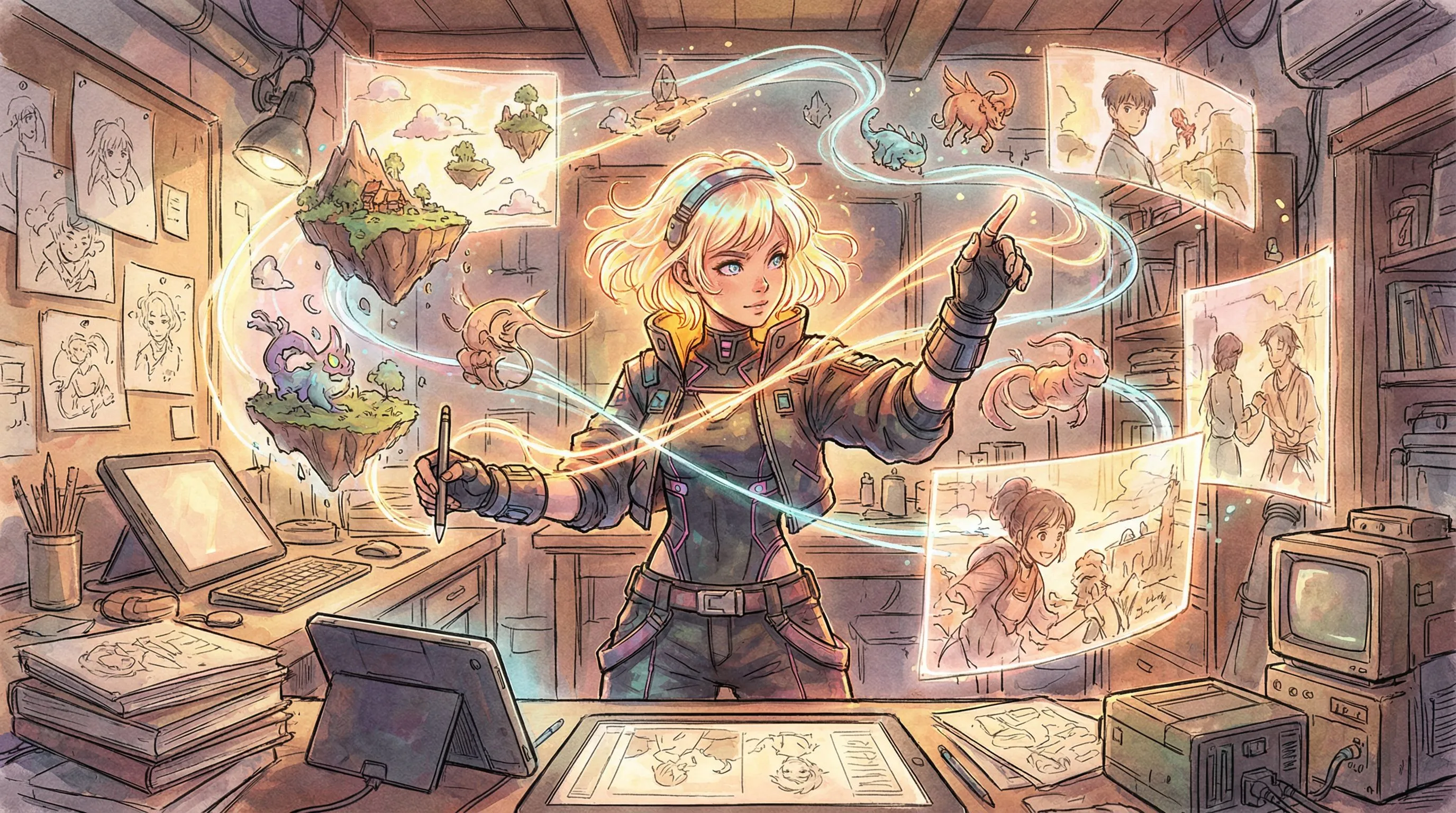
Visual novels sit at the intersection of five creative disciplines — narrative writing, character illustration, background art, music composition, and game engine scripting — all unified under a single artistic vision. That combination has made them one of the most rewarding forms of interactive entertainment to experience, and one of the most punishing to create.
The audience, however, has never been more ready. The global visual novel games market was valued at $9.4 billion in 2025** and is projected to reach **$21.8 billion by 2034, growing at a CAGR of 9.8% (Dataintelo). The broader interactive fiction market is expanding from $4.3 billion in 2025 to $7.8 billion by 2032 at a 12.0% CAGR (Accio). Mobile platforms now account for 38.6% of visual novel revenue, and the genre is diversifying far beyond its Japanese origins into mystery, horror, sci-fi, and hybrid formats appealing to global audiences.
Yet solo creators and small studios — the people driving most of the innovation — still face a brutal production equation. A modest visual novel with five characters, twenty backgrounds, and original music can exceed $5,000–$15,000 in art and audio alone before a single line of code is written (SEELE AI). The writing demands are staggering: a typical visual novel contains 50,000–300,000 words of dialogue, narration, and branching paths. And character consistency — keeping your protagonist's voice, appearance, and personality coherent across dozens of scenes and multiple routes — remains the single biggest technical barrier.
Jenova's Creative Fiction Writer is the AI visual novel maker built for this exact problem: crafting branching storylines, maintaining character voice across sessions, and producing scene-by-scene scripts with the persistent memory that visual novel development demands. Paired with the Roleplay Game Master for interactive playtesting and the Manga Creator for character art, it gives solo developers a production pipeline that would have required a full team eighteen months ago.
Quick Answer: What Is an AI Visual Novel Maker?
An AI visual novel maker is a tool that uses artificial intelligence to help creators build interactive fiction — generating branching narratives, character dialogue, decision trees, and scene scripts without requiring traditional coding or game engine expertise.
- Design branching narratives with multiple routes, endings, and decision points using Creative Fiction Writer
- Playtest routes interactively to discover plot holes and pacing issues before your audience does with the Roleplay Game Master
- Generate character sprites and CG scenes with consistent visual identity using the Manga Creator
- Craft optimized image prompts for AI art tools with reusable character identity blocks using the Prompt Generator
The Problem: Why Making Visual Novels Is Still So Difficult
The demand is proven. The tools for playing visual novels are everywhere. But the tools for creating them still leave independent developers stranded between ambition and execution.
The Five-Discipline Barrier
"Visual Novels are often considered the culmination of creative art, combining narrative prose, digital art, music, voice acting and software engineering into a single, cohesive work of art." — SEELE AI
A single visual novel requires competence in narrative writing, character illustration, background art, music composition, and game engine scripting — simultaneously. Solo creators typically possess expertise in one or two of these disciplines. The rest requires either hiring contractors, spending months learning new skills, or compromising on quality in ways that readers immediately notice.
Writing at Scale Breaks Every AI Tool
A visual novel isn't a short story. It's a narrative architecture — 50,000 to 300,000 words across multiple branching routes where every choice needs to produce consequences that feel meaningful. General-purpose AI writing tools lose character details within a few thousand words. As one 2026 analysis confirmed: "The biggest limitation of early AI writing tools was that they forgot what they'd written. Characters would change names, plotlines would contradict themselves, established facts would be ignored" (Storique via Jenova). For a format that requires a character to sound the same in Chapter 1's common route and Chapter 15's true ending, this is disqualifying.
Character Art Consistency Remains the Hardest Visual Problem
Your protagonist needs to look like the same person across 35+ sprite expressions, multiple outfit changes, and a dozen CG scenes. Traditional commissioning costs $200–$500 per character sprite set (SEELE AI). AI image generation has made individual illustrations cheap, but maintaining identity consistency — the same face, the same proportions, the same style — across an entire project remains the deepest technical challenge in AI-assisted visual novel art.
Branching Logic Is Deceptively Complex
A visual novel with three decision points and two options each creates eight possible paths. A commercial-quality visual novel with ten decision points, relationship variables, and route-locking conditions creates hundreds. Ren'Py — still the industry standard engine — requires Python scripting knowledge to implement this logic. The writing is hard enough. The implementation doubles the workload.
Why Creative Fiction Writer Is the Best AI Visual Novel Maker
This is exactly what Creative Fiction Writer was built for.
Unlike general AI chatbots that lose context after a few scenes, or visual novel engines like Ren'Py that handle implementation but offer zero writing assistance, Creative Fiction Writer is a specialized storytelling partner designed for the long-form, branching, character-driven narrative that visual novels demand.
| Challenge | General AI Chatbots | Template VN Engines (Ren'Py, TyranoBuilder) | Creative Fiction Writer |
|---|---|---|---|
| Branching narrative design | Loses context across branches | Manual scripting required | AI-architected with persistent plot tracking |
| Character voice consistency | Drifts after a few scenes | Not applicable (no writing assistance) | Persistent character profiles across sessions |
| Story length | Context window limits | No writing help | Unlimited memory across sessions |
| Coding required | N/A | Yes (Python/scripting) | None — natural language |
| Decision tree logic | No structural awareness | Manual implementation | AI-designed consequence chains |
| Model flexibility | Locked to one model | N/A | GPT-5.4, Claude Opus 4.6, Gemini 3.1 Pro Preview |
Persistent Memory That Doesn't Forget Your Characters
The breakthrough that makes AI visual novel writing viable in 2026 isn't smarter prose generation — it's memory. The Creative Fiction Writer maintains persistent cross-session memory of your entire project: every character's personality, speech patterns, emotional state, relationship dynamics, and plot position. Return to your project days or weeks later and the AI writes dialogue that sounds like the same characters your readers have been following.
Define each character once — vocabulary, tone, verbal tics, emotional tendencies — and the agent tracks those profiles across every scene, every route, and every session. When characters evolve through story events, the AI tracks those changes with versioned voice profiles. Your formal aristocrat stays formal. Your sarcastic sidekick stays sarcastic. And when the trauma in Route B changes how a character speaks, that evolution persists.
Branching Narrative Architecture
Visual novels aren't linear stories — they're decision trees with emotional weight. Creative Fiction Writer understands branching structure natively: it tracks which choices lead to which consequences, ensures route-specific scenes don't contradict shared scenes, and maintains logical consistency across parallel storylines. Common route → character routes → true ending? The agent knows that pattern. Relationship variables that gate route access? It tracks those too.
Multi-Model Creative Flexibility
Different AI models write different genres better. You might use Claude Opus 4.6 for emotionally complex romance scenes, GPT-5.4 for tight mystery pacing, and Gemini 3.1 Pro Preview for dialogue-heavy slice-of-life chapters. Jenova lets you switch models mid-project without losing any context — every character, every plot thread, every decision variable carries over.
Example Prompts for Visual Novel Development
"I'm creating a mystery visual novel set in a 1920s boarding school. The protagonist is a scholarship student named Elara who discovers that students have been disappearing for decades. There are four main suspects — each with their own route. Help me design the branching structure: a common route for the first three chapters, then four character-specific routes that each reveal a different piece of the mystery, converging in a true ending that requires completing all four routes."
"Write the opening scene of Chapter 1. Elara arrives at Thornfield Academy on a rainy September evening. Establish the gothic atmosphere, introduce the headmistress (cold, precise, hiding something), and end with Elara finding a name scratched into the windowsill of her dormitory room — a name that matches a student who disappeared in 1987. Tone: literary gothic, not horror. Think Donna Tartt meets Danganronpa."
"Generate character profiles for the four route characters. Each needs: a public persona, a secret they're hiding, a connection to the disappearances, a distinctive speech pattern, and a relationship arc with Elara that progresses from suspicion to trust (or betrayal, depending on the route). Make them feel like real people, not archetypes."
Competitor Context
While tools like Ren'Py remain the industry standard for visual novel engine scripting, they provide no writing assistance — you still need to produce every word of dialogue and every branching path yourself. Dedicated AI VN platforms like Rosebud AI and SEELE offer end-to-end visual novel creation with integrated art generation and dialogue system implementation, reducing development time by up to 95% according to their internal benchmarks (SEELE AI). However, these platforms focus on building the game — not on producing the deep, consistent narrative content that makes a visual novel worth playing. The Creative Fiction Writer bridges this gap: it's the AI writing partner that produces the story architecture, character voices, and scene scripts your engine needs — whether you implement in Ren'Py, TyranoBuilder, or any VN platform.
Try Creative Fiction Writer free — no credit card required.
Related Agents You'll Also Like
Roleplay Game Master
The most effective way to playtest a visual novel before building it. Step into your protagonist's shoes and experience your branching narrative from the player's perspective — in real time. The Roleplay Game Master maintains your world state, character personalities, and decision consequences across sessions, letting you discover plot holes, pacing problems, and character inconsistencies before they reach your audience. For visual novel developers, this is the difference between planning a route and experiencing it.
- Unlimited persistent memory across sessions for complete world state tracking
- Perfect character consistency — no voice drift across long playtests
- Test "what if" scenarios for branching paths before committing to your script
Manga Creator
For creators who need visual assets alongside their narrative — character sprites, expression sets, CG scenes, and background illustrations. The Manga Creator handles character reference sheets with identity embedding for visual consistency across your entire project, multiple professional art style templates, and persistent project state tracking across productions of any length.
- Character reference sheet architecture with identity embedding for consistent sprites
- Expression and pose variation from locked character designs
- Persistent project state across full visual novel asset pipelines
Prompt Generator
When you need character sprites, backgrounds, and CG illustrations generated through external AI image tools, the Prompt Generator crafts structured prompts with reusable character identity blocks — ensuring your protagonist looks the same across every scene, outfit, and expression. Invaluable for maintaining visual consistency when using tools like DALL·E, Midjourney, or Stable Diffusion for your VN art assets.
- Character identity blocks for visual consistency across dozens of images
- Style-specific prompts for anime, semi-realistic, and painterly VN aesthetics
- Batch prompt templates for generating full sprite sets efficiently
Creative Fiction Writer + Film Screenwriter
For visual novel scripts that need cinematic pacing — particularly action scenes, dramatic reveals, and CG event descriptions — the Film Screenwriter brings a screenwriter's structural discipline to scene construction. Use it alongside Creative Fiction Writer when your VN leans more toward visual storytelling than prose-heavy narration.
- Dialogue-first scene construction for snappy, natural exchanges
- Act structure awareness for route-level pacing
- Visual direction notes for CG scene composition
How It Works: Building a Visual Novel With AI
Here's the complete workflow for developing a visual novel using Creative Fiction Writer as your narrative backbone — from concept to implementable script.
1. Define your world document and character bible.
Before writing a single scene, create a project foundation document. Include: the setting (time period, location, rules of the world), 3-5 sentences per major character (personality, speech patterns, secrets, relationships, visual description), your genre and tone reference points, and the overall story premise.
"Modern-day Tokyo. Supernatural mystery with romance subplots. Tone: Steins;Gate meets Persona 5 — playful surface, serious stakes underneath. Protagonist is a university student who discovers they can see 'echoes' of decisions people almost made."
Upload this as a knowledge base attachment so Creative Fiction Writer references it across every session.
2. Design your branching architecture.
Use the agent to map your route structure before writing any scenes. Define: the common route length, the number of character routes, the decision points that gate route access, and the ending conditions (including whether a true ending exists).
"Design a branching structure for a mystery VN. Common route: Chapters 1-4, introducing all five suspects. Three main routes, each locked behind a relationship variable threshold with one character. Each route reveals a different piece of the central mystery. A true ending unlocks after completing all three routes. Map the key decision points and what variables they affect."
3. Write scene by scene, route by route.
Generate each scene with your architecture as a guide. Creative Fiction Writer maintains your character profiles, plot state, and branching variables across sessions — so Chapter 12 of Route B still knows what happened in Chapter 3 of the common route.
"Write Scene 4-3: the protagonist confronts Yuki at the shrine after discovering the photograph from 1998. Yuki deflects with humor first, then gets defensive. End the scene with a choice: 'Press harder' (increases suspicion variable, opens investigation branch) or 'Back off' (increases trust variable, opens romance branch). Maintain Yuki's speech pattern from her character profile — informal, uses sentence fragments, avoids eye contact when lying."
4. Playtest routes with Roleplay Game Master.
Before finalizing your script, switch to the Roleplay Game Master and play through critical routes as if you were the player. Experience your decision points firsthand. Discover whether the pacing works, whether the emotional beats land, and whether the branching logic produces satisfying — not arbitrary — consequences.
5. Generate visual assets with Manga Creator.
With your script complete, use the Manga Creator to produce character reference sheets, sprite expression sets, and CG scene illustrations with consistent visual identity across your entire project.
6. Implement in your engine of choice.
Export your completed scripts — dialogue, narration, branching logic, variable conditions, and CG direction notes — and implement in Ren'Py, TyranoBuilder, Visual Novel Maker, or any engine you prefer. The AI eliminates the writing bottleneck that typically consumes 60–80% of visual novel development time.
Results & Use Cases
📚 The Solo Developer: From Concept to Playable Demo in Weeks, Not Months
Scenario: A solo developer wants to create a romance visual novel with three routes, seven characters, and a common route spanning five chapters — but has zero budget for a writing team.
Traditional Approach: Write 80,000+ words of branching dialogue alone. Spend months battling inconsistencies between routes. Burn out before finishing Route 2. Shelf the project.
With Creative Fiction Writer: Upload the character bible and route architecture once. Generate scene scripts chapter by chapter, with persistent memory ensuring characters sound the same across every route. The agent tracks relationship variables, flags contradictions between routes, and maintains the emotional arc the player expects. What would take six months of solo writing becomes achievable in weeks of focused collaboration.
🎭 The Mystery Writer: Branching Logic Without the Spreadsheet
Scenario: A developer is building a detective visual novel where the player collects evidence across ten investigation scenes, and the final accusation scene changes based on which clues were found. The branching logic has 40+ possible states.
Traditional Approach: Build a massive spreadsheet tracking every variable, every scene gate, and every conditional dialogue branch. Test manually by playing through every possible path. Miss edge cases. Players find broken routes post-release.
With Creative Fiction Writer: Describe the evidence system and accusation logic in natural language. The agent designs the variable architecture, generates conditional dialogue for each evidence combination, and produces scripts that account for edge cases. Playtest the critical paths through Roleplay Game Master before implementation.
📱 The Mobile-First Creator: Episodic VN Content at Scale
Scenario: A creator is producing a mobile visual novel released in weekly episodes, each with 5,000–8,000 words, two decision points, and a cliffhanger ending.
Traditional Approach: Write each episode from scratch, re-reading previous episodes to maintain continuity. Fall behind the release schedule by episode four. Readers notice the quality drop.
With Creative Fiction Writer: The agent's persistent memory maintains character profiles, relationship states, and ongoing plot threads across every episode. Generate each week's content with full awareness of everything that's happened before. Maintain the production pace your mobile audience demands without sacrificing consistency.
🌍 The International Creator: VN Conventions Without Years of Study
Scenario: A non-Japanese creator wants to produce a visual novel that follows authentic genre conventions — proper route structure, character archetype awareness, and pacing that matches audience expectations for the otome or mystery subgenre.
Traditional Approach: Study dozens of visual novels across sub-genres. Learn conventions through trial and error. Risk producing something that feels off to experienced VN players.
With Creative Fiction Writer: The agent understands visual novel conventions across romance (otome, BL, GL), mystery, horror, sci-fi, and slice-of-life. It knows common route structures, standard archetypes and how to subvert them, and the pacing expectations of each subgenre. Non-Japanese markets now represent a rapidly growing segment of total visual novel revenue, with North America and Europe showing significant demand (Dataintelo).
FAQ
What is an AI visual novel maker?
An AI visual novel maker is a tool that uses artificial intelligence to help creators build interactive fiction — generating branching narratives, character dialogue, decision trees, and scene scripts. Unlike traditional engines like Ren'Py that handle implementation but not writing, an AI visual novel maker like Jenova's Creative Fiction Writer handles the narrative development itself — producing the story content your engine then presents to players.
Do I need coding skills to make a visual novel with AI?
No coding skills are required for the narrative development phase. Creative Fiction Writer produces complete scene scripts, branching logic descriptions, and character dialogue through natural language conversation. You'll still need a visual novel engine (Ren'Py, TyranoBuilder, or a platform like Rosebud AI) to implement the final playable product — but AI eliminates the writing bottleneck that typically consumes 60–80% of development time.
How does AI maintain character consistency across a 100,000-word visual novel?
Creative Fiction Writer uses persistent cross-session memory to maintain character profiles — personality traits, vocabulary, speech patterns, emotional tendencies, and relationship dynamics — across every scene and every route. Unlike general chatbots that lose context after a few thousand words, it remembers your entire project. Return weeks later and the AI writes dialogue that matches the character voice you established on day one.
Can AI-generated visual novel scripts actually be good?
AI narrative generation in 2026 is genuinely capable of producing stories with consistent characters, proper pacing, and prose that reads naturally. However, the best results come from treating AI output as a collaborative first draft — you provide creative direction, canon knowledge, and emotional intent; the AI handles volume, structural consistency, and the branching complexity that makes visual novels so demanding to write manually.
What visual novel genres does the AI handle?
Creative Fiction Writer handles all major visual novel genres: romance (otome, BL, GL, hetero), mystery/detective, horror/psychological thriller, sci-fi, fantasy, slice-of-life, and hybrid formats. The visual novel market is expanding well beyond traditional romance into action, horror, and mystery subgenres (Dataintelo), and the AI understands the conventions, pacing, and audience expectations of each.
How much does Jenova cost for visual novel development?
Jenova offers a free tier with all core features and limited usage. For developers working on larger projects who need extended sessions, paid plans start at $20/month — with no restrictions on which agents or AI models you can access. Every plan includes persistent memory, unlimited chat history, and full access to Creative Fiction Writer, Roleplay Game Master, Manga Creator, and the complete agent library.
Conclusion
The visual novel market is on a trajectory from $9.4 billion in 2025 to $21.8 billion by 2034 — one of the fastest-growing segments in interactive entertainment. Mobile platforms account for 38.6% of revenue, the genre is diversifying globally, and AI-powered tools have reduced production timelines by as much as 95% for asset generation. But the narrative — the 50,000 to 300,000 words of branching, character-driven storytelling that makes a visual novel worth playing — remains the hardest part to produce and the part where most projects die.
Creative Fiction Writer gives you persistent memory across sessions, multi-model flexibility between GPT-5.4, Claude Opus 4.6, and Gemini 3.1 Pro Preview, and a narrative partner that understands visual novel structure — common routes, character routes, decision variables, and true endings. Playtest your routes interactively with the Roleplay Game Master. Generate consistent character art with the Manga Creator. Craft optimized visual asset prompts with the Prompt Generator.
Try Creative Fiction Writer free — no credit card required. Explore the full agent library at Jenova.