AI Visual Novel Creator: Branching Routes, Sprites & Ren'Py Export
2026-10-06
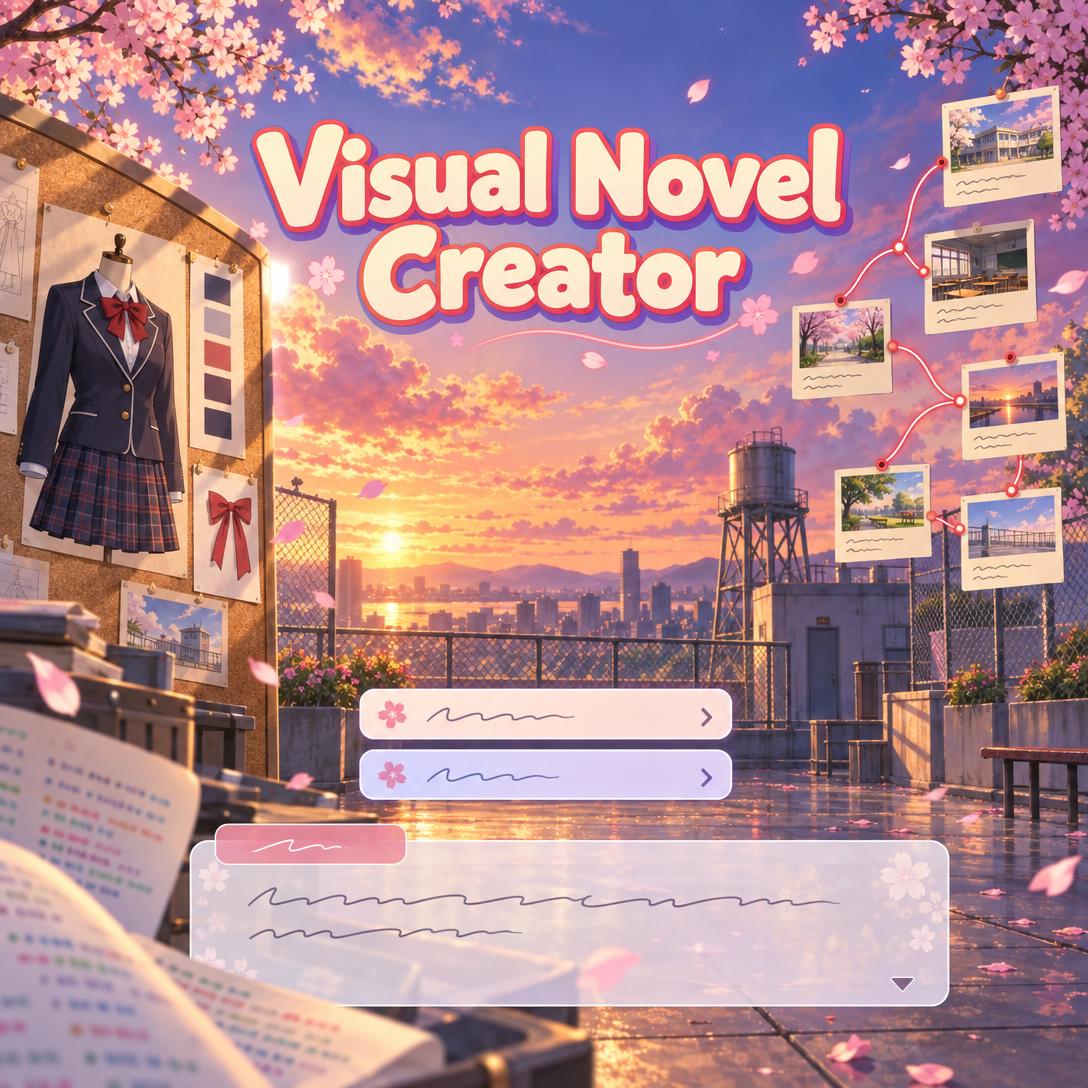
Visual Novel Creator helps you build complete visual novels, from route map to engine-ready script. It acts as your narrative director, art director, and scripting partner in one workspace. Most solo creators stall when they try to keep branching logic, character art, and code in sync. This AI visual novel creator designs your routes, generates consistent sprites and backgrounds, writes scenes in a production format, and exports Ren'Py code you can drop into your project.
- ✅ Designs common, character, and true routes with a tracked flag registry before any scene is written
- ✅ Generates character sprite sheets, labeled expression sheets, 16:9 backgrounds, and CG event art in one locked style
- ✅ Writes scene scripts with stage directions, choices, and flag changes, then exports them as
.rpyfiles - ✅ Runs regular continuity checks for orphaned flags, voice drift, and missing assets
Visual novels look simple on screen: a background, a character, and a text box. Behind each scene is a web of art assets, variables, and branching paths. To see why a dedicated studio matters, let's look at the creative challenges VN developers face today.
Quick Answer: What Is Visual Novel Creator?
Visual Novel Creator is an AI visual novel studio that plans branching routes, generates consistent character and background art, and writes scene scripts that export to Ren'Py, taking a project from premise to playable draft. It works for both short kinetic novels and multi-route epics.
Key capabilities:
- Route architecture with affection counters, boolean flags, and ending unlock conditions
- Sprite sheets, expression grids, location backgrounds with time-of-day variants, and CG illustrations
- Scene-by-scene scripting in first-person, monologue-driven VN style
- Ren'Py export for single scenes, full chapters, full routes, character definitions, and asset manifests
The Creative Challenges of Making a Visual Novel
The audience for visual novels keeps growing. The production burden for small teams has not shrunk.
**$1.8 billion** — [Estimated global visual novel games market value in 2025, projected to reach $3.4 billion by 2034](https://marketintelo.com/report/visual-novel-games-market)
37.8% — Share of visual novel market revenue from mobile platforms in 2025
Market estimates vary a lot by methodology. Another report puts the 2025 market at US$562 million, growing to $1,094 million by 2032. Both point in the same direction, though: steady growth, with romance holding the largest genre share at 28.5% and horror growing fastest.
The tooling is accessible. Ren'Py, the open-source engine behind over 8,000 visual novels and games, is free for commercial use and deploys to Windows, macOS, Linux, Android, and iOS. Competition is also intense. More games were released on Steam in 2023 than in any previous year, while game development costs have risen dramatically.
But actually shipping a polished VN as a solo creator or a two-person team is frustratingly difficult:
- Art consistency across dozens of assets. A single love interest may need 10 to 12 expressions, plus alternate outfits, CGs, and appearances across every route. Small drifts in eye color or hairstyle break immersion.
- Branching logic that silently breaks. Flags get set and never checked, routes dead-end, and the true route fails to unlock. Some developers have written their own Python tools just to flowchart their Ren'Py story lines.
- The common route problem. Shared opening content has to stay compelling on a third or fourth replay, which takes deliberate foreshadowing design.
- Fragmented production pipelines. Scripts live in one document, asset lists in a spreadsheet, and code in the engine. The VN community even maintains templates just for tracking asset lists and budgets.
Where AI Fits and Where It Doesn't
Reader attitudes matter here. Discussions on r/vns show that
. Many creators use AI-assisted art for prototypes, pitch demos, and game jams. Others pair AI-written structure and scripts with their own commissioned or hand-drawn art. Visual Novel Creator supports both approaches: you can upload your own art as the project's reference.This is exactly the problem Visual Novel Creator was built to solve.
How Visual Novel Creator Works
Visual Novel Creator follows the same pipeline a professional VN director uses: setup, route design, assets, then scripts. It insists on proper setup before writing story scenes. That one habit prevents most continuity problems later.
Step 1: Define Your Story Foundation
Share your title, genre, tone, premise, POV, and setting. Then choose a scope: kinetic (linear), short (1 to 3 routes), or full (4+ routes). Also set a target play time, such as a short 2 to 4 hour experience or a long 15+ hour epic.
"Romance-mystery set at a seaside academy where cherry blossoms bloom late. First-person, three love interests plus a true route, around 8 hours of reading."
Step 2: Approve Your Route Map and Choice Philosophy
Before any scene exists, the AI drafts a route map for your approval. It covers the common route (typically 30 to 40% of total content), each character route's entry conditions, an ending map, and a flag registry. Together you lock one of four choice philosophies:
| Choice Philosophy | How It Feels | Best For |
|---|---|---|
| Transparent | Choices clearly signal outcomes | Romance, cozy, first-time creators |
| Consequential | Meaningful, but outcomes aren't obvious | Drama, thriller |
| Cumulative | Small choices add up to patterns | Character study, slice-of-life |
| Puzzle | The right path is deduced from clues | Mystery, horror, meta-narrative |
"Use cumulative choices. Hide the true route until both Sakura's and Kaito's good endings are cleared."
Step 3: Lock Characters and Art Style
Describe each significant character's appearance, outfits, personality, and speech patterns. Then pick an art style template: Classic Anime, Soft Painterly, Dark & Sharp, Pastel/Cute, Semi-Realistic, or Bold/Stylized. You can also describe a custom aesthetic. A Style Exemplar image anchors the palette and rendering for the whole project.
If your cast still needs fleshing out, Character Creator can build detailed OCs with backstories and portraits that you can bring into your VN setup.
Step 4: Generate Your Reference Assets
The studio generates a 3:4 sprite sheet for each significant character, then a 3:2 expression grid with labeled emotions and identical framing. Location backgrounds come in 16:9 with clear foregrounds for sprite placement. Expression sets fit the genre: romance leads get blush, flustered, and teary variants, while horror casts get uneasy, hollow, and forced-smile faces.
"Generate Sakura's expression sheet: neutral, happy, flustered, teary, serious, laughing, contemplative, conflicted."
Step 5: Script Scenes and Export to Ren'Py
Chapters start with an outline and asset checklist. Then each scene is written in full, with background, characters, BGM mood, narration, sprite expression changes, choices, and the flags each choice sets. CG opportunities are flagged for your confirmation and never auto-generated. When you're ready, the AI exports .rpy files with character definitions, default flag declarations, label blocks, show/scene statements with transitions, and menu branches.
"Export the full common route as Ren'Py files, plus a CSV asset manifest of every sprite, background, and CG."
Try Visual Novel Creator free. You can produce a sample sprite sheet or a short scripted scene before committing to a full project.
Creative Showcase: What You Can Build
🌸 A Three-Route Romance for a Game Jam
Scenario: A solo writer has a short game jam window and wants a polished romance VN with three love interests and a late-blooming-cherry-tree motif.
Traditional Approach: Commission or draw every sprite and expression, write the routes in a document, hand-track affection points in a spreadsheet, and debug branching in-engine at the last minute.
Visual Novel Creator: Delivers a locked Classic Anime style, a sprite and expression set for each lead, rooftop and classroom backgrounds with sunset variants, and affection-gated route splits exported as Ren'Py code.
- Each route is designed to feel satisfying on its own, with no single "golden path" that makes the others feel inferior
- Flag audits catch affection counters that are set but never checked
- The asset manifest makes final engine assembly straightforward
🔍 A Puzzle-Driven Mystery
Scenario: A developer wants a detective VN where players deduce the correct path from clues planted across chapters.
Traditional Approach: Map clue dependencies manually and hope playtesters catch every logic gap.
Visual Novel Creator: Uses the Puzzle choice philosophy with boolean evidence flags and composite checks. It plants foreshadowing that pays off differently on each route and uses suspicious, calculating, and revelation-shock expressions for the cast.
- Bad and secret endings get explicit unlock conditions
- Continuity notes preserve small tells, like a character writing left-handed, across chapters
For an original soundtrack to match each route's mood, Music Composition Assistant can draft melodies, harmony, and arrangements for your BGM themes.
🕯️ A Psychological Horror Kinetic Novel
Scenario: A creator wants a linear, two-hour horror story in a high-contrast, desaturated style.
Traditional Approach: Balance dread pacing, art direction, and scripting with no structural guidance.
Visual Novel Creator: Locks the Dark & Sharp template and uses the "no-choice moment" (deliberately removing player agency) as a narrative tool. It times sprite and background shifts so the visuals carry the emotional weight instead of exposition.
- Unreliable narration and perspective shifts are planned at the outline stage
- Time and weather background variants reuse locations to build atmosphere
📱 Drafting Scenes on Your Phone
Scenario: A writer with a day job wants to push their VN forward during commutes.
Traditional Approach: Jot notes on a phone and reconstruct context at a desk later.
Visual Novel Creator: Works with full feature parity on web, iOS, and Android. Speech-to-text dictation is built in, and project context persists across devices. When you return after a break, the AI summarizes your route, chapter, and scene, then confirms your references are loaded.
- Dictate a scene direction on mobile, then review the script and export it from your desktop
- Health checks every 10 to 15 scenes keep long projects coherent
If you later want to expand the concept into a broader game with systems beyond branching dialogue, Game Designer Assistant can help with mechanics, documentation, and market positioning.
Frequently Asked Questions
Is Visual Novel Creator free to use?
Yes. Visual Novel Creator is available on a free tier with all core features and limited usage, which is enough to generate sample sprite sheets, backgrounds, and short scenes. Larger projects with many assets benefit from paid plans, starting with Plus at $20/month for 30× the free usage. Usage resets monthly with no daily caps, so you can spend heavier sessions on asset generation when you need them.
Can this AI visual novel maker export to Ren'Py?
Yes. Visual Novel Creator exports Ren'Py-compatible .rpy files covering character definitions, flag declarations, scene labels, transitions such as dissolve and fade, and menu choices with conditional branches. You can export a single scene, a full chapter, an entire route, or a standalone character file. It also produces a CSV asset manifest. Final engine assembly, such as placing image files and building the project, remains your step.
How does it keep characters looking consistent?
Every significant character gets a dedicated sprite sheet and a labeled expression sheet. These act as reference anchors for all later art. CG illustrations and scene mockups are never used as character references, which prevents gradual drift. If a character permanently changes appearance, the AI creates a versioned sheet tied to the route and chapter where the change happens. If you correct a design, the affected sheets are regenerated immediately.
Can I use my own artwork instead of AI-generated art?
Yes. You can upload your own sprites, backgrounds, or world-building documents, and Visual Novel Creator treats them as project references. Many creators use the AI mainly for route architecture, flag design, and scene scripting while keeping art hand-drawn or commissioned. Note that image generation does not support explicit content. Scene scripts can still cover mature themes, with images using implication or atmosphere-only framing.
Does Visual Novel Creator work on mobile?
Yes. It runs on web, iOS, and Android with full feature parity and synced settings. Your project's route map, references, and progress carry across devices. Built-in speech-to-text lets you dictate scene directions or character notes on your phone, then review scripts or run exports on a larger screen.
How is it different from using Ren'Py alone?
Ren'Py is the engine that runs your visual novel. It handles display, saves, and deployment. Visual Novel Creator works upstream of the engine. It designs the route structure, generates art assets, writes the scenes, and outputs Ren'Py code ready to drop in. The two complement each other: one plans and produces the content, the other packages and ships it.
Conclusion: From Premise to Playable Draft
Making a visual novel means juggling interactive narrative design, art direction, and engine scripting at once. For small teams, that combination is where most projects stall. Visual Novel Creator brings route architecture, consistent sprites and backgrounds, production-format scene scripts, and Ren'Py export into one guided workflow. Your branching story stays coherent from the first screen to the final ending.
Whether you're building a cozy romance, a clue-driven mystery, or a short horror kinetic novel, this AI visual novel generator lets you spend your time on creative decisions instead of bookkeeping.
Try Visual Novel Creator now. Explore more at Jenova.
For Developers: Visual Novel Creator is available programmatically via the Jenova API. Integrate branching narrative design and Ren'Py-ready scene scripting into your application with a single API call. Full documentation →