AI Visual Novel CG Generator: Event Art That Matches Your Cast
2026-09-14
Graphic Designer helps you generate visual novel CGs by turning a scene brief, character sheet, and emotional beat into finished event art. While sprites can be reused across hundreds of lines, CGs are the one-off illustrations that sell a confession, a betrayal, or a platform goodbye—and they are usually the first budget item a solo author cuts.
✅ Event CGs that match cast, palette, and lighting ✅ Solo portraits, group scenes, and route-end key art ✅ Fast revision when a rewrite changes pose or staging ✅ Built for indie VN authors and lean narrative teams
As of September 2026, more visual novel teams are shipping with smaller art crews and tighter illustration budgets. To understand why a dedicated visual novel CG generator matters, look at where event art actually stalls.
Quick Answer: What Is a Visual Novel CG Generator?
Graphic Designer is an AI visual novel CG generator that turns scene briefs and character notes into finished event illustrations you can drop into a gallery or route beat. It is built for key art, not random anime stills.
Key capabilities:
- Event CGs staged around a specific line, choice, or ending
- Group compositions that keep every heroine on-model
- Lighting, wardrobe, and palette locked to your existing sprites
- Revision passes when a route rewrite changes the emotional beat
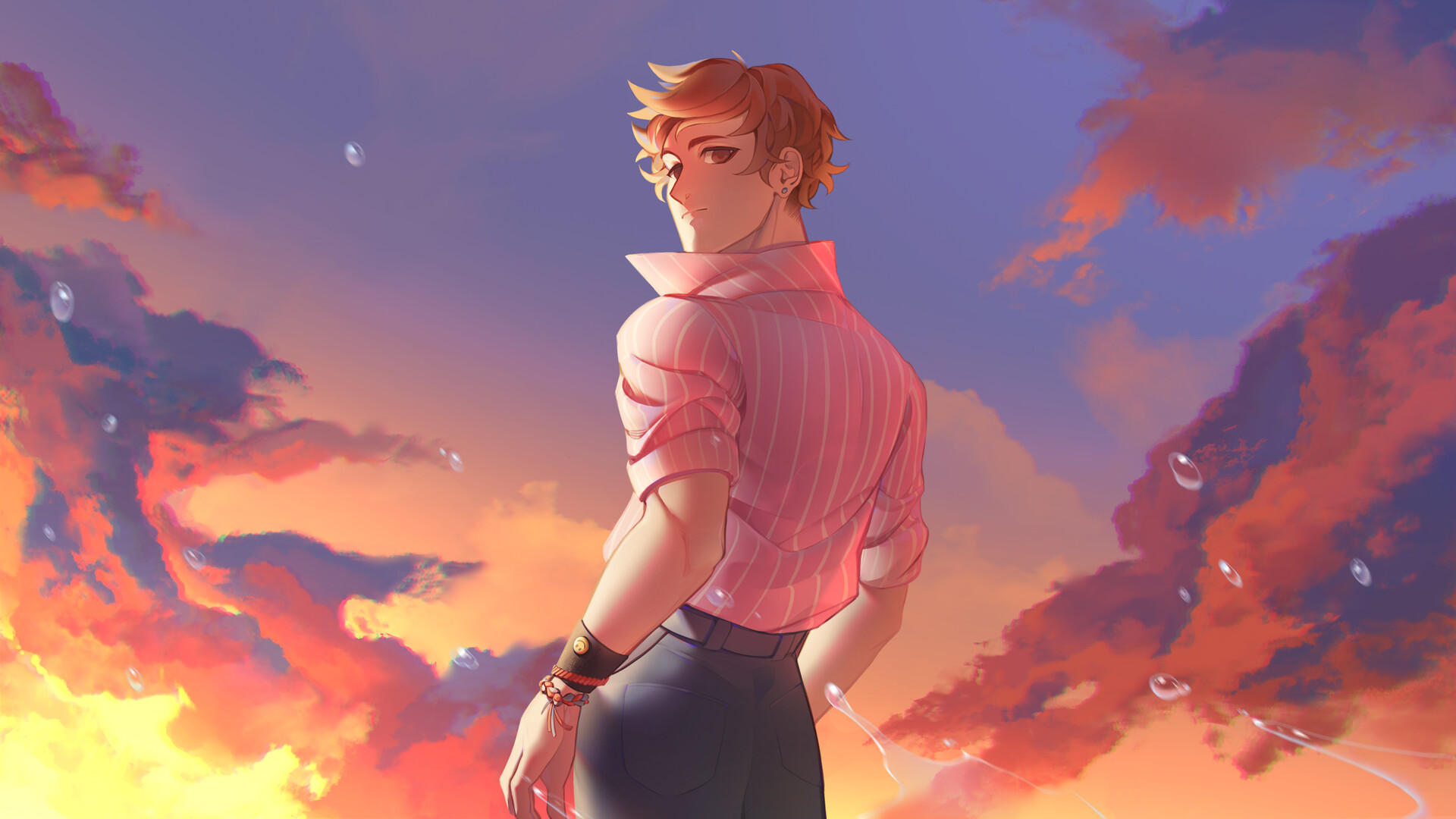
A pretty portrait of your protagonist is concept art. A framed look-back at sunset that lands on the exact line the player just chose is a CG. Visual novels live or die on that difference.
Why Visual Novel CGs Stall Production
Event CGs are the most expensive pictures in a VN for a simple reason: they cannot be reused. Sprites, backgrounds, and UI tile across the whole script. A confession CG, a station farewell, or a route-end group shot exists for one beat—and players notice when it is missing.
That cost lands hardest on self-funded teams. Industry surveys show studios and hobby authors are being asked to ship cinematic presentation with fewer specialists:
Half of all developers — are self-funding their games
1 in 10 — developers reported being laid off in the past year
1 in 3 developers — now use generative AI to streamline game development
Art is still the line item that breaks the budget. One documented hour-long indie visual novel spent nearly three thousand dollars on art alone and still could not afford a full CG set:
$2,985 — art cost for an hour-long visual novel, with CGs explicitly deferred
$150 — price of a single unlockable special scene when a full CG was out of reach
Commercial rates make the gap wider. Work that might cost about $100 as a personal commission often jumps once the image will ship in a paid game:
$300–$500 — typical commercial rate for artwork that was ~$100 for personal use, often 3× and sometimes 5×
But commissioning or generating a usable visual novel CG is frustratingly difficult:
- Generic image models produce striking faces that do not match your sprites
- Group CGs drift hair color, ear shape, and wardrobe across the same cast
- Route rewrites force a full re-illustration instead of a pose or lighting pass
- Steam-facing presentation now competes with a flood of new VN releases
Sprites and CGs Are Different Jobs
A sprite is a reusable actor. A CG is a directed still: composition, camera height, background storytelling, and the one expression that sells the line. Testing against real VN galleries shows why a random anime generator fails—players compare the CG to the sprite standing in the same scene two clicks earlier.
Character Drift Kills Immersion
If the heroine’s eyes change between the school-gate sprite and the rooftop CG, the player leaves the scene. Hair length, accessories, species traits, and outfit layers have to survive every event illustration, including crowded platform shots and quiet over-the-shoulder portraits.
Indies Carry the Art Load Themselves
When half the industry is self-funding, the writer is frequently also the art director. They need a CG the same week a route ending is rewritten, not a four-week illustration cycle they cannot pay for.
~7 new visual novels a day — volume of VN releases players see on Steam
More releases raise the presentation bar. They do not magically fund a CG artist. This is exactly what Graphic Designer was built for.
Why Graphic Designer
Graphic Designer treats the visual novel CG as a directed illustration: locked cast, locked palette, and a composition that serves one story beat. It is a standalone event-art studio for people who have to show the scene before they can afford a full CG pipeline.
| Traditional Approach | Graphic Designer |
|---|---|
| Wait on a CG artist or ship without event art | Generate a scene-ready CG from a brief in one working pass |
| Personal commissions that jump 3× for commercial use | Iterate event art without restarting a paid illustration cycle |
| Isolated anime portraits that do not match sprites | Character, wardrobe, and lighting notes carried into the frame |
| Group shots that drift hair, ears, and outfits | Multi-character staging with on-model constraints |
| Full re-paint when a route ending changes | Revision pass on pose, camera, and emotional beat |
The value is not “an anime picture of your characters.” The value is a CG a writer, programmer, or publisher can argue with productively—because the beat, the cast, and the camera are specific.
Event Composition, Not Random Portraits
Describe the CG the way a VN director talks: who is in frame, where the camera sits, what the player is not allowed to see yet, and which line the image must land on. The output should read as gallery art, not a character-select splash.
"Visual novel event CG, 16:9, no UI. Protagonist with tousled reddish-brown hair looks back over his shoulder at a sunset of orange and purple clouds. Pink pinstripe shirt, dark trousers, wrist bracelets, floating light motes. Melancholic route-end beat, anime illustration, painterly sky."
On-Model Cast, Including Group CGs
Call out hair, eye color, species traits, uniforms, and bags the same way your sprite sheet does. If three heroines share a platform, name each one and freeze the details that must not drift.
"Finished visual novel CG: three heroines at a train platform. Foreground silver-haired cat girl with blue eyes, light blue jacket, wink, reaching toward camera. Midground blonde twin-tails with dog ears and navy blazer. Rear pink-grey cat girl, red plaid scarf, messenger bag. Soft sparkles, kawaii anime lighting, match existing sprite palette."
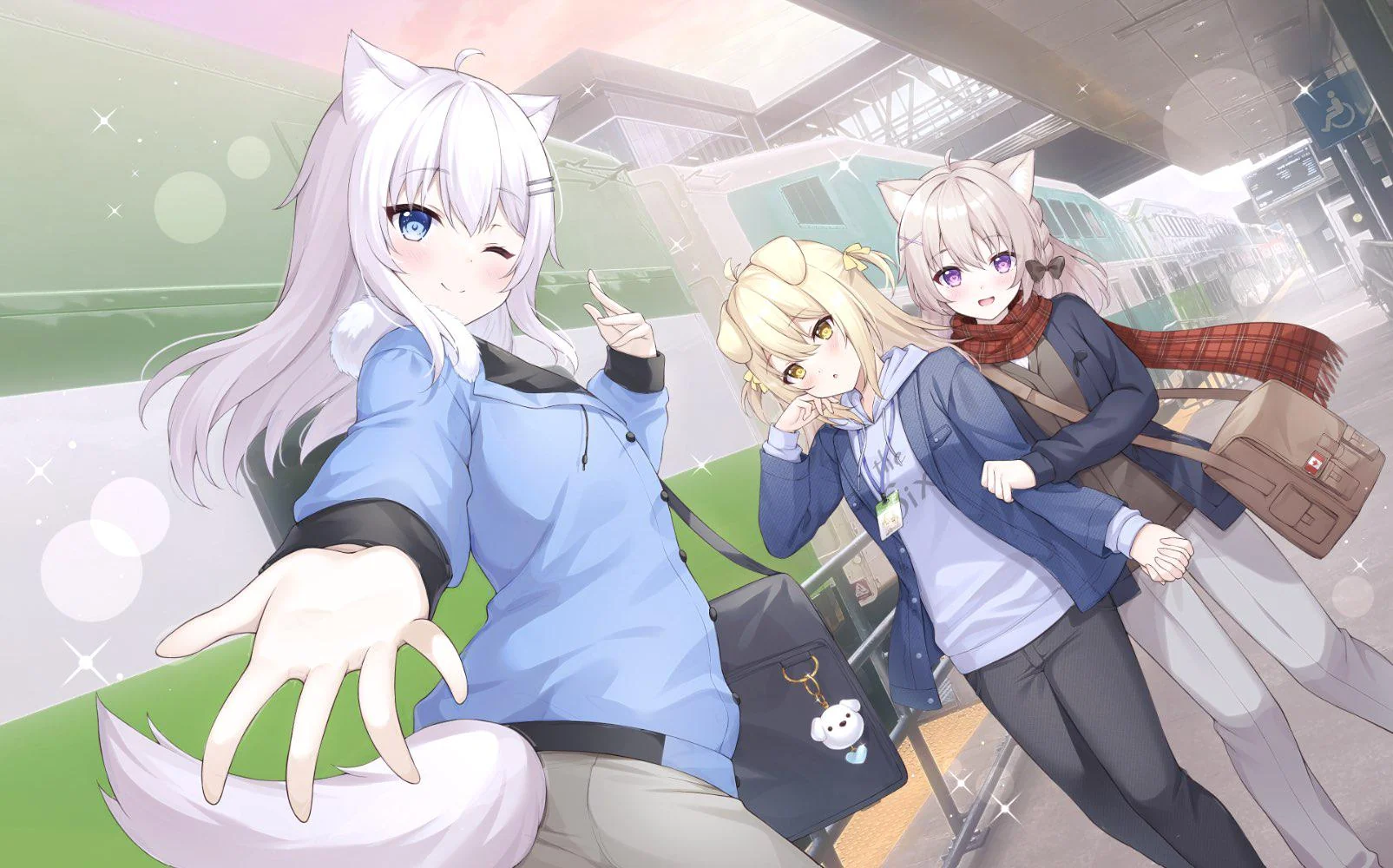
Group CGs fail when the generator treats the crowd as three separate portraits pasted together. A usable visual novel CG generator has to stage depth, eyelines, and shared lighting in one frame.
Lighting That Serves the Route
Confession scenes want warmth. Betrayals want hard contrast. Endings often want that last look-back against a sky the player will remember in the gallery. Specify time of day, rim light, and whether the background is a real location from your BG set or a stylized sky.
Generative tools are already inside production pipelines; the gap is using them for on-model event art rather than one-off spectacle.
90% of games developers — already using AI in their workflows
89% of developers — report that AI is changing what players expect
A CG that still looks like your game after the player opens the gallery is the illustration that matters.
Related Agents You'll Also Find Useful
If the CG still needs a tighter image prompt, a matching manga-style pass, or a design pass on how the scene sits in the game, these partners sit next to the illustration brief.
Manga Creator
When the visual novel should feel like a serialized manga—speed, acting, and character sheets that stay consistent across a long route—Manga Creator is the sequential partner. Use it to lock expressions and costume language before you generate the CG that players will screenshot.
- Character acting that survives from sprite to event art
- Style notes for anime line, screentone, or full-color polish
- Strong silent-beat staging when the CG carries the scene without VO
Prompt Generator
CG quality follows prompt discipline: shot size, wardrobe tokens, negative space for nametags, and “no UI.” Prompt Generator turns a messy scene note into a repeatable image brief you can reuse every time that heroine appears.
- Structured prompts for text-to-image models
- Token lists for hair, eyes, ears, and uniforms
- Refinement when a first pass drifts off-model
Game Designer Assistant
CGs are also design documents. If you are still deciding which choices unlock gallery art, how many event illustrations a route can afford, or whether a kinetic novel needs fewer, richer CGs, Game Designer Assistant sits on the systems side of the same production.
- Scope CGs against route length and budget
- Map event art to flags, endings, and gallery unlocks
- Keep presentation decisions aligned with genre expectations
Try Graphic Designer free — no credit card required.
How to Generate a Visual Novel CG
Step 1: Lock the Beat, Not Just the Characters Open the illustrator and paste the scene as it exists in the script: who is present, what just happened, and which line the image must sell. Name the route and the gallery title you would show in-game.
"Route B ending CG. After the last choice, he looks back from the cliff path. No other characters. The player should feel the missed confession, not action."
Step 2: Freeze On-Model Constraints Attach sprite notes the way a commissioner would: hair, eyes, height, ears, uniform layers, bags, and what must never change. If you have a reference sheet, describe it in the same pass.
"Same cast as school sprites. Silver hair to mid-back, blue eyes, white inner ears, blue jacket, khaki pants. Do not add new accessories. Keep the blonde’s ID lanyard."
Step 3: Direct Camera and Lighting Call the aspect ratio, camera height, and time of day. VN CGs are usually 16:9, with space at the bottom if you still composite a textbox, or full-bleed if the box hides.
"16:9, eye-level, sunset backlight, no textbox, no HUD, cinematic depth, painterly clouds, floating motes, gallery-ready."
Step 4: Generate, Then Interrogate Against Sprites Read the CG as a player who just saw the sprite. If the eyes changed, the ears vanished, or the jacket turned into a different garment, send a correction pass before you export.
"Revise: keep the wink and the reach, but restore the messenger bag and the red scarf. Platform stay, train stay. Softer sparkles, less glow on faces."
Step 5: Export for Engine and Gallery Save a clean still for Ren'Py, TyranoBuilder, or your custom ADV, plus a slightly tighter crop for Steam capsules and social stills. The CG should work as both an in-game event and a store screenshot.
Results & Use Cases
🎯 Confession CG on a Solo-Dev Budget
Scenario: A writer-programmer is finishing a kinetic novel. The script is done. There is money for sprites and four backgrounds, not for a CG artist.
Traditional Approach: Ship without event art, or pay $300–$500 commercial rates for a single illustration and hope the first pose is right.
Graphic Designer: A directed look-back CG—sunset, wardrobe locked, gallery-ready—produced from the scene brief the same day the line is locked.
- Presents a finished beat instead of a talking sprite against a sky
- Keeps the protagonist on-model with the standing sprite
- Gives the Steam page a still that is not just a menu screenshot
💼 Route-End Group CG for an Otome Cast
Scenario: Three heroines share a station farewell. The writer rewrote who reaches toward the player. Commissioning a new group illustration would slip the build.
Traditional Approach: Re-brief the artist, wait, discover the blonde’s bag is missing, wait again.
Event art plus Manga Creator: Lock acting and costume language, then generate the platform CG with named positions, shared lighting, and a revision pass on the reach.
- Multi-character staging without three mismatched portraits
- Costume continuity across the route
- Fast enough to survive a last-week script change
📱 Gallery Notes Between Playtests on Mobile
Scenario: A narrative designer is on a train after a playtest. Players said the ending CG felt “off.” They need a new brief before the evening art pass.
Traditional Approach: Memory, a notes app, and a desktop file that is not in sync.
The CG generator on phone: Dictate “colder light, keep the look-back, lose the sparkles,” generate a revised still, drop it in the production chat before the next build.
- Full briefing and revision on iOS and Android
- Faster than opening a desktop canvas for a lighting change
- Keeps the argument on the beat, not on when someone can draw
📊 Commercial Scope Without Pretending CGs Are Free
Scenario: A hobby team wants to sell on Steam. They now owe commercial licenses, a $100 Steam fee, and art that can survive reviews that say the CGs “feel off.”
Traditional Approach: Cut CGs entirely, then take the review hit for “just reading.”
Scoped event art: Two or three directed CGs at the choices that actually matter, generated and revised against sprites, instead of an empty gallery.
- Spend illustration effort on the beats players screenshot
- Pair with Game Designer Assistant so unlock flags match the art you can actually ship
- Keep commercial presentation without a full CG department
Even short visual novels are not cheap once you pay people. One transparent indie breakdown put a lovingly made hour-long title near ten thousand dollars once writing and programming time were counted—and CGs were still the luxury.
About $10,000 — estimated full cost of an hour-long indie visual novel on a shoestring budget
95% of developers — already using AI to automate repetitive tasks
Event illustration is repetitive in the production sense—same cast, new beat—and that is where a visual novel CG generator earns its keep.
FAQ
What is a visual novel CG generator?
A visual novel CG generator produces finished event illustrations from a scene brief so a team can show a confession, ending, or group beat without waiting on a full CG commission. Unlike a single random anime image, it is evaluated on whether the cast matches the sprites and whether the composition serves the line. Graphic Designer is built for that illustration job.
Is Graphic Designer free to use?
Yes. There is a free tier with core features and limited usage, and paid plans if you need more volume. You can generate a visual novel CG without a credit card. If you are illustrating every route ending in a sprint, a higher tier simply raises the monthly usage ceiling.
How is this different from a generic AI image generator?
Generic image tools optimize for a single impressive face. Visual novel CGs fail on the frames around that face: sprite-matched hair, shared lighting in a group shot, space for a textbox, and a pose that belongs to one script beat. A visual novel CG generator is evaluated on whether the still belongs in your gallery, not whether it would trend on an art feed.
Can it keep characters consistent across CGs?
It can if you freeze the constraints: hair, eyes, ears, uniform layers, and accessories in every brief. Pair a locked character sheet with Prompt Generator so the same tokens appear in every event illustration. Drift is a briefing failure more often than a style failure.
Does a visual novel CG generator work on mobile?
Yes. Brief the scene, generate the still, and send a lighting or pose revision from a phone or tablet with the same workflow as desktop. That matters when playtest notes arrive away from a drawing tablet and the ending CG has to change before the next build.
Can I use it for sprites, backgrounds, and CGs?
CGs are the primary job: directed, full-frame event art. You can also brief standing portraits and location stills, then keep wardrobe and palette aligned so the three asset types feel like one game. For route structure and how many CGs a build can support, bring in a game design partner before you generate a dozen endings you cannot implement.
Ship the Beat Players Will Screenshot
Visual novels go out looking unfinished when the first time anyone sees the confession is a talking sprite against a reused background. Self-funded teams, commercial art multipliers, and a crowded Steam calendar have made missing CGs more expensive, not less. A dedicated AI visual novel CG generator gives you on-model event art, group staging, and revision speed before you spend a commission you cannot redo.
Try Graphic Designer on the next route ending that is still a grey box in your gallery. Explore more at Jenova.
For Developers: Graphic Designer is available programmatically via the Jenova API — integrate visual novel CG generation into your art pipeline with a single API call. Full documentation →