AI Visual Novel: Design Branching Routes Without a Studio
2026-08-26
Game Designer Assistant helps you design a complete AI visual novel by turning a premise into route maps, choice logic, character bibles, and production notes you can take into any engine. While most solo creators stall on branching documentation, drifting tone, and art direction that changes between routes, this AI keeps the systems, story, and visual plan in one conversation. As of August 2026, visual novels remain one of the few game formats a single writer-designer can realistically ship—if flags, endings, and asset specs stay locked from the first scene.
✅ Maps multi-route stories, flags, and endings before you open an engine ✅ Writes scene outlines and choice architecture in your house style ✅ Produces character bibles, sprite specs, and CG shot lists ✅ Works across romance, horror, fantasy, sci-fi, and kinetic novels
To understand why this matters, look at what actually stops visual novel projects. The bottleneck is rarely the engine. It is the design work: keeping three romance routes coherent, deciding what a late-game flag should have unlocked in chapter two, and briefing art before you spend money on sprites you will throw away.
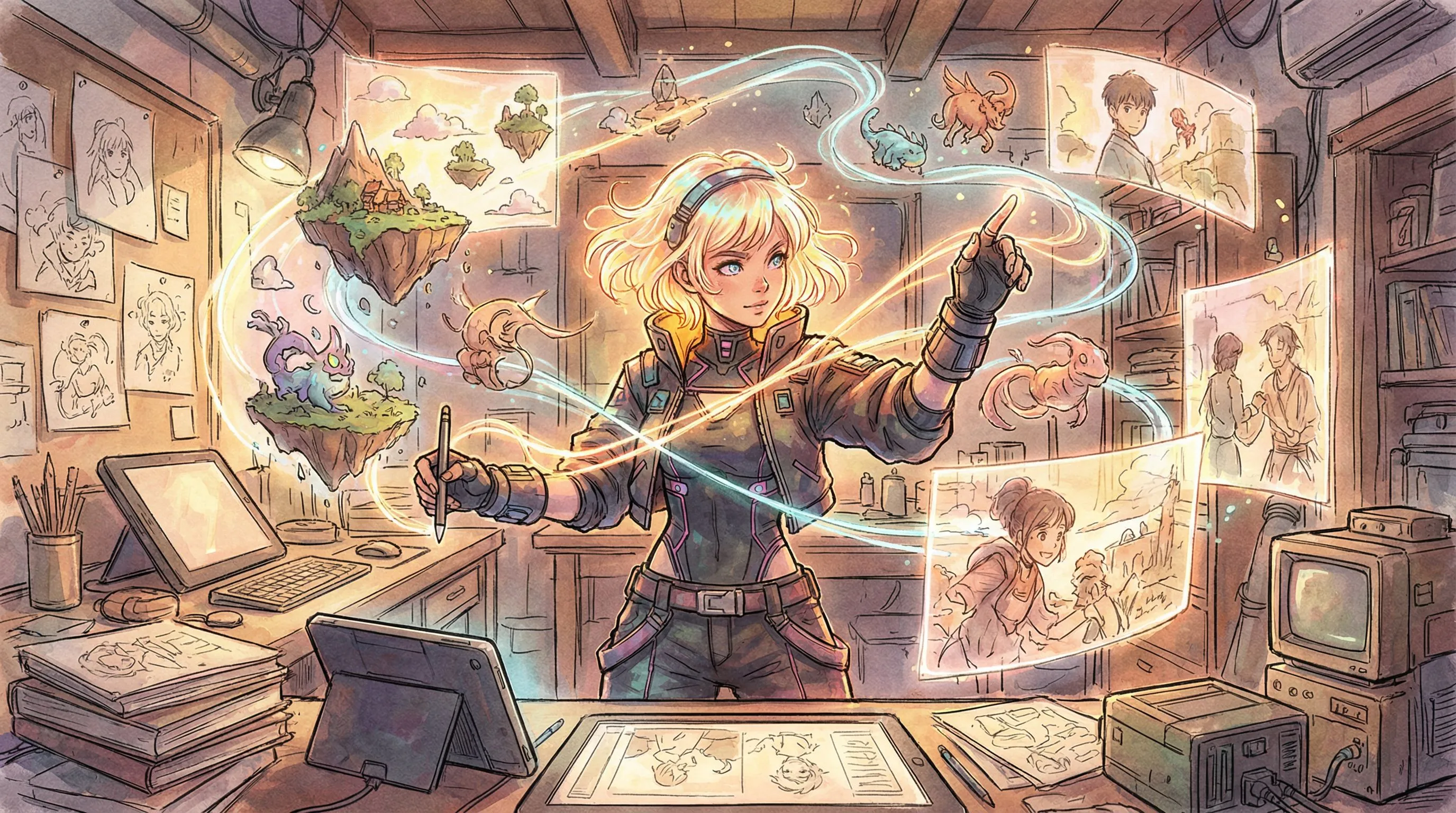
Quick Answer: What Is an AI Visual Novel?
An AI visual novel is an interactive, choice-driven story planned with AI for branching routes, dialogue, and character art direction so one creator can produce what used to require a small team.
Key capabilities:
- Route maps, flag logic, and multiple endings documented before implementation
- Scene outlines and choice architecture that stay consistent across playthroughs
- Character bibles, expression lists, and CG shot lists for sprites and backgrounds
- Genre-aware design notes you can hand to Game Designer Assistant, a writer, or an artist
Why Most Visual Novel Projects Stall
Demand for story-first games is not theoretical. Market researchers valued the visual novel category at $139 million in 2023, with a path to $620 million by 2031. A broader games-focused estimate puts the visual novel games market at $9.4 billion in 2025**](https://dataintelo.com/report/visual-novel-games-market). Interactive storytelling platforms more generally were valued at [**$4.8 billion in 2025.
Players want immersion. Getting a finished AI visual novel into their hands is still frustratingly difficult:
- Branching logic explodes after the second route
- Prose, sprites, and UI drift out of the same aesthetic
- Art spend happens before the story is locked
- Solo teams cannot afford a writer, director, and artist at once
$139 million → $620 million — Projected visual novel market size from 2023 to 2031, at an 8.5% CAGR
90% — Share of games developers already using some form of AI in their workflows
That last figure is the one to take seriously. Adoption is high. Trust is not. A SlashData survey of more than 2,000 developers found that 68% agree AI speeds production, while 52% also see a threat to creative originality. Visual novels are uniquely exposed to both sides of that split: they are text-heavy and modular enough for AI to help, and they fail immediately if every heroine sounds like the same chatbot.
Route Maps Collapse After Chapter Two
A kinetic novel can survive on a linear outline. A three-route romance cannot. Each choice needs a flag, each flag needs a later payoff, and each payoff has to feel authored rather than pasted. Spreadsheets break. Chat threads forget what the true end required. Creators rewrite chapter one four times because the common route was never specified.
Art Is Commissioned Before the Story Is Finished
Sprites, CGs, and backgrounds are the expensive surface of a visual novel. Commissioning a full expression set before you know which scenes exist is how budgets die. Verified Market Research notes that visual novels depend heavily on narrative quality and that high-end voice, music, and graphics do not automatically recoup. You need a locked shot list first.
Tone Drifts Across Routes and Endings
Players notice when the childhood-friend route is witty and the rival route is generic. They notice when a bad end moralizes in a different voice from the true end. Without a persistent bible—speech patterns, withheld secrets, visual motifs—an AI visual novel starts to feel assembled rather than directed.
Solo Developers Cannot Staff a Mini-Studio
Traditional production assumes a writer, a director, a sprite artist, and someone who understands engine logic. That is why so many promising premises never leave a notes app. This is exactly what this AI design partner was built for.
Why Game Designer Assistant
Game Designer Assistant treats your visual novel as a game system, not a pile of pretty paragraphs. You bring the premise, audience, and constraints. It returns route architecture, choice maps, documentation, and art direction you can implement in Ren'Py, Unity, Godot, or a commercial visual novel editor.
A Google Cloud and Harris Poll study found developers already use AI to automate repetitive work (95%) and for code and script support (44%). Eighty-nine percent say AI is changing what players expect from worlds and characters. The useful response is not “generate the whole game.” It is a design partner that keeps you in the director’s chair.
| Traditional Approach | Game Designer Assistant |
|---|---|
| Hire a writer, director, and artist separately | One design partner for systems, story structure, and art direction |
| Weeks to map a three-route flowchart | Route maps and flag logic in a single working session |
| Tone and secrets drift between routes | A living bible of speech patterns, flags, and visual motifs |
| Sprites and CGs commissioned before the plot is locked | Shot lists and expression specs before you spend on final art |
| Learn an engine before you have a story | Story and systems first; implement in any engine later |
Route Architecture Before Prose
Start with genre, platform, and how many endings you can actually produce. A Steam otome with three romance routes and a true end is a different machine from a two-hour horror kinetic novel. The assistant turns that brief into a common route, branch points, flag names, and a list of scenes that must exist for every path to resolve.
"I am making a 6–8 hour Steam otome set in a coastal conservatory. Three romance routes plus a true end. Map the common route, the earliest exclusive flags, and which CGs are route-locked."
Character Bibles That Survive Multiple Endings
Visual novels live or die on whether a character still feels like themselves on a bad end. You get speech tics, withheld information, visual motifs, and expression lists (neutral, soft smile, cracked composure) that a sprite artist can actually draw. That same bible is what keeps later chapters from inventing a new personality.
Choice Design With Consequences
A choice is not a quiz. It is a promise about who the protagonist is becoming. The assistant flags fake choices, delayed payoffs, and points where two options should feel morally expensive rather than statistically optimal. You leave with choice text, downstream flags, and notes on what the player should feel—not just what variable flipped.
Art Direction You Can Hand to an Artist
Concept-art notes, background palettes, sprite costume rules, and a CG shot list tied to scene IDs. You are not asking a model to “make anime.” You are producing a brief: three-quarter sprite, school-uniform variant, rain-soaked CG after the festival choice. That is the difference between generating noise and directing a look.
Related Agents You'll Also Find Useful
If you are building an AI visual novel, design is only one desk in the room. These partners cover the next steps most creators hit within the first month.
Writing Assistant
Once the route map exists, you still need lines that sound like people. Writing Assistant adapts to your narration style—spare horror, florid fantasy, or dry campus comedy—and stays useful for dialogue passes, inner monologue, and ending variations.
- Long-form route prose in a consistent voice
- Dialogue that matches each character bible
- Editorial passes when a common-route chapter runs long
Manga Creator
Most visual novel audiences arrive from anime and manga. Manga Creator thinks in faces, panel rhythm, and costume continuity—the same visual grammar you need for expression sheets and CG composition, even if you never draw a comic page.
- Character turnarounds and expression logic
- Scene staging that reads clearly as a still image
- Style rules so route CGs do not look like different series
Graphic Designer
Menus, logos, Steam capsules, and UI chrome are how players judge a visual novel before they read a line. Graphic Designer covers branding, illustration direction, and layout so the title screen matches the story you designed.
- Cover art and store-page direction
- UI and choice-box visual language
- Marketing assets that match the in-game palette
Try Game Designer Assistant free — no credit card required.
How to Design an AI Visual Novel Step by Step
Step 1: Brief the Premise and the Constraints
Open the design partner with genre, platform, playtime, audience, and how many endings you can finish. Constraints are the point. A 90-minute festival horror with one bad end is a shippable scope. An eight-route epic is not, until you prove the first two.
"Horror kinetic novel, ~90 minutes, PC and Steam Deck. One late choice, two endings. Japanese summer festival, no romance. I need a beat sheet and a CG list of 8 shots."
Step 2: Lock Characters Before You Write Chapter One
Ask for a bible: role in the plot, secret, visual silhouette, speech pattern, and the expressions you will actually commission. Do this before prose. A visual novel cannot recover from a heroine whose personality was invented in scene fourteen.
"Build bibles for a stoic shrine heir, a visiting photographer, and a local festival committee lead. Include secrets the player should not learn until the final hour."
Step 3: Map Routes, Flags, and Endings
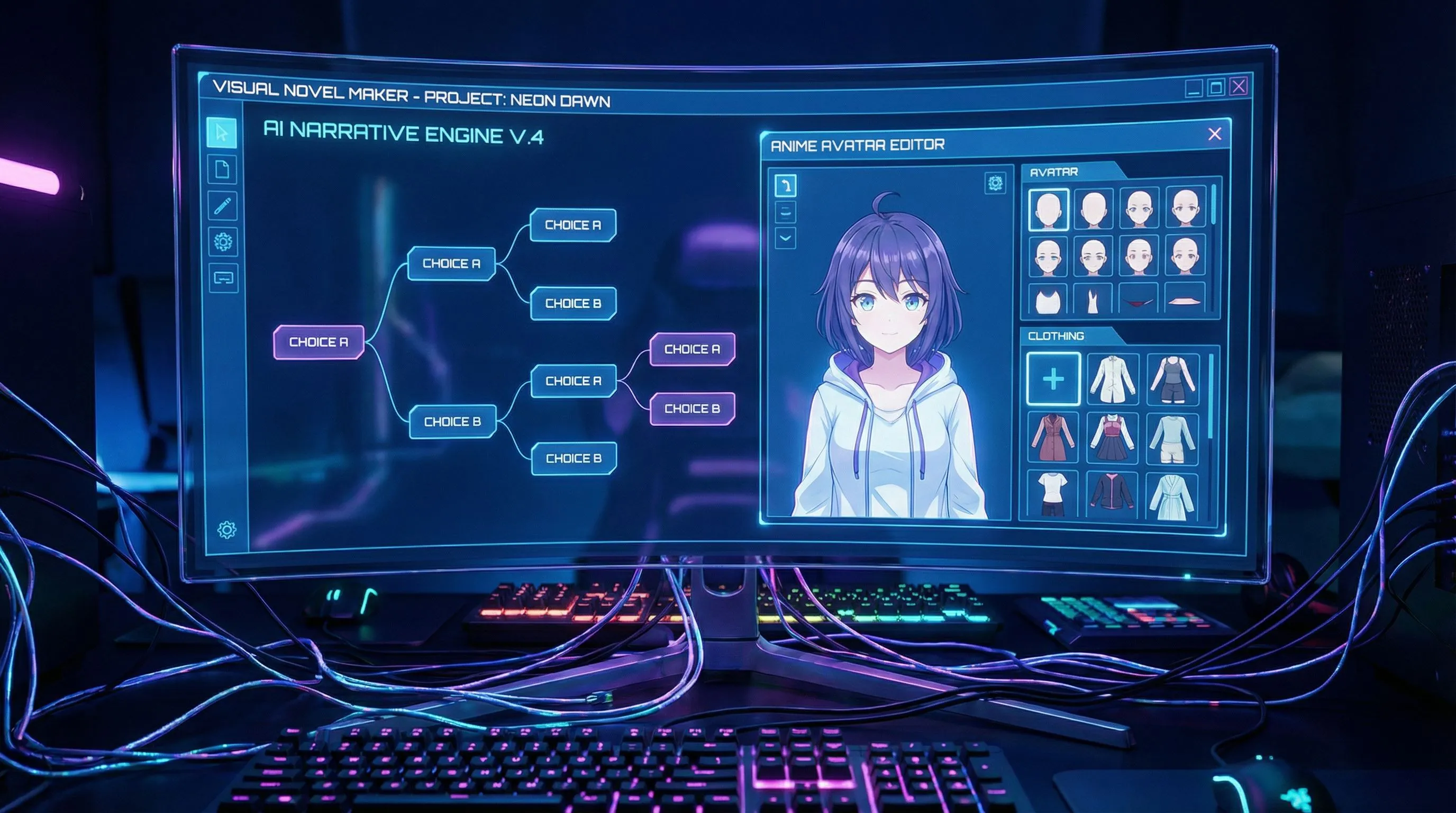
Have the assistant output a flowchart in plain language: common route chapters, exclusive scenes, flag names, and which choices are irreversible. Name flags like a programmer (met_photographer_night2) so they survive the jump into Ren'Py or Unity.
"Turn this beat sheet into flag logic. Mark irreversible choices. List scenes that must exist on every path and scenes that are route-exclusive."
Step 4: Draft Scenes and Choice Text
Write the common route first. Then exclusive scenes. Keep choices short, concrete, and costly. Move finished chapters to Writing Assistant if you want a voice pass without disturbing the flag map.
"Write the chapter-3 shrine scene. Two choices: stay and help close the stalls, or follow the photographer. Both must feel reasonable. Neither should telegraph the bad end."
Step 5: Produce the Asset List, Then Make Art
Export a production list: backgrounds by location and time of day, sprites by costume and expression, CGs by scene ID. Use that list with Manga Creator or Graphic Designer so you do not generate twenty versions of a hallway you never show.
"From the locked outline, give me a sprite sheet spec and a CG shot list with emotional purpose for each image. No extras."
Results & Use Cases
📊 Three-Route Steam Otome From One Writer
Scenario: A solo developer wants a coastal-conservatory romance with three love interests, a shared first act, and a true end that only unlocks after two routes.
Traditional Approach: Months of sticky notes, a writer for hire, and sprite commissions that start before the true-end conditions are known.
Game Designer Assistant: A flagged common route, exclusive scene lists, and a CG budget tied to what each route actually needs.
- True-end conditions specified before chapter one is drafted
- Expression lists limited to faces the story uses
- Dialogue voice maintained later with Writing Assistant
💼 Horror Kinetic Novel With a Late Branch
Scenario: A two-person team is targeting a festival-set horror story: mostly linear, one irreversible choice, two endings, heavy atmosphere.
Traditional Approach: Overbuilding a full branching engine for a story that only needs one hinge, then running out of art budget.
This design partner: A kinetic beat sheet, an 8-shot CG list, and notes on what the single choice must cost the player.
- Scope stays inside a jam or a short commercial release
- Backgrounds reused across day/night variants instead of new locations
- Visual motifs (paper lanterns, shutter clicks) specified once and repeated
📱 Route Fixes on a Phone Between Classes
Scenario: A student designer is commuting and realizes the rival route never pays off a promise from chapter two.
Traditional Approach: Wait until they are at a desktop, lose the thought, and ship a route that feels unfinished.
Game Designer Assistant on mobile: Voice or short text to reopen the bible, patch the flag, and draft the missing scene before the next stop.
- Works on web, iOS, and Android with the same project memory
- Choice text can be spoken, then cleaned into script format
- A Graphic Designer pass for the Steam capsule can wait until they are home
🎯 Forty-Eight-Hour Game Jam Visual Novel
Scenario: A jam team has a weekend, one writer, and one artist. They need a playable loop, not a franchise bible.
Traditional Approach: Half the weekend disappears into arguing about lore. The build is three rooms and a placeholder menu.
The AI visual novel workflow: A one-route outline, six backgrounds, four expressions, and a single ending written to the hour they actually have.
- Asset list cut to what the artist can finish
- Choices limited to two meaningful hinges
- Implementation starts on day one, not after a 20-page world document
FAQ
What is an AI visual novel?
An AI visual novel is a choice-based, story-first game whose routes, dialogue, and art direction were planned with AI assistance. The playable file still lives in an engine such as Ren'Py, Unity, or Godot. The AI’s job is the design load: flags, bibles, scene lists, and briefs. Game Designer Assistant is built for that design layer rather than for exporting a finished executable by itself.
Is Game Designer Assistant free?
Yes. You can start on a free tier with core features and limited monthly usage. Paid plans raise that usage ceiling if you are drafting multiple routes or keeping long production bibles in one project. You do not need a credit card to test whether the workflow fits a first common-route outline.
Can an AI visual novel tool write a game I can play today?
It can get you to a playable build much faster, but it does not replace an engine. Expect route maps, scripts, and asset specs you then implement—or hand to a programmer. That split is a feature. Players and storefronts are already sensitive to undisclosed AI content; researchers tracking Steam have noted a growing share of titles that disclose AI use. Directed design plus human implementation is the more durable path.
How is this different from Ren'Py or a general chatbot?
Ren'Py, TyranoBuilder, and similar tools are engines. They display sprites and run choices. They do not decide whether your true end is earned. A general chatbot can draft a scene and then forget the flag it invented. This design partner is built for systems, documentation, and genre-aware structure, then pairs naturally with Writing Assistant for the prose pass.
Does it work on mobile?
Yes. The same project can move between desktop and phone, which matters when you catch a plot hole on a commute. Speech-to-text is useful for dumping raw dialogue that you later tighten. Final engine work still happens on a computer; the design work does not have to.
Will an AI visual novel feel generic?
It will if you ask for “a romance with three cute routes” and accept the first draft. SlashData’s research shows many developers already worry about homogenized content. Specificity is the fix: local setting, costly choices, speech patterns, and a shot list that only your story would require. Keep the human as director. Use the AI as the production board.
Design the Story Before You Open the Engine
An AI visual novel succeeds when the route logic, the voices, and the pictures were decided on purpose. The market for story-driven games is growing, and most developers already have AI in the pipeline—but players can tell the difference between a directed story and a generated one. Game Designer Assistant gives you the route maps, bibles, and asset lists that make the difference visible in the build.
Try Game Designer Assistant now. Explore more at Jenova.
For Developers: Game Designer Assistant is available programmatically via the Jenova API — integrate visual novel design workflows into your application with a single API call. Full documentation →