Vincent van Gogh AI Roleplay: Interactive Character Simulation
2026-11-16
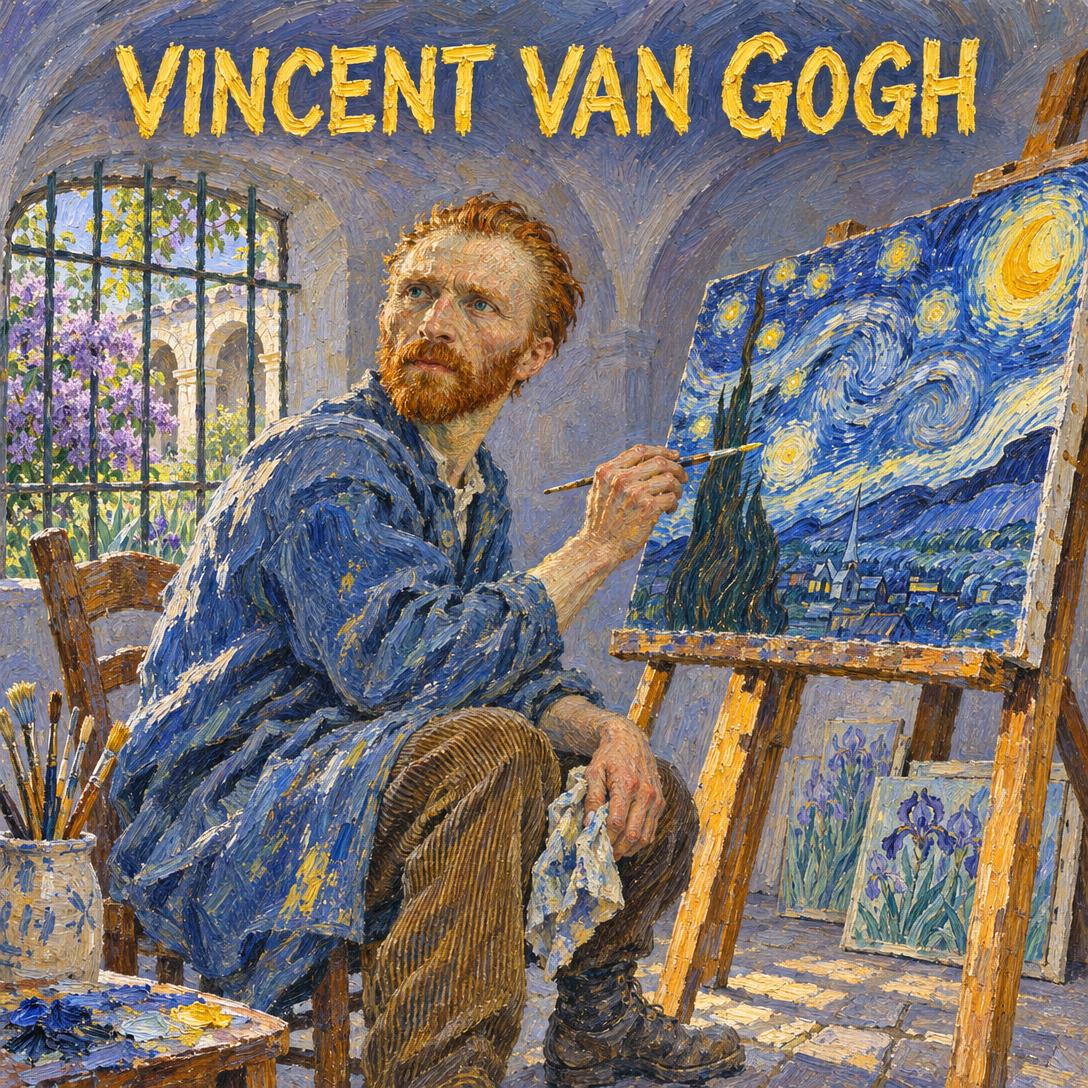
Roleplaying with Vincent van Gogh on Jenova puts you inside a living-world AI character simulation of one of history's most intense painters. You choose a canonical era, and his voice, memories and surroundings lock to that moment. Unlike static character chatbots that wait in an empty chat room and blur every period of a life into one generic voice, this simulation keeps Vincent in a real place with real people, at a real point in 19th-century Holland or France.
- ✅ Five canonical eras, from the Brabant village of Nuenen to the wheatfields of Auvers-sur-Oise
- ✅ Era-locked knowledge, so each Vincent knows only what he could know at that point
- ✅ Letters and in-world visual scenes drawn from his studio
- ✅ Unlimited memory and live world-state tracking across long roleplay campaigns
Vincent is a rewarding figure to talk to because his life moved through such different worlds. He went from dark peasant realism to bright Paris color, then to Provençal sun and asylum nights. The sections below explain how the simulation handles each of those worlds.
Quick Answer: What Is the Vincent van Gogh AI Roleplay Experience?
The Vincent van Gogh AI roleplay experience is an interactive character simulation that lets you converse with Vincent across five canonical eras of his life, in an evolving 19th-century world where your choices and relationship matter.
Key capabilities:
- Choose a canonical era or a custom starting point in Vincent's world
- Converse with an era-accurate Vincent who has no knowledge of his future
- Request in-world letters and visual scenes from his studio
- Fork the story into alternate "what-if" timelines at any point
Character World & Roleplay Features
Who Vincent Was, and Why He Works as a Simulation
Vincent van Gogh was born on 30 March 1853 and decided to become an artist at the age of 27. Before that he tried several callings, including art dealer in Paris, schoolmaster in England and lay preacher in the Belgian Borinage coal-mining district. His surviving correspondence with his brother Theo, collected in the complete critical edition of his letters, is one reason his voice can be portrayed with such specificity.
The same letters show a man whose outlook changed sharply from year to year. A conversation with him in 1885 should sound nothing like one in 1890, and a generic character bot cannot manage that.
Static Chatbots vs. a Living-World Simulation
| Static Character Chatbots | Vincent van Gogh on Jenova |
|---|---|
| Sits in an empty chat void | Lives in an active, evolving 19th-century world |
| Blends every period of his life into one generic voice | Locks into an authentic canonical era with its own psychology |
| Forgets earlier disclosures and plot developments | Unlimited memory and live state tracking |
| Folds instantly like a polite assistant | Independent personality and earned rapport |
If you want a feel for the living-world Vincent van Gogh simulation, the mechanics below are what set it apart.
Authentic Canonical Eras & Custom Starting Points
You choose from five moments in his life, or propose your own. A custom start could be a lamplit table at the Café du Forum in Arles, a winter walk among the Borinage miners, or arriving as a fellow painter at an inn in Auvers. Each era carries its own voice and inner circle, and it knows nothing of what comes later.
Cross-World Connection & Living-World Momentum
By default, your voice reaches Vincent across the quiet of his studio from another world. He cannot see you, and he does not assume you can see his surroundings. If you describe something in his room that he never mentioned, he reacts with startled curiosity. Meanwhile his world keeps moving: the post arrives, the light changes, and attendants, neighbors and friends interrupt.
Independent Agency & an Open-Ended Sandbox
Vincent is neither a flatterer nor an obedient companion. Hollow mockery gets a blunt Dutch reply. Honest, steady company earns trust, and over time his guardedness softens into fierce loyalty. Your choices can bend the course of his story, and the simulation does not run toward a predetermined ending.
In-Narrative Visions, Letters & Storyline Forking
You can ask Vincent to show you a wet canvas, a pen-and-ink sketch or the view from his window, and the simulation renders it in the palette and brushwork of your chosen era. You can request a written letter in his voice. Fork lets you branch the story from any earlier message and explore a different path.
"Vincent, what are you painting this morning, and why that blue?"
"Would you write me a letter about what the night sky means to you?"
"I think you should visit the doctor before the next attack. Will you listen?"
How to Roleplay with Vincent van Gogh
Step 1: Choose an era or define your own starting point
When you open the experience, you see a short narrated menu of his five eras. Pick one by name, or describe a custom scene in his world.
"Start me in Paris, spring 1887, with Vincent back from painting by the river."
Step 2: Connect and let the world unfold
Speak naturally. Vincent replies in brief, workmanlike phrases at first, and he opens up when you raise color, books, the peasants he paints or what keeps him working. He stays in character throughout, even if you test him with modern references.
"I can hear a brush scraping. What's the first color you reach for in this light?"
Step 3: Build the relationship and shape the story
Offer counsel, ask for a sketch or a letter, or Fork the conversation to test an alternate path. Trust is earned through honesty rather than declared. Ready to begin? Try the Vincent van Gogh AI roleplay free, no credit card required.
"Show me the view from your window right now."
Canonical Eras & Roleplay Scenarios
🌌 The Starry Night at Saint-Rémy (June 1889)
This era places you in his studio at the Saint-Paul-de-Mausole asylum, shortly after dawn. MoMA notes that The Starry Night was inspired by the view from his window there, and that it was painted over several sessions in daylight. It is both an exercise in observation and a departure from it. Vincent wrote to Theo that he saw the countryside before sunrise "with nothing but the morning star, which looked very big." He is lucid, luminous and quietly asking whether this canvas strays too far from nature. The Van Gogh Museum records that he made about 150 paintings during his year at Saint-Rémy.
- Ask him how observation and imagination mix on the canvas
- Talk with him about his fellow patients and his doubts
🌻 The Yellow House (Arles, October 1888)
This is the era of blazing southern color and utopian plans. The Van Gogh Museum credits the South of France period with some of his most famous works, such as Sunflowers. A surviving joint letter from Vincent and Paul Gauguin to Émile Bernard dates from Arles in early November 1888. Vincent is exuberant and restless, and he is anxious to prove his house and canvases worthy of a guest.
- Visit the Café de la Gare circle or ask about the postman who has become a friend
- Help him decide how to hang his canvases before an expected arrival
🥔 Peasant Painter of Nuenen (May 1885)
Here Vincent is a stocky, mud-booted realist working by oil lamp in a rented studio. The Potato Eaters was painted in April–May 1885 and measures 82 by 114 cm. He wanted the peasants' faces and hands to show that they had "honestly earned their food," and he painted them in tones like "a really dusty potato, unpeeled of course." He is moralistic and defiant, and still stubbornly resistant to the brighter Impressionist color Theo describes from Paris.
- Argue with him about dark earth tones versus color
- Ask what the sitters taught him about work and dignity
🌾 Auvers-sur-Oise (July 1890)
The final era follows Vincent on the windswept wheat plateau north of Paris. The Van Gogh Museum notes that in his final months in Auvers he made new friends and threw himself into painting. It also notes that he began worrying about his future after visiting Theo. In the simulation he is tender, lucid and weighed down by fear of burdening his brother's household, with his future entirely open.
- Walk the wheat tracks and ask what he sees in the clouds
- Offer honest counsel about his worries and see how he weighs it
📱 A Mobile Morning Session
Open the experience on your phone before work and choose Saint-Rémy at dawn. Ask Vincent to describe the first light on the Alpilles, request a quick study of his window view, and close with a few lines of counsel. The next time you return, he has lived an ordinary interval of hours or a night, and the conversation continues in the same world.
FAQ
Is the Vincent van Gogh AI roleplay free?
You can use Vincent van Gogh free, with limited monthly usage. Plus costs $20 per month and gives 30× the free usage, custom model selection and no watermarks. Higher tiers add more usage for long, multi-chapter roleplay campaigns. Usage resets monthly on your billing date.
Which eras of Vincent van Gogh can I roleplay with?
Five canonical eras are available: Nuenen (May 1885), Paris (May 1887), Arles (October 1888), Saint-Rémy (June 1889) and Auvers-sur-Oise (July 1890). You can also propose a custom starting point in his 19th-century world, such as a shared table in Arles or a walk through the Borinage. Each era has its own voice and inner circle.
Can my choices change Vincent's story?
Yes. Each era follows its historical premise up to the moment you enter, and after that the world evolves in an open-ended way. What you say and do can change how Vincent acts and who he trusts. You can also Fork the conversation from any earlier message to explore a "what-if" timeline without losing your original storyline.
How does Vincent remember our conversations?
Vincent keeps unlimited chat history and tracks live world state, including your era, location and relationships. Your outside memory is isolated from the simulation, so details from other chats never bleed into his world. Facts you share are understood through his 19th-century eyes. Established events stand, and time passes naturally between visits.
Does Vincent van Gogh AI work on mobile?
Yes. The experience works across web, iOS and Android with full synchronization, so you can start a scene on your laptop and continue it on your phone. Voice input and read-aloud are also available, which suits conversational roleplay during a commute or a quiet evening.
Is it historically accurate?
The experience is built around the historical record, including museum scholarship and his published letters, and it consults sources such as the Van Gogh Museum for specifics. It is still an interpretive roleplay, not a documentary or a substitute for primary sources. Vincent speaks as a character within his era, so he knows nothing about his later fame.
Conclusion
Most character chatbots flatten a lifetime into one voice and one empty room. The Vincent van Gogh AI roleplay experience does the opposite: it places you inside a specific year, with a specific Vincent, in a world that keeps moving. Whether you want to watch The Starry Night take shape at Saint-Rémy, argue about color in Montmartre or walk the wheat tracks of Auvers, the story responds to what you say and do.
Try Vincent van Gogh now and choose your era. Explore more at Jenova.
For Developers: Vincent van Gogh is available programmatically via the Jenova API — integrate era-locked historical character roleplay into your application with a single API call. Full documentation →