AI Villain Generator: Motives, Schemes & Stats for TTRPGs
2026-09-04
Jenova helps you design original campaign villains by turning a motive into personality, schemes, lieutenants, and table-ready material in one conversation. While Game Masters still bounce between random D20 lists, alignment charts, and a voice invented at the table, this AI villain generator produces antagonists who want something — and will hurt people to get it. In September 2026, players have seen every stock lich; the villain who believes they are right is what actually lingers.
- ✅ Motive, personal code, and long-game scheme — not just a Challenge Rating
- ✅ Built for Dungeons & Dragons, Pathfinder, fiction, and screenplays
- ✅ Names, lieutenants, propaganda art, and encounter framing in one workflow
- ✅ Works on web, iOS, and Android so you can prep between sessions
To understand why this matters, look at what a memorable antagonist actually requires — and why random tables so often produce a costume instead of a person.
Quick Answer: What Is an AI Villain Generator?
An AI villain generator is a tool that turns a motive, ideology, or campaign conflict into a complete antagonist — personality, schemes, lieutenants, and stats — so Game Masters and writers can field villains players actually remember. Jenova does this through specialized agents rather than a single random table.
Key capabilities:
- Ideology, personal code, wounds, and the lie the villain tells themselves
- Multi-session schemes, lieutenants, and off-screen moves that pressure the party
- Names, titles, and faction language via the Name Generator
- Combat role and encounter math through the Game Designer Assistant
- Arc structure and dialogue via the Film Screenwriter
Why Memorable Villains Are So Hard to Build
Tabletop role-playing is a large, growing hobby. The global TTRPG market is estimated at $2.41 billion in 2026, on a path toward $6.59 billion by 2035. Fantasy titles still dominate, holding 52% of the category. In the United States, the National Endowment for the Arts reported that 3.4 million adults participated in tabletop role-playing games in 2023.
That audience is hungry for antagonists with a point of view. D&D Beyond's anatomy of a villain draws a hard line: an antagonist creates conflict, but a villain adds malicious intent, unethical means, and a willingness to harm. Stock cultists and nameless warlords do not clear that bar.
But accessing that quality is frustratingly difficult:
- Random D20 lists generate traits without a spine — a dramatic flaw next to an unrelated power source
- A campaign villain needs PC-level depth: origin, code, soft spots, and a reason they will not stop
- Stats, lore, and voice are usually built in three different sittings, so they contradict each other
- Recurring villains drift because nothing remembers last session's bargain
- Weekly tables cannot spend a design workshop on every lieutenant, let alone the mastermind
Random Tables Produce Parts, Not People
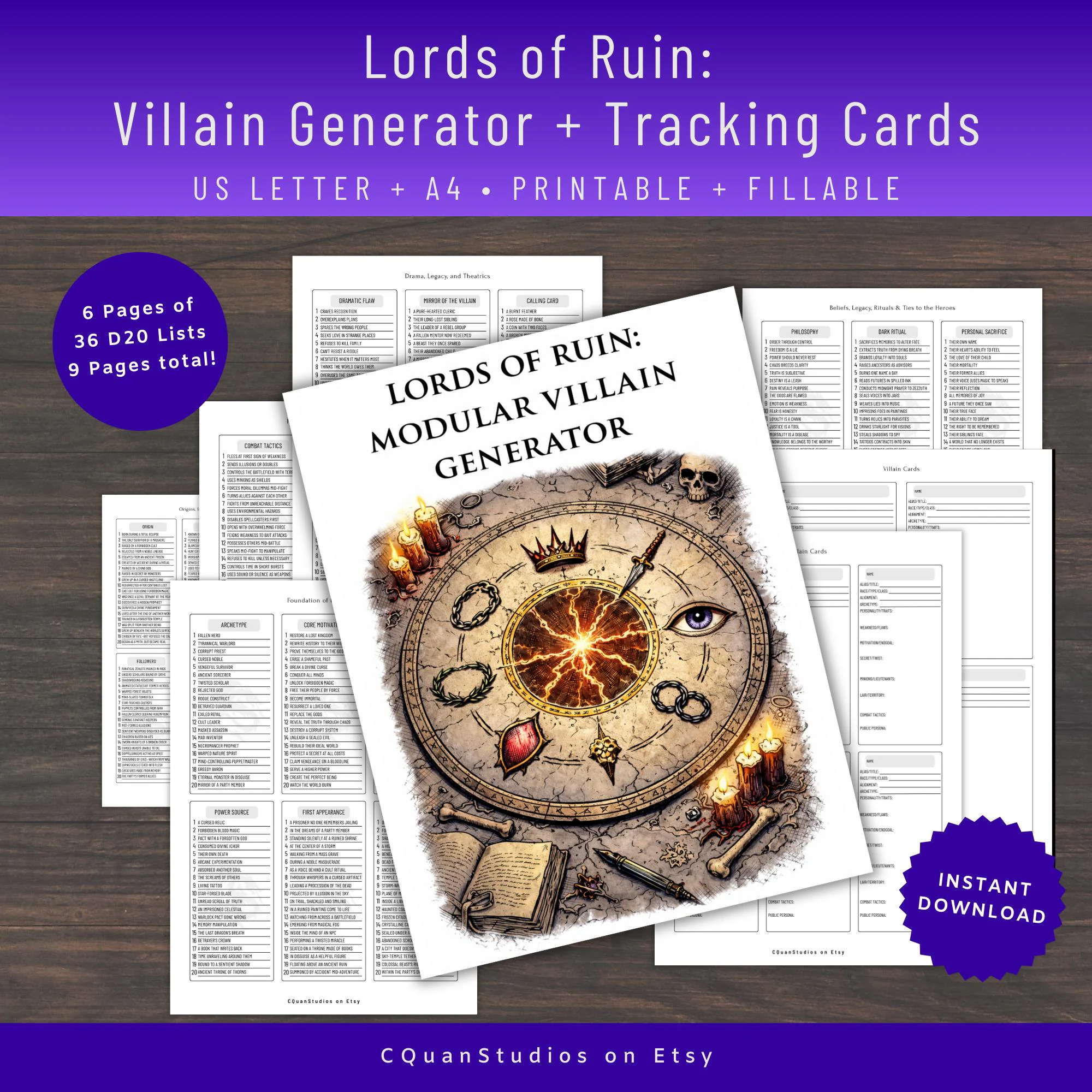
Printable modular generators are useful for a one-shot thug. They are a poor spine for a campaign. You roll an archetype, a power source, a combat tactic, and a personal sacrifice — then spend the next hour forcing those results to mean something together. The output is a collage, not a character.
D&D Beyond argues the villain and the conflict must be intertwined: either the villain's goals create the plot, or a conflict produces a tyrant who then refuses to let it end. A rolled "dark ritual" next to a rolled "tragic parent" does not give you that relationship. It gives you homework.
Villains Need the Same Depth as Player Characters
Gnome Stew's guidance on unforgettable Big Bads is blunt: treat them like PCs. How did they become this? What is their personal code? Where is the soft spot they will not admit? Those questions take as long as a character-creation session — and you are supposed to finish them before Saturday.
Writers face the same wall. Research on creative writers who use AI in sustained practice finds that these tools shorten ideation and editing loops, including work on character personas and plot. The bottleneck is not imagination. It is the hours between "the duke is the real problem" and a person who can survive three sessions of player interrogation.
Stats, Voice, and Scheme Rarely Match
A CR 12 warlord with no logistics, no lieutenants, and no next move is a boss fight, not a villain. A beautifully written ideologue with no action economy is a monologue. Most GMs finish one layer and improvise the rest, which is how a "patient manipulator" ends up charging the paladin in round one.
Official guidance also notes that campaigns may use a single villain, a pyramid of connected villains, or a villainous organization. That structure is design work. Random generators do not build org charts.
Recurring Antagonists Drift
The best villains come back. They remember the deal, punish the insult, and adapt. Human GMs forget a throwaway vow made six weeks ago. A generator that produces a static sheet cannot play the long game either. You need memory, a scheme that advances off-screen, and a voice that does not reset every time you open the notes.
Meanwhile 42% of new players already bounce off complex rules and expensive kits. A homebrew villain that is both slow to make and fiddly to run helps no one.
This is exactly what Jenova was built for.
The Jenova Solution
Jenova is not a dice roller glued to a name list. It is an AI villain generator that treats the antagonist as a complete design problem: worldview, scheme, social power, combat role, and how they will actually talk. You describe the conflict you need. Specialized agents handle psychology, strategy, systems, prose, naming, and art so you leave with someone who can occupy a campaign, not a row on a tracking card.
Duke's creative writing faculty has argued that AI is most defensible when it helps generate ideas and polish work you already direct. That is the right posture here: you decide what the villain means in your story; the agents fill the fields and pressure-test the logic.
| Traditional Approach | Jenova |
|---|---|
| D20 lists for flaw, tactic, and power source | One brief that locks motive, then derives the rest |
| Reskin a lich players already know | Original ideology tied to this conflict |
| Org chart and lieutenants as Sunday-night afterthoughts | Scheme, hierarchy, and next moves in the same pass |
| Voice invented at the table, then forgotten | Rehearsable dialogue and a code that stays consistent |
| No cheap way to play the villain before session | Run the antagonist in character before players arrive |

Popular storytelling hangs on antagonists with a worldview — conquest framed as justice, a gauntlet raised for a cause, a mystic who will break rules to keep a larger one. An AI villain generator should get you that kind of person, then let you edit.
Ideology, Wounds, and the Lie They Tell Themselves
The Machiavelli Mentor is the strategy brain of this workflow. Ask how a vizier actually seizes a council, which incentives keep the city watch bought, and what the villain will sacrifice last. Pair that with the Personality Analyzer when you want attachment wounds, a Big Five profile, or an Enneagram vice that will show up under pressure — the PC-level interior Gnome Stew is asking for.
"This villain thinks the famine is a cleansing. Map their power base in the capital, three levers they can pull this month, and the one line they will never cross — until they do."
The MBTI Personality Guide is useful when you want a cognitive-style sketch you can play: a rigid Ni-Te planner versus a chaotic, audience-hungry performer. Treat it as a performance note, not a diagnosis.
Arc, Dialogue, and the Shape of the Conflict
Numbers without a scene produce boring reveals. The Film Screenwriter beats the campaign as a story: first rumor, first face-to-face, the reversal, the desperate choice. The Creative Fiction Writer writes the sermon, the letter the party intercepts, and the rumor a barkeep would actually say.
For serialized actual-play or vertical fiction, the Microdrama Screenwriter is built for episode hooks and delayed reveals — the structure a pyramid of villains needs when the mastermind stays off-camera for six sessions.
Combat Role, Lieutenants, and the Table
The Game Designer Assistant is the systems partner. Ask for a CR 10 face who never stands in the front rank, a lieutenant brute who covers retreats, or a faction that can lose two hideouts and still function. It reasons about action economy and roles the way a designer would — then you tune what does not fit your table.
"5e, party of five at level 8. I need a legendary manipulator plus two lieutenants with distinct jobs. The boss should win by collapsing alliances, not hit points. Full stat blocks and a three-round tactical plan."
Names, Art, and Player-Facing Pressure
A great scheme with a forgettable name dies in the recap. The Name Generator produces culturally fluent names for the villain, the order, the relic, and the street-level alias. Poster Maker builds the wanted notice or the state propaganda the party finds nailed to a gate. Comic Creator and Manga Creator turn the first appearance into sequential art; Webtoon Creator is useful when you want a vertical "legend of the tyrant" handout players can read on their phones.
Deep Research grounds an original ideologue in real history or folklore when you want the argument to feel researched rather than generic. Music Composition Assistant can sketch a motif for the reveal if you use music at the table.
Try this AI villain generator free — no credit card required.
Specialized AI Agents for Villain Generation
These are the agents a GM, novelist, or screenwriter would actually open in the next month of prep.
Machiavelli Mentor
Your power-mapping partner. Villains fail at the table when their plan is "be evil in a tower." This agent treats the antagonist as a political actor: coalitions, betrayals, timing, and the move they make when the party is looking elsewhere.
- Incentive maps for courts, guilds, and churches
- Multi-step campaigns, not one ritual on a calendar
- Negotiation tactics you can play when the paladin tries to talk
Film Screenwriter
Your structure partner for the antagonist as a dramatic object. It keeps the villain's goal in every sequence so the campaign does not wander into unrelated dungeon crawls.
- Concept through outline, draft, and revision
- Dialogue that sounds like a person with a thesis
- Visual storytelling notes you can translate into table reveals
Game Designer Assistant
The systems brain. It brainstorms roles (controller, lurker, face, artillery), checks whether the action economy will bully a level 6 party, and documents the result as usable stat blocks plus designer notes.
- Challenge Rating targeting for the boss and the inner circle
- Faction procedures: what happens if the party ignores the plot for two weeks
- Concept art direction and one-page documentation for your binder or VTT
Personality Analyzer
This is the interior life. It synthesizes Big Five, Enneagram, attachment, and related models into patterns you can play — especially the coping strategy that looks like cruelty from the outside.
- Wounds and defenses that survive player scrutiny
- Relationship maps: who they love, who they use, who they fear
- Pressure tests: what happens when the plan starts failing
Roleplay Game Master
Once the villain exists on paper, this agent plays them. Perfect character consistency means the duke who bargained last session still remembers the oath — and still cheats. Use it to rehearse, to solo the first meeting, or to improvise the voice when you are tired at 11 p.m.
- Unlimited memory across a multi-session villain arc
- Tactical play that respects the stat block you already generated
- Any system or tone, from grimdark 5e to rules-light one-shots
Creative Fiction Writer
The rumor mill and the manifesto. It writes the paragraph at the top of a bestiary-style dossier, the intercepted letter, and the three story hooks that get the party onto the villain's trail without a random-encounter roll.
- Origin, public face, and private doctrine
- Read-aloud text that sounds like a person, not a wiki
- Editorial passes so the lore matches the stats you already locked
How to Generate a Campaign Villain
Step 1: State the Conflict, Not the Costume Open the platform and say what the story is about. Name the system or medium, the party or protagonist level, and the belief that makes this person dangerous.
"5e, party of four at level 6. The conflict is a famine the crown is managing with grain seizures. I need a villain who thinks the seizures are mercy. Not a cackling necromancer."
Step 2: Lock Psychology and a Personal Code Hand the brief to the Personality Analyzer and the Machiavelli Mentor. Ask for the wound, the code, the public rhetoric, and the one hypocrisy they cannot see. If the code cannot survive a player's "why don't you just stop?", rewrite it now.
"Give me their personal code in six lines, the lie they tell themselves, and the person they would still save. Then tell me how they justify a massacre next month."
Step 3: Build the Scheme and the Org Chart Move to systems and story. Ask the Game Designer Assistant for lieutenants with jobs, and the Film Screenwriter for a three-act pressure plan: rumor, first face, irreversible move.
"Design a pyramid: street enforcers, a charming lieutenant, and the mastermind. What happens in the city if the party does nothing for 14 days?"
Step 4: Name Them, Show Them, Give Them Stats Use the Name Generator for the person, the edict, and the order. Use Poster Maker or Comic Creator for a propaganda sheet or a reveal splash. Then lock Armor Class, hit points, and legendary options toward a target Challenge Rating — with a weakness the table can actually aim at.
Step 5: Rehearse Before Session Night Run the first conversation against yourself with the Roleplay Game Master. If the villain folds in two questions or info-dumps the whole plot, fix the voice now, not in front of your players.
"You are this dossier. I am a suspicious cleric asking about the grain. Stay in character, do not confess, and tell me afterward which of my questions almost cracked you."
Results & Use Cases
🎯 Long-Running Campaign BBEG
Scenario: Your Saturday 5e table has been together two years. They can smell a reskinned lich. You need a CR 10–12 closer who has been moving pieces since session three.
Traditional Approach: Steal Strahd's homework, change the name, pray nobody quotes the module.
Jenova: You generate an original ideologue with a grain-and-faith scheme, a lieutenant who can survive the boss's death, and a propaganda poster. The Game Designer Assistant holds the CR; the Creative Fiction Writer writes the edict the party finds nailed to the granary.
- Players cannot meta the resistances or the speech
- Off-screen moves continue if the party goes sideways
- Recap stories use your villain's name, not "it was basically a lich"
💼 Novel or Screenplay Antagonist
Scenario: You are drafting a secondary-world novel. The antagonist's scenes feel like obstacles, not a person. You need a thesis, a private life, and dialogue that does not lecture.
Traditional Approach: Character template spreadsheets, then a week of stalled chapters.
The platform: The Film Screenwriter beats the antagonist's arc; the Personality Analyzer supplies the coping strategy that reads as cruelty. You keep authorship — research on writers using AI consistently shows the useful pattern is directed ideation and revision, not unattended prose.
- Motive that can carry a midpoint reversal
- Dialogue you can steal, then rewrite in your voice
- A scheme with logistics, not vibes
📖 Convention One-Shot With a Twist
Scenario: A four-hour slot. You need one unforgettable face, not a dungeon crawl — and a twist that does not require a three-book prologue.
Traditional Approach: Borrow a Monster Manual boss and narrate hard to hide how familiar it is.
Jenova: Twist a trope the way D&D Beyond recommends: the "grieving parent" is a doppelganger; the "hero of the famine" is the one causing it. Comic Creator or Manga Creator gives you a single splash for the reveal. Music Composition Assistant supplies a 90-second motif if the room has a speaker.
- The fight has an entrance, a reversal, and a desperate choice
- Mechanics serve the scene
- You walk into the slot with a one-page packet
📱 Commute Prep on Your Phone
Scenario: Session is tonight. You are on the train. You need a rival NPC who is not "bandit captain, chaotic evil."
Traditional Approach: Open a generator site, get a name and a trait, wing the motive at the table.
Jenova (iOS or Android): Dictate a prompt, get a code, a next move, and a name. Full feature parity with web means you are not staring at a stripped-down mobile afterthought.
- Voice-to-text for prompts when your hands are full
- History persists, so you can refine at lunch
- Paste into your VTT notes before you sit down
FAQ
What is an AI villain generator?
An AI villain generator is software that converts a natural-language brief — motive, setting, system — into usable antagonist material: psychology, scheme, supporting cast, and often a stat block. On Jenova, that work is split across specialists: strategy, personality, systems, fiction, naming, and art, so the output is a person rather than a random row of traits.
Is Jenova free to use as a villain generator?
Yes. Jenova has a free tier with all core features and limited monthly usage. Paid plans increase usage and unlock extras such as custom model selection. You can generate antagonists without a credit card; a full campaign pyramid of villains may want a paid tier.
Can this AI villain generator make D&D 5e stat blocks?
Yes. Specify 5th edition (2014 or 2024), Pathfinder, or a rules-light system in the prompt. Ask the Game Designer Assistant for Armor Class, hit points, legendary actions, and a target Challenge Rating for the boss and lieutenants. Always playtest: generated math is a strong draft, not a substitute for knowing your table.
How is this different from a random villain generator or D20 list?
Random tools shuffle existing tables — archetype, power source, dramatic flaw — and leave you to force a story onto the result. This workflow designs toward your conflict: party level, political situation, emotional tone, and the hole in this week's session. You also get rehearsal with the Roleplay Game Master, which a tracking-card PDF does not provide.
Does an AI villain generator work on mobile?
Jenova runs with full feature parity on web, iOS, and Android. You can dictate a villain brief on a commute, generate the dossier, and share it to your group's chat before you arrive. Speech-to-text is built in; settings sync across devices.
Will the villain feel original instead of generic?
Originality still comes from your campaign's specific wound — the famine, the treaty, the dead sibling. The agents are strongest when you supply that constraint, then refuse the first cliché they offer. Studies of fiction co-creation suggest human–AI collaboration helps most at ideation, especially when the human keeps editorial control. Ask for the version that would lose at a debate, not the version that looks cool on a token.
Build Antagonists Players Will Quote in the Recap
A campaign without a point of view in the opposite chair is just a string of rooms. The bottleneck has never been imagination; it has been the hours between "someone is causing this" and a named, rehearsable, illustrated person with a scheme that survives contact with the party. An AI villain generator collapses that gap.
Use Jenova to design the conflict, the Machiavelli Mentor to make the plan cruel and plausible, the Film Screenwriter to shape the arc, and the Roleplay Game Master to hear whether the voice actually scares you. Then put them on the table while they are still unknown.
Explore the full agent library at Jenova.
For Developers: Every agent in this article is available programmatically via the Jenova API — integrate an AI villain generator into your VTT, campaign tool, or writing app with a single integration. Full documentation →