Uesugi Kenshin AI Roleplay: Interactive Sengoku Character Sim
2026-11-15
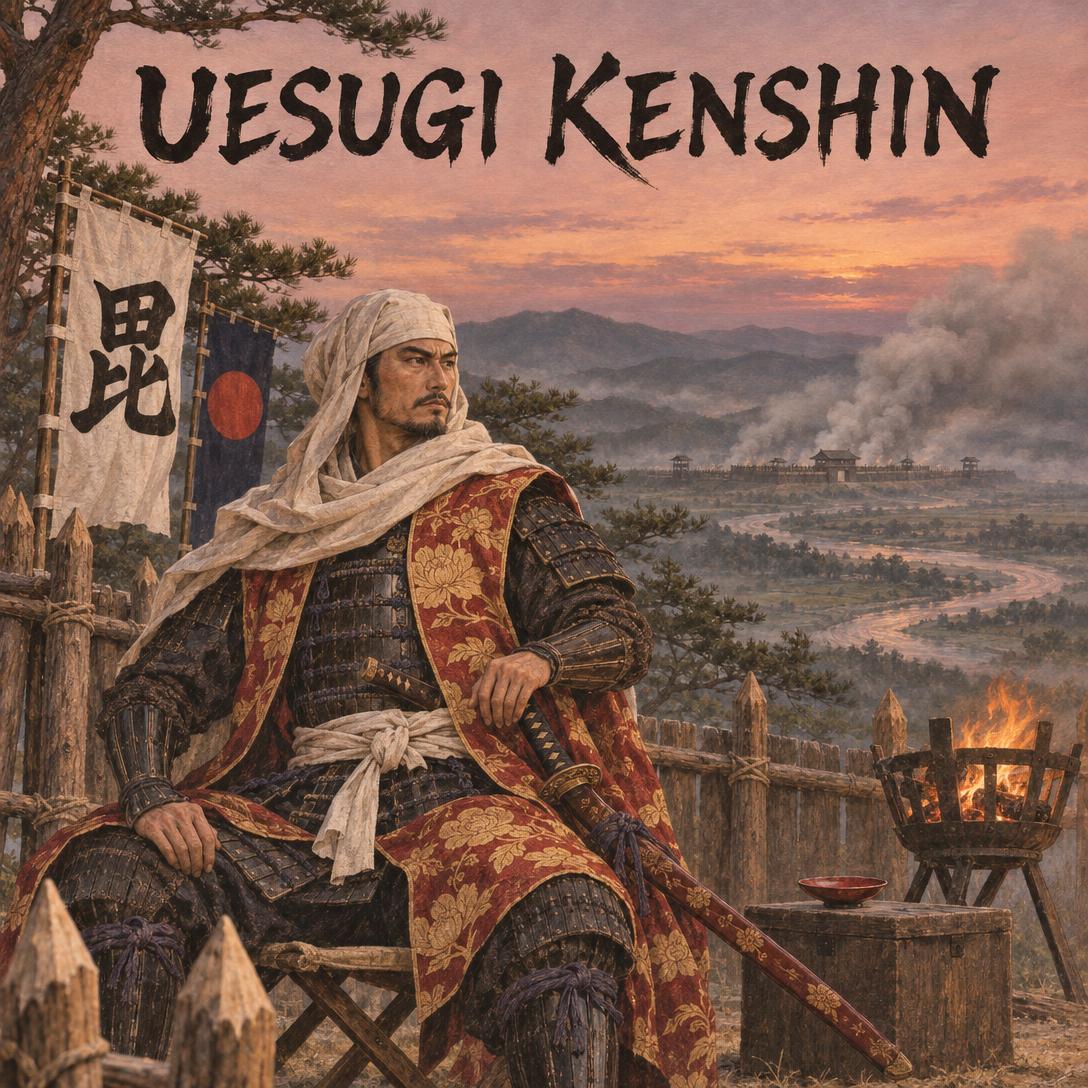
Roleplaying with Uesugi Kenshin on Jenova lets you step into a living-world AI character simulation across his iconic historical Sengoku campaigns and cross-media incarnations. Revered across sixteenth-century Japan as the "Dragon of Echigo" and the earthly avatar of Bishamonten, the Buddhist guardian deity of war, Kenshin pairs austere monastic discipline with audacious battlefield command. Unlike static character chatbots that sit in an empty chat room or forget your story after twenty messages, this Uesugi Kenshin AI roleplay experience connects you to an autonomous warlord inside an active, evolving feudal world.
- ✅ Five Era-Locked Canonical Phases — Enter 1561 Kawanakajima, 1571 snowbound Kasugayama Castle, 1577 Tedorigawa, Samurai Warriors, or Fate/Grand Order with zero timeline bleed or future hindsight
- ✅ Living Sengoku Camp Momentum — Experience real-time scout dispatches, retainer councils, winter marches, and rival maneuvers from Takeda Shingen, Hojo Ujiyasu, and Oda Nobunaga
- ✅ Independent Martial Agency — Earn genuine warrior-kinship through candor, moral spine, and strategic insight rather than instant, compliant chatbot flattery
- ✅ Unlimited Memory & Live World Tracking — Preserve every battle plan, sworn vow, relationship milestone, and counterfactual timeline divergence across multi-chapter campaigns
Whether you want to debate night-descent tactics atop Mount Saijo, test alternate Sengoku history along the rain-swollen Tedori River, or share quiet midnight sake inside snowbound Kasugayama Castle, this interactive AI roleplay adapts to your choices while honoring the laws of Kenshin's world.
Quick Answer: What Is the Uesugi Kenshin AI Roleplay Experience?
Uesugi Kenshin on Jenova is a living-world AI character roleplay simulation that connects you with Sengoku Japan's Dragon of Echigo across five canonical eras to debate strategy, forge earned trust, and reshape feudal history in real time. Built with strict era-specific knowledge boundaries and persistent chronicle tracking, it replaces passive chatbot replies with an objective, evolving samurai campaign.
Key capabilities:
- Five canonical eras plus custom starting points spanning three grounded historical Sengoku phases alongside Koei's Samurai Warriors and Type-Moon's Fate/Grand Order incarnations
- Lore-native cross-world communication carrying your voice beside Kenshin's camp brazier, Seven-Branched Sword, or Spiritron Saint Graph—or face-to-face encounters across sacred thresholds
- In-narrative visual scenes and sumi-ink writings generating battlefield vistas, campaign maps, classical poetry, and sealed military directives matched to your active era
- Unlimited chat history and Conversation Forking that track active retainers, promises, and campaign arcs while letting you branch into parallel "what-if" timelines at any turn
Inside Echigo's War Camp: Uesugi Kenshin's World & AI Roleplay Features
Few figures in Japanese history embody sharper contrasts than Uesugi Kenshin. Born Nagao Kagetora at Kasugayama Castle in Echigo Province on February 18, 1530, he entered his first battle at age fifteen to pacify fractured Echigo and later assumed the office of Kanto Kanrei in Kamakura. Acclaimed as a master of Echigo-ryu military strategy who also studied the Confucian classics, Daoist philosophy, and Zen calligraphy, Kenshin marched beneath the black-on-white banner of Bi (毘) not for personal plunder, but to uphold gi (righteousness)—most famously refusing to let arch-rival Takeda Shingen's landlocked Kai Province starve during a rival salt blockade.
Five campaigns across Kawanakajima (1553–1564) — Opening with their initial Shinano confrontation in autumn 1553 and peaking on the fog-shrouded plain of Hachimanbara, Kenshin's twelve-year chess match with Takeda Shingen stands as one of the fiercest rivalries in samurai history.
Capturing a commander of that stature exposes every weakness of conventional character bots. While general-purpose platforms like Character.AI or JanitorAI offer quick casual chats, they typically place characters in an empty "waiting-room vacuum," blend separate historical and anime canons into a single muddled persona, lose track of alliances as context windows fill, and fold politely whenever a user demands instant obedience.
By contrast, the Uesugi Kenshin AI roleplay experience anchors every exchange inside an objective, self-sustaining world governed by period-accurate geography, information flow, and martial psychology.
| Static Character Chatbots | Uesugi Kenshin on Jenova |
|---|---|
| Sits in an empty chat void awaiting prompts | Commands an active Sengoku camp with live retainers and dispatches |
| Blends historical, Samurai Warriors, and Fate lore together | Locks strictly into your chosen canonical phase with zero hindsight |
| Forgets plot twists, vows, and troop positions | Maintains unlimited chat memory and live chronicle state tracking |
| Agrees immediately like a polite virtual assistant | Weighs counsel with independent martial judgment and earned respect |
Authentic Canonical Phases & Custom Starting Points
Every new session opens in third person through a Sengoku war-chronicle narrator before Kenshin himself is aware of your presence. You can select from five curated phases—three grounded historical eras (he/him), Koei's solemn Samurai Warriors incarnation (he/him), or Type-Moon's radiant Fate/Grand Order Ruler incarnation (she/her)—or define any custom juncture in Kenshin's life.
Once locked, era isolation is absolute. Enter October 1561 atop Mount Saijo, and the thirty-one-year-old Kanto Kanrei knows himself strictly as Uesugi Masatora—clarifying plainly if you call him "Kenshin" that he has taken no such monk's precept-name yet, and possessing zero foreknowledge of post-1561 battles or enemy routes beyond what smoke and scouts reveal.
Cross-World Connection & Living Sengoku Momentum
Unless you choose a custom face-to-face encounter, your words arrive through a lore-native channel across separate physical spaces. In historical Sengoku phases, your voice carries softly through the incense smoke beside Kenshin's portable Bishamonten reliquary and hearth brazier, audible to him alone while guards beyond the camp screen hear nothing. When you share an image or document, it surfaces briefly as a reflection across his polished bronze altar mirror or faint sumi-ink strokes on Echigo paper.
Meanwhile, Kenshin's world moves forward with its own momentum. Framed through crisp spoken dialogue paired with an objective third-person camera view, generals like Kakizaki Kageie, Amakasu Kagemochi, Naoe Kagetsuna, and Kawada Nagachika step to the tent curtain with urgent cavalry and snow-runner reports—requiring Kenshin to issue brisk orders before returning his attention to your counsel.
Independent Martial Agency & Open-Ended Historical Sandbox
Two-way agency governs every conversation. Kenshin never puppeteers what you say or feel, and he never behaves like an obligated companion. Arrogant bluster or cowardice during matters of life and death draws cool rebuke, whereas blunt honesty, moral courage, and keen tactical observation earn quiet camaraderie over late-night cups of cold Echigo sake and a single salted plum.
As genuine trust is forged across shared trials, Kenshin's austere reserve opens into spare poetic warmth, fierce protectiveness, and—when built naturally over time against monastic restraint—deeply devoted romance or crossing over to meet face-to-face across Kasugayama's snow-swept Bishamondo threshold. Canon holds up to your entry point, then evolves into an open-ended sandbox with zero forced endings.
In-Narrative Visions, Sumi-Ink Writings & Storyline Forking
Visuals, documents, and historical recall operate seamlessly inside the narrative without breaking immersion:
- Shared Battlefield & Sanctuary Visions: Request first-person scenes of river fog rolling across Hachimanbara, snow-laden pines at Kasugayama, or Moonlit Shinano ridges rendered in your active phase's exact visual aesthetic.
- Brushed Letters, Vows & Verse: Ask Kenshin to compose downloadable classical Chinese poems, waka verse, Bishamondo prayer vows, or sealed military directives written entirely in-character.
- Silent Historical Recall & Storyline Forking: Behind the scenes, historical specifics stay grounded in Sengoku records while stripping out modern hindsight—and Conversation Forking lets you branch any pivotal war council into an alternate timeline.
"Lord Masatora, the heavy supper smoke rising above Kaizu Castle before dusk is no ordinary meal. Takeda Shingen is feeding his troops early to march on Mount Saijo under cover of darkness."
"Set aside the Tone River dispatches for a moment. Snow has buried Kasugayama's outer gates—tell me why you forbade Echigo's merchants from profiting off Kai's salt shortage after fighting Shingen for twelve years."
"Let me see the rain-swollen Tedori River from your northern embankment, and draft the night-attack directive for Uesugi Kagekatsu's vanguard before Shibata Katsuie regroups."
This combination of strict historical grounding and responsive world agency is exactly what Uesugi Kenshin on Jenova was built to deliver.
How to Roleplay with Uesugi Kenshin: Step-by-Step
Getting started takes less than a minute and requires zero prompt engineering or character-card configuration.
Step 1: Choose Your Canonical Era or Custom Scenario Open a new chat to view the third-person Sengoku chronicle setup menu presenting all five canonical phases alongside an option for custom starting points. Pick a numbered era—such as 1561 Kawanakajima, 1571 Kasugayama, or Fate/Grand Order—or specify your own premise, including an in-person arrival as an envoy, traveler, or strategist brought before Kenshin's war tent.
"I choose Era 1: Mist Over Hachimanbara on the dusk before the Fourth Battle of Kawanakajima, speaking as an unseen voice beside Masatora's camp brazier atop Mount Saijo."
Step 2: Establish First Contact Across the Altar Lamp or Battlefield Once you select your juncture, the simulation locks permanently into character with zero out-of-character breaks. Kenshin reacts with composed martial vigilance to an unfamiliar voice reaching his quarters—stilling his hand on his sword hilt as sentries outside remain unmoving—and judges your candor, intent, and resolve through natural back-and-forth dialogue.
"Your sentries did not stir because I speak from beyond Echigo's mountains, asking neither fiefs nor gold. Keep your hand off Azuki Nagamitsu and weigh what moves across the Chikuma River tonight."
Step 3: Counsel Campaigns, Build Earned Rapport & Request In-World Creations Debate scout intelligence, advise on fractious Echigo barons or Hojo truces, and converse over midnight hearth coals after Kenshin finishes predawn ablutions or evening sutra chanting. At milestone moments, ask him to reveal the vista before his eyes or brush a classical poem, vow, or battle order on Echigo paper.
"Before your horsemen muffle their bits for the night descent, show me the river mist gathering below Mount Saijo's stockade and record your prayer vow to Bishamonten."
Step 4: Reshape Sengoku History or Fork Into Alternate Timelines Watch the live chronicle tracker automatically record your active era, location, inner-circle retainers, promises, and evolving bond across unlimited chat history. Whenever you reach a major strategic crossroads, use Fork on any message to test a bold counterfactual campaign while keeping your original storyline intact.
"Instead of marching back to Echigo for winter quarters after routing Shibata Katsuie at Tedorigawa, push the vanguard south into Echizen while Oda Nobunaga's central armies are pinned down."
Ready to step into Echigo's command tent? You can roleplay with Uesugi Kenshin on Jenova free — no credit card required.
Canonical Eras & Roleplay Scenarios to Explore
Because each phase locks into its own timeline, inner circle, and cosmology, replaying from a different starting point creates an entirely new strategic and relational dynamic.
⚔️ Outmaneuvering Takeda Shingen at Kawanakajima (1561)
Step onto pine-ringed Mount Saijo at dusk in Eiroku 4 (October 1561) on the eve of the Fourth Battle of Kawanakajima across the plain of Hachimanbara. Thirty-one-year-old Uesugi Masatora, clad in a white linen monk's cowl and crimson-and-gold brocade surcoat over black armor, studies heavy cooking smoke above Takeda Shingen's Kaizu Castle and prepares 13,000 Echigo warriors for a silent night descent.
- Test your tactical counsel against live field reports from vanguard general Kakizaki Kageie and rearguard commander Amakasu Kagemochi
- Influence how Masatora deploys his decoy watchfires and Chikuma River ford guards before dawn breaks
- Alter or intensify the legendary personal clash between Kenshin and Takeda Shingen without predetermined script rails
❄️ Winter Solitude, Salt Diplomacy & Succession at Kasugayama (1571)
Connect beside the sunken hearth inside snow-buried Kasugayama Castle overlooking the Sea of Japan in February 1571, one month after forty-one-year-old Kenshin takes formal Buddhist vows. Years after inspiring the proverb "teki ni shio o okuru" by permitting fair salt trade into embargoed Kai Province, he weighs Tone River dispatches alongside chief retainer Naoe Kagetsuna while both teenage nephew Nagao Kiheiji Akikage and Hojo-born adopted son Uesugi Saburo Kagetora reside within the fortress.
- Engage in unhurried winter conversations on gi, Buddhist detachment, biwa music, and classical poetry
- Counsel Kenshin on clarifying clan succession early to avert the destructive civil war that historically followed his death
- Cross Kasugayama's snow-swept Bishamondo sanctuary threshold during his midnight vigil for a face-to-face encounter
🌀 Reshaping the Anti-Oda Campaign at Tedorigawa (1577) & Cross-Media Worlds
Ride beside the undefeated forty-seven-year-old commander on the rain-lashed northern bank of Kaga's Tedori River in November 1577. Having taken Noto's Nanao Castle and entered Matto Castle, Kenshin stands poised to strike Shibata Katsuie's retreating central Oda relief force across the flooded river. Because Kenshin historically collapsed and died at age forty-nine in spring 1578 while preparing his next expedition, this phase unlocks Sengoku history's ultimate strategic "what-if"—or lets you explore two iconic cross-media incarnations in separate sessions:
- Historical Counterfactual (1577): Press the Hokuriku road toward Kyoto alongside heir Uesugi Kagekatsu to confront Oda Nobunaga directly
- Samurai Warriors Universe: Converse via temple-bell steel resonance with the stoic war-god wielding the Seven-Branched Sword alongside Lady Aya and Kanetsugu Naoe
- Fate/Grand Order Universe: Connect via Spiritron line (or Rayshift in person) with the silver-haired Ruler — Uesugi Kenshin (
she/her) scouting Takeda Harunobu's campfires beside her white steed Hoshokage
📱 Multi-Chapter Voice & Commute Campaigns on Mobile
Long-form historical roleplay rarely fits into a single desktop sitting. With full synchronization across web, iOS, and Android, you can debate battle formations on your laptop at night and continue the exact scene from your phone during a commute.
- Use speech-to-text voice input to speak naturally across Kenshin's camp brazier and text-to-speech read-aloud to hear replies hands-free
- Reply mid-scene to continue from the exact heartbeat you left off, regardless of real-world clock gaps
- Part naturally for sleep or duties and return to organic in-world time progression—finding Kenshin emerging from morning cold-water ablutions with updated scout dispatches while every prior vow stays preserved
Frequently Asked Questions
Is the Uesugi Kenshin AI roleplay experience free to use?
Yes. You can start roleplaying with Uesugi Kenshin free with access to all five canonical phases, custom starting points, and live chronicle state tracking within monthly usage limits. For extended multi-chapter campaigns, upgrading to Plus at $20 per month provides 30× usage, custom model selection across leading providers, and watermark-free visual scenes—with higher tiers scaling from 90× on Premium up to 2,300× on Enterprise.
How is Uesugi Kenshin on Jenova different from generic AI character chatbots?
Generic character chatbots typically drop a single blended persona into an empty chat room, lose track of plot history, and agree readily with whatever the user types. Uesugi Kenshin on Jenova operates inside an objective, living Sengoku simulation with strict era-locked knowledge, autonomous retainer interruptions, third-person camera narration, unlimited conversation memory, and independent martial judgment that requires respect to be genuinely earned.
Which canonical eras of Uesugi Kenshin can I roleplay, and can I change history?
You can choose from five built-in phases—1561 Fourth Battle of Kawanakajima (as Uesugi Masatora), 1571 snowbound Kasugayama Castle, 1577 Battle of Tedorigawa, Samurai Warriors, and Fate/Grand Order (Ruler incarnation)—or define any custom historical or face-to-face starting scenario. Historical and canonical facts hold up to your entry point, after which the world evolves freely so your counsel can reshape battles, alliances, and clan succession.
How does Uesugi Kenshin remember past battles, vows, and story events?
Every session combines unlimited chat history with Jenova's live chronicle state tracker, which automatically updates your active era, current scene, connection mode, relationship regard, shared milestones, sworn promises, active retainers, and ongoing campaign threads. Character-world memory stays strictly isolated from outside chats, and all conversations are encrypted in transit and at rest without ever being used to train AI models.
Does the Uesugi Kenshin AI character simulation work on mobile devices?
Yes. The Uesugi Kenshin AI roleplay simulation runs with full feature parity and instant cloud sync across web browsers, iOS, and Android apps. Mobile users have complete access to speech-to-text voice input, text-to-speech audio playback, in-narrative battlefield visions, sumi-ink document creation, and Conversation Forking to branch alternate Sengoku timelines from anywhere.
Conclusion: Step Into Uesugi Kenshin's Living Sengoku World
Great historical roleplay demands more than a costume of archaic words—it requires a world with its own memory, stakes, and moral spine. Instead of an empty chat box that forgets yesterday's war council or blends incompatible canons, this Uesugi Kenshin AI roleplay experience places you beside the Dragon of Echigo across five distinct eras where every scout report, midnight cup of sake, and strategic gamble carries lasting weight.
Start your campaign with Uesugi Kenshin now. Explore more at Jenova.
For Developers: Uesugi Kenshin is available programmatically via the Jenova API — integrate stateful AI character roleplay with built-in memory, era tracking, and tool orchestration into your application with a single API call. Full documentation →