What Is the Best AI Trading Card Game Creator?
2026-09-19
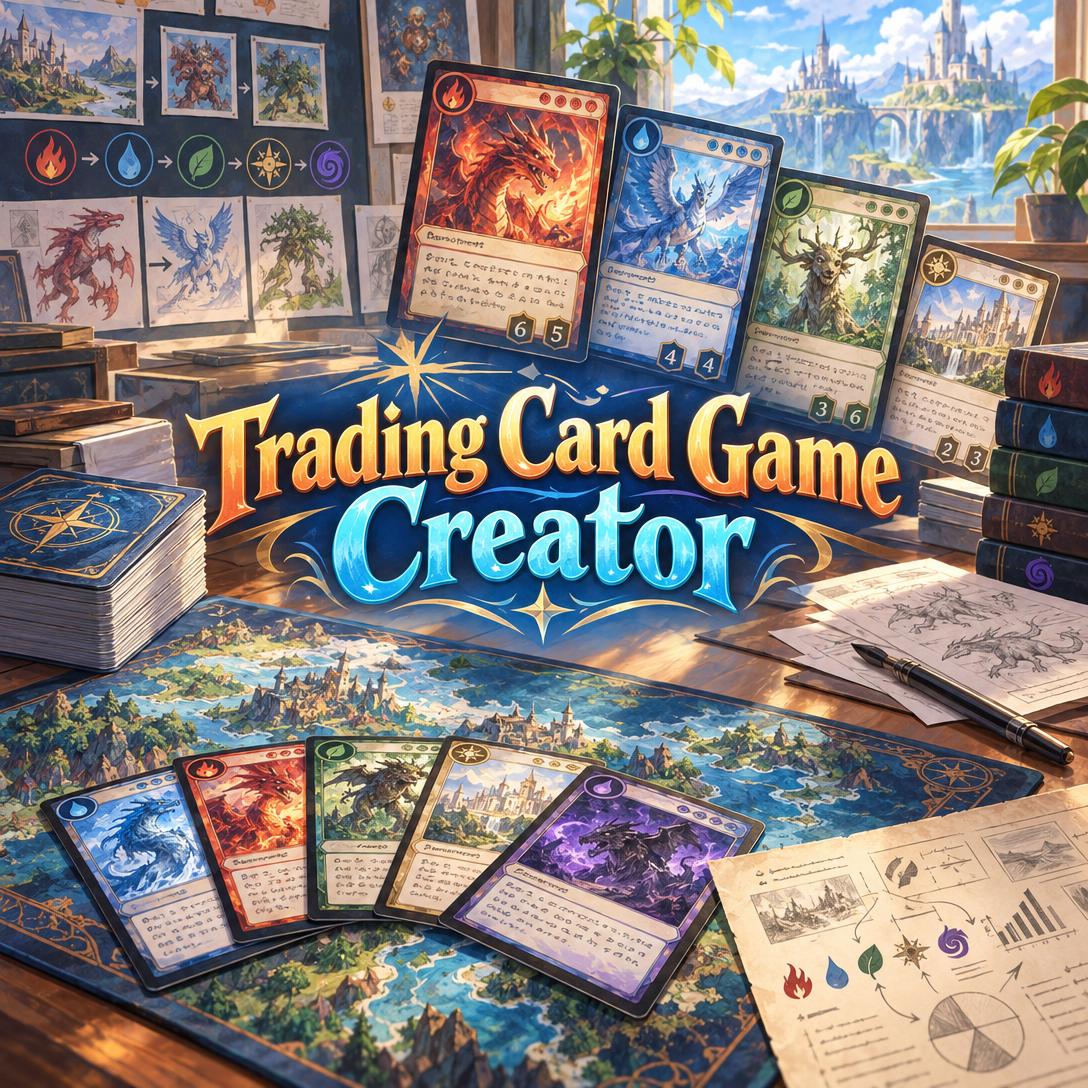
How Do AI TCG Studios Compare on Mechanics, Art Consistency, and Set Architecture?
The strongest AI trading card game creator in 2026 depends on whether you need integrated design (rules, lore, and art as one system), template-accurate custom cards, a playable digital rules engine, or printed decks. Trading Card Game Creator is strongest when those three layers must reinforce each other. Magic Set Editor remains the standard for template-based custom cards. Summer Engine is stronger if the output must be a playable digital game. Card Game Crafter AI is stronger if the goal is a physical printed deck from a prompt.
Key factors that separate a usable TCG studio from a one-off card image generator:
✅ Three-layer integration — a fire dragon should be lore, art, and a costed card at once, not three disconnected assets ✅ Locked card anatomy — name, type line, cost, stats, rules text, and rarity must occupy consistent zones across the set ✅ Rules language discipline — trigger wording, targeting syntax, and keywords stay identical from card 1 to card 200 ✅ Reference-driven art — frames, style exemplars, and faction palettes prevent visual drift as the set grows ✅ Set architecture — rarity mix, mana curve, and archetype support (aggro, control, midrange, combo) are designed, not improvised
To compare these tools meaningfully, it helps to evaluate them as TCG studios rather than as image generators. A beautiful card that cannot sit next to 119 others in a draft set is not a finished design.
Why Are Designers Turning to AI for Trading Card Game Creation in 2026?
Designers are using AI because TCG markets are large, production costs are real, and the bottleneck is no longer “can I draw one card” — it is “can I finish a coherent set.” BCC Research estimates the global trading card game market at $7.8 billion in 2024, with a projected $11.8 billion by 2030 at a 7.4% CAGR. Character cards alone held a 60.78% share in 2025, about $3.35 billion.
That commercial scale hides a design problem. A tournament-viable set is not 15 pretty illustrations. It is hundreds of cards with consistent templating, faction identity, and a curve that supports more than one strategy. Hobby manufacturing still sits in a wide band: Hero Time estimates $0.50 to $5 per unit depending on complexity and order size. Print-on-demand components are cheaper at prototype scale — The Game Crafter lists a trading deck at $0.19 per card for an 18-card deck — but layout, rules text, and art still have to exist first.
The practical pain points are consistent across designer forums:
- Visual drift after 20–30 cards, even when the first few look excellent
- Inconsistent rules text (“summon” on one card, “play” on the next)
- Unbalanced factions with no 2-drops, or a rare that makes commons irrelevant
- No path from concept to deliverable — art in one tool, stats in a spreadsheet, frames in another
AI does not remove those problems automatically. It only helps when the workflow locks schema, language, and references before mass card generation.
What Should You Look for in an AI Trading Card Game Creator?
You should look for a studio that can lock a card schema, write consistent rules text, hold an art reference system, and compose a set — not just render a portrait inside a border. Image quality is table stakes in 2026. The evaluation difference is whether card 87 still matches card 3.
This article uses a Three-Layer Integration Test plus four supporting checks:
| Dimension | What “good” looks like | Failure mode |
|---|---|---|
| Mechanical identity | Cost, stats, keywords, and win conditions are designed as a system | Cards that look cool but have no curve or archetype role |
| Lore identity | Factions, characters, and flavor text map to mechanics | Generic flavor pasted onto unrelated effects |
| Visual identity | Frames, palettes, and style stay locked across the set | Beautiful singles that do not read as one game |
| Rules language | One verb set, one trigger syntax, one targeting style | Amateur “homebrew” wording that breaks at scale |
| Reference discipline | Style exemplar, frames, and type references exist before production cards | Using finished cards as style refs, causing drift |
| Set architecture | Rarity mix, booster logic, and archetype support are planned | A pile of rares with no commons that teach the game |
| Deliverables | Cards, card back, rulebook, registry | Images only, with rules living in chat history |
Complexity budgeting matters as much as art. Commons should be readable on first pass. Rares can ask for a reread. Mythics can bend rules. Tools that generate every card at “legendary uniqueness” produce sets that are exhausting to learn and impossible to draft.
Audience fit should be explicit. A 30-card kitchen-table game needs a simple schema (name, type, cost, power, effect, art). A multi-set TCG needs subtypes, faction coding, dual costs, collector numbers, and expansion planning. The right creator asks which of those you are building before it starts drawing dragons.
Which Tools Are Best for Designing Original TCG Cards and Complete Sets?
Magic Set Editor is best for template-accurate custom cards, Summer Engine is best for a playable digital rules engine, Card Game Crafter AI is best for prompt-to-print physical decks, and Jenova’s Trading Card Game Creator is best when original mechanics, world-building, and card art must be designed together. No single tool wins every job.
Trading Card Game Creator (Jenova)
Jenova’s Trading Card Game Creator works as a full-stack TCG studio: game identity, card types, resource system, combat, keywords, world bible, frames, and individual cards. It is built to treat a card as lore plus illustration plus rules text, then keep that contract across a set.
In practice, that means it can co-design a Card Schema (which fields exist and where they sit), lock a rules language (“deploy” vs. “summon”), and generate reference cards before production cards. It can also move into set composition — rarity mix, faction coverage, and expansion planning — and export supporting documents such as a rulebook or card registry.
Honest limitations: it is not a print-on-demand manufacturer, and it does not compile a Godot or Steam-ready video game. Visual consistency still depends on locking frames and exemplars first. Designers who only need Magic: The Gathering proxy templates will move faster in Magic Set Editor.
Jenova pricing, as of 2026, is usage-tiered on the platform: Free at $0 with limited usage; Plus at $20/month (30× usage); Premium at $50; Pro at $100; Max at $200; Ultra at $500; Enterprise at $1,000. Related design work often sits nearby — Game Designer Assistant for systems documentation, Character Creator for recurring legends, and Concept Art Creator for faction look-dev before frames are locked.
Magic Set Editor
Magic Set Editor is a desktop program for designing cards for Magic: The Gathering and other games, then generating printable or uploadable images. It includes a statistics window for set-level data such as average mana cost and rare counts, plus export to HTML, Apprentice, or CCG Lackey.
, which is a strong credibility signal for templating accuracy.Strengths: free, template-driven, excellent for existing-game frames, and set-aware. Limitations: it is not an AI world-builder or art generator. New game templates require real template work. Original IP still needs art and mechanics from somewhere else.
Summer Engine
Summer Engine’s AI card game maker builds a deck, resolving effects, draw/discard loop, mana or energy, turn structure, and card art as a Godot 4–compatible project. It is free to download and start, with the core engine open source; advanced AI usage is paid as the project grows. Export targets include Windows, macOS, Linux, mobile, and web.
Strengths: cards that actually do what they say in a running game. Limitations: it optimizes for digital playable output, not collector-style physical TCG production, deep faction lore bibles, or print-ready 63×88 mm card sheets as a primary artifact.
Card Game Crafter AI
Card Game Crafter AI turns a world description into named characters, art, flavor, stats, and rules, then offers physical printing. Previewing is free; printed 60-card decks start at $16.99 at the 16-deck tier and fall to $4.24 at 500+, with $1.50 shipping per deck and a 16-deck minimum. Two archetypes are live: a monster-battle TCG (HP, attacks, energy, evolutions) and a property-trading deal game.
Strengths: the shortest path from vibe to boxed cards. Limitations: you are choosing among live archetypes rather than inventing a novel rules engine. It is weaker if you need custom turn structure, original keyword grammar, or a 200-card constructed environment.
nanDECK and layout-first tools
, and Chrome-based tools such as Dextrous focus on fast cards, tiles, and tokens. These excel at layout and print sheets. They do not replace mechanical design or lore integration.| Feature / Dimension | Magic Set Editor | Jenova Trading Card Game Creator | Summer Engine | Card Game Crafter AI |
|---|---|---|---|---|
| Mechanical design | Template-first; designer supplies rules | Resource systems, combat, keywords, balance frameworks | Playable effects, mana, draw/discard loop | Archetype-bound (monster-battle or property-trading) |
| Art & visual consistency | User-supplied art into templates | Style exemplars, frames, faction refs, rarity sheets | Set-wide restyle inside a digital project | AI art per generated world; print-focused |
| Set architecture | Stats window (curve, rare counts) | Rarity mix, archetypes, expansion planning | Deck/set generation inside a running game | Starter-deck worlds, not multi-set TCG engines |
| Primary output | Card images, HTML, playtest exports | Card images, rulebook, registry, packaging art | Godot-compatible playable game | Preview decks + physical printed cards |
| Pricing (as of 2026) | Free / open source | Free tier; paid from $20/month | Free to start; pay for advanced AI | Free preview; print from $16.99 per 60-card deck (16-deck tier) |
| Best for | MTG-style custom sets and proxies | Original TCGs that need lore + rules + art | Digital card games you can export and ship | Prompt-to-print physical decks |
How Does Card Schema Design Affect Whether a TCG Feels Professional?
A TCG feels professional when every card uses the same anatomy and the same rules grammar — and that only happens if the schema is locked before art production. Amateurs start with illustrations. Published games start with fields: what a card must display, in what order, in what language.
A useful schema scales with complexity:
- Simple: Name, Type, Cost, Power, Effect, Art
- Moderate: Name, Type, Subtype, Faction, Cost, ATK/DEF, Keywords, Effect, Flavor, Rarity
- Complex: Dual resource costs, HP, evolution stage, set symbol, collector number, faction-specific zones
The schema is not cosmetic. It determines frame zones, data you must track, and whether a 3-cost creature is comparable to every other 3-cost creature. Without it, AI will invent a new layout every few cards.
Rules language is the second lock. Professional sets pick one term for zones (hand, deck, battlefield, graveyard — or custom names) and one verb for putting a card into play. They also lock trigger grammar. “When [X] is deployed” and “When [X] enters play” are both valid. Mixing them makes the game feel unedited.
Targeting syntax has mechanical consequences, not just tone. “Target creature” and “Choose a creature” are different rules objects in stack-based games. An AI studio that does not enforce a template will silently mix them. Jenova’s workflow treats that template as a project-wide contract. Magic Set Editor enforces it through frame templates. Prompt-only image generators usually do not enforce it at all.
How Do You Keep Visual Identity Consistent Across Hundreds of TCG Cards?
You keep visual identity consistent by generating dedicated reference artifacts first — style exemplar, frame templates, type reference cards, faction palettes, card back, and rarity treatments — then using those as the only style source for production cards. Using finished cards as the next card’s reference is how drift starts.
Standard TCG cards sit near 2.5 × 3.5 in / 64 × 89 mm proportions on print services such as The Game Crafter. That portrait 5:7 window is unforgiving. Name, art, type line, rules, flavor, and stats compete for a few square inches. If the art window jumps 10% or the cost pip moves, the set stops reading as one product.
A practical reference stack:
- Art style exemplar — rendering, palette, texture, detail level
- Frame templates per type — creature vs. spell vs. equipment
- Reference cards — full examples with real text in every zone
- Faction visuals — color, motif, symbol
- Rarity sheet — the same card at common, uncommon, rare, mythic
- Card back — one back for the whole game
Frame strategy is a real design choice. Type-only frames (faction in the art) stay clean. Type × accent color is the usual default. Full faction frames look distinctive and explode the reference count. AI tools that skip this conversation will still make attractive singles. They will not make a collectible set.
Jenova’s limitation here is honest: image models still wander if references are weak or skipped. The quality gate (legible text, correct frame, matching style, correct stats) is the difference between a studio workflow and a novelty generator. Magic Set Editor avoids some of this by not generating art at all. Summer Engine restyles a digital deck as one project, which is a different consistency problem — UI chrome rather than print frames.
How Do You Design a Balanced TCG Set With AI Assistance?
You design a balanced set by defining a vanilla stat rate, filling the mana curve, mapping rarity to complexity, and confirming each faction can support at least two archetypes. AI is useful for proposing cards inside that framework. It is a poor substitute for the framework itself.
A structured balance pass usually includes:
- Vanilla test — a no-ability creature at cost 3 sets the baseline; keywords cost stats
- Curve population — cheap threats for aggro, 3–5 cost value for midrange, expensive finishers for control
- Quadrant check — does the card work when you are developing, even, winning, or losing?
- Rarity ceiling — commons teach; uncommons condition; rares build around; mythics bend rules
- Interaction scan — infinite loops, free boards, hard lockouts, accidental one-turn kills
Set size conventions used across commercial TCGs are a reasonable starting template, not a law:
| Set size | Commons | Uncommons | Rares | Mythic / Legendary |
|---|---|---|---|---|
| Small (~60) | ~25 | ~18 | ~12 | ~5 |
| Medium (~120) | ~45 | ~35 | ~28 | ~12 |
| Large (200+) | ~70 | ~55 | ~50 | ~25 |
Not every game needs aggro, control, midrange, combo, and tempo. A casual 30-card game can support two strategies. A constructed TCG that claims five archetypes but only prints control cards will collapse into one deck. This is where AI image tools fail most often: they optimize uniqueness per card, which is the opposite of a healthy common slot.
Jenova can run this as a design conversation — flag a 1-cost that outclasses a 6-cost, or notice a faction with no 2-drops. Summer Engine can reveal balance by playing the digital build. Magic Set Editor’s statistics window surfaces curve and rarity counts after the fact. Card Game Crafter AI states that balancing is included in generation for its live archetypes, which helps beginners and constrains designers who want a novel engine.
Power creep across expansions is a separate skill. New mechanics should add decisions without making the core set unplayable. If every expansion’s commons are stronger than the last set’s rares, you no longer have a collectible game. You have a treadmill.
How Do You Get the Most Out of an AI Trading Card Game Studio?
You get the most out of an AI TCG studio by locking identity, schema, and visual references before you mass-produce cards — then generating in batches that fill curve slots, not in random bursts of legendaries. Skipping setup is the usual way projects stall at “20 cool cards, no game.”
For Jenova’s Trading Card Game Creator, a durable sequence looks like this:
- Open the agent and state scope — kitchen-table, serious original TCG, or existing-IP mapping.
- Lock game identity: genre, audience, complexity, win condition, resource system.
- Lock the Card Schema and rules language (verbs, triggers, targeting).
- Build the world so factions have mechanical identities, not just color palettes.
- Approve frames, a style exemplar, and one reference card per type.
- Design cards in batches (for example, 10 Frost commons) as a table, then generate images one at a time.
- Run set-health checks: curve holes, faction gaps, wording drift, degenerate combos.
- Export a rulebook and card registry when the core set is stable.
A useful opening prompt:
"I want a moderate-complexity original TCG for teens and adults, 120-card core set, four elemental factions. Single resource, 40-card decks, 20 HP. Start with game foundation — don't draw production cards yet. After rules lock, show one concept creature so I can judge the art direction."
For Magic Set Editor, setup is template-first: install the editor, load or create a template, then enter card data and generate images. For Card Game Crafter AI, describe mood, factions, and art style, preview the full decks for free, and pay only if you print. For Summer Engine, describe the loop — roguelike deckbuilder, duel, or solitaire — and treat the result as a playable Godot project.
Batch discipline matters in every tool. Ask for “10 commons that fill 1–4 mana for an aggressive faction, mix of vanilla and one-keyword, no legendaries.” Do not ask for “make my set.” The second prompt produces a pile. The first produces a game.
What Do Game Design Experts Say About AI-Assisted TCG Creation?
Game design specialists generally treat AI as a production accelerator that still fails without schema locks, reference discipline, and set-level evaluation — the same constraints human teams already use.
"The mistake we see over and over is generating the illustration first. In a real TCG, the illustration is the last 30 percent of the card. Cost, type, rules grammar, and the role on the curve decide whether the card belongs in the set. If those are not locked, AI will give you 50 unique pieces of concept art wearing a fake frame."
"Visual consistency is an infrastructure problem, not a prompting problem. Teams that keep a style exemplar, type frames, and faction references — and refuse to use finished cards as the next style source — get sets that look published. Teams that iterate from the last pretty image get a binder of singles."
"Balance is where conversational AI is underrated if you force it to use a vanilla rate and an archetype checklist, and overrated if you ask it to 'make it fair.' Fairness is not a vibe. It is whether each faction has playable 2-drops, whether commons teach the keyword, and whether a rare creates a deck or creates a lockout."
— Jenova Product Team, AI agent design for game creation workflows
That view matches how professional pipelines already work. Playtest cards in established games often start in structured editors, not in unstructured image chats. AI changes the speed of art and first-draft rules text. It does not change the need for a set that can be taught, drafted, and expanded.
References
- BCC Research — Global trading card games market size ($7.8B in 2024; $11.8B by 2030; 7.4% CAGR)
- Mordor Intelligence — Character cards’ 60.78% TCG market share in 2025 (~$3.35B)
- Hero Time — Card game manufacturing cost range ($0.50–$5 per unit)
- The Game Crafter — Custom printed trading deck component pricing and card dimensions
- Magic Set Editor (GitHub) — Card design, statistics window, and export formats
- Magic Set Editor community site — Templates and custom-set development
- Summer Engine — AI card game maker features, Godot 4 export, and free-to-start pricing
- Card Game Crafter AI — Prompt-to-print decks, archetypes, and physical deck pricing
- dylanwolf.com — Prototyping a card game with nanDECK
- Dextrous — Browser-based card, tile, and token design software