AI Trading Card Game Creator: Full Sets, Lore & Card Art
2026-09-19
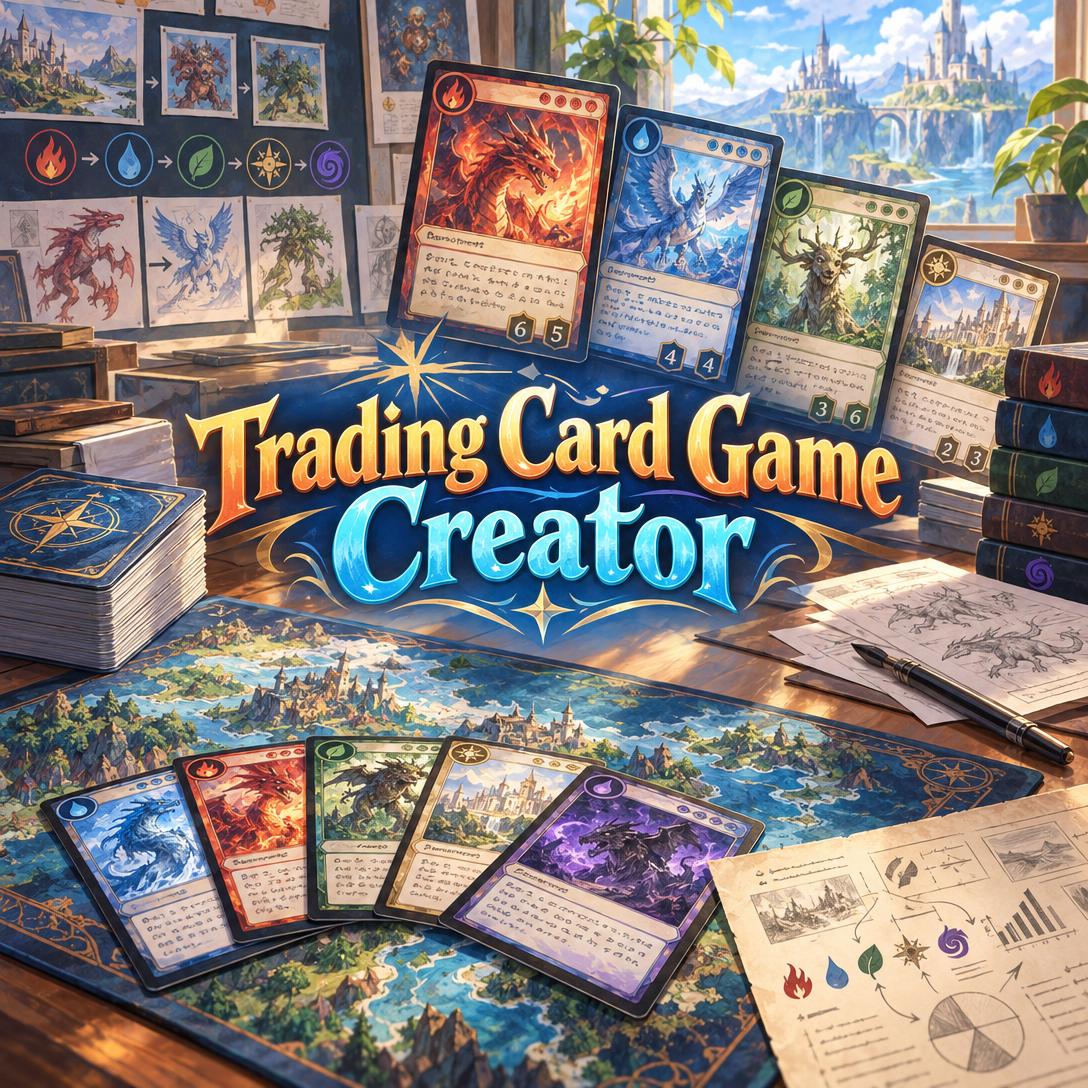
Trading Card Game Creator helps you design a complete trading card game by treating mechanics, lore, and card art as one system. While most custom TCG projects stall because rules, world-building, and visuals drift apart, this AI studio keeps a fire dragon as myth, illustration, and a costed 5/4 at the same time.
✅ Designs original TCGs from first concept through playable cards and set structure ✅ Locks rules language, card anatomy, factions, and visual references before mass card production ✅ Balances costs, stats, keywords, and archetypes instead of generating disconnected pretty pictures ✅ Produces card frames, card backs, rarity treatments, rulebooks, and expansion plans in one workflow
A finished TCG is not a pile of illustrations with numbers in the corners. It is a resource system, a combat model, a faction identity, a readable rules template, and a visual language that still looks like the same game on card 200. To understand why that integration is so hard to fake, it helps to look at what independent designers actually run into.
Quick Answer: What Is Trading Card Game Creator?
Trading Card Game Creator is an AI TCG studio that designs mechanics, world lore, card frames, and individual cards so a custom game stays playable and visually consistent. It can support a 30-card kitchen-table game or a multi-set, tournament-minded TCG.
Key capabilities:
- Game foundation: resource systems, turn structure, combat, win conditions, and keyword frameworks
- World-building that maps factions, characters, and magic systems onto mechanical identity
- Visual production: art direction, card frames, reference cards, rarity treatments, and card backs
- Card craft: stat/cost balancing, rules templating, flavor text, set architecture, and expansion planning
Creative Challenges in Custom TCG Design
The trading card game business is not a niche hobby shop anymore. Mordor Intelligence estimates the TCG market at USD 15.11 billion in 2026, on a path toward USD 24.36 billion by 2031 at a 10.03% CAGR. Non-sports titles — fantasy, anime, and original universes — already held 64.43% of market share in 2025, which is exactly the space most independent creators want to enter.
That demand is why so many people try to invent their own game. But turning a cool dragon sketch into a set people can actually play is frustratingly difficult:
- Mechanics, lore, and art are usually built by different people (or different tools) and never reconverge
- Card text drifts: “summon,” “play,” and “deploy” appear on the same type line across one set
- Illustration style slides after 20 cards, so commons look like a different product than rares
- Mana curves, vanilla stat rates, and degenerate combos get discovered after the set is “done”
USD 15.11 billion — Trading card game market value in 2026
10.03% CAGR — Projected TCG market growth from 2026 through 2031
64.43% — Share of the TCG market held by non-sports games in 2025
38% — Approximate share of players who engage with online trading card experiences
Indie teams feel this most on Kickstarter’s tabletop games category, where a campaign lives or dies on whether the prototype looks finished and the rules survive a second play. Commissioning a full set of unique illustrations, writing templated rules, and playtesting archetypes (aggro, control, midrange, combo, tempo) is months of specialist labor.
Physical cards still carry social weight that digital clones do not. Players talk about binders, trades, and the moment across the table when a bomb rare resolves — a gap Yahoo’s TCG coverage describes as ownership plus human reaction, not just a licensed digital copy. If you want a game people can print, sleeve, and argue about, the design has to be coherent enough to live off-screen.
Publishers already treat this as systems work. Hasbro has reported using AI inside Magic: The Gathering design workflows to speed set balancing and narrative integration. Independent creators rarely have a design team, a world bible editor, and an art director on staff. They need one studio that refuses to generate a 6-cost dragon until the game can explain what “6,” “dragon,” and that faction actually mean.
This is exactly what the TCG studio was built for.
How It Works
The TCG design studio walks a project through seven workstreams: introduction, game foundation, world-building, visual design, card creation, set architecture, and expansion design. You can jump around, but hard dependencies stay locked — no project cards before reference cards, no frames before a card schema.
Step 1: Lock the Game Foundation Decide what kind of game you are actually making: kitchen-table 30 cards, or a 120-card core set with draft and constructed in mind. Together you set identity, card types, resource economy, turn phases, combat, win conditions, and a rules language template so every later card uses the same verbs and trigger wording.
"I want a moderate-complexity fantasy TCG with four elemental factions, a single mana resource, 20 life, and creature combat that can hit the opposing player. Target audience is hobby-store night, not a 400-page living rules document."
Step 2: Map the World onto Mechanics Factions are not just color palettes. Aggressive cultures get haste, burn, and cheap threats; defensive cultures get shields, freeze, and expensive finishers. Characters, geography, and the magic system should explain why a keyword exists, not sit in a lore doc nobody reads during play.
If you also need named heroes, villains, and recurring faces with consistent portraits, Character Creator can build those figures as design references before they appear on legendary cards.
"The Ember Dominion should feel aggressive: low-cost creatures, Burn, and Haste. Frost Sovereignty is control — high toughness, Freeze, and Shield. Connect each keyword to the faction’s history."
Step 3: Freeze the Visual Language Before a single set card is generated, you establish an art style exemplar, card frames per type, faction accents, a card back, and a rarity reference sheet. Reference cards — fully finished examples with art, text, and stats in the locked layout — become the anchor against visual drift.
"Use high-fantasy painterly art, type-plus-accent frames, red/orange flame motifs for Ember, and show Common through Legendary treatments of the same creature so rarity is readable at arm’s length."
Step 4: Design and Generate Cards Against the Schema Each card is designed as data first: name, type, cost, stats, keywords, templated effect text, flavor, and art direction. Then the full portrait card is produced at standard TCG proportions, with a quality check for legible text, frame match, and faction color. Batches can be planned as a table (curve slots, rarities, roles) before images are made one by one.
"Create 10 Ember commons that fill the 1–4 mana slots: a mix of vanilla beaters, one Haste attacker, one Burn payoff, and no rules text longer than a single sentence."
Step 5: Build the Set, Then the Rulebook Once enough cards exist, you compose rarity distribution, booster logic, archetype support, and starter decks that actually teach a faction’s play pattern. The studio can then assemble a rulebook covering setup, card anatomy, combat examples, and a keyword glossary — the document a new player needs on night one.
If you are also documenting economy loops, progression, or a digital client around the same game, Game Designer Assistant is a natural next desk for systems analysis and design documentation that sits beside the card file.
Try Trading Card Game Creator free — no credit card required.
Creative Showcase
🐉 Original Fantasy Core Set
Scenario: You want a 120-card first set with four factions, eight keywords, and enough commons that a booster draft is possible among friends.
Traditional Approach: A designer writes a 40-page bible, an artist quotes per illustration, and six months later the 3-drops are all 4/4s with extra abilities while the 1-drops never got made.
The TCG studio: Locks a vanilla stat baseline, fills each faction’s curve, and generates reference-matched cards so Ember’s 2-drop and Frost’s 2-drop look like the same product in different colors.
- Rarity mapped to complexity (commons read on first glance; legendaries may bend a rule)
- Intended synergies and degenerate loops flagged while cards are still cheap to change
- Set registry tracking so you know Frost still needs uncommons at 3–4 mana
🎬 Licensed Universe, Card-Game Structure
Scenario: You have permission — or a fan-project brief — to translate a novel, anime, or game IP into houses, signature weapons, and set-sized story arcs.
Traditional Approach: You copy character names onto generic templates. The magic system never becomes a keyword, and locations never become a card type.
This studio: Maps houses to factions, major characters to legendaries, weapons to equipment, and story arcs to expansion themes, then still requires a full rules foundation and visual lock so the result plays like a TCG rather than a sticker album.
When environments and creatures need a stronger concept pass before they hit a card window, Concept Art Creator can explore silhouettes and world shapes that later become the art-style exemplar.
- IP is a starting map, not a cage — you can extend or reinterpret source material
- Type taxonomy stays mechanically distinct even when names come from an existing world
- Flavor text does world-building in two sentences instead of repeating the wiki
📱 Kitchen-Table Set Designed on a Phone
Scenario: You are on a commute and want a 40-card micro-TCG for two players, printable at home this weekend.
Traditional Approach: A desktop layout tool, a separate chat for rules, and a third app for images — none of which share a card schema.
The card creator on mobile: Same web, iOS, and Android workflow. You can lock a simple schema (name, type, cost, power, effect, art), generate a concept card to test the look, then build a tiny curve you can sleeve tonight.
- Speech-to-text for messy design notes while you walk
- Persistent memory so tomorrow’s session still knows “deploy,” not “summon”
- Complexity budget kept honest: one resource, two factions, no stack of nested triggers
Character cards still dominate collector demand — they held 60.78% of TCG market share in 2025 — which is why a phone-sized legendary with a readable face and a real ability outperforms a collage of unnamed spells. Digital formats are growing faster than paper in some estimates (11.4% CAGR for digital versus 7.6% for physical), but a design that prints cleanly still travels to both.
FAQ
Is Trading Card Game Creator free?
Yes. Trading Card Game Creator is available on a free plan with core features and limited monthly usage. Paid tiers increase usage if you are generating large sets, frames, and rulebooks in volume. No credit card is required to start, and you can design on web, iOS, or Android with the same project memory.
How is this different from a generic AI image generator?
An image model can draw a dragon. It will not tell you whether a 6-mana 5/4 with Burn 2 is above the vanilla rate, whether “When this is summoned” breaks your locked template, or whether the frame still matches card 47. This studio designs the card as a rules object, a lore object, and a visual object, then generates the portrait against reference frames so the set does not look like 80 unrelated commissions.
Can it design a complete original TCG, not just single cards?
Yes. Scope can be a short casual game or a multi-set TCG with rarity tables, booster composition, starter decks, and expansion planning that adds mechanics without erasing old cards. You can also import a half-built game: the studio audits what already exists and slots into the right phase instead of forcing you to restart.
Does Trading Card Game Creator work on mobile?
It does. Full feature parity across web, iOS, and Android means you can lock a schema on a laptop, generate frames at a desk, and review or request the next common on your phone. Chat history and project decisions persist, which matters when a TCG is a weeks-long artifact rather than a one-shot prompt.
Can it turn an existing story or IP into a card game?
Yes, with research and a structural map: factions, legendaries, equipment, keywords, locations, and set-sized conflicts. Existing IP still needs a locked card schema and visual references. The output is a TCG structure you can playtest, not a list of character portraits with invented stats.
How does card balancing work?
You choose the rigor. Casual games get outlier checks (“this 1-drop outclasses your 6-drops”). Structured projects can lock a vanilla stat rate, keyword costs, mana-curve targets, rarity-to-complexity ceilings, and archetype support. Evaluation language from real TCG design — tempo, card advantage, the vanilla test, quadrant theory — is used to explain trade-offs, not to bury you in unexplained numbers.
Conclusion
A custom trading card game fails in the gaps: when the lore book does not match the board, when card 12 and card 90 look like different products, and when the first playtest reveals that nobody can parse the text. The market around those games is large and still growing, from hobby-store paper to digital play, but players can feel an incoherent set in the first pack.
Trading Card Game Creator is the studio that keeps mechanics, world, and art on the same card. You leave with frames, reference language, balanced cards, and a set you can print, sleeve, and expand — not a folder of unrelated dragons.
Try Trading Card Game Creator now. Explore more at Jenova.
For Developers: Trading Card Game Creator is available programmatically via the Jenova API — integrate TCG design, rules templating, and card generation into your application with a single API call. Full documentation →