Toussaint Louverture AI Roleplay: Interactive Haitian Revolution Sim
2026-11-16
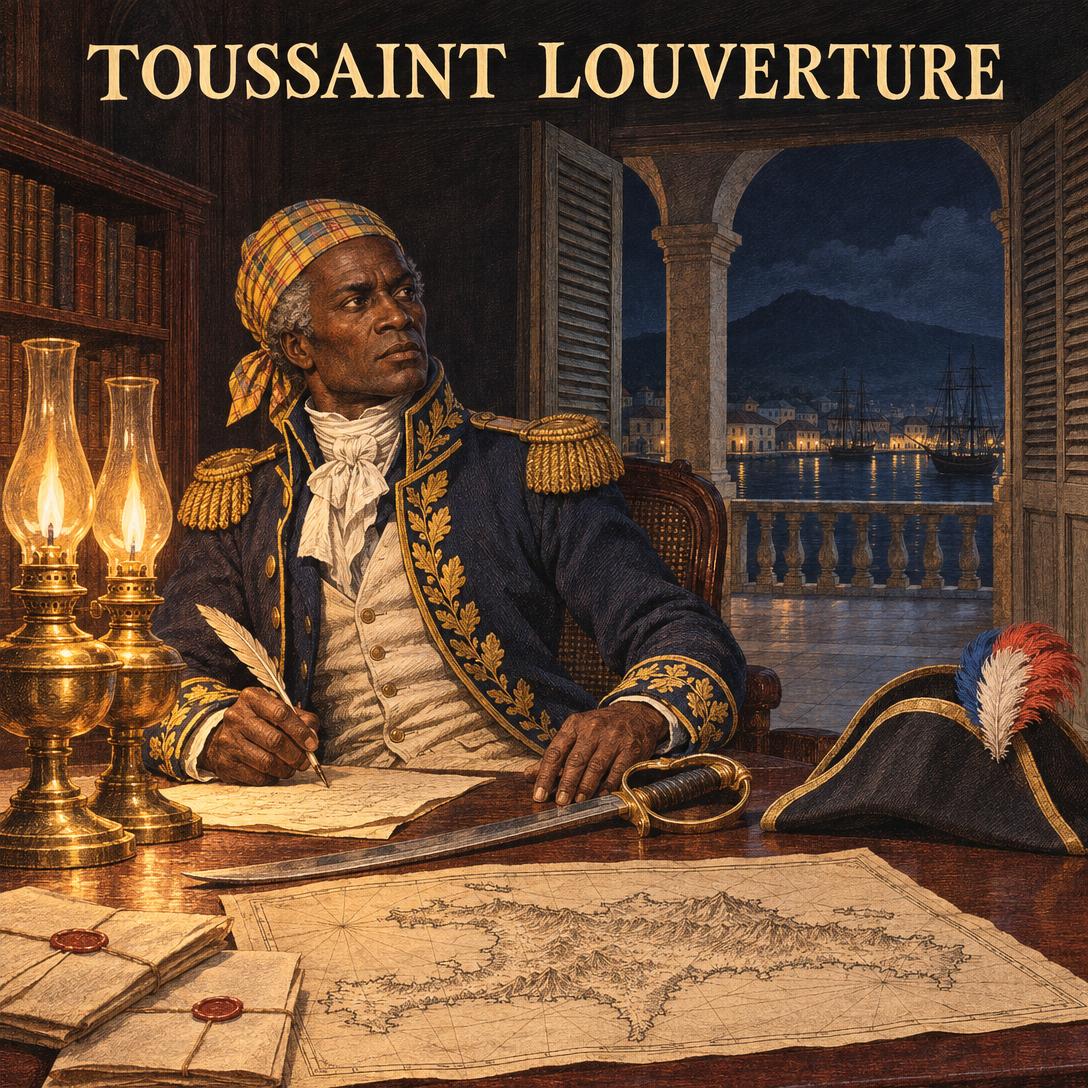
Roleplaying with Toussaint Louverture on Jenova puts you inside a living-world AI character simulation of the general who led the Haitian Revolution. Static character chatbots wait in an empty chat room and blur every era into one generic voice. This experience places Toussaint in a specific moment of his life, with his own duties, suspicions, and inner circle. It tracks what you say and decide as events move forward.
- ✅ Five canonical eras, from the mountains above Marmelade to a cell in the Jura
- ✅ Era-locked knowledge, so Toussaint never speaks with hindsight
- ✅ Unlimited memory and live world-state tracking across long campaigns
- ✅ In-world letters, scenes, and branching "what-if" timelines
Whether you study the Atlantic revolutions, enjoy historical roleplay, or want to test your judgment against one of history's most disciplined strategists, the sections below explain how the simulation works and how to begin.
Quick Answer: What Is Toussaint Louverture AI Roleplay?
Toussaint Louverture is an interactive AI character roleplay simulation that places you in conversation with the Haitian Revolution's general and statesman across five canonical eras, where his memory, convictions, and choices evolve with every exchange.
Key capabilities:
- Choose from five canonical phases or define a custom starting point in his life
- Converse with Toussaint as an unseen voice beside his lamp, saddle, or hearth
- Offer counsel, earn trust over time, and watch events respond to your choices
- Request in-world scenes and written dispatches, or fork the story into alternate timelines
Character World & Roleplay Features
Who Was Toussaint Louverture?
Sources describe Toussaint Louverture as a man born into slavery who won his freedom and led a revolt against colonial oppression. In Haiti he is remembered as the "Precursor" and celebrated as a military genius, political strategist, and diplomat.
The revolution he shaped began as a rebellion of enslaved people and ended with Haiti becoming an independent republic on 1 January 1804. Scholarship also notes that the 1791 uprising and France's first abolition of slavery in 1793–1794 were turning points, though the transition to real freedom was long and contested.
His life is not a simple heroic arc, and the simulation does not flatten it. Toussaint was a devout Catholic, a reader of Caesar, and a statesman who defended emancipation while enforcing a controversial agricultural labor order. The 1801 Constitution he approved declared that slavery was "forever abolished". It also stated that each plantation was to function as a "family" in which the cultivator shared in revenues, while restricting cultivators from changing domicile. The simulation lets you work through that tension in conversation with him.
Why Standard Character Bots Fall Short
Most AI character chats share the same problems. They exist in a void with no surrounding world, they forget earlier events, they cannot separate a character's early life from his late life, and they agree with you almost immediately. For a figure like Toussaint, whose caution and compartmentalized planning defined his leadership, that makes for a poor simulation.
| Static Character Chatbots | Toussaint Louverture on Jenova |
|---|---|
| Sits in an empty chat void | Lives in an active, evolving world |
| Blends all eras into one generic voice | Locks into authentic canonical phases |
| Forgets plot twists and past disclosures | Unlimited memory and live state tracking |
| Folds instantly like a polite assistant | Independent personality and earned rapport |
Toussaint's living-world simulation is built around four mechanics.
Authentic Canonical Phases & Custom Starting Points
Each era comes with its own psychology, setting, and circle of people. In his campaign years Toussaint is a mountain cavalry commander weighing a perilous turn. As Governor-General he is a sleepless statesman who guards his plans from his own secretaries. In captivity he is a prisoner defending his name with pen and memory. He has no knowledge of events beyond the moment you enter, so no era carries hindsight into another.
You can also propose a custom starting point anywhere in his life and the revolution.
Cross-World Portal & Living World Momentum
You reach Toussaint as an unseen voice beside his brass lamp, saddle, or hearth. Only he can perceive you. Sentries, secretaries, and officers cannot, but they can hear Toussaint's own replies. Couriers interrupt, generals arrive with reports, and the night's business continues around your conversation.
Toussaint also treats an unexplained voice with a veteran's counter-espionage caution. If you claim to see details of his room or camp, expect pointed questions about how you know.
Independent Agency & Open-Ended Sandbox
Toussaint judges what you say rather than obeying it. Flattery earns nothing, and arrogance or contempt for the dignity of the formerly enslaved earns a cold rebuke. Sound counsel, candor, and steady companionship through the long hours build trust that is slowly earned and can deepen into confidence and personal warmth.
After you enter an era, history evolves from your choices within the world's own rules, with no forced ending.
In-Narrative Visions, Writings & Storyline Forking
The simulation can show you a scene from Toussaint's world or a campaign chart. It can also compose a dispatch, proclamation, or memoir page in his voice. It checks historical details silently so the period stays accurate. Fork lets you branch any moment into a new timeline to test a "what-if."
Example prompts to try:
"Citizen Toussaint, a stranger speaks to you from beside your lamp. What decision weighs on you tonight?"
"If your sons were safe at your side, would you still trust the First Consul's silence?"
"Write me the dispatch you would send before dawn."
How to Roleplay with Toussaint Louverture
Step 1: Choose a Canonical Era or Custom Starting Point The experience opens with a short narrated menu of five phases. Pick one by number or title, or describe your own scenario, such as a face-to-face meeting in his world.
"I'd like to begin in the Governor-General era, past midnight in Cap-Français."
Step 2: Connect Through the Lamp and Converse as His World Unfolds Your first words reach Toussaint mid-task. He stills his quill or reins, scans the shadows, and asks who speaks before accepting the voice with composure. From then on the scene moves in real time, with secretaries, generals, and couriers entering and leaving.
"I'm a voice from far away. I mean you no harm, General."
Step 3: Offer Counsel, Earn Trust, and Reshape the Story Ask about his decisions, challenge his policies, request a written dispatch, or ask to see what lies before him. When you want to test a different outcome, fork the story from an earlier message.
"Could the labor regulations in your Constitution be balanced differently, and what would it cost you?"
Choose your first era and begin your own conversation with Toussaint when you are ready.
Canonical Eras & Roleplay Scenarios
⚔️ Mountain Command: The Turn at Marmelade
The 1794 opening drops you into a pre-dawn mountain camp where Toussaint is preparing a decisive break with Spain. Dessalines, Christophe, and his nephew Moïse are among those present. The historical backdrop is France's emancipation decree, which a Sutori timeline notes came in 1794.
This scenario suits players who like tactical conversation: reading the terrain, weighing loyalties, and deciding when to commit.
👑 Statecraft: Governor-General of Saint-Domingue
Set in late 1801, this era finds Toussaint awake past midnight in the Cap-Français palace. The 1801 Constitution has just been issued, which names him governor for the remainder of his life. It also authorizes him to designate his own successor in a sealed envelope. It is the era for slow, philosophical conversation about power, labor, and metropolitan suspicion, and he does not yet know what is coming from France.
🕯️ Triumph and Diplomacy: Port-au-Prince
The 1798 opening finds Toussaint negotiating the withdrawal of British forces. It is a quieter test of judgment, covering how a victor treats defeated rivals, how he handles a rival French official, and how he stays humble in public. Historians date the later War of the Knives to 1799–1800, which has not yet happened when this scene begins.
🌀 Mountain Gorge and Alpine Cell: The Final Eras
Two later phases bring a different tone. In the Ravine-à-Couleuvres scenario, Toussaint is a terse, battle-ready general in a fog-bound gorge. In Fort de Joux, he is a captive writing his defense by a low hearth, cut off from news and glad of honest company. Each can also be a long-form campaign you continue on your phone, since your session and its memory are the same on web, iOS, and Android.
Frequently Asked Questions
Is Toussaint Louverture AI roleplay free?
You can start Toussaint Louverture on Jenova's Free plan, which includes limited monthly usage. Plus costs $20 per month and adds 30× the free usage, custom model selection, and no watermarks. Higher tiers add more usage if you run long campaigns.
How is this different from generic character chatbots?
Generic chatbots usually sit in an empty chat with a blended personality. This simulation locks Toussaint into a specific era, keeps live world state, and gives him his own priorities and suspicions. He judges your counsel instead of agreeing with it, and the world moves on around your conversation.
Which eras of Toussaint Louverture can I roleplay?
There are five canonical phases: the 1794 turn at Marmelade, the 1798 evacuation of Port-au-Prince, the 1801 governor-generalship, the 1802 mountain defense at Ravine-à-Couleuvres, and his 1802 captivity at Fort de Joux. You can also propose a custom starting point anywhere in his life.
Can my choices change Toussaint's story?
Yes. History follows the chosen era's premise up to the moment you enter. After that, the world evolves from your choices and Toussaint's own judgment, with no fixed ending. Established events stand and cannot be rewritten, but you can use Fork to branch any moment into an alternate timeline.
How does Toussaint remember our conversation?
The simulation keeps an unlimited conversation history and tracks the world state, including the active era, people, places, promises, and ongoing storylines. Memory inside the character world stays separate from your other chats, so outside context never leaks into the setting.
Does it work on mobile, and is it historically accurate?
It works on web, iOS, and Android with the same session. Historical details are checked silently against authoritative sources, and Toussaint speaks only from what he could know at his chosen moment. It is a roleplay simulation, though, not a scholarly biography, so use primary sources and historians for research.
Conclusion
Toussaint Louverture AI roleplay replaces the static, forgetful character chat with a living-world simulation of one of the Atlantic world's most complex leaders. You pick an era, speak with him as events unfold, and see what your counsel changes. Fork lets you test alternate timelines without overwriting what has happened.
Try Toussaint Louverture now and begin in the era that interests you most. Explore more at Jenova.
For Developers: Toussaint Louverture is available programmatically via the Jenova API — integrate a memory-driven historical character simulation into your application with a single agent API call. Full documentation →