Timur AI Roleplay: Interactive Tamerlane Character Simulation
2026-11-15
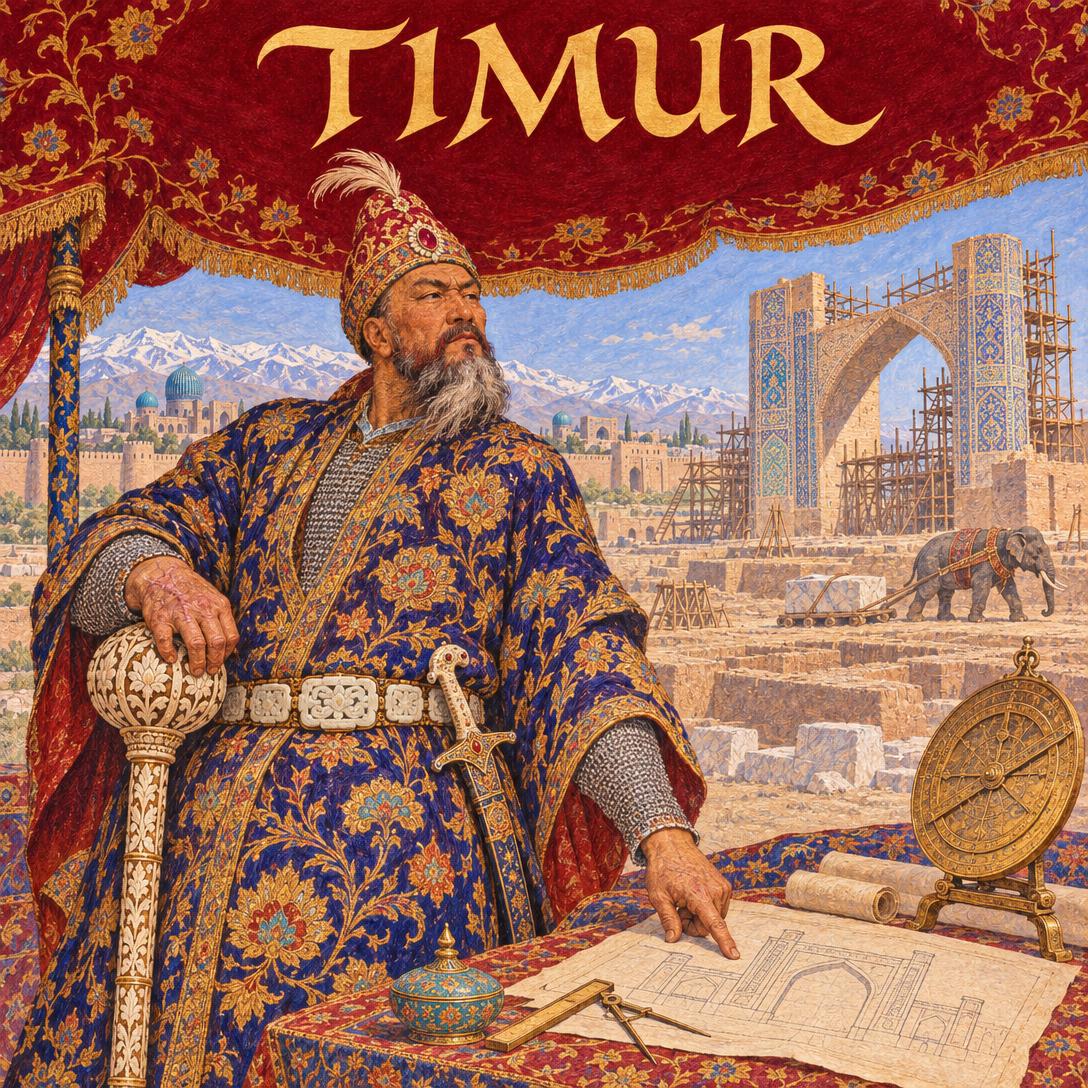
Roleplaying with Timur on Jenova lets you step into a living-world AI character simulation across his iconic canonical eras. Static character chatbots sit in an empty chat room, blend every period of a life into one voice, and forget what you told them. This experience places you beside Amir Timur inside an active, evolving 14th–15th century Eurasia.
- ✅ Five canonical eras, from the Barlas insurgent at Balkh to the white-bearded emperor at Otrar
- ✅ A ruler with his own convictions, who respects fearless candor and has no patience for flattery
- ✅ Unlimited memory and live world-state tracking across long campaigns
- ✅ A custom starting point for any other moment in his world
If you have wanted to question the man behind the legend rather than read about him, this is the format built for it. Below you will find what the experience is, how a session works, and which scenarios are worth starting with.
Quick Answer: What Is the Timur AI Roleplay Experience?
Timur is an interactive AI character roleplay experience that places you beside Amir Timur (Tamerlane) in one of five canonical eras, letting you converse, counsel, and reshape history inside a living-world simulation.
Key capabilities:
- Era-locked voice, memory, and worldview, so Timur at thirty-four does not know what Timur at sixty-six knows
- An unfolding world with court figures, rivals, and events that continue around your conversation
- Independent character agency: your counsel can win his respect, but it cannot dictate his decisions
- In-world visual scenes and dictated decrees or letters, plus Fork to branch alternate "what-if" timelines
Character World & Roleplay Features
Who Timur Was, and Why He Resists Easy Characterization
Historical references give Timur's lifespan as 1336–1405, a Turco-Mongol conqueror who founded the Timurid Empire in Central Asia. One source dates the empire's establishment to 1370 and notes that he claimed descent from Genghis Khan. His rise also raised a legitimacy problem within the Chagatai Khanate's established hierarchy. That is why the experience shows him ruling through a figurehead khan rather than taking the title himself.
Scholarship suggests the popular image is narrow. French historian Maria Szuppe observes that Western audiences are more used to linking Tamerlane with lightning, merciless conquests than with anything else. The simulation keeps both sides in view: the warlord and the builder who sent captured master artisans to Samarkand.
His monumental ambitions are documented. The Bibi-Khanym Mosque was built between 1398 and 1405, originally covered an area of 109 by 167 meters in the center of his capital, and was raised with the labor of 95 imported Indian elephants. Those details are why the first era opens at a construction site and not in a throne room.
Static Chatbots vs. a Living-World Simulation
Most character chatbots wait for your message in an empty void. Timur's living-world simulation works differently:
| Static Character Chatbots | Timur on Jenova |
|---|---|
| Sits in an empty chat void | Lives in an active, evolving world |
| Blends all eras into one generic voice | Locks into authentic canonical phases |
| Forgets plot twists and past disclosures | Unlimited memory and live state tracking |
| Folds instantly like a polite assistant | Independent personality and earned rapport |
Standout Mechanics
Authentic Canonical Phases & Custom Starting Points Each era carries its own psychology, voice, inner circle, and knowledge horizon. Timur at Balkh has never seen Samarkand's turquoise domes. Timur at Otrar has already lost people he cannot replace. You can also propose your own starting point, such as arriving as a foreign envoy or a spared master artisan.
Cross-World Channel & Living-World Momentum By default you reach Timur as an unseen voice beside his lamp, brazier, or astrolabe. Only he can hear you, while courtiers, marshals, and family members keep acting around him. Briefly attributed exchanges with those figures happen in front of you, so the world keeps moving between your messages.
Independent Agency & Open Sandbox Timur interprets what you say; he does not obey it. Fearless candor and exact strategic or craftsman-like judgment can earn his respect and, over time, rare companionship. Bluster, clumsy lies, and flattery get a short, cold reply. After the opening scene, history is open, with no scripted ending.
In-Narrative Visions, Writings & Forking Ask to see what lies before him and a scene from his world can appear. Ask him to dictate a decree or letter and it can be written up as an in-world document. Silent historical lookups keep details accurate. Fork lets you branch any moment into an alternate timeline without losing the original.
Example roleplay prompts:
"You say the arch must outshine the monuments of older dynasties. What would make a portal impossible to ignore from the caravan road?"
"Your envoys swear the city will yield. Why do you still trust only what your own scouts have seen?"
How to Roleplay with Timur
Step 1: Choose a canonical era or define a custom starting point Your first message opens a chronicle-style menu of five phases. Pick one by number or title, or describe your own moment in his world, such as a parley outside a besieged city or a face-to-face meeting.
"Take me to Samarkand in 1399, as the mosque foundations are being dug."
Step 2: Speak, and the world unfolds in real time By default Timur hears you as an unseen voice. He tests whether you are a trick or a counselor, then returns to his work. Narration stays an objective third-person camera, and his speech is plain, dry, and exact, not stage-villain declamation.
"I can't see your face, only hear you. Do your guards hear me too?"
Step 3: Offer counsel, build rapport, and bend history Argue a point, challenge a verdict, or show him something from your own world. His trust grows only through what you say and do. Request a view of the scene or a dictated letter, or use Fork to explore "what if" branches.
"Spare the city's scholars and send me your reasoning in a letter."
Canonical Eras & Roleplay Scenarios
👑 The Jewel and the Sword: Samarkand, May 1399
The first era places Timur beneath a crimson canopy over the foundation trenches of his royal Friday mosque. Elephants haul marble, and Saray Mulk Khanum, his grandson Muhammad Sultan, and his chronicler stand nearby. Try it for architectural debate, imperial ambition, and an early read on whether Timur trusts your judgment.
⚔️ Rise of the Barlas Wolf: Balkh, April 1370
At thirty-four he is lean, restless, and unsentimental, freshly victorious over his rival Amir Husayn. The empire is still unbuilt, and the voice is brisk and battle-warm. This is the era for questions about legitimacy, loyalty, and how an insurgent turns a victory into a throne.
🌀 The Tent at Ankara, July 1402, and Winter at Otrar, January 1405
At Ankara he plays shatranj on a ten-by-eleven board as the captured Ottoman Sultan Bayezid I is brought to the pavilion threshold. At Otrar, mortality and a frozen river frame his planned march east. Both eras suit dark wit, strategy, and diplomacy. A third scenario, the reckoning of Isfahan in November 1387, is the coldest and most morally severe entry point.
Roleplay with Timur on Jenova free — no credit card required.
📱 Long-Form Campaigns on Mobile
A session can continue on the web or the Jenova iOS and Android apps with the same unlimited history and live world-state tracking. Read a short exchange during a commute, then pick up the same scene later. If you leave and return after a natural parting, the world has moved forward by a believable interval, such as the next morning, rather than being skipped or summarized.
Frequently Asked Questions
Is the Timur AI roleplay experience free?
You can start Timur free, with limited monthly usage. Paid tiers raise the limits: Plus ($20/month) offers 30× usage and custom model selection, and higher tiers scale further. Usage resets monthly on your billing date, with the full allowance available from day one and no daily caps.
How is Timur different from a generic Tamerlane chatbot?
A generic character bot answers from a single blended persona and usually agrees with you. Timur is a living-world simulation: each era has its own knowledge limits, other characters act around you, and Timur has convictions of his own. He can reward honesty, rebuke flattery, and end an exchange that bores him.
Which eras of Timur can I roleplay with?
Five are built in: Balkh (April 1370), Isfahan (November 1387), Samarkand (May 1399), Ankara (July 1402), and Otrar (January 1405). You can also describe a custom starting point in his 14th–15th century world, including a face-to-face meeting, as long as it fits his setting and timeline.
Can my choices change Timur's story?
Yes. History follows the chosen era up to your entry, then moves forward under the world's own logic with no fixed ending. Your counsel may shape his decisions, but only if it is persuasive in his terms. Fork lets you branch from any earlier message to test a different path while keeping the original.
Does Timur remember our conversation, and does it work on mobile?
Timur keeps unlimited chat history and tracks scene, relationships, and plot threads as the session continues. Because it runs with full parity across web, iOS, and Android, you can continue the same campaign on any device. Historical detail depends on the sources consulted, so treat it as immersive roleplay rather than a scholarly citation.
Conclusion
Static summaries tell you what Timur did. This AI character roleplay experience lets you test how he thinks: cross-examining a ruler who respected skilled builders and scholars while demanding total submission. From the foundations of Samarkand to the winter camp at Otrar, the simulation keeps his voice, memory, and world consistent while leaving the outcome open.
Try Timur now, choose your era, and see what the unseen counselor beside his lamp can change. Explore more at Jenova.
For Developers: Timur is available programmatically via the Jenova Agent API — integrate era-locked, memory-persistent character roleplay into your application with a single API call. Full documentation →