AI Time Loop Story Generator: Structure Loops That Earn the Reset
2026-09-10
Writing Assistant helps you generate a time loop story by locking the reset rules, the memory map, and the one thing that can actually change. While most drafts stall on the second iteration — same café, same clock, no new information — this AI provides a causal scaffold so each pass costs the protagonist something. In September 2026, writers still lose weeks rewriting day one instead of designing the loop as a machine. You get a partner that will interrogate who remembers, what persists, and why the exit is earned.
✅ Defines loop length, memory, and persistence before you write prose ✅ Flags iterations that repeat without new information or cost ✅ Drafts beat sheets, iteration logs, and exit conditions in your voice ✅ Works for short fiction, screenplays, comics, and playable narrative
To understand why this matters, look at how time loop stories collapse even when the premise is strong. Readers will forgive a simple reset. They will not forgive a twelfth morning that teaches them nothing.
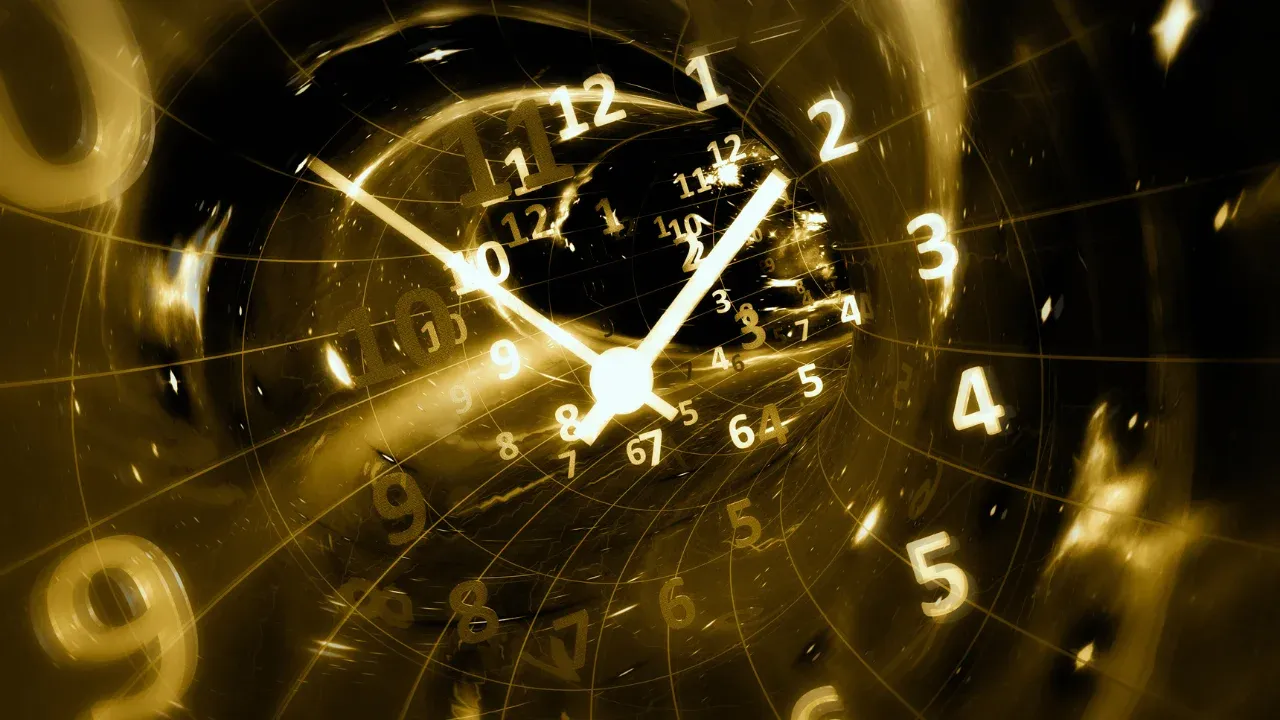
Quick Answer: What Is a Time Loop Story Generator?
A time loop story generator is a writing tool that builds a repeating timeline with locked rules, changing information, and an earned exit so each iteration still advances character and plot. It is the layer that turns “the day repeats” into a causal machine.
Key capabilities:
- Reset length, trigger, and what the world forgets
- Memory rules: who retains what, and what objects persist
- Iteration logs that force new information, cost, or failure each pass
- Exit conditions that follow from the rules, not from fatigue
- Voice-matched drafts of the same scene at iteration 1, 7, and 40
Why Time Loop Stories Stall After Day One
Writers are not short on appetite for this form. [Story prototyping tools were valued at $2.8 billion in 2025](https://dataintelo.com/report/story-prototyping-tools-market) and are projected toward $7.1 billion by 2034, which is a useful proxy for how much narrative is now sketched, branched, and stress-tested before anyone types “Chapter 1.” Interactive film and television sits on a similar curve: the [interactive film and TV market was valued at $3 billion in 2025](https://www.wiseguyreports.com/reports/interactive-film-television-market) with a path toward $7 billion by 2035. Time loops thrive in both spaces because a reset is cheap to stage and expensive to write well.
$2.8 billion — Story prototyping tools market value in 2025
That NSF project names the exact tension a loop dramatizes. Virtual environments need the participant’s agency — meaningful choice — without abandoning the author’s structure. A time loop is author structure made visible: the street, the clock, the crowd all lock. The only free variable is what the rememberer does with a day they have already spent.
But building a loop that resets cleanly and still escalates is frustratingly difficult:
- The reset is a costume change; the second morning copies the first
- Memory rules drift, so a notebook survives a wipe the protagonist does not
- Paradoxes (bootstrap, grandfather, predestination) collide inside one scene
- The escape arrives because the writer is tired, not because the rules paid off
Iteration without accumulation
Interactive narrative research keeps returning to the relevance of decisions: a choice that does not change what the audience can know or do is decoration. In a loop, that failure is louder. If iteration 4 is iteration 1 with a different metaphor for rain, the reader has already left. Interactive narrative design is supposed to create meaningful participatory experiences — even on the page, the reader is participating by tracking the machine. Stop feeding the tracker and the premise dies.
Rules that contradict the wipe
Time-travel fiction lives on paradoxes: closed causal loops, grandfather problems, information that has no origin. You do not need to solve physics. You do need one consistent answer to three questions: What resets? Who remembers? What, if anything, leaks? When a handwritten note says the minute never changes and no one remembers — then a stranger comments on yesterday — the loop is already broken, and not as plot.
Exits that feel like the author giving up
A fair loop teaches the protagonist how to leave. An arbitrary loop waits for a solar flare, a magic word, or a sudden sermon. Readers who have invested eight iterations will accept a hard ending. They will not accept an ending that ignores the rules you spent those iterations teaching.
This is exactly what Writing Assistant was built for.
Why Writing Assistant
Writing Assistant treats the loop as a product: a set of constraints, a memory model, and a sequence of scenes that must not clone each other. You bring the fantasy — a street clock stuck at 11:55, a historian who keeps rewriting the same knight, a commuter who is the only person who notices the identical men on the crosswalk — and it answers with rules, beat sheets, and prose that can survive a tenth pass.
The risk of one-click generation is real. Writers who hand the whole draft to a model tend to off-load the thinking and produce more uniform work. A useful generator does the opposite. It refuses a pretty paragraph that violates the wipe. It asks what the protagonist knows now that they did not know at dawn. It keeps your diction so iteration 12 still sounds like you, not like a template of déjà vu.
| Traditional Approach | Writing Assistant |
|---|---|
| Rewrite the opening café until it sparkles | Lock reset, memory, and persistence, then write the café once |
| Each iteration is a full-day recap | An iteration log: new information, new cost, new failure |
| Paradoxes appear when a later chapter needs them | One paradox type chosen up front and stress-tested |
| The exit is a twist you invent on page 90 | The exit is implied by the rules on page 1 |
Build the machine before the morning
The assistant will push you to a one-page loop bible: duration (a minute, a commute, a day, twenty-five years), trigger, who is loop-aware, what objects persist, and the fail condition if the protagonist does nothing. That page is the story. Prose is how you prove it.
"Define a 24-hour loop in a rain-soaked city. Only the protagonist remembers. Analog clocks freeze at 11:55. Digital clocks keep moving. A notebook written in ink persists; pencil does not. List five things she can change by iteration 6 and three she still cannot."
"Rewrite this Groundhog-style morning so iteration 1 is ignorance, iteration 4 is experiment, and iteration 9 is moral cost. No recap longer than 80 words."
"The escape cannot be love or a speech. Derive three exits that follow from the frozen-clock rule, then pick the cruelest one that still feels fair."
Same scene, three information states
A loop is not twelve chapters. It is one chapter photographed at different knowledge levels. The street is identical. The sentence order should not be. Ask for the same 400 words as a first pass, a tactical pass, and a heartbroken pass, and keep the physical blocking still. If the blocking has to move for the prose to work, the loop is cheating.
Causal honesty, not physics homework
You can run a closed bootstrap (the protagonist causes the loop that traps them), an open breakable loop, or a predestination trap. Mixing all three in one novella is how drafts die in chapter six. The assistant will make you pick, then hunt every scene that smuggles in a second metaphysics.
Related Agents You'll Also Find Useful
If the loop bible is the skeleton, these partners cover the forms you will likely need within a few sessions of locking the rules.
Film Screenwriter
A time loop on screen is a visual rhyme: the same clock, the same crossing, a frame that must be recognizable on pass three. Film Screenwriter turns the bible into sluglines, intercuts, and a reset that a reader can see without a caption.
- Boards the “camera” so iteration 1 and iteration 8 share blocking
- Writes dialogue that can repeat with one altered stress
- Keeps act structure honest when the calendar never advances
Comic Creator
Comics make the loop’s rigidity visible: identical panels, one changing detail, a crowd walking in lockstep. Comic Creator is the partner for that sequential proof.
- Turns a five-iteration arc into a readable page rhythm
- Spots panels that accidentally move a prop the wipe should restore
- Gives writers a picture of space: who has the doorway, who is already a copy
Game Designer Assistant
If the loop is playable, the reader is a player. Game Designer Assistant stress-tests verbs, fail-forward deaths, and knowledge that persists across a run.
- Maps which discoveries are run-knowledge vs. character-knowledge
- Flags puzzles that require a wiki instead of a second attempt
- Documents victory as an exit the systems already taught
Try Writing Assistant free — no credit card required.
How It Works
Step 1: Name the prison, not the vibe
Open with the constraint the audience will learn to hate. A minute stuck at 11:55 is a different machine than a 25-year cycle. Tell the writing partner who is loop-aware, what “winning” does to everyone else, and how many iterations the reader should sit through before the exit.
"One woman, one street clock frozen at 11:55, a city that resets around her. She keeps a notepad. No one else remembers. I need a short-story loop with seven on-page iterations and an exit that uses the clock, not a speech."
Step 2: Lock memory, persistence, and the information budget
Write the wipe as a checklist. People, weather, receipts, wounds, recordings, rumors. Then give the protagonist one leak — a stain, a scar, a sentence in ink — and make every iteration spend that leak on a new fact. If the leak explains the whole mystery on pass two, shrink it.
"Persistence: ink, scars, and analog timepieces. Wipe: digital logs, other people's memory, weather. She may learn one new rule per iteration. Stop me if I break that."
Step 3: Draft the visual rhyme before the interiority
A loop the reader can see will survive a quieter interior. Use a clock, a crossing, a corridor, a crowd that moves as one. Then write the first morning as blocking, not mood.
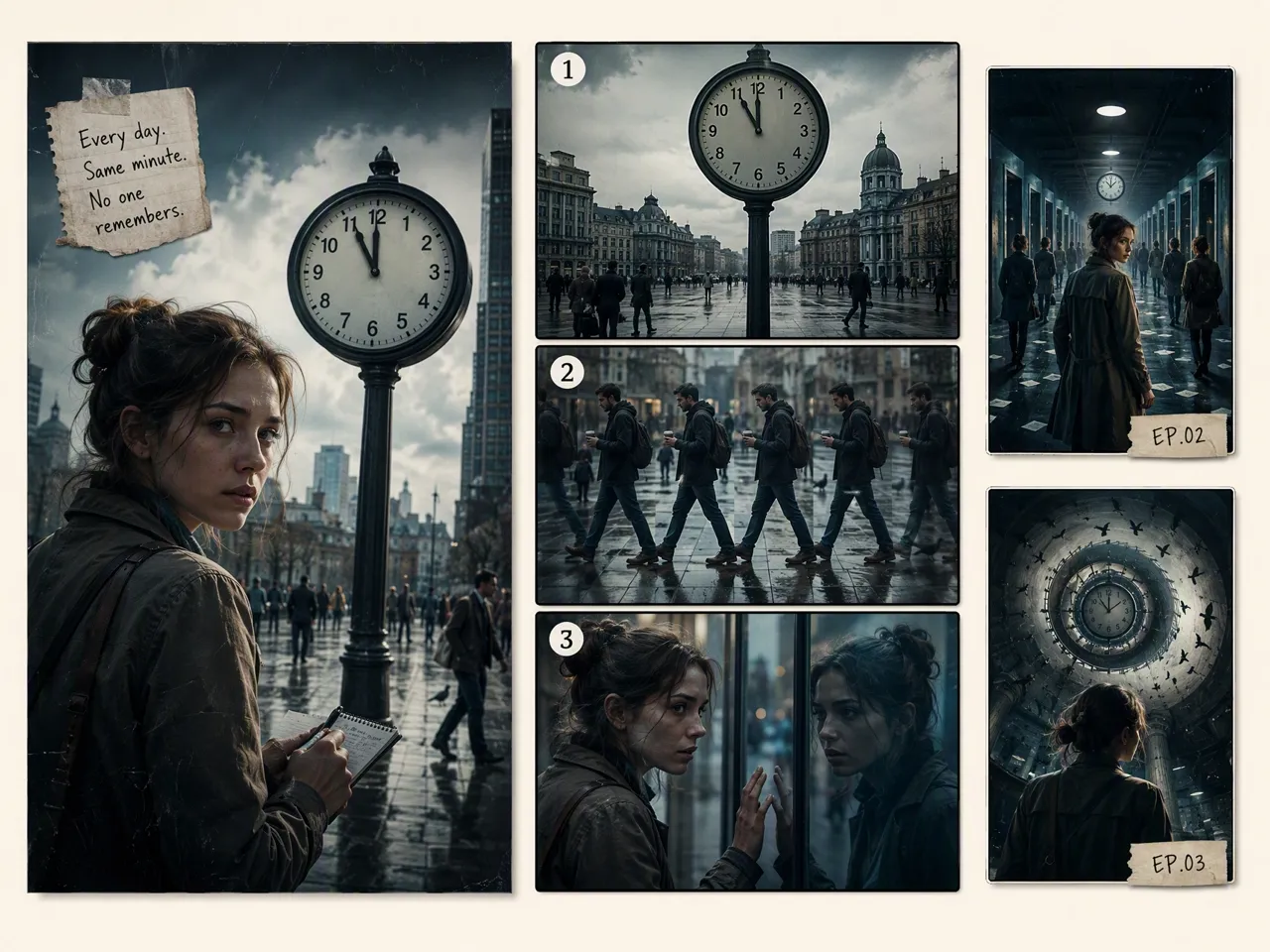
That board is the contract: the clock does not move, the extras repeat, and only the rememberer’s face is allowed to change. If your prose cannot honor that, cut description, not the rule.
"Turn this loop into a six-panel beat sheet: frozen clock, identical crosswalk, the note, the corridor, the mirror, the spiral. Caption each panel with what she knows that the extras do not."
Step 4: Run an iteration log, not a synopsis
For each pass, record only four lines: what she tries, what the world does anyway, what she learns, what it costs. Whenever a pass adds no cost and no fact, delete it. This is also where you hand a screenplay pass to a film partner or a page rhythm to comics if the rules are right and the medium is not.
Step 5: Derive the exit from the rules you already taught
List every leak you allowed. The ending should spend them. A clock that never reaches noon should matter at the close. A city that forgets should pay a price if someone is finally remembered. Then write the last iteration at the same length as the first, so the reader can feel the difference in information, not in word count.
Results & Use Cases
📊 A short story that does not recap the rain
Scenario: You have a literary loop: a woman, a frozen street clock, a notepad. Draft 2 is 9,000 words of weather.
Traditional Approach: Rewrite the opening seven times. Beta readers skip to the “real” plot, which never arrives because the real plot was supposed to be the repetitions.
Writing Assistant: You cap on-page iterations at seven, freeze analog time at 11:55, and make ink the only memory that survives. Each pass is an experiment with a cost: a stolen minute, a ruined alliance, a sentence she should not have written down.
- Readers can track the machine without a diagram
- The notepad becomes evidence, not a diary
- The last morning is short because the information is dense, not because you truncated
💼 A feature outline that can actually be shot
Scenario: A producer wants a loop thriller they can budget. Twelve unique locations per iteration will kill the film.
Traditional Approach: A 40-page treatment that treats every reset as a new set day. The third-act “break” is a lecture about fate.
Film Screenwriter: You lock four recurring locations and one visual tell (the clock). Dialogue is written to be repeated with a single changed stress. Comic Creator boards the crosswalk so extras stay identical while the lead’s eyeline changes.
- The loop is visible in stills, not only in voiceover
- Iteration 8 is cheaper than iteration 1, which is the point
- The exit is a physical action with the clock, already planted in scene one
📱 Beats on a phone between stops
Scenario: You commute. You can draft on a phone with one thumb. A 2,000-word recap of “day one again” will not get finished before the station.
Traditional Approach: Notes app fragments, no rules document, a weekend of trying to remember whether the scar persisted.
Writing Assistant: You keep a four-line iteration log in chat. Each session adds one pass. The same thread syncs to web, iOS, and Android, so the loop bible is in your pocket when a new leak occurs to you on the platform.
- One iteration per session, not a novel on the train
- Memory rules are a checklist you can tap through
- You can read the last three logs aloud and hear whether the cost is actually rising
🎯 A playable loop that does not need a wiki
Scenario: You are designing a game where death is a reset. Players are spoiling the mystery in a forum instead of dying on purpose.
Traditional Approach: Lore dump on a loading screen. Knowledge the character should not have leaks into the UI.
Game Designer Assistant: You split run-knowledge from character-knowledge, make every death spend a tell, and require the exit to be executable with verbs the player already has. The writing partner then writes the in-world note — “Every day. Same minute. No one remembers.” — as a diegetic UI, not a quest marker.
- Failures teach the next run
- The mystery is a loop rule, not a cutscene
- Design and prose share one memory model
FAQ
What is a time loop story generator?
A time loop story generator is a writing workflow that produces a repeating timeline with explicit rules: what resets, who remembers, what persists, and how the protagonist leaves. It is not a button that emits a Groundhog Day clone. The useful version outputs a loop bible, an iteration log, and scenes that change in information and cost even when the street does not.
How do I keep time loop iterations from feeling repetitive?
Give every pass a budget: one new fact, one new cost, one failed tactic. Keep blocking still so the reader can see the difference. Interactive stories fail when decisions stop being relevant; a loop fails the same way when iteration 6 does not answer a question iteration 5 asked. Writing Assistant will refuse a pretty recap that adds neither.
Is Writing Assistant free?
Yes. You can use it on the free tier with core features and limited monthly usage. Paid tiers raise usage if you are iterating on long loop bibles, multiple POVs, or a full screenplay. You do not need a paid plan to lock reset rules or draft a seven-pass log.
Can a time loop story generator handle paradoxes and causal loops?
Yes, if you pick one metaphysics and keep it. Bootstrap paradoxes, grandfather problems, and predestination traps each imply different persistence rules. The assistant can stress-test a closed causal loop or an open breakable one. It should stop you from running both in the same chapter.
Does this work on mobile?
Yes. Short iteration logs, checklists, and 400-word scene passes fit one-handed drafting. Sessions sync across web, iOS, and Android, so you can lock the wipe on a laptop and add a leak on a phone the way a commuter would.
How is this different from a general chatbot?
A general chatbot will write a rainy morning on command. It will not reliably notice that your notebook survived a wipe your protagonist did not, or that your exit ignores the clock you spent eight iterations teaching. This agent is built for voice-matched drafts plus the structural interrogation a loop requires — rules, logs, and causal honesty — before anyone formats a manuscript.
Conclusion
A time loop story generator fails in public. There is no montage to hide a hollow reset, and no calendar to pretend the plot advanced. The fix is not more weather. It is a locked wipe, a memory map, an iteration that always spends something, and an exit the rules already implied.
Writing Assistant is the partner for that machine: prison, leak, log, visual rhyme, and the last morning written at the same length as the first. Pair it with screenplay, comics, or game-design help when the bible is solid and the medium needs a different camera.
Try it on a loop you have already rewritten too many times. Then explore more at Jenova.
For Developers: Writing Assistant is available programmatically via the Jenova API — integrate loop-bible drafting, iteration logs, and voice-matched scene generation into your application with a single API call. Full documentation →