AI TikTok Script: How to Write Viral TikTok Videos with AI (May 2026)
2026-05-22
TikTok now has 1.9 billion monthly active users who spend an average of 1 hour and 37 minutes per day on the platform — scrolling through roughly 23 million videos uploaded every single day. The creators who consistently break through that noise share one thing in common: they don't improvise. They script.
But writing a TikTok script is deceptively hard. You have three seconds to hook a viewer, sixty to ninety seconds to deliver value, and one shot at a closing line that drives a follow, a save, or a share. The global AI video generation market is projected to reach $18.6 billion by the end of 2026, growing at a 34% CAGR — and a massive share of that growth is driven by creators using AI to write, structure, and optimize short-form video scripts before they ever hit record.
Platforms like Jenova put this capability into a single conversation. The Social Media Content Generator writes platform-native TikTok scripts with hooks, scene breakdowns, voiceover text, and CTAs — then remembers your brand voice, content history, and audience preferences across every session. Pair it with agents for real-time trend research, visual design, and long-form writing, and you have a complete TikTok content system that scales without burning out.
In this guide, we break down what makes an effective AI TikTok script, why the platform's algorithm demands a script-first approach, and how to use AI agents to produce videos that earn watch time, saves, and followers in 2026.
Quick Answer: What Is an AI TikTok Script?
An AI TikTok script is a structured video outline — including hook, body, and call-to-action — generated by artificial intelligence and optimized for TikTok's short-form video format and algorithm.
- Hook-first scriptwriting — AI-crafted opening lines engineered for the critical first 3 seconds with Jenova's Social Media Content Generator
- Scene-by-scene structure — visual directions, voiceover text, on-screen text cues, and timing markers for seamless filming
- Trend-aligned content — scripts built around current TikTok trends, sounds, and formats using Real-Time Search
- Brand voice consistency — persistent memory ensures every script sounds like you, not a generic template
The Problem: Why Most TikTok Videos Fail Before They Start
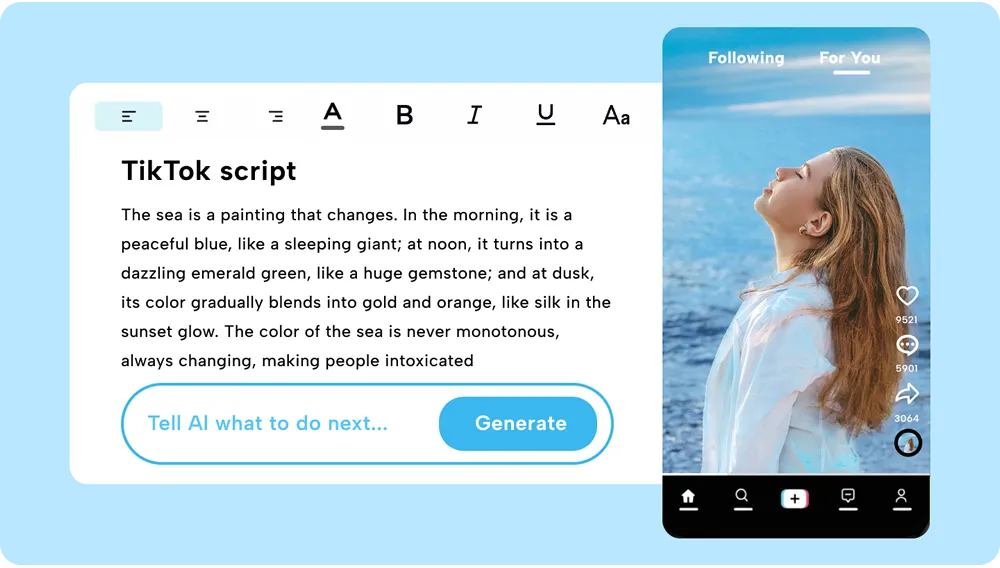
The 3-Second Verdict Is Real
TikTok's algorithm makes its initial distribution decision based on what happens in the first moments of a video. Research analyzing 9.2 million recommended videos found that viewers watch about 55% of videos to the end — meaning nearly half of all content loses its audience before the midpoint. The difference between a video that gets pushed to 100,000 viewers and one that dies at 300 almost always comes down to the opening hook. And hooks aren't improvised — they're written.
TikTok's average engagement rate reached 3.7% in 2025 — significantly higher than any other major social platform. The average TikTok post generated about 3,492 likes, 50 comments, and 248 shares. But that engagement goes exclusively to videos that survive the first few seconds.
Improvisation Doesn't Scale
Most creators treat TikTok like a spontaneous medium — point the camera, talk, post. The result is filler words, meandering structure, and unclear value propositions that the algorithm punishes with low completion rates. As Teleprompter.com's 2026 TikTok trends analysis found, "TikTok looks more planned in 2026. Creators still move fast, but the best videos feel focused and easy to follow." The creators winning are the ones scripting before they film — outlining hooks, structuring key points, and writing closing lines that drive action.
The Volume Problem Is Crushing Solo Creators
Consistency is the single biggest algorithm factor on TikTok. But producing 5–7 scripted videos per week — each requiring research, hook writing, scene structuring, voiceover drafting, and CTA optimization — demands 15–25 hours of creative work before a single frame is filmed. AI tools cut TikTok production time by an average of 70% while improving consistency, which is why the most prolific creators in 2026 all use AI somewhere in their workflow.
Scripts That Sound "AI" Get Punished
Here's the paradox: creators need AI to keep up with volume demands, but TikTok's audience — and its algorithm — rewards human delivery, real tone, clear speech, and a calm pace. Generic AI-generated scripts full of corporate phrasing and robotic transitions get scrolled past instantly. The AI script tool matters less than whether it can match your voice, your niche, and your audience's expectations.
Why an AI TikTok Script Changes Everything
From Blank Page to Camera-Ready in Minutes
The fundamental shift isn't that AI can "write content" — it's that AI can produce structurally optimized, platform-native scripts that follow the exact patterns TikTok's algorithm rewards: a pattern-interrupt hook in the first second, value delivery in a clean problem-steps-example-takeaway framework, and a closing CTA designed to trigger saves or follows rather than passive likes.
| Capability | Manual Scriptwriting | AI TikTok Script |
|---|---|---|
| Hook generation | Brainstorm alone, test by posting | Multiple hook variations generated instantly, optimized for scroll-stopping |
| Script structure | Trial-and-error over weeks | Algorithm-aligned frameworks (hook → value → CTA) built into every output |
| Trend integration | Hours browsing TikTok Creative Center | AI cross-references current trends with your niche in seconds |
| Voice consistency | Depends on your energy that day | Persistent memory maintains your tone and vocabulary across hundreds of scripts |
| Volume capacity | 3–5 scripts per week before burnout | 10–20+ scripts per session without quality degradation |
| Format adaptation | Rewrite for each content type | One research session generates tutorials, storytelling, listicles, and challenges |
While general-purpose tools like ChatGPT can generate basic TikTok script outlines, they reset context with every new session — meaning they forget your niche, your audience, your past content performance, and the voice that makes your content recognizably yours. Jenova's Social Media Content Generator maintains persistent cross-session memory of your brand identity, content history, and platform-specific requirements, building increasingly precise scripts with every conversation. And it's powered by models from OpenAI, Anthropic, Google, and more — no vendor lock-in, no single algorithm deciding what "good" sounds like.
TikTok's Own Data Confirms: Scripts Win
The platform itself has moved decisively toward scripted, structured content. TikTok's 2026 creator trends report highlights that longer short-form videos (60–180 seconds), search-optimized content, and educational formats are outperforming spontaneous clips — all formats that require pre-written scripts to execute well.
TikTok trends push creators to plan scripts before recording. Clear talking points improve pacing, reduce filler words, and help creators maintain eye contact — which increases retention and saves.
The data is consistent across industry analyses: 78% of marketing teams now use AI for video content creation, and TikTok creators who use AI for planning — outlining ideas, writing hooks, testing different captions — are posting more consistently and seeing stronger algorithmic distribution.
How Jenova Builds a Complete TikTok Script System
Most AI writing tools produce isolated text. Jenova lets you build a multi-agent TikTok content system where each agent handles a different dimension of the creation workflow.
Your Social Media Content Generator writes platform-native scripts with hooks, scene directions, voiceover text, on-screen text cues, and CTAs — all calibrated to TikTok's engagement patterns. When you need to identify what's trending right now, bring in Real-Time Search with @ to pull live data from TikTok, Reddit, YouTube, and Google. Need thumbnail concepts or on-screen graphics direction? The Graphic Designer creates visual assets matched to your brand. And when a TikTok script needs to become a longer blog post, newsletter, or YouTube script, the Writing Assistant handles the adaptation.
All agents share conversation context when mentioned with @, creating a seamless workflow from trend discovery to final script — powered by frontier models with no vendor lock-in.
Specialized AI Agents for TikTok Scriptwriting
📱 Social Media Content Generator
Your platform-native scriptwriting partner that produces TikTok-ready scripts matched to the platform's format, pacing, and engagement patterns. Unlike generic AI writers, this agent understands that a TikTok script isn't a blog post read aloud — it's a performance document with visual directions, timing cues, and hooks engineered for the first frame.
- Hook-first architecture — every script opens with a scroll-stopping line tested against proven TikTok hook formulas
- Scene-by-scene breakdown — voiceover text, on-screen text overlays, visual directions, and transition cues
- Brand voice persistence — remembers your tone, vocabulary, audience, and past content performance across sessions so every script sounds authentically you
🔍 Real-Time Search
Cross-platform research engine that pulls live trend data, competitor content analysis, and audience insights to inform your TikTok scripts with what's actually working right now — not what worked last month.
- Trend discovery — identify trending sounds, formats, hashtags, and content angles before they peak
- Competitor analysis — see what hooks, structures, and CTAs are driving engagement for similar creators in your niche
- Search demand validation — TikTok is increasingly a search engine, so scripts built around actual search queries get long-tail distribution
✍️ Writing Assistant
Adaptive writing partner that transforms TikTok scripts into other content formats — or converts existing long-form content into TikTok-native scripts. When you've written a killer script that performs, this agent helps you repurpose it across platforms without losing the original's energy.
- Cross-platform adaptation — turn a TikTok script into an Instagram Reel caption, YouTube Short outline, or LinkedIn post
- Long-form to short-form conversion — extract the most compelling 60 seconds from a blog post, podcast transcript, or newsletter
- Tone calibration — matches the conversational, direct style that TikTok rewards over polished corporate messaging
🎨 Graphic Designer
Visual design partner for creating on-screen text overlays, thumbnail concepts, and branded visual elements that complement your scripted content.
- On-screen text design — text overlay concepts with font, color, and placement guidance for key moments in your script
- Thumbnail and cover frames — first-frame concepts that maximize click-through when your video appears in search results
- Brand consistency — maintains visual identity across dozens of TikToks while staying within platform aesthetic norms
How It Works: From Idea to Camera-Ready Script
Step 1: Research What's Working Right Now
Start by bringing Real-Time Search into your Jenova chat to identify current trends, high-performing hooks, and content gaps in your niche.
"What TikTok content formats are getting the most saves in the personal finance niche right now? I'm looking for educational angles targeting 25–35 year olds. Also check Reddit for what money questions people are asking most this week."
Step 2: Generate Your Script
Share the trend data and your content goals with Jenova's Social Media Content Generator. The agent produces a complete, camera-ready script with hook, scene breakdown, voiceover text, on-screen text cues, and closing CTA.
"Write a 60-second TikTok script about '3 money mistakes people make in their 20s.' I want a controversial hook that makes people stop scrolling, a fast-paced problem-solution structure for each mistake, and a closing line that drives saves. My tone is direct, slightly sarcastic, and Gen Z-coded. Include on-screen text cues for each transition."
Step 3: Generate Variations
Ask for multiple hook variations and structural alternatives so you can test what resonates. The agent remembers what you've tried before and suggests new angles rather than repeating itself.
"Give me 5 alternative hooks for that same script. I want one that's a bold claim, one that's a question, one that starts with 'Nobody talks about this,' one that uses a number, and one that's intentionally polarizing."
Step 4: Adapt for Multiple Formats
Use the Writing Assistant to repurpose your best-performing TikTok script into other content formats — an Instagram carousel script, a YouTube Shorts voiceover, a tweet thread, or a newsletter segment.
"Take my '3 money mistakes' TikTok script and adapt it into an Instagram carousel outline with 7 slides. Keep the same energy but restructure for a visual reading format instead of spoken delivery."
Step 5: Design Visual Elements
Bring in the Graphic Designer to create on-screen text concepts, cover frame designs, or branded visual elements that complement your script.
"Design on-screen text overlay concepts for the three key moments in my TikTok script — one bold statement per mistake. Use a clean sans-serif font, white text with a dark drop shadow, centered lower-third placement. My brand colors are black, white, and electric blue."
Step 6: Iterate Based on Performance
After posting, share your analytics with the Social Media Content Generator. The agent learns which hooks, structures, and CTAs drive the best results for your specific audience and adjusts future scripts accordingly.
"My last TikTok got 45K views but only 200 saves. The watch-through rate was 62% — people are staying but not saving. How should I adjust my script structure and CTA to convert more viewers into saves?"
Results & Use Cases
📊 Solo Creator Scaling from 3 to 15 Videos Per Week
Scenario: A fitness creator with 80,000 followers wants to triple their posting frequency without hiring a team or sacrificing the authentic, direct tone that built their audience.
Traditional Approach: Spends 2–3 hours per video brainstorming, outlining, filming multiple takes because they keep losing their train of thought, and re-editing when the structure feels off. At 3 videos per week, that's 6–9 hours of pre-production alone. Scaling to 15 would require 30+ hours — physically impossible for a solo creator who also needs to film, edit, and engage with comments.
AI TikTok Script Solution: Jenova's Social Media Content Generator generates 15 camera-ready scripts in two batch sessions per week — each with a unique hook, structured scene breakdown, and closing CTA matched to the creator's established voice. The creator reads each script once, films in a single take using a teleprompter, and moves on. Total scripting time drops from 9+ hours to under 2, and the scripts are structurally tighter than anything they wrote manually.
💼 Brand Launching a TikTok Presence from Zero
Scenario: A B2B SaaS company wants to build a TikTok presence targeting founders and marketing leaders — but nobody on the team has ever created TikTok content and they have no idea what works on the platform.
Traditional Approach: Hires a social media agency at $3,000–$8,000/month. Agency produces polished videos that look like advertisements. TikTok's algorithm punishes content that feels like a polished ad, and initial engagement is near zero. Three months and $15,000 later, the company has 400 followers and no pipeline impact.
AI TikTok Script Solution: Real-Time Search identifies that "SaaS pricing mistakes" and "startup marketing fails" are generating high save rates in the business niche. The Social Media Content Generator writes scripts in a founder-direct tone — no jargon, no polish, just sharp insights delivered in 60 seconds. The company's CEO films each video from their desk in one take. The scripts sound like a smart friend giving advice, not a brand selling software — exactly what TikTok rewards.
📱 E-Commerce Creator Running Product Reviews at Scale
Scenario: A beauty creator monetizing through TikTok Shop needs to produce 4–5 product review videos daily to keep up with new inventory and maintain algorithmic visibility.
Traditional Approach: Writes notes on each product, films while glancing at bullet points, rambles through unstructured reviews that average 40% watch-through rates. Inconsistent posting schedule because scripting takes too long.
AI TikTok Script Solution: The Social Media Content Generator generates review scripts from basic product information — name, key ingredients, price point, target concern. Each script follows a proven review structure: hook (unexpected claim about the product), problem it solves, 2–3 key observations, verdict, and CTA to check TikTok Shop. The creator films 5 reviews in a single 90-minute session, each from a tight script with natural-sounding language. Watch-through rates climb because every video has clear structure and pacing.
🎯 Agency Managing Multiple Creator Accounts
Scenario: A talent management agency runs TikTok content for 8 creators across fitness, finance, beauty, and lifestyle — each requiring unique voice, style, and content strategy.
Traditional Approach: One content strategist per 2–3 creators. Each strategist manually researches trends, writes scripts, coordinates filming schedules, and reviews edits. The team burns through $25,000/month in labor costs and still can't keep every creator posting daily.
AI TikTok Script Solution: Each creator has a dedicated conversation thread with Jenova's Social Media Content Generator, where their unique voice, niche, audience demographics, and content history are stored in persistent memory. One strategist generates a week's worth of scripts for all 8 creators in a single workday — each script tailored to the individual creator's established tone. Real-Time Search feeds niche-specific trend data into each thread, ensuring no two creators are covering the same angles. The agency's per-creator content cost drops by 60%.
FAQ
How is an AI TikTok script different from using ChatGPT?
General-purpose AI like ChatGPT can generate basic script outlines, but it resets context with every session, doesn't understand TikTok-specific structural requirements (hook timing, on-screen text cues, save-driven CTAs), and can't maintain your brand voice across hundreds of scripts. Jenova's Social Media Content Generator is built for platform-native content — it produces scripts with scene breakdowns, visual directions, and voiceover text formatted for TikTok's pacing, and it remembers your voice, niche, and past performance across every conversation.
Will AI-scripted TikToks sound robotic?
Only if you use the AI output verbatim without calibrating it to your voice. The key is using AI to generate structure — hooks, scene sequences, transitions, CTAs — then delivering those scripts in your natural speaking style. Jenova's agents learn your vocabulary, tone, and pacing preferences over time, producing scripts that sound increasingly like you wrote them yourself. As TikTok's 2026 trend analysis emphasizes: "AI can help you plan faster, but you still need to sound like yourself on camera."
How many TikTok scripts can I generate per day with AI?
With a structured workflow — batch trend research, batch script generation, batch variation testing — most creators produce 10–20 polished, camera-ready scripts per session with Jenova's agents. The practical bottleneck isn't script generation; it's filming and editing. AI shifts the time investment from writing (the hardest creative work) to production (the more mechanical work).
Is Jenova free to use for TikTok scripting?
Jenova offers a free tier with access to all core features, including the Social Media Content Generator, Real-Time Search, Writing Assistant, and Graphic Designer. Paid plans start at $20/month for expanded usage and custom model selection. All data is encrypted and never used for model training.
Does scripting work for spontaneous, authentic TikTok content?
The best "spontaneous" TikTok content is almost always scripted. The difference is in delivery, not preparation. A scripted video delivered naturally — with pauses, vocal variety, and eye contact — feels more authentic than an improvised video full of filler words and meandering structure. Scripts give you the content; your on-camera presence gives it the authenticity. Professional TikTok creators in 2026 overwhelmingly script their content and use teleprompters to maintain natural delivery.
What types of TikTok videos benefit most from AI scripts?
Educational content, product reviews, listicles, storytelling videos, and series-format content benefit the most — all formats where clear structure directly correlates with higher watch-through rates and saves. Trend-jacking and reaction videos benefit less, though AI can still help write hooks and CTAs for those formats. TikTok's 2026 trends data shows that educational and expertise-led content — which requires the tightest scripting — is one of the platform's fastest-growing categories.
Conclusion
The gap between TikTok creators who grow and those who stall almost always comes down to one thing: structure. Not production value, not equipment, not posting time — structure. A clear hook in the first second. A value-delivery framework that holds attention through the middle. A closing line that converts passive viewers into followers and savers.
With 1.9 billion monthly active users, 23 million videos uploaded daily, and an algorithm that makes its distribution decision in the first three seconds of every video, the margin for unscripted improvisation has effectively disappeared. The creators dominating in 2026 aren't more talented — they're more prepared. And AI tools are cutting their production time by 70% while producing tighter, more consistent scripts than manual brainstorming ever could.
Try the Social Media Content Generator to write your first AI TikTok script — free, no credit card required. Pair it with Real-Time Search for live trend data, or use the Writing Assistant to repurpose your best scripts across platforms. Explore the full agent library at Jenova.