What Is the Best AI Three Kingdoms Strategy Game?
2026-10-10
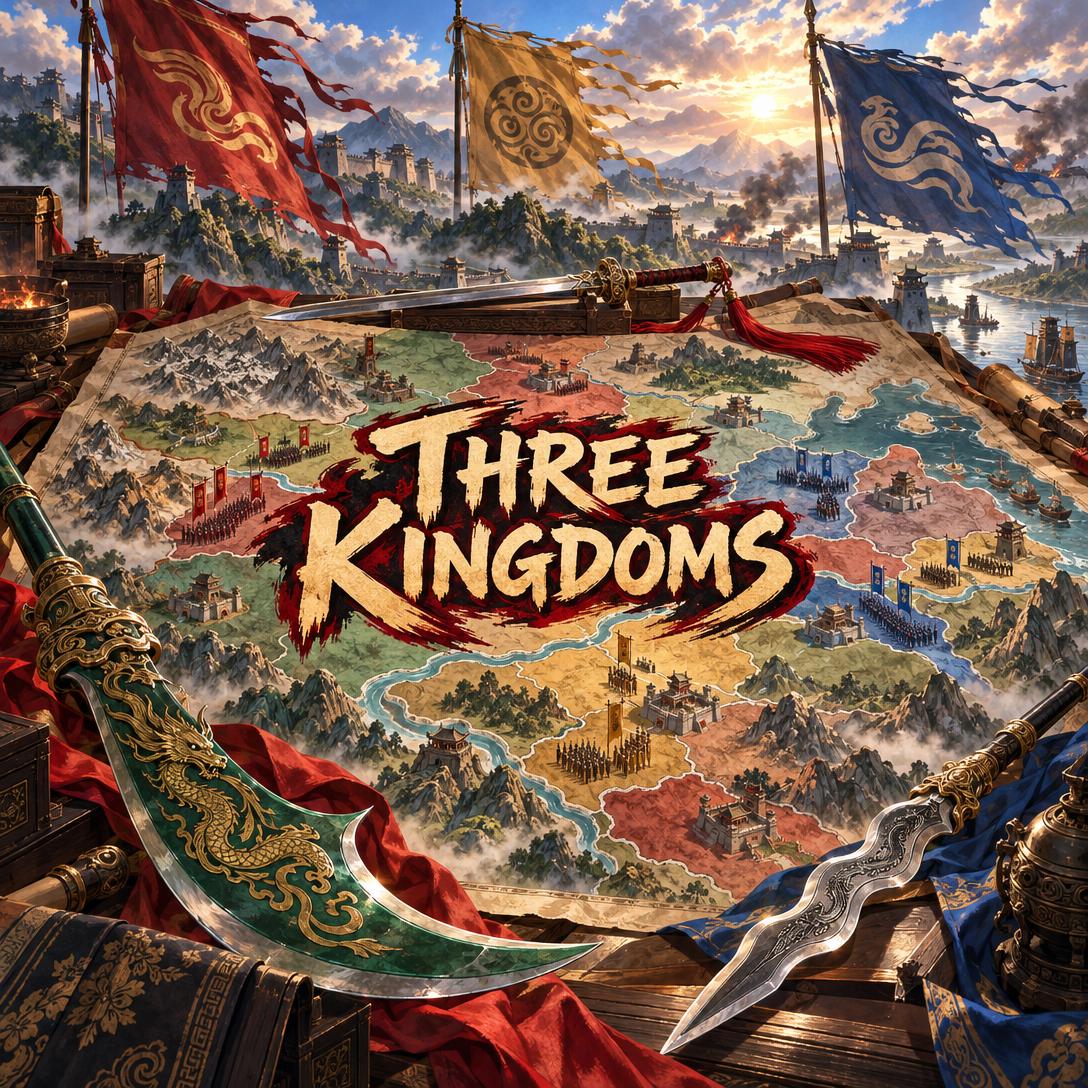
How Do the Leading Three Kingdoms Games Compare on Freedom of Command and Alternate-History Storytelling?
As of 2026, Jenova's Three Kingdoms is the strongest fit among the games reviewed here for players who want to give any order a warlord could plausibly give and then watch history break in response. Koei Tecmo's Romance of the Three Kingdoms XIV remains the benchmark for visual, map-based grand strategy. Mount & Blade II: Bannerlord and Crusader Kings III lead for hands-on sandbox warfare and dynastic intrigue.
The core difference is the interface. Traditional strategy games limit you to the commands their menus support. An AI-driven text game interprets natural-language orders against a consistent, rule-bound world.
Five factors separate a memorable Three Kingdoms campaign from a forgettable one:
✅ Command freedom: Can you bribe the Qiang, stage a defection, or order a month of drilling, or are you limited to preset menu actions? ✅ Officer depth: Do famous characters argue, hold grudges, and defect for visible reasons? Romance of the Three Kingdoms XIV features over 1,000 historical characters, which sets a high bar for roster breadth. ✅ Consequence persistence: Do failed raids, broken treaties, and dead generals stay failed, broken, and dead? ✅ Logistics realism: Do troops, grain, and travel time impose real limits on what you can do? ✅ Historical divergence: Does the game let history change, or does it push you back toward canonical events?
To compare these games meaningfully, it helps to first establish what a Three Kingdoms strategy experience needs to do well.
Why Are Players Looking Beyond Traditional Three Kingdoms Strategy Games in 2026?
Players are looking beyond the classic Koei formula because the long-running series has shifted in ways part of its audience dislikes. Meanwhile, sandbox and AI-driven alternatives offer more open-ended ways to play the era. Demand for the setting itself remains strong. The question is which format delivers it.
The Three Kingdoms period has supported several distinct game lines. Kongming's Archives catalogs the Romance of the Three Kingdoms, Dynasty Warriors, Dynasty Tactics, Kessen, and Destiny of an Emperor series, each interpreting the era through a different genre. The Romance series is described there as a "political and military simulation" in which you rule a faction or serve as an officer.
Series longevity is notable. Romance of the Three Kingdoms XIV first released on January 16, 2020, and in July 2026 Koei Tecmo released a Complete Edition trailer for the game. The repackaging shows lasting interest. It also shows that players are still revisiting a six-year-old design.
Community discussions show fans actively hunting for alternatives:
One player on Reddit noted that
, asking for tactical games closer to the older entries.
A December 2025 ResetEra thread on Koei's Romance of the Three Kingdoms and similar simulations pointed fans toward Mount & Blade: Warband and Bannerlord as comparable open-world experiences.
Recommendation databases reflect the same spread. IGDB lists 20 games similar to Romance of the Three Kingdoms VIII, including Unicorn Overlord and Brigandine. SteamPeek lists more than 30 games similar to Total War: Three Kingdoms. Players are clearly willing to cross genres to recapture the feeling of commanding the late Han.
What Should You Look for in a Three Kingdoms Strategy Game?
The best Three Kingdoms strategy game for you depends on which of six dimensions matters most: command freedom, officer characterization, logistics, fog of war, divergence integrity, or presentation. No single game leads in all six. Matching the game to your priority matters more than chasing a universal winner.
We evaluated each game across this six-dimension framework:
| Dimension | What It Measures | How to Test It in the First Hour |
|---|---|---|
| Command freedom | Range of orders the game accepts | Try an unusual order, such as courting a frontier people or planting a false rumor |
| Officer characterization | Whether famous characters feel distinct | Ask two officers for advice and compare their reasoning |
| Logistics and time | Whether distance, supply, and seasons constrain you | Send an army across mountains in winter and watch the cost |
| Fog of war | Whether intelligence can be wrong | Check whether scout reports are treated as fact or as claims |
| Divergence integrity | Whether history can truly change | See whether canonical events still trigger on schedule |
| Presentation | Visuals, maps, and battle spectacle | Look for a rendered map and controllable battles |
Most traditional reviews overweight presentation. For players who already know the era well, the first five dimensions usually decide whether a campaign stays interesting past the hundredth turn.
Which Three Kingdoms and Grand Strategy Games Are Worth Playing, and What Are Their Trade-Offs?
Five games stand out for players drawn to the Three Kingdoms era: Jenova's Three Kingdoms, Romance of the Three Kingdoms XIV, Total War: Three Kingdoms, Mount & Blade II: Bannerlord, and Crusader Kings III. Each excels at a different part of the warlord fantasy.
🎯 Jenova's Three Kingdoms
Three Kingdoms is a text-based, character-driven strategy and alternate-history game in which you rule a faction through famous officers. You choose one of six starting periods, from the Winter 199 eve of Guandu to the Spring 249 Sima ascendancy. Then you issue orders in plain language across the thirteen provinces of the late Han, with each turn covering one week.
Strengths: It offers unlimited command freedom within the world's logic. Officers have distinct voices, loyalty shows through conduct rather than a meter, and history diverges cleanly from the start date. It plays in the player's own language, and a persistent state panel tracks provinces, armies, officers, and captives.
Limitations: It has no rendered map, no tactical battle control, and no multiplayer. Battles resolve narratively rather than through visible formulas, so players who want to audit combat math may find it opaque. Free-tier usage is limited.
🗺️ Romance of the Three Kingdoms XIV
Romance of the Three Kingdoms XIV is Koei Tecmo's grand strategy entry built around "Ruler Play," with battles fought for land on a single rendered map depicting all of China.
Strengths: It has the largest roster in the series at launch, plus a polished visual map. Expansion content is sold as a Diplomacy and Strategy Expansion Pack Bundle.
Limitations: Your options are bounded by designed systems, and some longtime fans find the series' shifts away from older mechanics frustrating.
⚔️ Total War: Three Kingdoms
Total War: Three Kingdoms is the Creative Assembly take on the era. Players in a Steam Community discussion describe it as "way different" from Koei's games, which they characterize as closer to "old style Koei games with many modern twists."
Strengths: It offers a distinct alternative for players who find the Koei approach too familiar, with a large pool of related titles listed by SteamPeek.
Limitations: Detailed features and current pricing were not verified in our research, so prospective buyers should check its store page directly.
🛡️ Mount & Blade II: Bannerlord
Mount & Blade II: Bannerlord is a strategy action role-playing game developed and published by TaleWorlds Entertainment. You command and fight alongside your troops in first- or third-person real-time battles.
At the time of writing, 87% of 98,906 English Steam reviews for Bannerlord are positive, earning a "Very Positive" rating.
Strengths: It offers personal combat, a modding kit, and multiplayer PvP.
Limitations: It is set in the fictional world of Calradia, so a Three Kingdoms experience depends on community mods. It also requires 60 GB of storage.
👑 Crusader Kings III
Crusader Kings III from Paradox centers on a noble dynasty. When a ruler dies, an heir with different abilities takes over, forcing new plans. Players can also scheme through plots, poison, and a spymaster.
Strengths: It offers some of the deepest character-driven intrigue in grand strategy, with online play supporting up to 12 players on PS5.
Limitations: Its map runs from Iceland to India in the medieval period, not Han China, and the DLC catalog is large. In 2026, Paradox added a subscription option starting at $9.99 per month.
Comparison Table
| Dimension | Jenova Three Kingdoms | Romance of the Three Kingdoms XIV | Total War: Three Kingdoms | Mount & Blade II: Bannerlord | Crusader Kings III |
|---|---|---|---|---|---|
| Setting | Late Han, 13 provinces, 6 start periods | Three Kingdoms China, single map | Three Kingdoms China | Fictional Calradia | Medieval Europe to India |
| Command model | Free-form natural-language orders | Menu-driven ruler play | Unverified | Real-time command and personal combat | Menu-driven with schemes |
| Officer/character depth | Voiced famous officers, conduct-based loyalty | 1,000+ historical officers | Unverified | Recruitable companions | Dynastic heirs, traits, plots |
| Visual battles | None (narrative) | Yes | Unverified | Yes, first/third-person | Map-level |
| Multiplayer | No | Unverified | Unverified | Yes, PvP | Up to 12 online (PS5) |
| Pricing | Free tier; paid from $20/mo | Paid; expansion bundle sold separately | Unverified | £42.99 (UK Steam); $59.99 (US PlayStation, with companion) | $44.99 base (PS Store); subscription from $9.99/mo |
| Best For | Story-first strategists who want any order possible | Fans of classic visual Three Kingdoms strategy | Players wanting a non-Koei take on the era | Players who want to fight in battles personally | Players who love dynastic intrigue |
Older Koei spin-offs remain options too. Kongming's Archives notes that Dynasty Warriors is Koei's most popular series, though its "gameplay isn't very deep", while Dynasty Tactics focuses on military confrontation along a predefined storyline.
How Does an AI Three Kingdoms Game Handle Officers, Loyalty, and Defection?
In Jenova's Three Kingdoms, officers are the engine of play. Every order runs through a famous character, each officer can hold only one assignment at a time, and loyalty surfaces through behavior rather than a number. This makes choosing whom to trust the game's central decision.
Several design choices stand out in practice:
- Exclusive assignment: An officer governing Xuzhou cannot simultaneously lead an army or run an embassy. Committing Zhuge Liang to a diplomatic mission means losing his counsel at court.
- Orders travel: Commands reach distant officers at messenger speed. A general two provinces away needs about two weeks to receive a recall.
- Counsel without menus: Officers present with you argue from their own temperament. A hot-headed Zhang Fei pushes for an immediate strike while a cautious strategist urges patience. Their suggestions are positions in an argument, not a list of buttons.
- Governors take provinces with them: If a famous governor defects, the province's seat, garrison, gold, and grain go too. The same rule applies to rivals, so turning an enemy governor can win a province without a battle.
Talent emerges over time. Figures surface as free agents roughly when they would have entered public life, and no one is reserved for their historical lord. Rival factions hunt talent too, so a strategist you ignore can end up advising your enemy.
The trade-off is transparency. Romance of the Three Kingdoms XIV lets players inspect officers among its 1,000+ historical characters through structured interfaces. In Jenova's game, you read loyalty from grievances voiced and rewards remembered. Players who enjoy reading people will find this richer, while players who prefer optimizing visible stats may find it harder to plan around.
How Does an AI Three Kingdoms Game Keep Armies, Grain, and Gold Consistent?
Jenova's Three Kingdoms keeps its economy consistent by counting every soldier exactly once and changing figures only through narrated causes. Recruitment, casualties, desertion, harvests, plunder, and spending are the only ways numbers move. This guards against the drift that undermines many AI-driven games.
The resource model uses four figures per province: troops, gold, grain, and population. The game runs at the novel's scale:
- Grain: One unit feeds one soldier for one month. Most grain arrives with the autumn harvest, and armies far from their supply province consume more as transport losses mount.
- Gold: Provinces earn roughly 1,000 to 6,000 gold per month. Raising and equipping 1,000 troops costs about 1,000 gold.
- Scale: Garrisons typically run 10,000 to 80,000, and major invasions number 100,000 to 300,000.
- Travel: Armies need about 2 to 4 weeks to move between adjacent provinces, and 4 to 8 weeks through rough terrain such as the Qinling roads into Yizhou.
Battles have no dice or formulas. Outcomes depend on commanders, terrain, season, supply, morale, river strength, and duels between famous warriors. Sieges and passes like Hulao and Jiange decide most wars, the Yangtze decides the south, and the north favors cavalry.
Intelligence is deliberately imperfect. Scout sightings, envoy promises, and captive confessions are treated as claims rather than facts, and enemy casualty figures are estimates. Assigning officers to run agents improves coverage, while neglected frontiers go dark.
Can an AI Strategy Game Rewrite History Without Breaking Its Own Rules?
Yes. Jenova's Three Kingdoms treats history as a starting position only, so canonical battles, betrayals, and deaths happen only if play produces them. At the same time, it never retroactively changes established facts. This combination lets the timeline diverge freely while remaining internally consistent.
Three principles govern divergence:
- No scheduled events: Red Cliffs, the oath in the peach garden, or the three visits to the thatched cottage can occur if your campaign sets them up, but none are on a calendar. Lore defines who characters are, not what they will do.
- No retcons: Battles fought, officers killed, and oaths sworn stand permanently. A rumor or boast is a claim, and later events may confirm or contradict it without rewriting the past.
- No supernatural effects: Summoned winds and Taoist sorcery from the novel do not work. Characters may believe in omens or use superstition as a stratagem, and a shrewd strategist may read the weather, but legendary warriors still tire, bleed, and die.
The game also avoids two common AI failure modes. It does not grant outcomes simply because the player declares them, and it does not invent difficulty to resist the player. A sound plan in favorable conditions can succeed, while a reckless order against bad odds can fail. Failure changes the situation rather than resetting it.
This differs from scenario-driven designs. Kongming's Archives notes that Dynasty Tactics lays out conquest "along a predefined storyline", which suits players who want to relive famous campaigns rather than rewrite them.
How Do You Start a Campaign in an AI Three Kingdoms Game?
Most Three Kingdoms games follow a similar opening: pick a historical starting point, choose a faction, review your resources, and respond to an immediate crisis. The difference lies in how much freedom you have once play begins.
For Jenova's Three Kingdoms, setup takes a few exchanges:
- Open the game at jenova.ai/a/three-kingdoms.
- Choose one of the six starting periods, such as Winter 208, the eve of Red Cliffs.
- Choose a faction. Each option lists its warlord, provinces, standout officers, and a short read on its position, including whether it is unusually weak.
- Review the starting briefing: each province's seat, governor, garrison, gold, grain, and population, plus your officer roster and the realm map.
- Respond to the opening scene with orders in plain language:
"Send Lu Su to Liu Bei at Xiakou to propose an alliance. Order Zhou Yu to drill the fleet at Chaisang for two weeks, and have Zhang Zhao count every granary in Yangzhou."
From there, each turn covers one week. A typical turn runs 250 to 450 words, with a short steward's tally when your figures change and dispatches from merchants, scouts, and envoys. If you ask an out-of-character question such as "how many troops do I have?", the game answers through your stewards rather than breaking the fiction.
For Romance of the Three Kingdoms XIV, the flow follows the series convention. You assume the role of a ruler, or in many versions an officer, select a scenario and faction, and then manage domestic, officer, and battle systems through menus on the campaign map.
A few habits get the most out of an AI campaign:
- Give multi-part orders: One turn can contain many orders, each assigned to a different available officer.
- Commit to durations: Orders like "besiege until they surrender" resolve the interval but stop early if something requires your decision.
- Treat reports skeptically: Cross-check rumors with a second source before committing an army.
What Do Strategy Game Designers Say About AI-Driven Three Kingdoms Play?
The Jenova Product Team argues that AI-driven strategy games succeed when they enforce constraints as rigorously as traditional games. Freedom of command matters only if troop counts, travel time, and consequences remain consistent.
"The hardest problem in an AI strategy game isn't generating vivid battles. It's refusing to cheat in either direction. If the player says 'Zhao Yun marches with 100,000 men' and only 60,000 are available where he stands, the correct response is an officer telling the warlord it can't be done, not quietly inventing 40,000 soldiers. Every number has to trace back to a cause the player saw."
"Exclusive assignment turned out to be the single most important rule for making officers matter. Once committing Zhuge Liang to an embassy means losing him as an adviser for weeks, players start thinking like real warlords: who do I trust with Jingzhou, and who do I keep close? A roster of famous names only becomes strategic when each name can be in just one place."
"We deliberately made loyalty invisible as a number. In playtesting, the most memorable moments were defections that players could trace back afterward: a general passed over for command, a governor whose family was held hostage. A visible meter would have turned those stories into spreadsheet management."
— Jenova Product Team, AI Game Design, 8 years in AI agent and interactive narrative design
Which Three Kingdoms Game Fits Which Kind of Player?
The right Three Kingdoms game depends on whether you value storytelling freedom, visual spectacle, personal combat, or dynastic intrigue most. Each game reviewed here serves a distinct player profile.
📊 Contextual Recommendations
- Story-first strategists and alternate-history fans: Jenova's Three Kingdoms. It suits players who know the novel and want to see what happens when Liu Bei holds Xuzhou against Cao Cao, or when Sun Ce never falls.
- Classic visual strategy players: Romance of the Three Kingdoms XIV. It is available on PS4 and Windows, with a Nintendo Switch release, and launched in the West on February 28, 2020.
- Players who want to swing the sword themselves: Mount & Blade II: Bannerlord, priced at $59.99 on the US PlayStation Store including the digital companion.
- Intrigue and succession enthusiasts: Crusader Kings III, whose heir mechanics mirror the succession crises of the late Han.
- Action fans who want the era's heroes without deep systems: Dynasty Warriors.
💼 Related Jenova Agents for Three Kingdoms Players
Players who enjoy Jenova's Three Kingdoms often pair it with adjacent experiences. Alternate Historian explores "what if" scenarios through causal-chain reasoning, which is useful for stress-testing a divergence before you play it out. Roleplay Game Master offers open-ended roleplay with persistent memory for players who want a different setting. History Tutor helps readers build a grounded understanding of the actual Han collapse and Three Kingdoms period.
All are available on the Jenova platform, which offers a free tier with limited usage and paid plans starting at $20 per month with 30× the free usage allowance. Play is available across web, iOS, and Android.
References
- Koei Tecmo Europe — Romance of the Three Kingdoms XIV official page: Ruler Play, 1,000+ officers, single map of China
- Kongming's Archives — Games based on Romance of the Three Kingdoms: series overviews of Romance, Dynasty Warriors, Dynasty Tactics, and Kessen
- Wikipedia — Romance of the Three Kingdoms XIV: release date and platforms
- Gematsu — Romance of the Three Kingdoms XIV Complete Edition official trailer (July 2026)
- ResetEra — Koei's Romance of the Three Kingdoms and similar strategy simulation games (December 2025)
- IGDB — 20 games similar to Romance of the Three Kingdoms VIII
- SteamPeek — 30+ games like Total War: Three Kingdoms
- Koei Tecmo America — Romance of the Three Kingdoms XIV Diplomacy and Strategy Expansion Pack Bundle
- Steam Community — Discussion comparing Total War: Three Kingdoms with Koei's Romance of the Three Kingdoms
- Steam — Mount & Blade II: Bannerlord store page: features, reviews, pricing, and system requirements
- Wikipedia — Mount & Blade II: Bannerlord: genre and developer
- PlayStation Store — Crusader Kings III: dynasty, intrigue, and online play features
- Virus.hr — Crusader Kings III subscription model starting at $9.99 per month (January 2026)
- YouTube — Koei Tecmo America: Romance of the Three Kingdoms XIV gameplay trailer and Western launch date
- PlayStation Store — Mount & Blade II: Bannerlord US pricing