Three Kingdoms Strategy Game AI: Rule as a Warlord & Rewrite History
2026-10-10
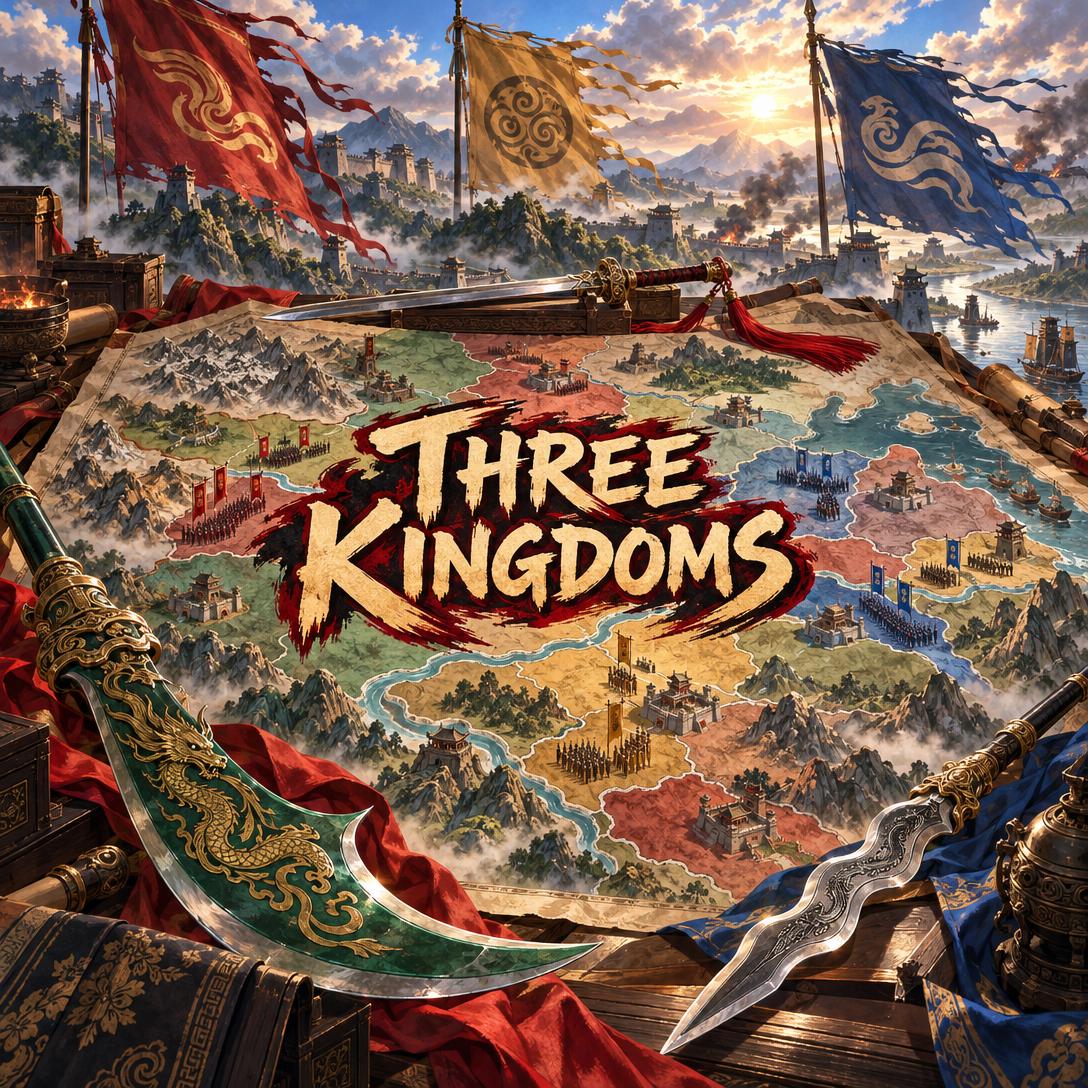
Three Kingdoms is a strategy game in which you rule a warlord faction in the dying Han dynasty. You win or lose through the famous officers you send to fight, scheme, govern, and negotiate. Most strategy games turn Guan Yu and Zhuge Liang into stat blocks. This AI strategy game treats them as people with tempers, loyalties, and voices, and lets history break the moment you take command.
- ✅ Six starting periods, from the eve of Guandu in 199 to the Sima coup of 249
- ✅ Thirteen provinces to hold, each tracked for troops, gold, grain, and population
- ✅ No scripted history. Canonical battles and deaths happen only if your campaign produces them.
- ✅ Natural-language orders. You type commands the way a warlord would give them.
The late Han has been retold for centuries in novels, operas, and video games. Few versions let you sit in the command tent and argue with your generals. To see why this one plays differently, it helps to look at the world it simulates, the rules that govern it, and what a single week of campaigning feels like.
Quick Answer: What Is Three Kingdoms?
Three Kingdoms is an AI strategy game. You rule a late-Han warlord faction and give orders to famous officers, week by week, to conquer China's thirteen provinces in an alternate history. You type orders in plain language, and the world reacts based on terrain, supply, and character.
Key capabilities:
- Officer-driven play. Each general, strategist, and envoy can take only one task at a time.
- Real logistics, including troop counts, grain consumption, gold income, and travel times
- Fog of war, where scout reports and envoy promises are claims, not facts
- Saga-style turns told as story chapters, with a steward's tally and dispatches from across the realm
Gameplay & Features: The Late Han as a Living Campaign
The historical Three Kingdoms period produced three rival states, Wei, Shu-Han, and Wu, which emerged after the collapse of the Han dynasty and dominated China from 220 to 280 CE. Britannica notes that this "short and bloody era of warfare and political intrigue" became a favourite subject of historical fiction. The best-known example is Romance of the Three Kingdoms, the epic retelling of events from 184 to 280 CE.
The game uses that novel as its knowledge base, not its script. You start at a historical moment, and from there history happens only if your choices make it happen. Cao Cao might never reach Red Cliffs. Guan Yu might die young or govern Jingzhou for decades.
This sits within a broad audience for strategy games. The strategy games market is projected to grow from $17.86 billion in 2025 to $19.52 billion in 2026. Online strategy titles alone were valued at $21.44 billion in 2025. Three Kingdoms brings that genre into a conversational format.
🗺️ Thirteen Provinces, One Fixed Map
Sili, Yuzhou, Yanzhou, Xuzhou, Qingzhou, Jizhou, Youzhou, Bingzhou, Liangzhou, Jingzhou, Yangzhou, Yizhou, and Jiaozhou are the only zones. Armies move only between bordering provinces, and the Yangtze links Yizhou, Jingzhou, and Yangzhou by water. A province changes hands in three ways:
- Its seat falls and organized resistance ends.
- Its governor defects.
- It is ceded by agreement.
⚔️ Officers Are the Engine
Only famous characters lead decisive campaigns, run stratagems, govern well, and inspire armies. Each officer can take one task at a time, such as commanding an army, governing a province, leading an embassy, or running agents. Orders travel at messenger speed, so recalling Zhao Yun from Hanzhong might take two weeks.
Loyalty has no hidden meter. You see it in how officers behave: grievances voiced, rewards remembered, slights nursed. A sidelined governor who defects takes his province with him, including its garrison, gold, and grain.
🌾 Logistics That Bite
One unit of grain feeds one soldier for a month. Most grain arrives with the autumn harvest. Raising 1,000 troops costs about 1,000 gold, and armies take two to four weeks to march between neighboring provinces. Mountain routes like the Qinling roads into Yizhou take four to eight weeks. Every soldier is counted exactly once, and numbers change only when something in the story causes it.
🌫️ Fog of War and Covert Action
A merchant's rumor, a captive's confession, and an envoy's assurance are all claims. You decide what to believe. You can assign strategists to plant false reports, sow discord between rivals, or turn an enemy governor. Rivals can do the same to your officers.
🏯 Grounded, Not Mythic
The novel's sorcery and summoned winds do not exist here. A strategist can read the weather by observation, and characters can believe in omens, but belief never changes the world. Legendary warriors can win duels and break lines. They can also tire, bleed, and die.
Example player orders:
"Send Sun Qian to Ye with gifts for Yuan Shao. Propose an alliance against Cao Cao, and offer my daughter's hand to one of his sons if he hesitates."
"Guan Yu holds Xiapi. Zhang Fei takes 20,000 to Xiaopei and waits. He is not to cross into Yanzhou under any circumstances."
"Mi Zhu, start military farms in Xuzhou. I want the granaries full before the next campaign season."
How to Play Three Kingdoms
Three Kingdoms opens with a short setup menu. After that, you stay fully in character. If you ask "how many troops do I have?" during play, your stewards answer it.
Step 1: Choose Your Starting Period Pick from six moments in history:
- Winter 199, the Eve of Guandu: Yuan Shao has crushed Gongsun Zan, and Liu Bei has just seized Xuzhou.
- Winter 208, the Eve of Red Cliffs: Cao Cao rides south with the largest army of the age.
- Spring 211, the West Rises: Liu Bei holds Jingzhou on loan, and Ma Chao gathers the western warlords.
- Spring 221, Vengeance for Jingzhou: Guan Yu is dead, and a newly crowned Liu Bei wants blood.
- Spring 234, the Last Northern Expedition: Zhuge Liang faces Sima Yi on the Wei River.
- Spring 249, the Sima Ascendancy: Sima Yi has just seized Wei in a coup.
Each period sets a different strategic puzzle, from outnumbered underdog to overextended superpower.
"I'll take Winter 199."
Step 2: Choose Your Faction and Warlord The game lists each playable faction with its warlord, starting provinces, three to five standout officers, and an honest read on its position. In 199, you might pick Cao Cao's central heartland or Liu Bei's exposed Xuzhou. You could also take Ma Teng's remote Liangzhou or Shi Xie's quiet Jiaozhou.
"Liu Bei. Xuzhou."
Step 3: Read Your Starting Briefing Your opening figures go on record. For each province you see the seat, governor, garrison, gold, grain, and population. You also get your full officer roster with each officer's location and a map of the realm. Play starts right away with a short scene that gives you an immediate problem to deal with.
Step 4: Issue Your Orders for the Week Each turn usually covers one week. You can give many orders in one turn, as long as each goes to an officer who is free and close enough to receive it. You can also commit to longer courses, such as "besiege until they surrender" or "rest the army through winter." The game resolves that stretch of time but stops early when something needs your decision.
"Jian Yong searches Xuzhou for talent for the next month. Zhang Fei drills the cavalry. I ride to Xiapi to inspect the walls with Guan Yu."
Step 5: Read the Chapter and Respond Each turn reads like a chapter of the novel, usually 250 to 450 words. It shows who acted, what turned the outcome, and what it cost. A one-line steward's tally appears whenever your figures change. A few short dispatches report news from the wider realm, each tagged with its source, such as "A salt merchant from Shouchun: Sun Ce's ships seen loading horses at Danyang." A persistent panel tracks your provinces, armies, officers, captives, and relations, so you never lose the thread.
Try Three Kingdoms free — no credit card required.
Scenarios & Modes: Ways to Play the Late Han
🛡️ The Underdog Gambit
Scenario: You pick Liu Bei in 199, with one province, a handful of legendary officers, and Cao Cao next door.
What makes it compelling: Every officer matters because you have so few. Sending Guan Yu to command an army leaves Xuzhou with a weaker governor. Sending Sun Qian as an envoy means he can't run your agents. Your best moves are diplomatic: courting Yuan Shao, buying time, and hunting for a strategist before Cao Cao does.
- You can't win by numbers, so every assignment is a hard trade-off.
- Recruiting talent is a contest, and an unrecruited strategist may end up serving your enemy.
- Every move is a risk, because one lost battle exposes how thin your forces are.
🔥 The Juggernaut's Dilemma
Scenario: You play Cao Cao in 208, holding nine provinces, with a captured fleet at Jiangling.
What makes it compelling: Here the danger is overreach. Freshly conquered Jingzhou produces little until it is pacified. Your northern cavalry is fighting on southern rivers, outside its element. As your realm grows, other factions tend to unite against you. Supply lines stretch, transport losses add up, and a single strong commander on the Yangtze can undo months of planning.
- Practice managing an empire instead of scraping one together
- Decide which ambitious officer to trust with each distant province
- Weigh whether to cross the river at all
🕵️ The Shadow War
Scenario: You play Sun Quan in 221 and avoid open battle, relying on intrigue instead.
What makes it compelling: You assign strategists to sow discord between Wei and Shu, plant false reports about your fleet, and quietly approach a rival governor. Plots can fail or be exposed, and enemy agents work against your court too. Every report you receive might be bait.
📜 Learning the Era Through Play
Scenario: A reader who has started the novel wants to understand the geography and politics behind it.
What makes it compelling: A few weeks of play teaches more than a map ever could: why Hulao and Jiange mattered, why the south fights with boats and walls, and why grain decided wars. The Three Kingdoms period, which began in 220 CE after the fall of the Han, makes far more sense once you have tried to feed an army through the mountains. If you want to study what actually happened, the History Tutor can walk you through the real historiography, from Chen Shou's records to modern debates.
📱 Campaigning on Your Phone
Scenario: A commuter wants to play a campaign in ten-minute sessions on the train.
What makes it compelling: Week-long turns fit short sessions well. Read a chapter, dictate orders with speech-to-text, and pick up later on the web exactly where you left off. Web, iOS, and Android all offer the same features, and the state panel keeps every province, army, and officer up to date between sessions.
🧭 After the Campaign
Scenario: Your Liu Bei took Ye in 203, and you want to explore what that would have meant for China.
What makes it compelling: Your campaign leaves behind a history of its own that you can think through. The Alternate Historian can pick up from there and trace the causal chains your divergence might have set off across later centuries.
FAQ
Is the Three Kingdoms AI strategy game free to play?
Yes. Three Kingdoms can be played on Jenova's free tier, which includes all core features with limited usage. Players who want longer campaigns can upgrade to paid plans starting at $20 per month for Plus, which gives 30× the free usage. Usage resets monthly on your billing date, with no daily caps. That suits multi-week sieges and long campaigns well.
How historically accurate is the Three Kingdoms game?
The starting position is historical. Factions, provinces, rosters, and each character's temperament come from Romance of the Three Kingdoms and history at your chosen start date. After that, nothing is scheduled. Battles, betrayals, and deaths happen only if your campaign produces them, and the novel's supernatural events are left out. The game simulates the era faithfully but does not replay it.
Can I play as Liu Bei, Cao Cao, or Sun Quan?
Yes, as long as they hold a province at your chosen start date. Cao Cao is playable in 199, 208, and 211. Liu Bei is playable in 199, 211, and 221. Sun Quan leads Wu from 208 onward. Liu Bei holds no province in 208, so he starts as a landless band that can become a faction by seizing territory.
How is this different from a general AI roleplay chat?
General AI chats rarely enforce constraints. This game counts every soldier once, makes armies take real time to march, and keeps officers to one task each. Your declarations don't decide outcomes. A reckless order can fail and a sound plan can succeed. If you'd rather build your own setting from scratch, the Roleplay Game Master runs open-ended campaigns in any genre.
Can I win, and what happens if I lose?
There is no victory screen. If you unify all thirteen provinces, play continues, and you then face unrest, frontier pressure, and ambitious officers. You lose if your faction holds no provinces, or if your warlord dies or is captured with no famous character left to succeed them. The game then narrates the fall and delivers an epilogue covering the realm's fate and the turning points of your campaign.
Does the game work on mobile?
Yes. The game runs on web, iOS, and Android with the same features on each, and your progress syncs across devices. Speech-to-text lets you dictate orders instead of typing, and the week-based turns fit short sessions on the go.
Conclusion
The Three Kingdoms era has been retold for nearly two thousand years, usually with a fixed ending. Here the ending is up to you. You choose who governs, who marches, whom to trust, and when to gamble. The world answers with consequences: grain runs short, rumors turn out false, and a sidelined governor walks his province over to a rival.
If you want a strategy game where logistics are real, officers have personalities, and history changes from your first order, the Three Kingdoms AI game offers that. You can start as Cao Cao's juggernaut or Liu Bei's desperate band.
Try Three Kingdoms now. Explore more at Jenova.
For Developers: Three Kingdoms is available programmatically via the Jenova API, so you can add officer-driven strategy and alternate-history campaigns to your application with a single API call. Full documentation →