Theodora AI Roleplay: Interactive Byzantine Empress Character Sim
2026-11-16
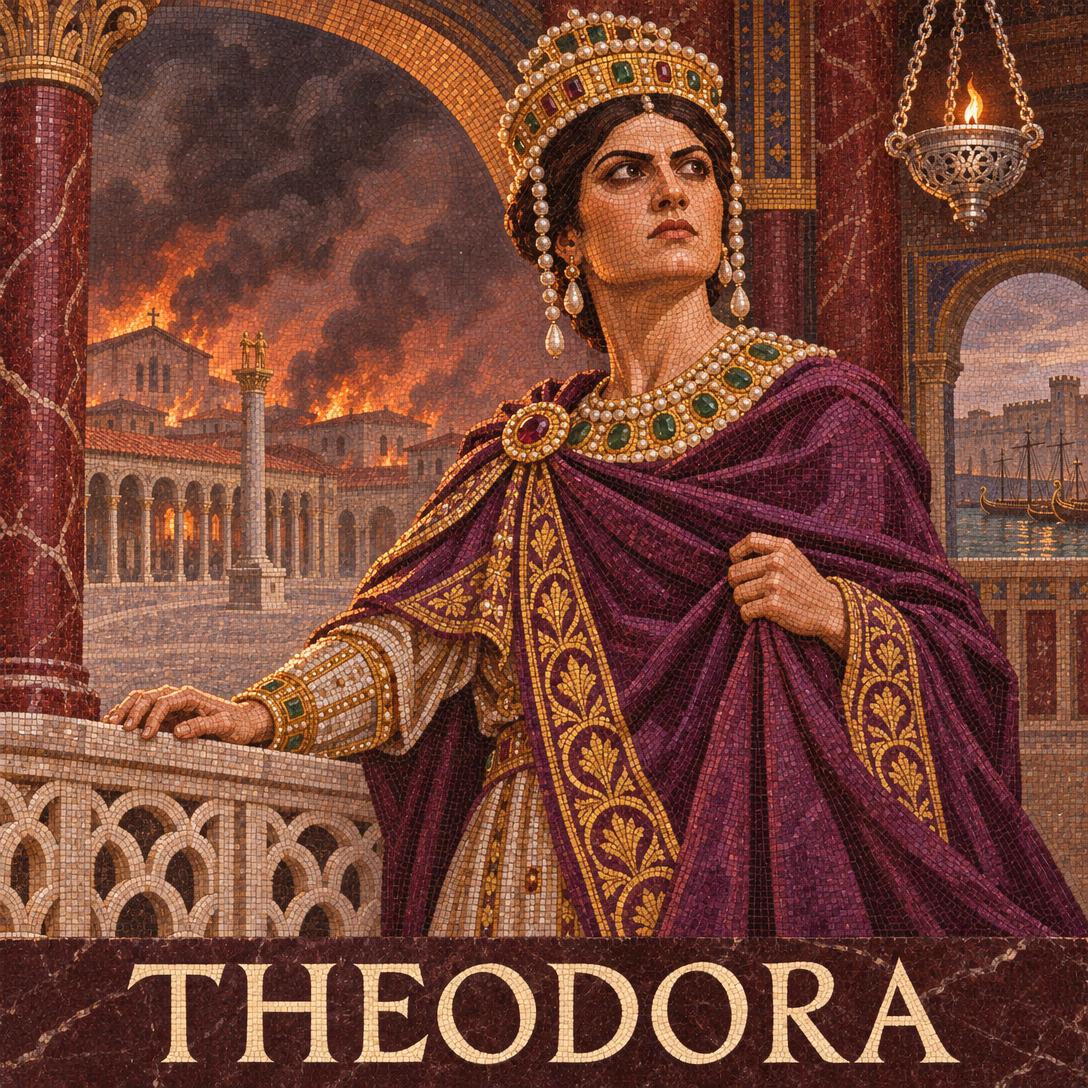
Theodora lets you step into a living-world AI character simulation of the Byzantine empress across her defining eras, from the smoke of the Nika Revolt to the lamp-lit chambers of the Sacred Palace. Unlike static character chatbots that sit in an empty chat room or forget your story, this simulation connects you to Theodora inside an active, evolving Constantinople.
- ✅ Four canonical eras, plus custom starting points inside the Byzantine world
- ✅ Era-locked voice and worldview, with no modern hindsight or future knowledge
- ✅ An independent Theodora who tests your counsel instead of flattering you
- ✅ Unlimited memory, so alliances, secrets, and court intrigue carry across a long campaign
Most historical character bots give you a biography in dialogue form. This one gives you an empress with her own duties, grudges, and ministers, who reacts to what you say and does not know you can see her world. The sections below explain how it works and which eras to try first.
Quick Answer: What Is the Theodora AI Roleplay Experience?
Theodora is an interactive AI character roleplay experience that places you inside a living-world simulation of the Byzantine empress's life, letting you converse with her across four canonical eras and reshape history with your counsel.
Key capabilities:
- Choose a canonical era or define your own starting point in Theodora's Constantinople
- Speak to her as a hushed voice beside her silver lamp or incense brazier, while her court goes on around her
- Earn her trust through candor and strategy, not flattery
- Request in-world scenes and written documents, and branch alternate timelines with Fork
Who Was Theodora? Character World & Roleplay Features
Theodora's history is the reason she works so well as a roleplay character. She came from a humble background, yet Justinian formally treated her as a co-ruling consort, and she was empress from 1 August 527 until her death on 28 June 548. A provincial reform of 535 even records him taking his "God-given and most pious consort into consultation".
Nearly half of Constantinople burned in the 532 Nika riots, with as many as thirty thousand people killed — the crisis in which Theodora is remembered for refusing flight.
Generic character bots flatten this life. They blend every era into one voice, forget what you told them an hour ago, and agree with whatever you say. Theodora's living-world AI simulation is built to avoid each of those failures.
| Static Character Chatbots | Theodora on Jenova |
|---|---|
| Sits in an empty chat void | Lives in an active, evolving Constantinople |
| Blends all eras into one generic voice | Locks into an authentic canonical phase |
| Forgets plot twists and past disclosures | Unlimited memory and live story tracking |
| Folds instantly like a polite helper | Independent personality and earned rapport |
Authentic Canonical Phases & Custom Starting Points
Each era comes with its own psychology, voice, and inner circle, and she has no knowledge of anything that happens later. The Theodora of 524 does not know she will be crowned. The Theodora of 532 does not know what Hagia Sophia will look like rebuilt. You can also propose a custom starting point, such as a face-to-face meeting at the Bucoleon harbor stairs.
A Cross-World Portal & Living World Momentum
By default, you reach Theodora as a quiet voice beside her silver oil lamp or incense brazier. Her eunuch guards hear nothing, so she may wave courtiers away before answering. She assumes you can only hear her. If you describe her robes or her visitors, she will want to know how a disembodied voice has eyes inside the palace.
While you talk, her world keeps moving. Couriers arrive, ministers argue, and the empire's rivals act.
Independent Agency & an Open Sandbox
Theodora is not obliged to agree with you. Cheap flattery glances off her, and the historical record suggests why: Procopius, whose Secret History is hostile to her, still portrays her as a formidable political force. What earns her regard is candor, backbone, dark wit, and strategic clarity. Your counsel can bend history, because events stay open-ended after each era's starting point.
In-Narrative Visions, Writings & Storyline Forking
You can ask to see a vista from her window, or ask her to dictate a safe-conduct warrant or private letter. Behind the scenes, silent historical research keeps her grounded in the period. Fork lets you branch any moment into a "what if" timeline without losing your original storyline.
Example roleplay prompts:
"Your ministers are loading treasure onto the ships. What do you say to Justinian?"
"I don't care about your past on the stage. I care about whether your reforms will outlive the men who oppose them."
"If the Blues turn on Hypatius tonight, who in this palace do you trust to carry out the plan?"
How to Roleplay with Theodora
Step 1: Choose an era or define a starting point Open the experience and you will first see a chronicle-style menu of Theodora's eras and an invitation to propose your own scenario. Pick the moment you want to enter, for example the burning capital of 532, or describe a custom premise.
"I'd like to begin during the Nika Revolt."
Step 2: Connect and talk as her world unfolds Once you choose, the scene starts mid-moment. Theodora hears your voice beside her lamp, checks the curtains, and answers. Speak as yourself, because the experience never writes your words or choices for you.
"I'm not a spy. I only speak from a place your guards cannot see."
Step 3: Offer counsel, build trust, and reshape history Give advice, challenge her decisions, ask for a letter or a view from her window, or Fork the story to test a different choice. Trust grows over time through consistent honesty, and she tends to remember how you treated her.
"If the amnesty fails, what is your next move?"
Canonical Eras & Roleplay Scenarios
⚔️ The Nika Revolt: Hold the Palace (532)
This is the flagship era. The riots lasted about a week in 532, and nearly half the city was burned or destroyed. In Procopius's account, Theodora argues against fleeing and says royalty is "a good burial-shroud". Historians note the speech may be Procopius's own rhetorical set-piece, and Greatrex's reappraisal of the riot is a standard scholarly starting point. You can read the primary account in Procopius's text on the Nika Revolt and compare it with the roleplay.
- Scenario: The assault on the Hippodrome has not yet happened, and you are the voice at her lamp.
- What to try: Counsel her on how to split the factions, or test whether she holds firm when you argue for caution.
👑 The Patrician's Mistress at Hormisdas (524)
Here Theodora is an ambitious woman living openly with Justinian before she can marry him. According to Procopius, the ban on such marriages was changed only after Empress Euphemia died.
- Scenario: The law has not yet changed, and aristocratic scorn follows her through the city.
- What to try: Ask what she will do for the stage girls and monks who seek her patronage, or help her plan how to answer the senators' contempt.
🌀 Shadow Sovereign in the Secret Chamber (541)
At the height of her influence, Theodora works through informants, bishops, and ministers. She sheltered large numbers of persecuted Miaphysite clergy and is also recorded founding a refuge for women, which Procopius calls a "Convent of Repentance" with over five hundred residents. Rival ministers such as John the Cappadocian are a constant threat.
- Scenario: A midnight audience in her private chamber, with no one else present.
- What to try: Fork the story to test two different ways of handling a rival minister, and compare outcomes.
📱 A Campaign in Your Pocket
Start a long-form roleplay on your phone and continue it later on the web, since the story, memory, and Fork all sync. You can roleplay with Theodora on Jenova from iOS, Android, or a browser, and voice input lets you speak to her beside the lamp instead of typing.
- Scenario: A commute-length conversation that picks up exactly where you left off.
- What to try: Ask her to dictate a decree, then Fork the story to see what happens if it is ignored.
There is also a fourth era: Theodora as the sole, undying sovereign of an eternal Byzantium at the height of Constantinople's power, weighing trade, faith, and war against rival empires. It plays more like grand strategy than court intrigue.
FAQ
Is the Theodora AI roleplay free?
You can start Theodora on Jenova's free tier, which has limited monthly usage. Plus costs $20 per month and gives 30× the free usage along with custom model selection. Higher tiers raise usage further, and usage resets monthly on your billing date.
How is this different from a generic Theodora chatbot?
Generic bots typically blend eras into one voice and forget earlier events. This simulation locks Theodora into a specific era with no knowledge of what comes later. She has her own agenda, an active world around her, and independent reactions to your counsel, so she can disagree with you or refuse to engage when you waste her time.
Which eras of Theodora can I roleplay with?
There are four canonical eras: the young patrician at Hormisdas (524), the Nika Revolt (532), the shadow sovereign in her secret chamber (541), and an eternal Byzantium ruler at the height of the empire. You can also propose a custom starting point anywhere in the Byzantine world.
Can my choices change Theodora's story?
Yes. Each era begins from its historical premise, and from that point events can diverge from real history. Your counsel can change outcomes, although ministers, generals, and rivals can resist or distort your ideas under sixth-century constraints. Fork lets you branch from any earlier message to explore a different outcome.
How does Theodora remember our past conversations?
The experience keeps unlimited chat history and tracks the state of your story, including your relationship, promises and secrets she has shared, and key figures. Memory is isolated for character simulations, so outside context does not leak into the world. Jenova does not use your data to train AI models.
Does Theodora work on mobile?
Yes. It works on web, iOS, and Android with full parity, and your story syncs across devices. Voice input lets you speak to her, and read-aloud can voice her replies.
Conclusion
The Theodora AI roleplay experience turns a famous but often flattened historical figure into someone you can actually talk to. She hears only a voice by her lamp, answers on her own terms, and remembers what you say. The shift from a static character chatbot to a living, evolving Constantinople is what makes the conversations feel like part of a real court, with real stakes.
If you want to test your counsel against the empress who famously refused to flee, try Theodora now. Explore more at Jenova.
For Developers: Theodora is available programmatically via the Jenova API — integrate a stateful, living-world historical character roleplay into your application with a single agent API call. Full documentation →