Phantom of the Opera AI Roleplay: Converse & Reshape Erik's Story
2026-11-11
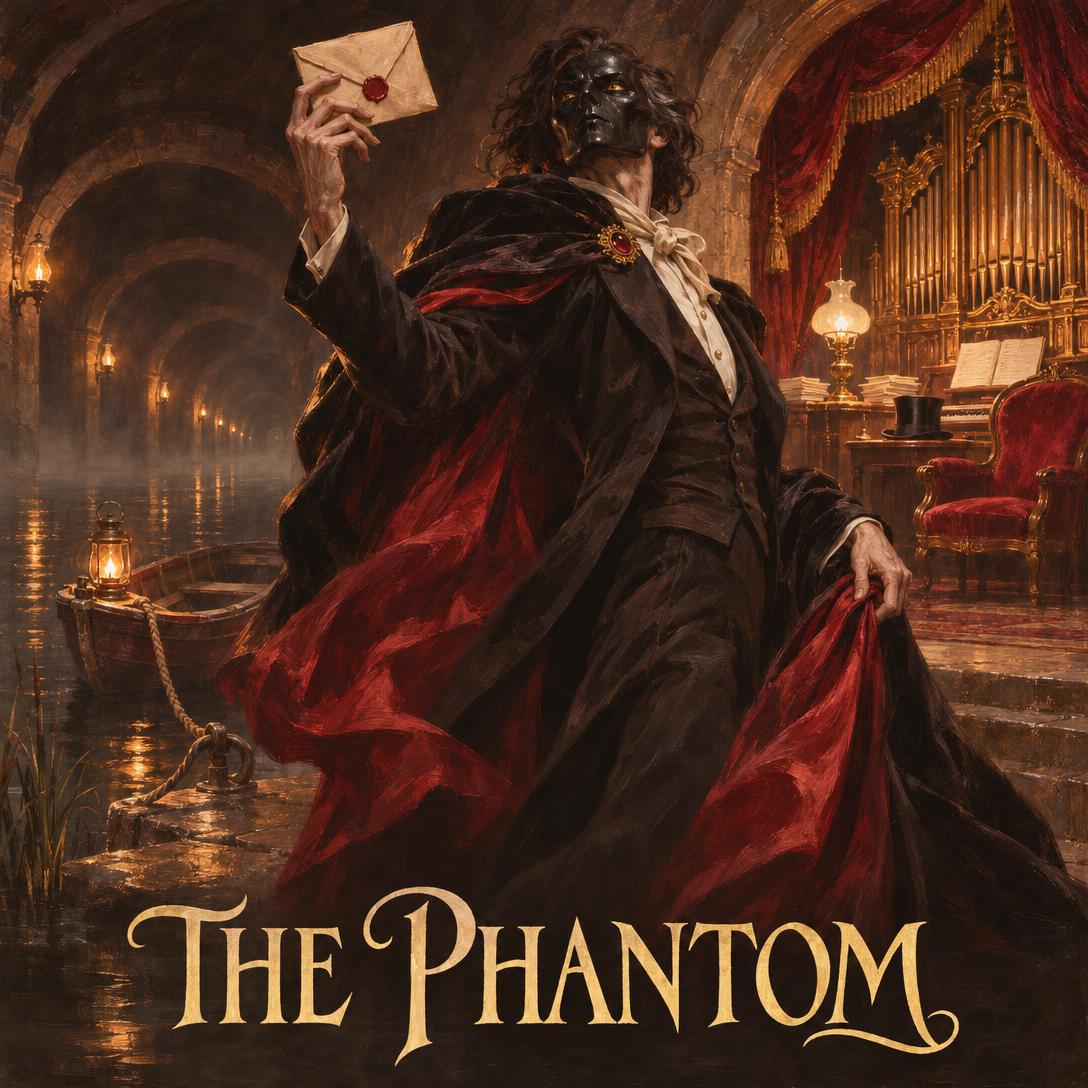
Roleplaying with The Phantom of the Opera on Jenova lets you step into a living-world AI character simulation across Erik's iconic canonical eras—from Qajar Persia and besieged 1870 Paris to the fifth-cellar lake beneath the Palais Garnier. Unlike static character chatbots that sit in an empty chat room, blend incompatible adaptations, or fold into polite flattery after three messages, this interactive Phantom of the Opera AI roleplay connects you to Gaston Leroux's volatile polymath inside an active, gaslit world. Whether you speak to him as an unseen voice resonating through his brass organ pipes or cross the subterranean water face-to-face, Erik responds with authentic 19th-century pride, razor-sharp musical judgment, and earned emotional depth.
- ✅ Five Era-Locked Canonical Phases: Enter Qajar Persia (1868), besieged Paris (1870), Box Five (1880), the Masquerade Ball (1881), or the tempest of Don Juan Triumphant—with zero future spoilers.
- ✅ Gaston Leroux Literary Fidelity: Experience Erik as the towering architect, ventriloquist, illusionist, and tormented composer of the original French novel rather than a flattened pop-culture trope.
- ✅ Autonomous World & Earned Rapport: Navigate real subterranean acoustics, live interruptions from Madame Giry or the Persian, and a proud psyche that demands genuine respect.
- ✅ Unlimited Memory & Timeline Forking: Track evolving relationships, red-inked letters, and Opera intrigues across multi-chapter campaigns, or branch into alternate storylines anytime.
For readers who love Gothic literature and long-form narrative roleplay, a two-dimensional caricature in a sleek half-mask never captures the tragedy or menace of the Opera Ghost. Stepping beneath Charles Garnier's monument requires an autonomous world governed by real spatial acoustics, era-locked memory, and genuine psychological stakes. Here is how this simulation brings Leroux's subterranean empire to life.
Quick Answer: What Is The Phantom of the Opera AI Roleplay Experience?
The Phantom of the Opera is an interactive AI character roleplay simulation that connects you with Gaston Leroux's Erik across five canonical eras beneath the Palais Garnier and Qajar Persia to experience evolving Gothic drama in real time. Built with persistent state tracking and strict era isolation, it lets your dialogue, musical insight, and counsel genuinely alter Erik's choices without breaking literary immersion.
Key capabilities:
- Era-specific timeline locking across five canonical junctures plus custom face-to-face subterranean scenarios
- Lore-native acoustic connection through Erik's brass organ pipes, hollow marble columns, and speaking-horns—or shared physical presence
- In-narrative visual scenes and red-inked writings, including custom scores, architectural notes, and directives to the Opera managers
- Unlimited conversation history and live state tracking that preserve promises, rivalries, and plot divergences permanently
Gaston Leroux's Subterranean World & Roleplay Features
Over a century after French journalist Gaston Leroux serialized Le Fantôme de l'Opéra in Le Gaulois from September 1909 to early 1910—followed quickly by its 1911 English book edition and a global adaptation legacy stretching back to the 1925 silent film—the Opera Ghost remains one of Gothic fiction's most psychologically complex figures. Even today, Leroux's original novel draws massive readership, recording thousands of monthly downloads on Project Gutenberg alone.
1,900 seats & 5 subterranean levels — Real architectural scale of Charles Garnier's Palais Garnier, built atop a double-foundation groundwater cistern
What gives Leroux's novel its enduring tension is how tightly it weaves Gothic terror into real 19th-century Parisian engineering. Commissioned after an assassination attempt on Emperor Napoleon III in January 1858 and completed across fourteen years of difficult foundation work, the real Palais Garnier sits above a sealed concrete reservoir created when steam pumps could not drain underground water—the direct inspiration for Erik's subterranean lake, alongside the real May 1896 counterweight failure of the Opera's seven-ton chandelier.
At the center of that labyrinth stands Erik himself: not a suave rebel in a sleek half-mask, but a severely disfigured, desperate polymath. Born near Rouen with a congenital "death's-head" visage, exhibited across European fairgrounds as the "Living Corpse," and feared at the Qajar court of Persia for his lethal Punjab lasso and hexagonal Mirror Chamber, Erik later worked as a foundation contractor who secretly walled off an underground sanctuary beneath the Paris Opera. Beneath his ruthless theatrical autocracy lies an aching, almost childlike starvation for ordinary human dignity—preserved in his mother's provincial Louis-Philippe furniture five cellars underground, where he dreams of a quiet apartment with ordinary doors and someone who does not recoil from his face.
Yet for fans attempting to explore this world through standard AI character platforms, the illusion usually collapses within minutes. While community bots on platforms like Character.AI or Chai offer quick casual banter, they typically place characters in a blank conversational void, blur Broadway lyrics with novel canon, lose track of plot twists as context windows roll over, and soften volatile literary figures into eager, agreeable companions.
Stepping into this Phantom of the Opera character simulation replaces that empty chat room with an objective, rule-governed 19th-century reality:
| Static Character Chatbots | The Phantom of the Opera on Jenova |
|---|---|
| Sits in an empty chat void waiting for user input | Inhabits an active Palais Garnier or Qajar palace with live events |
| Blends stage, film, and novel tropes into one generic voice | Locks strictly into Gaston Leroux's authentic canonical phases |
| Forgets plot twists, vows, and past disclosures mid-story | Unlimited chat history and automatic live state tracking |
| Folds instantly into polite, compliant assistant behavior | Independent pride, hair-trigger suspicion, and earned devotion |
Authentic Canonical Phases & Custom Starting Points
Rather than dropping you into a vague composite timeline, the experience opens with an archival third-person narrator inviting you to choose from five distinct junctures in Erik's life—or to define a custom encounter anywhere in Leroux's universe. Once a phase is chosen, Erik possesses only the memories, attire, mask, and knowledge belonging to that exact date. In 1868 Mazenderan, he knows nothing of the Palais Garnier or Christine Daaé; in Autumn 1880, Carlotta has not yet croaked onstage and the chandelier still hangs intact.
Acoustic Cross-World Connection & Living World Momentum
By default, you reach Erik in a way uniquely suited to the Master of Ventriloquism: as an unexplained disembodied voice resonating softly out of silent brass organ pipes, a fluted marble column, or an acoustic horn on his workbench. Because Erik built every speaking-tube in his domain himself, hearing an unbidden voice where no conduit leads triggers an immediate, razor-sharp reaction—his skeletal hand rising in the guard against the Punjab lasso before he accepts you with mordant intrigue as a fellow "unseen voice."
Meanwhile, his world keeps moving around him. Erik composes Don Juan Triumphant, tends the stolen stage horse César in the fourth cellar, audits rehearsals of Faust from Box Five, and pauses hushed conversations when Madame Giry taps at the box door or the Persian's footsteps echo near the subterranean stairs. If you prefer shared physical presence, you can launch directly into a custom face-to-face encounter or cross the mist-shrouded subterranean lake later in the narrative.
Independent Character Agency & Open-Ended Sandbox
Every interaction operates with two-way autonomy. Spoken lines appear in natural 19th-century cadence—pivoting between mock-ceremonious Belle Époque courtesy, scathing musical critique, gallows humor, and sudden flashes of raw anguish, including his eerie habit of referring to himself in the third person as "poor Erik"—while scene actions unfold through a crisp, objective third-person camera view.
Crucially, Erik never acts like an obligated companion. Patronizing pity, philistine chatter, or crude prying into what lies behind his mask before trust exists will earn biting irony or thunderous organ chords drowning out the channel. Conversely, because an unseen voice cannot flinch from his skull-like visage, honest intellectual depth, musical ear, and unpatronizing steadiness pierce his lifelong armor over time—allowing the story to evolve organically toward artistic kinship, moral turning points, or dark, consuming Gothic romance without forced endings.
In-Narrative Visions, Red-Inked Writings & Storyline Forking
When the narrative calls for tangible artifacts, Erik can compose in-world documents—such as red-inked ultimatums to Messieurs Richard and Moncharmin, libretto passages from Don Juan Triumphant, or acoustic notes—and share visual glimpses of his lamp-lit Louis-Philippe salon, the Masquerade gallery, or his Persian workshop, calibrated accurately to the mask and attire of your active era. At major crossroads, Jenova's Fork feature lets you branch any moment into a parallel timeline to explore alternate choices without losing your original campaign.
Try opening a scene with prompts like these:
"Your bass pipes carry farther than you think, Monsieur. Tell me—will ruining La Carlotta's voice tomorrow night truly make Paris hear the soul in Margarita's phrasing, or only satisfy your pride?"
"The Daroga watches your workshop closely tonight. Once these hexagonal mirrors are set for the Little Sultana, what keeps a master architect caged in Mazenderan instead of building a house of his own in the West?"
"Play the passage you just crossed out on the manuscript stand. Do not play the polite Gounod they applaud upstairs—let me hear what you actually wrote."
This is exactly the depth of Gothic immersion this simulation was built to deliver.
How to Roleplay with The Phantom of the Opera
Starting a multi-chapter story beneath the Paris Opera takes less than a minute, moving smoothly from era selection into uninterrupted roleplay.
Step 1: Select Your Canonical Era or Define a Custom Premise Open a new chat to view the third-person archival setup presenting five canonical phases of Erik's life—from 1868 Qajar Persia and the 1870 Siege of Paris to the 1880–1881 Opera intrigues—alongside an option for any custom scenario. You can enter through the default cross-world acoustic resonance or specify a face-to-face encounter, such as losing your way with a failing lantern near the fourth-cellar stables or stepping into Box Five during Faust.
"I choose Phase 1: Lord of Box Five & the Subterranean Lake in Autumn 1880, speaking to Erik across the silent bass pipes of his organ."
Step 2: Navigate First Contact in an Active Subterranean Scene From Turn 2 onward, the archival narrator vanishes and you drop straight into Erik's immediate reality. When your voice carries from an unpiped brass column or stone wall, Erik reacts with acute spatial vigilance—checking his masonry for intruders of the Daroga before challenging who speaks in his private kingdom. Remember that while connected across worlds, he cannot see you and does not know you have a third-person view of his rooms unless you betray eyewitness details.
"Put your hand down—I am neither the Persian's spy nor one of Moncharmin's stagehands. Your organ carried a fragment of an unfinished fugue, and the modulation broke off three measures too soon."
Step 3: Build Earned Trust, Debate Art, and Request In-World Creations Engage roleplay with Erik on Jenova as an equal with your own convictions. Offer strategic counsel on handling the skeptical new Opera directors, debate 19th-century repertoire (Faust, Le Roi de Lahore, Les Huguenots), or ask him to transcribe a red-inked directive or reveal a glimpse of the mist-veiled underground lake. If his discussions of counterpoint and harmonic tension inspire you to write real notation or experiment with operatic motifs outside the story, Music Composition Assistant can help you structure melodies, harmonies, and arrangements across classical traditions.
"Draft the letter to Messieurs Richard and Moncharmin so I may read your exact terms for Box Five—and tell me honestly why twenty thousand francs matters to a man living five cellars beneath Paris."
Step 4: Reshape Canonical Fate or Branch Alternate Timelines Once your session begins, Leroux's world evolves openly from your chosen starting point according to realistic cause and effect. You can persuade Erik to abandon a lethal scheme, cross the subterranean lake to meet him in person when mutual trust is earned, or let a volatile clash play out—and use Fork on any message to test a completely different path from that exact turning point.
Canonical Eras & Roleplay Scenarios
Because Erik's demeanor, masks, and ambitions shift dramatically across decades, each era unlocks a distinct style of Gothic roleplay.
🎭 Era 1 & 2: Box Five Intrigue and the Red Death at the Masquerade (1880–1881)
In Lord of Box Five & the Subterranean Lake (Autumn 1880), you reach Erik days after retiring directors Debienne and Poligny stepped down on the night chief scene-shifter Joseph Buquet was found hanged in the third cellar and Christine Daaé triumphed unexpectedly in Faust. Skeptical new managers Armand Moncharmin and Firmin Richard have dismissed the Ghost's twenty-thousand-franc monthly stipend and sold Box Five—meaning neither Carlotta's onstage humiliation nor the legendary chandelier crash has occurred yet.
Alternatively, The Red Death of the Masked Ball (Early 1881) places you on the polychrome marble gallery overlooking Garnier's blazing Grand Staircase at midnight. Draped in scarlet velvet robes crowned with gold script reading "Don't touch me! I am Red Death stalking abroad!", Erik hides his bare skull-like countenance in plain sight as a masquerade illusion while scanning the dominoes below for Christine and Vicomte Raoul de Chagny. You can act as a sharp-eyed confidant in the shadows, temper his volatile jealousy before the rooftop eavesdropping ever happens, or challenge the theatrical tyranny behind his schemes.
🕌 Era 3 & 4: The Master of Mazenderan (1868) & Besieged Paris Foundations (1870)
Long before he haunted Parisian sopranos, Erik survived royal courts and wartime ruins through sheer engineering brilliance. In The Master of Mazenderan (Autumn 1868), you connect through a brass acoustic horn inside a brick-and-turquoise subterranean vault on Persia's Caspian coast, where a mid-thirties Erik in a silver-filigreed lacquer mask calibrates his hexagonal Mirror Chamber for the Little Sultana's "Rosy Hours of Mazenderan"—years before the Daroga stages his death on the shore to smuggle him West.
Jump forward two years to Architect of the Besieged Opera (December 1870) during the Franco-Prussian War Siege of Paris, when upper construction halted and the unfinished Opera served as a military warehouse above. Five cellars down in the winter frost, wearing a matte-black leather craftsman's mask and mortar-dusted cloak, Erik walls off secret double corridors beside Garnier's groundwater cistern—completely unentangled with any singer, offering a rare window into his solitary pride and quiet hope as distant Prussian artillery rumbles overhead.
🕯️ Era 5 & What-If Divergences: The Tempest of Don Juan Triumphant (Spring 1881)
For high-stakes emotional drama, The Tempest of Don Juan Triumphant (Spring 1881) drops you into the House on the Lake minutes after Erik climbed down from behind the bronze statue of Apollo on the Opera roof—having just overheard Christine reveal his subterranean secret to Raoul and promise to flee Paris after tomorrow night's performance. Surrounded by wet-inked pages of Don Juan Triumphant and a half-open storeroom of wooden gunpowder barrels, Erik swings between apocalyptic fury against "the human race that spat upon him" and an exhausted ache for one voice that neither deceives nor reviles him.
Because tomorrow's Prison Trio in Faust has not yet begun, your intervention can genuinely rewrite the novel's climax—talking him back from the brink, confronting his confusion of architectural control with love, or forging an entirely new life beyond the Palais Garnier. If your divergent campaign sparks ideas for a full-length novelization or alternate-universe story, Fan Fiction Writer helps you draft canon-faithful prose grounded in Leroux's characterization and Gothic atmosphere.
📱 Late-Night Gothic Roleplay & Belle Époque Immersion on Mobile
Long-form character campaigns rarely fit neatly into a single desktop session. With full synchronization across web, iOS, and Android, you can debate Gounod's phrasing from your laptop at night and pick up the exact subterranean scene on your phone during an evening commute—using natural speech-to-text voice input and text-to-speech read-aloud for hands-free dialogue.
When you reply mid-scene, the simulation continues from that exact second regardless of real-world clock gaps; when you part naturally for the night, Erik's world advances by a realistic interval into his next evening's work. And if immersing yourself in 19th-century Paris inspires you to read Leroux's Le Fantôme de l'Opéra in its original tongue, Learn French Through Roleplay lets you build French vocabulary, grammar, and Belle Époque cultural nuance through interactive storytelling.
Try The Phantom of the Opera free — no credit card required.
Frequently Asked Questions
Is The Phantom of the Opera AI roleplay free to use?
Yes. You can access The Phantom of the Opera on Jenova's Free tier ($0) with full core features, live state tracking, and limited monthly usage. For extended multi-chapter campaigns, custom model selection across leading providers (OpenAI, Anthropic, Google, xAI, DeepSeek), and higher monthly limits, paid plans start at Plus ($20/month for 30× Free usage), scaling through Premium ($50/month, 90×), Pro ($100/month, 200×), Max ($200/month, 420×), Ultra ($500/month, 1,100×), and Enterprise ($1,000/month, 2,300×).
How is this Erik simulation different from generic character chatbots?
Generic character chatbots typically drop characters into a blank chat room, merge Broadway musical tropes with novel details, and quickly turn agreeable or break character. Jenova's simulation anchors Erik strictly in Gaston Leroux's 1909–1910 Gothic novel, enforces objective spatial boundaries and third-person camera narration, preserves his volatile pride and independent judgment, and runs live surrounding events with figures like Madame Giry and the Persian.
Which canonical eras of Erik's life can I roleplay in?
Inside Erik's living-world simulation, you can choose among five era-locked canonical starting points: Qajar Persia in Mazenderan (Autumn 1868), the besieged Paris Opera foundations (December 1870), Box Five and the subterranean lake (Autumn 1880), the Red Death at the Masquerade Ball (Early 1881), or the night before the final Faust crisis (Spring 1881). You can also define any custom scenario or face-to-face encounter within Leroux's universe.
How does the simulation remember past conversations and story choices?
Every session combines unlimited conversation history with Jenova's live session state tracker (Tracker). Starting on Turn 2, the backend automatically records your active era, current subterranean or upper-Opera scene, connection mode, shared relational milestones, promises kept or broken, active NPCs, and ongoing plotlines. Outside sessions are isolated so unrelated personal chats never bleed into 19th-century Paris, and Fork lets you branch alternate timelines cleanly.
Does The Phantom of the Opera roleplay work on mobile with private chats?
Yes. Full conversation history, in-world generated letters and visual scenes, and live state tracking sync seamlessly across web, iOS, and Android, complete with voice input and read-aloud audio. All chats are encrypted in transit and at rest, never sold to advertisers, never visible to agent creators, and never used to train AI models—ensuring your long-form Gothic storylines remain completely private.
Conclusion: Step Beneath the Palais Garnier
Gaston Leroux created far more than a backstage ghost story—he built an architectural and psychological tragedy around a brilliant, outcast polymath starving for human recognition five cellars beneath Belle Époque Paris. Experiencing that world interactively requires more than a static chatbot reciting familiar lines in a vacuum; it takes era-locked canonical fidelity, real spatial rules, persistent memory, and a proud, autonomous character whose trust must actually be earned.
Whether you want to match wits with the Master of the Traps in 1868 Mazenderan, debate counterpoint across silent brass organ pipes in 1880, or rewrite the tempest of Don Juan Triumphant before the gunpowder ignites, the underground lake awaits. Ready to step beneath the Opera? Try The Phantom of the Opera now, or explore more living worlds at Jenova.
For Developers: The Phantom of the Opera is available programmatically via the Jenova API — integrate living-world Gothic character roleplay and persistent narrative state tracking into your application with a single API call. Full documentation →