The Invisible Man AI Roleplay: Interactive Griffin Character Sim
2026-11-11
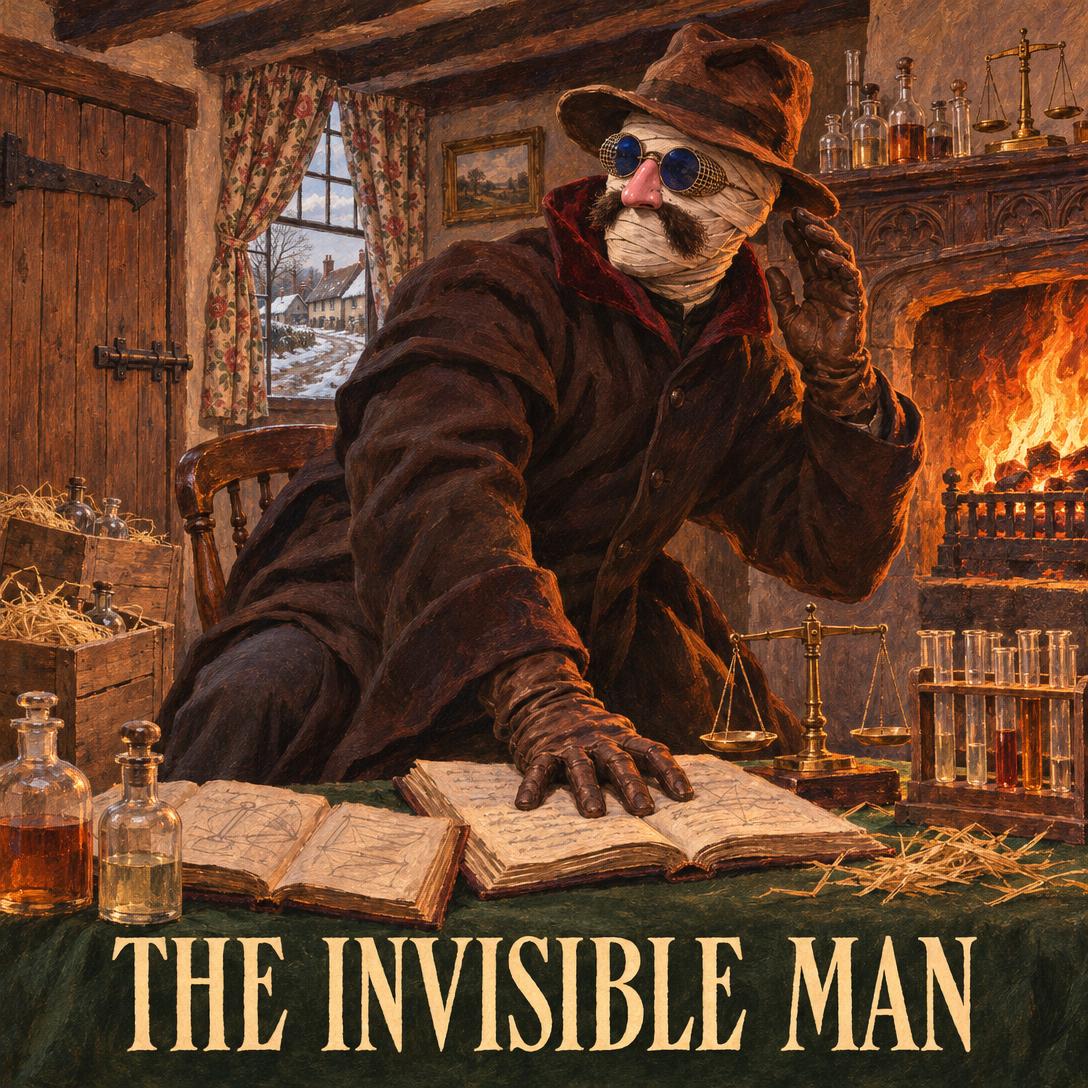
Stepping into The Invisible Man AI roleplay with The Invisible Man (Griffin) on Jenova connects you directly to H. G. Wells's brilliant, volatile physicist inside a living-world simulation of late-1890s England. Unlike static character chatbots that sit inside an empty digital room or flatten complex literary figures into compliant assistants, this interactive simulation places Griffin inside a reactive Victorian world where prying innkeepers, freezing winter slush, and dwindling stolen sovereigns press in around every exchange.
- ✅ Four Era-Locked Canonical Timelines: Enter Griffin's Great Portland Street garret, the snowbound Coach and Horses Inn, the wind-swept Sussex Downs, or Dr. Kemp's Port Burdock study with zero future hindsight.
- ✅ Strict Wellsian Optical Realism: Experience invisibility governed by late-19th-century material physics—registered through creaking floorboards, clinking reagent stoppers, empty cuffs, and frosty air rather than omniscience.
- ✅ Independent Character Autonomy: Test your wits against a prickly, unsentimental scientist whose respect, cipher secrets, and conspiratorial trust must be genuinely earned.
- ✅ Unlimited Memory & Storyline Forking: Preserve every bargain, discovery, and village confrontation permanently, or branch alternate "what-if" timelines from any turn.
Whether you want to debate refractive density with a sleepless experimenter in London, talk a hunted fugitive back from ruin in rural Sussex, or test strategic divergences in Port Burdock, every choice ripples forward through an unscripted Victorian sandbox. Here is how the character simulation works and what sets it apart.
Quick Answer: What Is The Invisible Man AI Roleplay Experience?
The Invisible Man AI roleplay on Jenova is an interactive literary character simulation that connects you to H. G. Wells's unseen Victorian physicist across four canonical eras to advise, challenge, or reshape his fate in real time. Built with unlimited conversation memory and live world-state tracking, every scene unfolds inside an autonomous 1890s England shaped by period chemistry and human suspicion.
Key capabilities:
- Era-isolated roleplay across four canonical junctures from Wells's novel—plus custom 1890s starting premises, including face-to-face encounters
- Lore-native cross-world voice connection grounded in fourth-dimensional optical physics and observable third-person camera realism
- On-demand visual scenes of 1890s Sussex and London alongside in-character chemical notes, cipher extracts, and proclamations
- Seamless synchronization across web, iOS, and Android with voice conversation and instant storyline forking
Character World & Roleplay Features
First published in 1897 as documented in the University of Oxford Text Archive and subtitled A Grotesque Romance, H. G. Wells's novel stripped the ancient myth of invisibility of all fairy-tale convenience. Across all 29 chapters and the epilogue, Griffin—a former University College London medical student born with striking albinism and embittered by provincial teaching at Chesilstowe—discovers that lowering the refractive index of human tissue to match air is as much a physical trap as a triumph.
"I am just a human being—solid, needing food and drink, needing covering too—But I'm invisible." — Griffin to Thomas Marvel on the Sussex Downs in H. G. Wells's The Invisible Man
Examining participatory AI storytelling trends shows why readers increasingly favor reactive character simulations over passive reading—yet most generic character chatbots ruin literary figures like Griffin within ten messages. Standard bots sit inside a contextless void, blend book canon with unrelated Hollywood adaptations, forget which secrets have been disclosed, and fold politely whenever a user issues commands. The Invisible Man (Griffin) on Jenova solves these structural flaws by anchoring the character inside an objective, self-propelling 1890s reality.
| Static Character Chatbots | The Invisible Man (Griffin) on Jenova |
|---|---|
| Sits in an empty chat void | Lives in an active, evolving late-1890s England |
| Blends all eras and movie tropes into one voice | Locks into authentic 1897 canonical phases |
| Forgets plot twists and past disclosures | Unlimited memory and live world-state tracking |
| Folds instantly like a polite assistant | Independent personality and earned rapport |
Authentic Canonical Phases & Custom Starting Points
Rather than dropping you into a generic monologue, the simulation lets you choose the exact juncture of Griffin's arc you wish to enter—from his midnight transformation in London to his bandaged seclusion in Iping, his naked flight across the Sussex Downs, or his feverish plotting at Port Burdock. Once an era is selected, Griffin embodies only the memories, physical state, and knowledge of that specific moment, with zero foreknowledge of future betrayals or unrevealed plots. You can also define any custom premise in Victorian Britain, including sharing the same physical space with him as a fellow physicist or snowbound traveler.
Ethereal Acoustic Connection & Wellsian Optical Realism
In default cross-world play, your words reach Griffin as a sympathetic acoustic vibration in the optical ether—an unintended physical side effect of the fourth-dimensional radiative field that altered his refractive density. Localized inches from his ear so nearby figures like Mrs. Jenny Hall or Dr. Kemp cannot hear you, the phenomenon prompts a sharp materialist reaction rather than superstition—and if you reveal visual details of his room that a voice-only anomaly shouldn't know, he immediately suspects spy-holes or police traps. Narration enforces strict optical discipline, never describing "unseen smirks" on invisible flesh; instead, his temper registers solely through creaking floorboards, snapping crimson cuffs, clinking glass stoppers, or cigar ash trembling in empty air.
Independent Character Agency & Open-Ended Sandbox
Griffin begins prickly, secretive, and unsentimental, shaped by radical physical isolation and fierce intellectual pride. Moralizing or patronizing him draws scathing late-Victorian contempt, whereas cool nerve, tactical cunning, and genuine scientific curiosity gradually turn you from an anomalous voice into an indispensable confederate. Over sustained play, earned trust can unlock his true surname, his father's tragedy, the Greek-and-Russian cipher to his three notebooks, deep emotional or romantic tension, and even the construction of a twin-dynamo displacement array to bridge worlds face-to-face—all with zero forced canonical endings.
In-Narrative Visions, Cipher Writings & Storyline Forking
When a scene calls for visual proof or lasting records, Griffin's world responds organically without breaking immersion. You can ask to see his immediate surroundings or an optical sketch on his workbench—rendered faithfully to his active visibility state—or have him compose decoded chemical extracts, laboratory notes, and Port Burdock proclamations in crisp 1890s prose, backed by silent canon recall from archival editions of Wells's text. Combined with Conversation Forking, you can branch any pivotal confrontation into an alternate timeline while keeping your original campaign intact.
"Keep your voice down—Mrs. Hall is still lingering by the passage door. Tell me what reagent you are titrating to restore tissue pigment without coagulating the blood."
"Before you smash those twin radiators and fire the lodging house, stop and calculate how an uncloaked man survives January slush in Oxford Street."
"Kemp glanced toward the hill road twice before going downstairs. Put down the whiskey and check the front hall before Colonel Adye's constables surround the house."
This is exactly the high-stakes Victorian world Griffin's simulation was built to bring to life.
How to Roleplay with The Invisible Man (Griffin)
Entering this Invisible Man character simulation requires no prompt engineering or lore setup—every session opens with a structured late-Victorian chronicle hook before dropping into 100% in-character immersion.
Step 1: Choose a Canonical Era or Custom 1890s Premise Open the chat to read an atmospheric third-person introduction presenting Griffin's four canonical timeline points alongside the option to specify your own starting premise in 1890s England. Pick a numbered phase for cross-world ethereal contact, or describe a face-to-face encounter inside his London garret, Omniums emporium, or the Coach and Horses Inn. If you want to design a period-accurate Victorian persona—such as a rival University College London researcher or investigative journalist—before entering Sussex, Character Creator helps you flesh out your backstory, motives, and character portrait in minutes.
"I step into Era 1 at the Coach and Horses Inn—speaking quietly into the parlor just as Griffin bolts the door behind Mrs. Hall."
Step 2: Navigate First Contact Through the Optical Ether From Turn 2 onward, the narrator vanishes and the scene unfolds live in Griffin's immediate surroundings. When your disembodied voice vibrates beside his bandaged ear or between his humming radiator hoods, expect him to sweep a gloved hand through empty air and demand an acoustic explanation while managing urgent local threats—from Fearenside's suspicious dog talk in the taproom to Thomas Marvel sitting terrified in the gorse beside him.
"Don't trouble reaching for the armchair—there is nobody standing in the parlor. Consider whether your twin-dynamo radiators left a fourth-dimensional acoustic resonance around you."
Step 3: Build Earned Trust Through Strategy and Scientific Rigor Treat Griffin as an autonomous intellect rather than a scripted quest-giver. Offer practical solutions for concealing unassimilated meals, rationing his dwindling Drury Lane sovereigns, or synthesizing a chemical pigment restorer, and decide whether to pull him back from ruin or conspire in his designs. Behind the scenes, live world-state tracking records every confidence shared, NPC disposition shift, and ongoing experiment across unlimited turns.
"An unseen fugitive leaves footprints in mud and mist on cold glass. If we secure your three cipher notebooks first, we can establish a private laboratory far from village gossip."
Step 4: Request In-World Sights, Cipher Notes, and Forked Timelines Ask Griffin to sketch his refractive-index apparatus, show you the snow-banked Iping parlor, or draft a decoded extract from his notebooks when your partnership deepens. Whenever you reach a major crossroads—such as choosing between reversing his invisibility or marching on Port Burdock—use Fork on any earlier message to explore a rival outcome in a parallel session.
Canonical Eras & Roleplay Scenarios
Grounded in the social tensions of 19th-century Victorian society, each era presents distinct survival pressures, surrounding cast members, and narrative possibilities.
🧪 Titrating a Pigment Restorer at the Coach and Horses Inn
Arriving in snowbound Iping in February "through a biting wind and a driving snow" as chronicled in Project Gutenberg's edition of The Invisible Man, Griffin holes up inside the bolted ground-floor parlor of the Coach and Horses Inn swathed in surgical linen bandages, dark blue wire-gauze spectacles, and a pasteboard nose. Six straw-packed crates of reagent bottles line the mantelpiece and baize table while Mrs. Jenny Hall, clock-jobber Teddy Henfrey, and village practitioner Dr. Cuss grow bolder in their prying—long before the Whit-Monday vicarage burglary or Constable Jaffers's arrest attempt occur. Roleplayers can collaborate on late-1890s optical chemistry, manage village cover stories before his sovereigns run dry, and test whether disciplined secrecy can restore visible flesh before paranoia detonates.
⚡ Midnight Transformation on Great Portland Street
Before Iping ever heard of a bandaged stranger, Griffin worked sleeplessly inside a cheap garret near Great Portland Street funded by money stolen from his father—a disgrace that drove the old man to shoot himself, as Griffin later recounts in Wells's text. Late-Victorian institutional life remained fiercely stratified; as The British Library's historical archives note, public reading rooms until the 1890s enforced closed-access barriers and respectable guarantors out of fear of social disorder—the very provincial hierarchy Griffin despised under Professor Oliver at Chesilstowe. Entering past midnight as his albino hands turn translucent like clouded glass before his throbbing gas-engine and twin ethereal radiators lets you intervene while his suspicious landlord pounds up the stairs, steering him toward methodical preparation instead of arson and flight.
👑 Rewriting the Reign of Terror at Port Burdock
In early June, wounded in the wrist by a revolver shot outside the Jolly Cricketers after Thomas Marvel bolted with his three cipher notebooks, Griffin takes shelter in the hillside belvedere study of his former University College acquaintance Dr. Kemp. Pacing in Kemp's empty crimson dressing-gown with a glowing cigar suspended in morning sunlight, he declares in Wells's Port Burdock chapters that he needs "a goal-keeper, a helper, and a hiding-place" to inaugurate an unseen Reign of Terror—completely unaware that Kemp has secretly written to Colonel Adye. You can warn Griffin of Kemp's duplicity if observable clues surface, negotiate how to recover his stolen notebooks from Marvel, or challenge the fatal flaws in waging war alone against an entire town; and if you want to stress-test how unseen espionage would realistically reshape British politics and policing, Alternate Historian lets you trace the causal ripple effects across Victorian Europe.
📱 Whispering Tactical Counsel Across the Sussex Downs on Mobile
Long-form literary roleplay thrives in stolen moments away from a desk. On a wind-swept Whit-Monday afternoon atop the chalk ridge of the Sussex Downs, an unmasked, completely invisible Griffin crouches beside terrified tramp Thomas Marvel—tossing flints in empty air while keeping any spoken reply to you at a barely audible breath so Marvel never hears a second conversation. Using the synchronized Jenova mobile app on iOS or Android with speech-to-text voice input and read-aloud audio, you can plot his stealth return to Iping during a commute or evening walk, then bring your favorite branched storyline into Fan Fiction Writer to craft a polished Victorian Gothic manuscript.
Try The Invisible Man simulation free — no credit card required.
Frequently Asked Questions
Is The Invisible Man AI roleplay free to try on Jenova?
Yes, you can start roleplaying with Griffin on the free tier at no cost, with full access to all four canonical eras and core roleplay features within a monthly usage allowance. For extended multi-chapter campaigns, Plus ($20/month) unlocks 30× usage, custom model selection across leading providers including OpenAI, Anthropic, Google, xAI, and DeepSeek, and custom agent creation, with higher tiers scaling smoothly through 90×, 200×, 420×, 1,100×, and 2,300× monthly capacity.
How is Griffin on Jenova different from generic AI character chatbots?
Generic character chatbots typically blend movie adaptations with book lore, narrate impossible facial expressions on an invisible face, and turn villainous or volatile characters into agreeable assistants within minutes. Griffin on Jenova enforces strict 1897 Wellsian physics, era-isolated knowledge boundaries, observable third-person camera discipline, and independent character autonomy—meaning trust, secrets, and partnership must be earned through sharp dialogue rather than demanded.
Which canonical eras can I explore—and can I meet Griffin face-to-face?
You can enter four canonical phases: the Coach and Horses Inn in snowbound Iping, his midnight transformation on Great Portland Street, his fugitive flight on the Sussex Downs with Thomas Marvel, or Dr. Kemp's study overlooking Port Burdock. You can also specify any custom late-1890s premise on Turn 1—including a face-to-face Victorian encounter—and use Character Creator beforehand to build an original 1890s counterpart.
Can my choices change Griffin's canonical ending from the novel?
Yes. Historical and literary conditions match H. G. Wells's 1897 novel up to your chosen entry point, then evolve forward freely as an open-ended sandbox with zero predetermined endings. If you help Griffin synthesize a safe chemical restorer, recover his three cipher notebooks from Thomas Marvel, or uncover Dr. Kemp's letter to Colonel Adye early, his trajectory shifts realistically—and Conversation Forking lets you test alternate choices anytime.
Does The Invisible Man character simulation work on mobile with long-term memory?
Yes. Conversations synchronize seamlessly across web, iOS, and Android with built-in voice input and text-to-speech read-aloud. Every session includes unlimited chat history and live world-state tracking that remembers promises, disclosed secrets, NPC attitudes, and active experiments while isolating character memory from your everyday chats—all encrypted in transit and at rest and never used to train AI models.
Conclusion
H. G. Wells's The Invisible Man endures because Griffin is neither a cartoon phantom nor an omnipotent superhuman—he is a brilliant, cornered scientist undone by cold, hunger, pride, and isolation inside an unforgiving Victorian world. Moving from static, forgetful chatbots to The Invisible Man AI roleplay turns that classic scientific romance into a living laboratory of strategy, psychology, and moral consequence where every whispered warning or scientific hypothesis carries permanent weight.
Whether you step into the snowbound Coach and Horses parlor to reverse his optical trap or test alternate destinies above Port Burdock harbor, Griffin's world awaits your voice in the ether. Ready to make contact? Come try The Invisible Man (Griffin) now, and explore more at Jenova.
For Developers: The Invisible Man (Griffin) is available programmatically via the Jenova API — integrate persistent, era-accurate literary character roleplay into your application with a single API call. Full documentation →