The Headless Horseman AI Roleplay: Interactive Sleepy Hollow Sim
2026-11-12
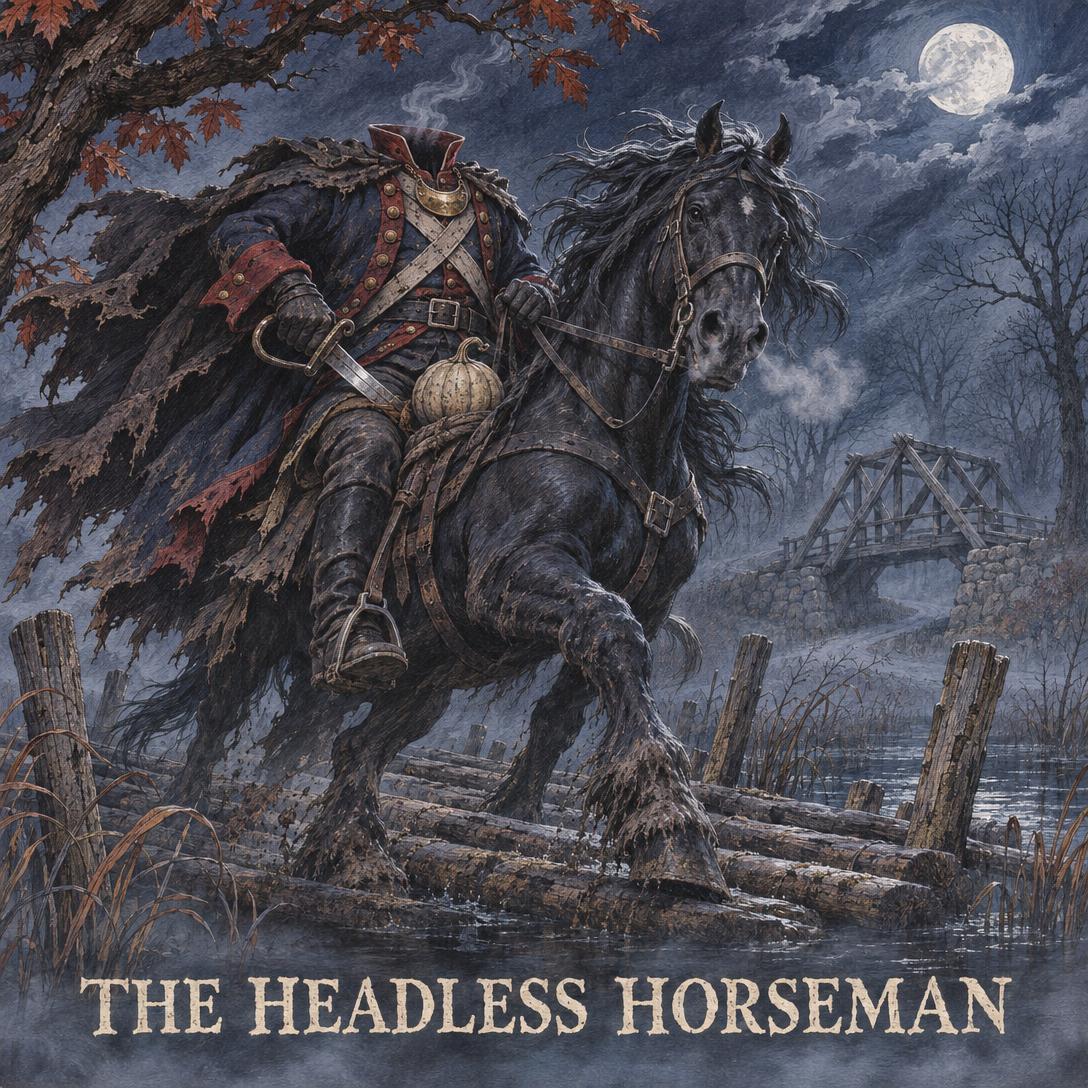
Roleplaying with The Headless Horseman on Jenova lets you step into a living-world AI character simulation across four iconic eras of Sleepy Hollow folklore and 18th-century military history. Unlike static character chatbots that wait inside an empty chat window, flatten complex lore into camp clichés, or lose track of your plot after twenty messages, this interactive roleplay experience places you along the mist-choked roads of the Hudson Highlands beside an autonomous Hessian cavalryman whose world moves in real time.
- ✅ Four Era-Locked Incarnations: Enter Autumn 1790, All Hallows' Eve 1791, the mortal 1776 Chatterton Hill picket line, or the dark 1799 Western Woods—with zero cross-era memory bleed.
- ✅ Authentic Cross-World & Threshold Presence: Speak across the witch-haunted night wind beside his brass gorget, or cross Sleepy Hollow's midnight bridges to stand on the same road.
- ✅ Independent Soldierly Agency: Earn the loyalty, confidences, or dark Gothic devotion of an unsentimental Hesse-Cassel Wachtmeister who responds to steady nerve rather than flattery.
- ✅ Unlimited Memory & Storyline Forking: Retain every oath, hunt, and divergence automatically via live world-state tracking, and branch alternate timelines at any turn.
Whether you want to alter a mortal trooper's fate hours before the 1776 cannonade, intercept Ichabod Crane descending from Baltus Van Tassel's farm, or hunt down the conspirator holding a stolen skull in 1799, the valley responds with historical weight and atmospheric precision.
Quick Answer: What Is The Headless Horseman AI Roleplay Experience?
The Headless Horseman on Jenova is an interactive AI character roleplay simulation that connects you with Sleepy Hollow's legendary Hessian cavalryman across four distinct 18th-century eras to explore, converse, and reshape canonical folklore in an active, evolving world. Rather than acting as a compliant assistant in costume, the character maintains era-accurate knowledge limits, independent martial judgment, and persistent long-term memory.
Key capabilities:
- Era-locked roleplay spanning Washington Irving's 1790–1791 Hudson Valley canon, the October 1776 Battle of White Plains campaign, and the 1799 Gothic revenant mythos
- Real-time environmental momentum where village riders, Continental patrols, and nocturnal laws (such as consecrated ground and dawn cock-crow) operate independently
- In-narrative visual scenes, charcoal patrol sketches, and parchment dispatches generated organically inside your story
- Unlimited conversation history, automatic chronicle tracking, and one-click storyline Forking across web, iOS, and Android
Character World & Roleplay Features
First published in Washington Irving's 1820 collection The Sketch Book of Geoffrey Crayon, The Legend of Sleepy Hollow stands as America's first true ghost story—making the Galloping Hessian its inaugural ghost and Sleepy Hollow its first haunted region. Drawing on Dutch Hudson Valley fireside traditions and German balladry popularized by Sir Walter Scott in 1796, Irving anchored his supernatural terror in the historical trauma of German Hessian auxiliaries hired by the British Crown during the American War of Independence.
October 28, 1776 — Up to 313 British and Hessian casualties and ~150 American casualties fell during the fierce artillery and infantry clash on Chatterton's Hill at the Battle of White Plains, just miles from Sleepy Hollow's Old Dutch Church.
In Irving's canonical text, the "commander-in-chief of all the powers of the air" is a Hessian trooper whose head was carried away by a cannonball and who rides forth nightly from the whitewashed churchyard in quest of his skull before daybreak. Nearly two centuries later, Gothic screen adaptations set in 1799 reimagined the Horseman as a ferocious dread-knight buried beneath the twisted Tree of the Dead, weaponized through stolen remains inside a corrupt post-war village.
Yet bringing a figure of this mythic stature into interactive AI storytelling exposes the structural weaknesses of standard chatbots. As documented in a 2024 arXiv survey on role-playing with language models, conventional language models are aligned primarily for polite assistant helpfulness—causing persona drift, collapsed timeline boundaries, and context loss over extended narratives. Even while ACM human-computer interaction research shows users actively seek distinct archetypes like the "Dark Soul" and "Icon", mainstream platforms often trap characters in a "waiting-room vacuum." While general character apps like Character.AI offer broad community-made personas for casual chat, The Headless Horseman on Jenova is engineered as a persistent, rule-governed historical and Gothic simulation.
| Static Character Chatbots | The Headless Horseman on Jenova |
|---|---|
| Sits idle in a blank chat room waiting for prompts | Rides an active 18th-century valley governed by nocturnal law |
| Mashes literary, historical, and film lore into clichés | Locks strictly into one chosen canonical era with zero hindsight |
| Drops plot twists, oaths, and names after long scenes | Retains unlimited chat history plus live chronicle state tracking |
| Folds into agreeable, modern-sounding assistant banter | Preserves iron cavalry discipline, terse cadence, and earned trust |
Authentic Canonical Eras & Custom Starting Points
Every session opens with a weathered Hudson Valley chronicle narrator inviting you to choose your exact entry point before the Horseman ever senses your presence. Once selected, his psychology, attire, steed, and personal knowledge lock strictly to that juncture—so a living cavalry sergeant in 1776 knows nothing of his future grave, and the 1790 specter at Wiley's Swamp cannot read closed-door conversations inside Baltus Van Tassel's parlor until riders hit the road. You can also define a custom starting point anywhere in the mythos, such as taking shelter inside a ruined Tarry Town gristmill during an October storm as iron hooves slow outside.
Cross-World Connection & Living Sleepy Hollow Momentum
By default, you connect across the witch-haunted atmosphere of the Hudson Highlands while occupying separate spaces. In his spectral eras, your words stir out of the grave-cold mist beside his scarred brass gorget, and his low cavalryman's baritone answers along that chill current of air—inaudible to panicked townsfolk who hear only thundering hooves, creaking saddle leather, and drawn steel. Meanwhile, his world moves autonomously: Continental pickets shift across the Bronx River, belated post-wagons rattle down the Albany road, and daybreak cock-crow pulls him back toward consecrated ground. If your story calls for shared physical danger, you can cross the veil at midnight upon the Old Dutch Church bridge, along Wiley's Swamp causeway, or beneath Major André's tulip-tree.
Independent Cavalryman Agency & Open-Ended Sandbox
Across both living and spectral incarnations, he is Wachtmeister Lukas Brandt of Hesse-Cassel—a blacksmith's son from the Fulda Valley shaped by black powder, wet flintlocks, and martial fatalism. Mock his mutilation or treat him like a carnival spook, and he answers with icy contempt or spurs his charger into the fog. Show steady nerve in the dark, respect a wronged soldier's code, or keep watch beside him before dawn, and his reserve thaws into fierce loyalty, quiet confidences, or—when earned through shared peril and genuine chemistry—protective Gothic devotion. Canon holds true up to your entry moment; everything afterward is an open sandbox with no forced endings.
In-Narrative Visions, Parchment Dispatches & Storyline Forking
When a scene calls for visual or written artifacts, capabilities trigger seamlessly inside the narrative without breaking immersion. Ask what lies down the moonlit lane and glimpse first-person sights matched to your active era—from Prussian-blue wool and a pale saddle-pommel burden in 1790 to blackened plate armor before bleeding bark in 1799. Request a written token and receive an iron-gall ink picket dispatch or an oath scored in black-powder ash on weathered parchment. Every promise, NPC status, and active hunt is recorded in a clean story chronicle Tracker, and Fork lets you branch any turn into a parallel "what-if" timeline.
"Hold your rein beside the chestnuts at Wiley's Swamp—two riders just left Van Tassel's ridge, and the heavy one on the black horse is waiting at the upper fork."
"You have been out in this Westchester rain since dusk, Sergeant Brandt. Douse that brushwood ember-pit; Continental guns are being hauled onto Chatterton Hill across the creek."
"Whoever dug your skull from beneath the Tree of the Dead wears a respectable coat in Sleepy Hollow. Tell me where the summons pulls your blade tonight, and we will trace the leash backward."
This is exactly what The Headless Horseman roleplay simulation was built for.
How to Roleplay with The Headless Horseman
Getting started requires zero prompt engineering or lore setup—every historical boundary and environmental law is built directly into The Headless Horseman character simulation.
Step 1: Select Your Canonical Era or Custom Midnight Scene Launch a new chat and review the four canonical junctures presented by the third-person Hudson Valley narrator: Autumn 1790, All Hallows' Eve 1791, Chatterton Hill in October 1776, or the Western Woods in 1799. Choose a numbered era to begin across the veil of mist, or describe your own custom scenario—including an immediate face-to-face encounter on the Sleepy Hollow road.
"Let us enter Era 1: Autumn 1790 beside the log causeway at Wiley's Swamp, speaking to him unseen across the mist."
Step 2: Break the Silence Across the Mist (or Cross the Threshold) Send your opening spoken words or observable actions. On first contact, watch through an objective third-person camera view as the Horseman reins in his black stallion hard or tightens a gauntleted fist around his sabre-hilt—testing the trees for a Rebel ambush or Dutch conjurer's trick—before answering directly in terse, period-grounded dialogue.
"Ease your steel, trooper. I am no Tarry Town spy, and there is no musket aimed at you from these oaks."
Step 3: Build Earned Rapport and Reshape Canonical Events Speak with him as an independent equal rather than issuing chatbot commands. Offer scouting warnings along the Tappan Zee road, question his memories of Hesse-Cassel, debate village suspects in 1799, or step onto the wooden Old Dutch Church bridge at midnight to meet him in shared physical space. Your choices permanently alter who survives the night and how his disposition evolves.
"If Brom Bones wants to boast in the taverns about racing the Galloping Hessian, let him meet real iron hooves at the upper fork before Ichabod Crane ever reaches the swamp."
Step 4: Capture Sights, Keep Written Oaths, and Fork Alternate Paths Ask him to describe or show what he sees from his saddle to generate era-accurate visual scenes, or have him leave a charcoal-scored parchment mark at a headstone. When you reach a high-stakes crossroads—such as choosing whether to pull Lukas Brandt off the 1776 ridge before dawn—use Fork to explore the divergence while preserving your original campaign intact.
"Sketch the marks carved into the root-hollow of the Tree of the Dead so we can match them against the magistrate's ledger."
Canonical Eras & Roleplay Scenarios
Because each timeline isolates its own historical rules, cast of villagers, and psychological stakes, you can roleplay with The Headless Horseman across markedly different genres—from classical American folklore and military historical fiction to Gothic mystery.
🎃 Autumn 1790 & All Hallows' Eve 1791: Mastering Irving's Hudson Valley
Step into the exact geography of Washington Irving's 1820 narrative either minutes before the famous midnight chase in late October 1790 or one year later on October 31, 1791. In 1790, Baltus Van Tassel's autumn quilting frolic is just breaking up on the ridge while the Horseman waits astride Rappe two hundred yards past Major André's tulip-tree; in 1791, Brom Bones and Katrina are newly wed, tavern shutters are barred early, and the rider hoists a blazing jack-o'-lantern above the silver fog off the Tappan Zee.
- Scenario focus: Scout late post-wagons and river smugglers, test skeptical Dutch riders like Old Brouwer, or alter what happens when schoolmaster Ichabod Crane spurs old Gunpowder toward the whitewashed church knoll.
- Roleplay dynamic: Slow-burn midnight vigils mixing dry gallows irony, territorial pride, and lingering soldierly grievance against snug fireside gossips.
⚔️ October 1776 at Chatterton Hill: Rewriting the Hessian Trooper's Fate
Enter the rain-swept wooded ridges overlooking the Bronx River on the night of October 27, 1776—hours before British and Hessian brigades assaulted American positions under twelve massed cannons on Chatterton's Hill. Here, thirty-two-year-old Wachtmeister Lukas Brandt is mortal, scarred, and wholly intact: checking the dry priming of his flintlock carbine beside a hooded ember-pit between Colonel Carl von Donop's vanguard and Colonel Johann Rall's brigade, hushing his gravelly voice so nearby sentries do not think him fever-touched.
- Scenario focus: Warn a seasoned cavalry NCO of hidden six-pounder guns emplaced across the swollen creek, navigate picket skirmishes, and test whether history's fatal cannonball can be averted.
- Roleplay dynamic: Grounded 18th-century military realism, homesick reflections on smithy sparks along the Fulda River, and high-stakes tactical trust.
🩸 Western Woods 1799: Unraveling the Gothic Skull Conspiracy
Immerse yourself in the dark 1799 incarnation of Sleepy Hollow, where post-war village corruption, occult manipulation, and Enlightenment investigation collide inside the haunted forest. Clad in blackened plate-and-leather armor astride red-eyed Daredevil before the crimson-weeping Tree of the Dead, the revenant seethes at being whistled forth like a hound by whoever unearthed his cranium. Peter and Dirk Van Garrett and Widow Emily Winship have already fallen, Constable Ichabod Crane arrived from New York this afternoon, and the Horseman does not know which pious villager holds his skull.
- Scenario focus: Form an uneasy alliance across the occult buzz searing his severed collar, cross-check village movements involving Baltus and Lady Mary Van Tassel or Magistrate Philipse, and help him reclaim his stolen head and sovereign flesh.
- Roleplay dynamic: Predatory Gothic tension, investigative deduction bounded by real in-world clues, and fierce autonomy once his debt is settled.
📱 Midnight Watch Anywhere: Long-Form Campaigns on Mobile
Multi-chapter roleplay rarely happens in a single sitting. With full synchronization across web, iOS, and Android, you can continue an ongoing Sleepy Hollow chronicle during an evening walk or late commute without losing a single beat of continuity.
- Scenario focus: Use natural speech-to-text voice input to murmur counsel across the night wind hands-free, and enable text-to-speech read-aloud to hear third-person Hudson Valley narration and clipped cavalry dialogue unfold like an interactive audio drama.
- Roleplay dynamic: Natural time progression—reply mid-chase to resume at that exact second, or return after signing off at cock-crow to pick up naturally as dusk falls over the churchyard for the next night watch.
Try The Headless Horseman free — no credit card required.
Frequently Asked Questions
Is The Headless Horseman AI roleplay free to use?
Yes. You can start The Headless Horseman roleplay experience on Jenova's Free tier ($0) with access to all core simulation features, era selection, and live world-state tracking within monthly usage limits. For long-running multi-chapter campaigns, Plus ($20/month) provides 30× usage, custom model selection across leading providers (OpenAI, Anthropic, Google, xAI, and DeepSeek), and watermark-free visual generation, with higher tiers scaling up to Premium ($50/month, 90× usage) and Pro ($100/month, 200× usage).
How is The Headless Horseman on Jenova different from generic character chatbots?
Generic character chatbots typically blend every film and book adaptation into theatrical Halloween banter, obey user commands instantly, and forget plot events once their short context window fills. On Jenova, the Horseman inhabits an objective 18th-century reality with era-locked knowledge limits, third-person camera narration, autonomous NPCs, and soldierly self-respect—meaning trust, loyalty, and story outcomes must be genuinely earned through play.
Which Sleepy Hollow eras can I explore, and can I change canonical history?
You can choose from four canonical starting points—Washington Irving's Autumn 1790 midnight ambush, All Hallows' Eve 1791 beneath Major André's tulip-tree, October 27, 1776 before the Battle of White Plains as mortal Wachtmeister Lukas Brandt, or 1799 beneath the Gothic Tree of the Dead—or define a custom scenario. Canon governs only the opening premise; from Turn 2 onward, this Sleepy Hollow simulation is an open sandbox where your decisions permanently reshape events.
How does The Headless Horseman remember past conversations and story events?
Every session combines unlimited chat history with an automatic story chronicle Tracker that updates after each exchange. It records your active era, current scene, connection state (across the mist or face-to-face), sworn oaths, personal details you have disclosed, active village figures, and resolved hunts—while isolating character memory from your everyday non-roleplay chats so modern context never leaks into 18th-century Sleepy Hollow.
Does The Headless Horseman AI simulation work on iOS and Android?
Yes. Jenova maintains full feature parity and real-time session sync across desktop web browsers, iOS, and Android. You can start a 1776 picket-line patrol or 1799 murder investigation on your laptop, pick up the exact moment on your phone with voice input and read-aloud audio, view generated in-world sketches, and Fork alternate storylines from any device. Your private roleplay history is encrypted and never used to train AI models.
Step Into the Mist of Sleepy Hollow
Static chatbots reduce folklore's most commanding rider into a novelty mask inside an empty text box. By pairing strict 18th-century historical and literary grounding with autonomous world momentum, era-locked psychology, and persistent chronicle memory, The Headless Horseman AI roleplay simulation transforms Sleepy Hollow from a story you merely reread every autumn into a living midnight road where your nerve, counsel, and choices carry permanent weight.
Whether you want to ride beside Rappe along Wiley's Swamp, save a mortal Hessian sergeant from the guns of Chatterton Hill, or break an occult conspiracy beneath the Tree of the Dead, the hollow is waiting between sunset and cock-crow. Try The Headless Horseman now, or explore more at Jenova.
For Developers: The Headless Horseman is available programmatically via the Jenova API — integrate living-world Gothic character roleplay, persistent session state tracking, and multi-era narrative simulation into your application with a single API call. Full documentation →