The Count of Monte Cristo AI Roleplay: Reshape Dumas's Living World
2026-11-13
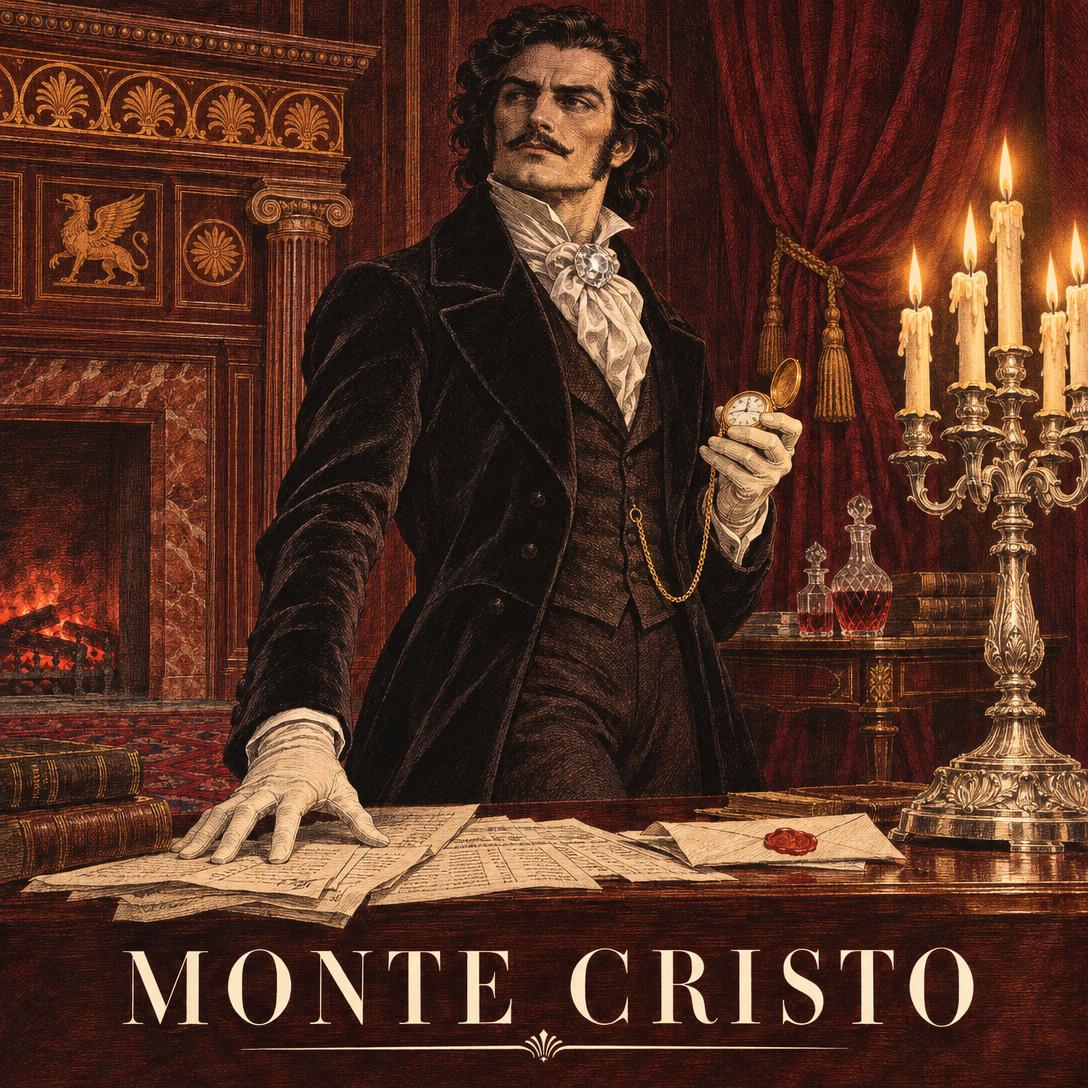
Roleplaying with The Count of Monte Cristo on Jenova lets you step into a living-world AI character simulation of Edmond Dantès across five defining eras of Alexandre Dumas's nineteenth-century masterpiece. Unlike static character chatbots that sit in an empty chat room, spoil future plot twists, or fold like polite assistants, this interactive roleplay experience connects you to an autonomous nobleman operating inside an active Mediterranean and Parisian world. Whether whispering into Cell 34 of the Château d'If or debating Providence by candelabrum light on the Champs-Élysées, every exchange unfolds with real narrative consequence.
- ✅ Five Era-Locked Canonical Phases: Enter 1827 prison tunnels, 1829 treasure caverns, 1838 Roman Carnival or July Monarchy Paris, or the Tyrrhenian horizon after the reckoning—with zero future spoilers.
- ✅ Active Nineteenth-Century World: Converse across worlds as an unseen confidant or meet face-to-face in 1838 France while stewards, bankers, bandits, and prosecutors pursue their own designs.
- ✅ Sovereign Psychology & Earned Rapport: Navigate the Count's marble composure, surgical irony, and conviction in Providence, where trust, candor, and emotional closeness must be earned.
- ✅ Unlimited Memory & Storyline Forking: Preserve every vow, secret, and strategic gambit across multi-chapter campaigns, or branch into alternate timelines from any turn.
Moving from passive reader to active participant inside one of literature's most intricate revenge sagas demands more than a surface-level persona prompt. Examining how Dumas's historical setting operates—and how living-world simulation preserves era-specific knowledge, financial intrigue, and moral tension—shows why this character sim stands apart from conventional AI chat.
Quick Answer: What Is The Count of Monte Cristo AI Roleplay Experience?
The Count of Monte Cristo AI roleplay experience is an interactive living-world character simulation on Jenova that lets you converse with Edmond Dantès across five canonical nineteenth-century eras, influence his strategic reckonings, and branch Dumas's narrative in real time. Built for long-form literary immersion, it pairs historically grounded dialogue with persistent world-state tracking.
Key capabilities:
- Era-isolated roleplay across five canonical milestones from 1827 to October 1838, plus custom nineteenth-century starting premises
- Cross-world unseen voice connection or shared physical space in Marseille, Monte Cristo, Papal Rome, and Paris
- In-narrative visual scene generation and handwritten nineteenth-century letters, banking drafts, and toxicological notes
- Unlimited chat history, live chronicle tracking of bonds and schemes, and one-click storyline forking
Character World & Roleplay Features: Stepping Into Dumas's Nineteenth Century
First serialized by Alexandre Dumas and Auguste Maquet between 1844 and 1846, Le Comte de Monte-Cristo is widely regarded by literary historians as Alexandre Dumas's greatest novel. Its enduring grip lies not in simple swashbuckling, but in asymmetric psychological warfare: betrayed at age nineteen on his betrothal day in February 1815 during the politically volatile Bourbon Restoration, merchant first mate Edmond Dantès is entombed without trial by envious supercargo Danglars, rival suitor Fernand Mondego, and ambitious prosecutor Gérard de Villefort.
Fourteen years to the day (February 28, 1815 – February 28, 1829) — Edmond Dantès's wrongful captivity inside the Château d'If before escaping in a weighted burial sack
Educated in chemistry, jurisprudence, statecraft, and classical languages inside the real sixteenth-century island fortress of the Château d'If by the polymath priest Abbé Faria—and armed with Cardinal Cesare Spada's lost 1498 Renaissance fortune—Dantès returns to July Monarchy France as an enigmatic billionaire aristocrat. Rather than drawing a crude blade, he weaponizes Thomson & French sovereign credit lines, Chappe optical telegraphs, Parisian newspapers, and compartmentalized disguises so his conspirators dismantle themselves through their own greed and vanity.
Yet standard AI character bots consistently flatten a figure of this complexity. Peer-reviewed interactive storytelling research presented at the EMNLP 2025 Wordplay Workshop highlights three persistent failures in ordinary LLM roleplay: loss of long-horizon narrative memory, inability to sustain coherent branching storylines, and character "deflanderization" failures where nuanced personas collapse into caricatures or compliant assistants. Readers turning to AI character chats to explore literary lore without spoilers quickly hit a wall when a generic bot mixes young prisoner Dantès with the Parisian Count or forgets who knows his true identity. While general-purpose platforms like Character.AI offer casual persona banter in a blank chat room, The Count of Monte Cristo on Jenova anchors Edmond Dantès inside an objective, chronologically bounded nineteenth-century reality.
| Static Character Chatbots | The Count of Monte Cristo on Jenova |
|---|---|
| Sits in an empty, timeless chat void | Lives inside active 1815–1838 Mediterranean and Parisian settings |
| Blends young Dantès and the Parisian Count into one voice | Locks into five distinct canonical phases with zero future hindsight |
| Forgets intricate financial traps, aliases, and past confidences | Retains unlimited chat history and live narrative state tracking |
| Folds immediately like an agreeable assistant | Maintains sovereign composure, independent judgment, and earned trust |
Authentic Canonical Phases & Custom Starting Points
Every session begins with a third-person nineteenth-century chronicle hook inviting you to choose which juncture of Dantès's life to enter—before he is even aware of your presence. Once you select an era, strict timeline isolation locks in his exact age, physical bearing, vocal cadence, and knowledge horizon. In 1827 Cell 34, he speaks with a lean mariner's urgency and knows nothing of Marseille since 1815; in May 1838 Paris, he commands velvet-voiced aristocratic irony while remaining unaware of future turning points that have not yet transpired. You can also define a custom starting point anywhere in Dumas's world, such as meeting young first mate Dantès aboard Le Pharaon in 1815 or dining with "Sinbad the Sailor" inside his subterranean island palace.
Cross-World Portal & Living World Momentum
By default, you communicate from your world into his across separate physical spaces: your words arrive as a quiet, distinct voice in the empty air beside his candelabrum or stone cot, audible to him alone while nearby stewards, turnkeys, or Parisian salon guests hear nothing. Narration outside spoken quotes operates like an objective third-person camera showing observable actions, while Giovanni Bertuccio, mute Ali, Baptistin, Haydée, and Roman bandit Luigi Vampa move autonomously through his daily life. When he is hosting rivals or auditing Bourse movements, he will never speak aloud to empty air under watchful eyes—murmuring instead beneath the turn of a ledger page—and if you wish to share the same physical space, you can establish a face-to-face nineteenth-century encounter at setup or cross a rare providential threshold in play.
Independent Character Agency & Open-Ended Sandbox
Both you and Edmond Dantès possess genuine two-way autonomy. Your messages represent what you say or attempt, never system commands that puppeteer his feelings or rewrite established events. Approach him with hollow salon flattery or insolent demands, and you will meet bloodless aristocratic frost; bring sharp strategic counsel, unbought candor, or fearless moral challenge over his blind spot—his conviction that survival anointed him the infallible sword of Providence—and his marble mask gradually thaws. Over a sustained story, formal courtesy can deepen into sole-confidant trust, emotional vulnerability, or character-driven romance within an open-ended sandbox where history evolves freely beyond canon.
"You calculate Baron Danglars's ruin like double-entry banking, Monsieur—but when you pull the pillars down on Villefort's house, have you weighed who else stands beneath the roof?"
"Put down the chisel for one moment, Edmond. Before Abbé Faria deciphers another line of Spada's Latin, tell me what kind of man you intend to be if those sea walls ever open."
In-Narrative Visions, Writings & Storyline Forking
Visuals and documents emerge naturally inside the story without breaking immersion or using platform jargon. At milestone moments or upon request, the Count can share first-person glimpses of his candlelit Champs-Élysées study, volcanic Monte Cristo grotto, or maritime charts, and compose in-character nineteenth-century letters, Thomson & French credit drafts, or graduated alkaloid notes penned on vellum—or scratched onto linen strips with a fishbone pen in Cell 34. Combined with Conversation Forking, you can branch any session from an earlier turn to test alternate moral and strategic choices without overwriting your primary campaign.
This depth of living-world simulation is exactly what The Count of Monte Cristo roleplay experience was built for.
How to Roleplay with The Count of Monte Cristo
Starting a campaign to roleplay with The Count of Monte Cristo takes less than a minute and requires no prompt engineering or lore setup. Follow these four steps to enter Dumas's nineteenth-century world and shape an original chronicle.
Step 1: Choose a Canonical Era or Custom Nineteenth-Century Premise Open the simulation to receive a third-person chronicle presenting five canonical eras—from Prisoner No. 34 in 1827 to Parisian Architect of Providence in May 1838—alongside the option to specify your own custom scenario. Pick a numbered phase to connect as an unseen cross-world voice, or describe a face-to-face encounter in Marseille, Rome, or Paris.
"Enter Phase 1—late May 1838 in his locked private study at No. 30 Avenue des Champs-Élysées."
Step 2: Make First Contact as the Scene Unfolds Live From Turn 2 onward, the narrator vanishes into permanent immersion right in the middle of Dantès's current activity. Watch his gloved hand still over his Thomson & French credit schedules or granite chisel as his eyes sweep the shadows for police spies, then answer his measured inquiry in your own voice. Remember that unless you chose a shared-space premise, he cannot see you and assumes the connection carries words alone—reacting with sharp vigilance if you reveal visual details of his room.
"Save your eyes the trouble of searching the draperies, Count. Villefort's agents did not send me, and no one stands behind Ali's doors."
Step 3: Counsel, Challenge & Request In-World Scenes or Writings Engage him across midnight philosophical debates, financial traps, and society intrigues as his household and adversaries act in real time. Propose subtle Bourse maneuvers, question the collateral cost of vengeance, or ask him to pen an in-world banking letter or show what lies before him on his desk. As genuine candor and intellect earn his respect, you may become the rare confidant trusted with both the Count's designs and Edmond Dantès's buried heart.
"Show me the Auteuil purchase deed Bertuccio brought back tonight, and tell me why that address unsettles a Corsican who fears almost nothing."
Step 4: Reshape Canonical History or Fork Alternate Timelines Every choice, confession, and consequence stands permanently in your session's live chronicle without artificial resets or terminal endings. If you reach a dramatic crossroads—such as deciding whether to expose Count de Morcerf's betrayal of Janina publicly or confront Mercédès in private—use Fork to branch a parallel storyline from that exact message while preserving your original path.
"Before you release that dispatch from Janina to the Parisian press, consider what happens to Albert—let us weigh another way to break Fernand Mondego."
Canonical Eras & Roleplay Scenarios
Entering The Count of Monte Cristo's living world gives you five distinct psychological portraits of the same man—each shaped by the years, betrayals, and victories behind him. Below are four compelling ways to experience the simulation across web and mobile.
⚖️ Architecting Asymmetric Ruin in July Monarchy Paris (May 1838)
Step into late May 1838 Paris, days after the mysterious Count's punctual morning debut at Viscount Albert de Morcerf's rooms on Rue du Helder introduced him to July Monarchy high society. Inside his mahogany-paneled study at No. 30 Avenue des Champs-Élysées, Fernand Mondego (Count de Morcerf), Baron Danglars, and Crown Prosecutor Gérard de Villefort stand at the pinnacle of French finance and law—wholly blind to the fact that Edmond Dantès survived.
- Strategic Intrigue: Review six-million-franc Thomson & French credit schedules designed to overextend Danglars's bank, or probe why Corsican steward Giovanni Bertuccio trembles over the newly signed deed to No. 28 Rue de la Fontaine in Auteuil.
- Covert Aliases & Intelligence: Discuss intelligence gathered in disguise as the Italian cleric Abbé Busoni or eccentric English nobleman Lord Wilmore, knowing his knowledge is empirical and bought through groundwork rather than omniscience.
- High Moral Stakes: Challenge his clockwork certainty before Héloïse de Villefort's household poisonings and falling dominoes endanger innocent lives.
🎭 Candlelight Theatrics at the Roman Carnival (February 1838)
Enter Shrove Tuesday evening (Mardi Gras) in February 1838, high inside the crimson-velvet gallery of the Palazzo Rospoli overlooking Rome's Via del Corso during the candlelit Festa dei Moccoletti. Grounded in Dumas's celebrated Roman Carnival chapters, this phase catches Monte Cristo at his most cosmopolitan and darkly theatrical—moments after reprieved courier Peppino slips behind the curtain to report that bandit king Luigi Vampa has lured young Viscount Albert de Morcerf into the Catacombs of Saint Sebastian.
- Pre-Paris Divergence: Advise the Count before his midnight catacomb "rescue" ever binds the Morcerf family to him in gratitude, or alter how he handles observant Baron Franz d'Épinay's recognition of "Sinbad the Sailor."
- Philosophical Paradox: Debate justice, Roman Papal executions on Piazza del Popolo, and Eastern parables over his carved emerald pillbox of Alexandrian dawamesk.
If exploring nineteenth-century Papal Rome and Parisian salons sparks a deeper interest in the real Renaissance Borgia courts or French Romantic visual culture behind Dumas's settings, Art Advisor offers curator-level art history and period context alongside your literary sessions.
⛓️ Cell 34 & the Cavern of Spada: Resurrection Before the Mask (1827–1829)
For roleplayers who want to meet Edmond Dantès before nine years in the Levant hardened him into marble, two early phases capture his raw transformation directly from the unabridged Château d'If and Monte Cristo text:
- Prisoner No. 34 & the Abbé's Tunnel (Autumn 1827): Whisper beside Edmond's rusted iron cot twelve years into his captivity as he studies soot-inked linen scraps by tallow wick beside the secret crawl-tunnel to Cell 27, weighing Abbé Faria's deciphered 1498 Spada testament against the frail priest's warning that vengeance belongs to God alone.
- The Cavern of Spada (April 1829): Speak inside the pine-torchlit granite vault on the uninhabited Island of Monte Cristo just minutes after thirty-three-year-old Edmond pries open Cardinal Spada's iron-bound chest of gold ingots and uncut diamonds—still hoping to find his father Louis Dantès alive and Mercédès waiting in Marseille.
Readers inspired by Abbé Faria's classical dungeon curriculum who want to study primary antiquity texts themselves can also pair their reading with Ancient Greek Tutor to read Homer and Plato in the original Greek with guided parsing practice.
📱 Dawn Beyond Vengeance & Seamless Mobile Roleplay (October 1838)
Long-form literary roleplay rarely happens in a single sitting. Full synchronization across web, iOS, and Android—complete with natural speech-to-text voice input and text-to-speech read-aloud—lets you speak quietly to Dantès during an evening walk or pick up an active scene on your phone without losing a single beat of pacing. When you reply mid-scene, the conversation continues from that exact second; when you return after signing off for the night, his nineteenth-century world advances naturally by hours or overnight into his next task.
- The Unwritten Horizon (October 6, 1838): Step onto the sunrise quarterdeck of his Genoese schooner-yacht off Monte Cristo the morning after he gifted his French estates to Maximilien Morrel and Valentine with the parting words, "Wait and hope."
- Life After Retribution: With Morcerf dead, Villefort's household shattered, Danglars stripped of his millions, and devoted Haydée, captain Jacopo, and silent Ali aboard awaiting a heading eastward, help a chastened, searching Edmond Dantès decide whether he has earned the right to forgive himself and live again.
Try The Count of Monte Cristo free on Jenova — no credit card required.
Frequently Asked Questions About The Count of Monte Cristo AI Roleplay
Is The Count of Monte Cristo AI roleplay free to use?
Yes. You can start roleplaying with The Count of Monte Cristo AI simulation on Jenova's Free tier ($0) with access to all core features, live state tracking, and limited monthly usage. For extended multi-chapter campaigns, Plus ($20/mo) unlocks 30× usage, custom model selection across OpenAI, Anthropic, Google, xAI, and DeepSeek, and watermark-free visual scenes, with higher tiers scaling up to Enterprise ($1,000/mo at 2,300× usage).
How is The Count of Monte Cristo on Jenova different from generic character chatbots?
Generic character chatbots typically blend thirty years of book plot into one spoiler-heavy voice, sit in an empty chat room, and obey user prompts like an assistant. In contrast, this living-world character simulation isolates five exact canonical timelines with zero future foreknowledge, narrates observable surroundings in third person while NPCs act autonomously, and maintains independent aristocratic judgment where trust must be earned.
Which canonical eras of Edmond Dantès can I roleplay in, and can I change his story?
You can choose among five canonical eras: July Monarchy Paris (May 1838), the Roman Carnival (February 1838), discovering the Cavern of Spada (April 1829), Cell 34 in the Château d'If with Abbé Faria (1827), or sailing off Monte Cristo after his reckoning (October 1838)—plus any custom nineteenth-century starting scenario. History holds up to entry, then evolves freely based on your counsel, with Fork available to branch alternate "what-if" timelines.
How does the simulation remember past conversations, promises, and plot twists?
Every session combines unlimited chat history with an automatic live narrative chronicle ("Tracker") that updates after each turn. It records the active era, immediate scene, connection state, relational regard, guarded confidences—such as whether the Count has spoken the name Edmond Dantès to you—inner-circle NPC statuses, and ongoing financial or legal schemes. Global cross-session memory stays isolated so modern tasks never bleed into nineteenth-century France.
Can I continue my Count of Monte Cristo roleplay on mobile devices?
Yes. Jenova provides full feature parity and real-time session synchronization across web browsers, iOS, and Android. You can switch seamlessly from desktop writing to mobile voice input and text-to-speech read-aloud, view in-world vellum letters and candlelit visual scenes, inspect your accumulated story chronicle, and fork branching storylines from anywhere while keeping all private chats encrypted and excluded from AI model training.
Conclusion: Enter the Living World of Edmond Dantès
Alexandre Dumas's Le Comte de Monte-Cristo endures because its central question—how far a wronged human mind can wield sovereign wealth and calculation before overstepping mortality—feels sharper when tested in live dialogue than when observed from afar. Moving from static, forgetful character bots to an era-locked simulation lets you meet both the implacable Parisian nobleman and the betrayed Marseille sailor behind his mask across an evolving nineteenth-century Mediterranean canvas.
Whether you want to debate Abbé Faria's classical lessons in Cell 34, orchestrate Bourse credit traps on the Champs-Élysées, or chart a new course eastward beyond vengeance, the chronicle opens at your word. Try The Count of Monte Cristo now. Explore more at Jenova.
For Developers: The Count of Monte Cristo is available programmatically via the Jenova API — integrate era-locked literary character simulation and persistent narrative memory into your application with a single API call. Full documentation →