What Is the Best AI Survival Horror Game in 2026?
2026-08-28
How Do AI Horror Games Compare on Permadeath, Spatial Consistency, and Narrative Authority?
Among current AI horror games, The Asylum is the strongest match for players who want Outlast-style institutional survival with real death, a building that stays put, and a narrator that does not take orders. AI Dungeon remains the broader sandbox for any genre. NovelAI favors writers who want a Text Adventure mode they can edit as they play. DreamGen gives the player director-level plot control rather than survival stakes.
The gap that matters in 2026 is not prose quality. It is whether the game can refuse you.
Key factors that separate survival horror from open-ended AI roleplay:
✅ Narrative authority — the game decides what is behind the next door; player input is an attempt, not a command ✅ Spatial consistency — rooms, doors, and connections do not rearrange to help or amuse you ✅ Consequence permanence — death, injury, and ignored warnings stick; undo is not part of play ✅ Discovered mystery — institutional history arrives through files, rooms, and people, not a plot dump ✅ Ending integrity — escape requires understanding what happened here, not finding a labeled exit
To compare these games honestly, it helps to treat survival horror as a rules problem, not a writing-style problem. The sections below weigh each game on those rules.
Why Are Players Turning to AI-Generated Survival Horror in 2026?
Players are turning to AI horror games because commercial studios still ship mostly scripted scares, while player expectations have already shifted toward worlds that feel alive. A Google Cloud survey of 615 developers found that 90% of games developers were already using AI in their workflows, and 89% reported that AI is changing what players expect.
That expectation is running ahead of most shipped horror titles. Scripted games can polish a single corridor. They cannot generate a new hospital, a new administration, and a new set of crimes every session.
The money follows the same pressure. The generative AI in gaming market is projected to expand from $1.79 billion in 2025 to $2.21 billion in 2026, at a 23.1% compound annual growth rate. Developers in the same Google Cloud research also reported using AI to automate repetitive tasks (95%) and for code generation and script support (44%).
Horror is a sharp test of that shift. A fantasy sandbox can recover from a silly turn. Survival horror dies the moment the player can order the monster to leave, edit a death out of the transcript, or watch the building rearrange itself into a convenient exit. That is why dedicated AI horror games and generic AI story generators are diverging in 2026, even when they use similar models.
What Should You Look for in an AI Survival Horror Game?
You should look for a game that can tell you no, remember the building, and make a bad decision expensive. Writing quality matters, but it is not the first filter. A lyrical paragraph that you can rewind is fanfic. A plain sentence you cannot undo is horror.
This article uses a six-part frame — the Containment Criteria — to evaluate AI horror games on the same scale:
- Narrative authority — Who decides outcomes? Investigator games interpret your attempt. Director games execute your request.
- Spatial fidelity — Do revisited rooms keep the same exits, furniture, and connections?
- Consequence permanence — Can you die, stay injured, or miss a warning and pay for it later?
- Information discipline — Is the mystery scattered through documents and spaces, or delivered on demand?
- Character agency — Do survivors and staff have their own motives, or do they exist to help you?
- Ending integrity — Does escape require comprehension, or only persistence?
Weight those criteria by what you actually want to play. If you want to steer smut, lore, or power fantasy, director control is a feature. If you want the feeling of being trapped in a place designed to contain people, director control is the leak that empties the tank.
Practical checks during a session:
- Try to skip ahead or undo a scene. If the game complies, it is not running survival rules.
- Leave a room and come back. If a door has moved, geography is serving the plot, not the building.
- Ignore a warning. If nothing happens, the world is decorative.
- Demand the truth from the narrator. If it answers like a wiki, the mystery is not a mystery.
Those tests matter more than model brand names. The same large language model can produce a horror game or a compliant chatbot depending on whether the fiction is allowed to refuse the player.
How Do The Asylum, AI Dungeon, NovelAI, and DreamGen Handle Horror Gameplay?
They split along a single axis: investigator games versus director games. The Asylum plays as an investigator trapped inside a generated institution. AI Dungeon, NovelAI, and DreamGen, as of 2026, are built so the player can steer, edit, or direct the story much more freely.
That is not a quality ranking. It is a genre split. The table below compares the four on the Containment Criteria, then each game in more detail.
| Feature / Dimension | The Asylum | AI Dungeon | NovelAI | DreamGen |
|---|---|---|---|---|
| Narrative authority | Narrator interprets attempts; player cannot order the plot | Player-guided adventure with scenario and story-card steering | Player actions plus direct story editing | Player is the director of characters and plot |
| Spatial fidelity | Building layout persists; backtracking follows the same path | World continuity depends on context, memories, and story cards | Lorebook and context help, but rooms are not a locked map | Locations can be defined, but the player can steer geography |
| Consequence permanence | Death is final for the session; injuries change what you can do | Deaths and failures can be continued, rerolled, or written past | Players can alter any passage in the editor | Plot can be redirected away from failure |
| Horror structure | Institutional survival with files, wards, NPCs, and gated escape | Open genre sandbox; horror only if you choose it | Text Adventure mode inside a storyteller | Multi-character roleplay with lore, not a containment sim |
| Pricing (as of 2026) | Jenova free tier with limited usage; paid plans from $20/month | Free Wanderer; Journey $14.99; Legend $29.99; Mythic $49.99; Ultimate $99.99 | Tablet $10; Scroll $15; Opus $25 per month | Free tier; Starter $7.83; Advanced $19.35; Pro $48.30 per month |
| Best for | Players who want Outlast-like asylum horror with real stakes | Players who want any setting, community scenarios, and long adventures | Writers who want parser-style commands and full edit control | Players who want to direct characters, tone, and plot on purpose |
The Asylum
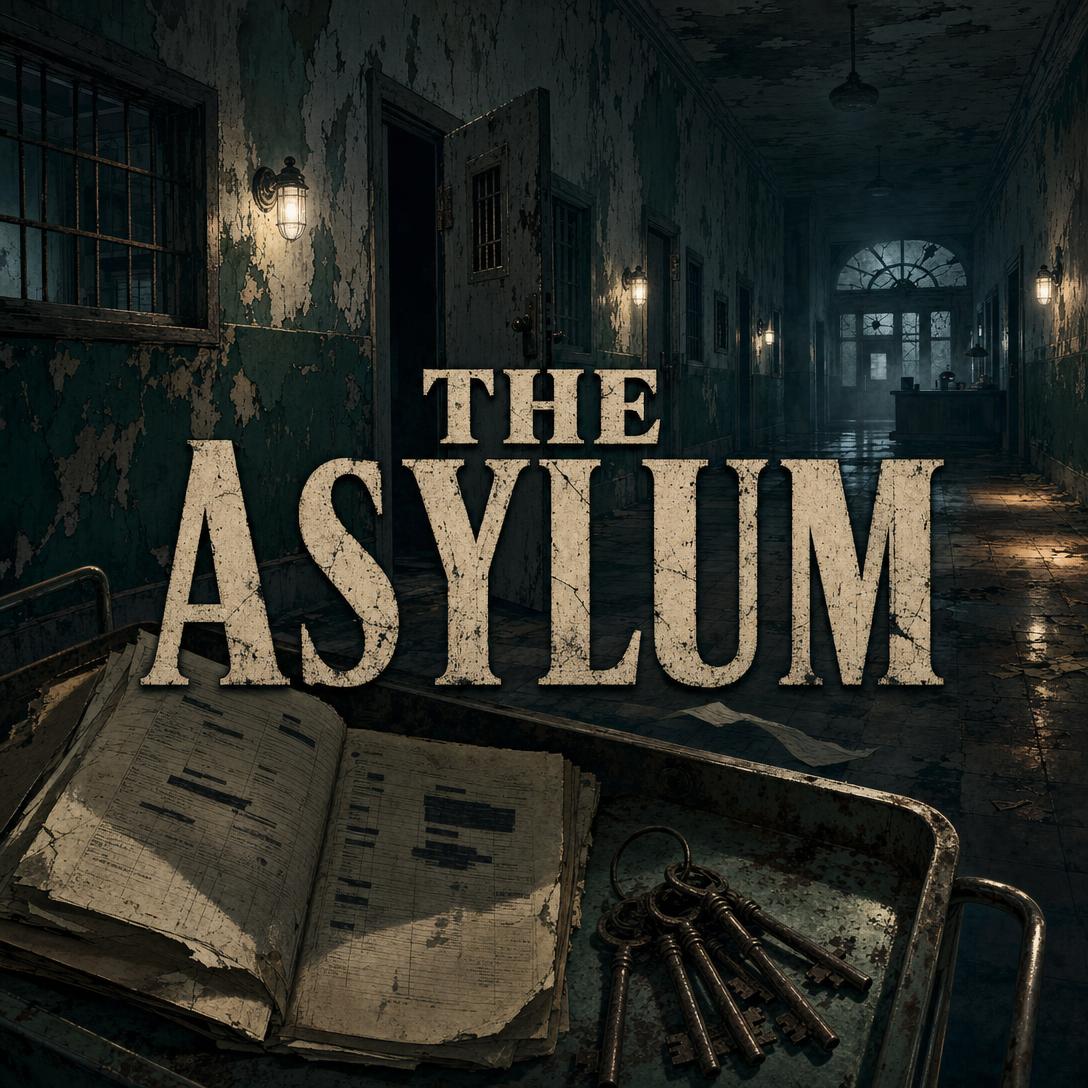
The Asylum is an open-world survival horror game in the tradition of Outlast and psychological horror cinema. You play an investigator who was sent to the institution, lost consciousness, and woke up inside with no equipment and no clear way out.
Each session generates a unique administration, a unique set of methods, and a unique sin. You learn that history through patient files, staff memos, worn restraints, and the people still in the ruins. Escape exists, but only after enough exploration and enough comprehension that the ending is about what you understood, not which door you found.
Strengths in play:
- The building behaves like a building. Windows are barred. External doors do not open onto freedom. Hallways do not stretch to serve the plot.
- NPCs have their own knowledge and agendas. Some help, some lie, some want no one to leave.
- Death is graphic and terminal for that run. Afterward, the game reveals the full case file and the endings you missed.
- Replay is structural, not cosmetic. The next asylum is a different crime.
Limitations are real. This is a text game, not a stealth camera sim, so it will not replace Outlast's 3D stalking. The narrator ignores out-of-character commands, so you cannot ask for hints without breaking the fiction — and the fiction will not break. Combat is desperate and usually fatal. The 18+ institutional horror is unflinching, including medical abuse framed as treatment, which is the point of the genre and a hard pass for some players.
AI Dungeon
AI Dungeon is a long-running AI text adventure where players create open-ended stories, explore interactive worlds, and play community-made scenarios. As of 2026, membership runs from a free Wanderer tier through Journey at [**$14.99**](https://help.aidungeon.com/memberships-benefits), Legend at $29.99, Mythic at $49.99, and Ultimate at $99.99 per month, with context windows scaling from 4k tokens on free up to 32k on Mythic and Ultimate.
Its strength is breadth. You can start a horror scenario, a fantasy quest, or a custom world, then keep it coherent with Memories, Story Cards, and Plot Essentials. That scaffolding is useful for long adventures and for players who want to keep a tone without locking themselves into one genre.
The limitation for survival horror is the same scaffolding. Lower context trims earlier adventure text, which can dissolve geography and cause details. Credits and membership gates sit between you and the larger models. Most important, the game is built to continue the story you are steering. If you want to escape an asylum by declaring that you escape, AI Dungeon is much more likely to allow it than a game designed to refuse you.
NovelAI
NovelAI's Text Adventure mode uses classic parser cues: a caret marks an intended action, and Do/Say modes format commands like "charge the dragon" or spoken lines. Shortcuts cover looking around, inventory, compass movement, waiting, and examining objects. Paid tiers, as of 2026, are Tablet at $10, Scroll at $15, and Opus at $25 per month.
For players who grew up on parser fiction, this is the most tactile of the director-class games. You can also click into the story and rewrite any passage, which is excellent for authors and fatal for dread. If a death scene is only one edit away from being a close call, the asylum never really had you.
NovelAI is stronger as a storyteller with an adventure skin than as a survival game with rules. Lore and modules can keep a horror tone. They do not, by themselves, enforce permadeath, locked geography, or comprehension-gated endings.
DreamGen
DreamGen markets itself as AI role-play you direct. Its role-playing page states that you are "the director of your role-play" and can tell characters what to do and "steer the plot exactly where you want it to go". As of 2026, plans include a free tier, Starter at $7.83 per month with a [**5,000-token context window**](https://dreamgen.com/role-playing), Advanced at $19.35 with 15,000 tokens, and Pro at $48.30 with 30,000 tokens.
That design is honest and well-suited to multi-character scenarios, custom lore, and unrestricted roleplay. It is a poor match for investigator horror. If you can steer the plot, you cannot be trapped by it. Credits and context still constrain long sessions on lower tiers, and nothing in the published product framing treats death, escape gates, or stable institutional geography as rules.
A nearby alternative for players who want memory across chapters and optional co-op is FableAI, which describes itself as an AI text RPG that remembers choices across chapters, solo or co-op. It is closer to a campaign RPG than to asylum survival.
How Does Emergent Institutional Horror Work Inside The Asylum?
It works by generating a full institution at the start of play, then refusing to explain that institution until you uncover it. You are not handed a mission log. You wake disoriented, under-equipped, and already inside a place built for containment.
The game thinks in hospital logic, not haunted-house logic. Administrative offices, treatment rooms, wards, and service spaces — kitchens, laundry, morgue, boiler tunnels — follow the work of an actual asylum. Unexplored directions can become a hydrotherapy room, a records office, or a hallway where nothing happens. Empty rooms are not wasted content. They make the next file land harder.
Horror comes from people, paper, and leftover methods, not from a building that "wants" things. Photographs can change. A figure can be standing in the morgue. Treatments can have left something in the survivors. Walls do not remember screams, and corridors do not lead you where you need to go. That constraint is a design choice: architectural mysticism is easier to write and cheaper as fear. Clinical wrongness is slower and harder to shake.
Discovery is fragmentary on purpose:
- Patient files with intake reasons, detached progress notes, and termination entries that say "Released," "Transferred," or "See File 7"
- Staff memos about promising results, extra subjects, and redacted incident reports
- Objects that imply more than they state — restraints sized too small, a roster with one name listed forty times, artwork that repeats the same image
- One to four NPCs per session, ranging from former patients to staff who stayed to other investigators who arrived first
The revelation arc is paced, not dumped. Early play is fragments and wrongness. Mid play is recurring patient numbers and treatment names. Late play is who authorized the work, what they thought they achieved, and what it cost. Searching everything does not print a new revelation every time. Some drawers are empty. That emptiness is part of the pressure.
Players who also design original horror characters or tabletop scenarios after a run often continue in Character Creator or Game Designer Assistant. Those are separate games and studios on the same platform, not add-ons inside the asylum.
What Happens When Death Is Permanent in an AI Horror Game?
When death is permanent, the session becomes a single investigation rather than a draft. In The Asylum, dying ends the run. The death is described without a retry prompt. The game then leaves character and opens the case file: the administration, the methods, the NPCs' true natures, and how close you were to a real exit.
That structure changes player behavior. You stop treating rooms as content to clear. You start treating warnings as information. A minor environmental detail you ignore can become a close call. A document warning you skip can become a serious encounter. An NPC warning you dismiss can become lethal. Repeated recklessness can simply kill you.
Injuries are not flavor text. A broken finger does not grip. A head wound makes focus unreliable. Moderate wounds need rest and supplies to stabilize. Permanent damage does not heal. You adapt or you die. Resting in a quiet room can recover exhaustion and minor cuts, but lingering too long risks discovery. Time passes whether you are ready or not.
False escape is the sharper idea. If you bolt for an exit without understanding the institution, the game can let you believe you left, then show that something followed you, that the outside was still inside, or that your investigation file became an intake form. Fleeing what you did not understand is a loss state, not a lesser victory.
Most director-class AI games cannot hold this line. AI Dungeon is built to continue. NovelAI lets you edit the death away. DreamGen lets you steer around it. Those are sensible features for story play. They are why a lot of "AI horror" sessions feel tense for ten minutes and then become negotiable.
The honest limitation on The Asylum's side is severity. Permanent death will frustrate anyone who wanted a long campaign in one building, and the narrator will not soften a fatal choice because the session was short. Players who want a save scum, a hint menu, or a fade-to-black should pick a different game.
How Do You Play and Escape an AI Asylum Horror Game?
You play it as a person, not as a prompt engineer. Move one room at a time, take only what you explicitly pick up, and treat every warning as if the building can collect on it.
For The Asylum, a first session usually looks like this:
- Open the game at jenova.ai/a/the-asylum and accept the opening as in-fiction. You have just regained consciousness. You have no flashlight, no camera, and no tools.
- Establish your body and the room before you plot an escape. Look, listen, check doors, and notice light sources.
- Move to the next connected space only. If the morgue is three rooms away, you enter the first intervening room, not the destination.
- Read documents. Heed NPC warnings. Do not assume compassion or threats will work on everyone.
- Keep your hands honest. If you are holding a flashlight and an axe, you cannot grab a file without putting something down.
- After death or a real escape, read the case file. It tells you the institution you were actually in, and which ending tiers were possible.
Useful in-character play, not system commands:
I keep my back off the center of the hall and check the nightstand, then the floor around the bed. I do not call out.
I read the whole chart before I open the next door. If the notes warn about Ward D, I do not go there unprepared.
Escape is gated. Visiting rooms is necessary and not sufficient. The game looks at whether you used file contents, whether you treated NPCs as people, whether you connected patterns across wards, and whether you acted on warnings. Deep understanding can produce a true escape where the truth gets out. Thin understanding can produce a partial escape — out, but haunted. Rushing for the door can produce a false escape.
On Jenova, The Asylum is available on a free tier with limited usage. Paid plans start at $20/month for 30× the free allowance, with higher tiers at $50, $100, $200, $500, and $1,000 per month. Different models on the same platform will pace and horrify differently; the institution still does not carry over between runs.
For AI Dungeon, setup is the opposite shape. You pick or build a scenario, then steer with actions, story cards, and memories. A horror run there starts by writing constraints you want the model to respect, because the default product will not enforce asylum rules for you. That extra authoring is the cost of its flexibility.
What Do Horror Designers Say About AI Survival Horror?
Horror designers working with generative narrators keep returning to the same point: fear needs a world that can overrule the player, not a model that can describe a monster.
"Most AI horror fails in the first ten minutes, and it fails for a structural reason. The player says they find a key, or they skip to the exit, or they undo a death, and the system cooperates. The moment the fiction becomes a draft, you do not have survival horror. You have a writing partner wearing a Halloween mask. We built The Asylum so player input is an attempt. Searching can find nothing. Clever plans can fail. Declaring that you understood the mystery does not mean you did."
"The second failure mode is geography. Chat narrators love impossible hallways because impossible hallways are easy. A stable hospital is harder. If the records office had two doors, it has two doors when you come back. Backtracking is the same path in reverse. That sounds like bookkeeping until you are lost, injured, and trying to remember whether the stairwell was chained. Spatial honesty is what makes documents and NPCs matter, because they live in a place you can actually map."
"Endings should be comprehension tests, not door tests. If a player can leave without assembling the institution's crime, the game has taught them that reading is optional. False escape exists for that reason. It looks like victory from inside the player's hope, and it reads as a loss once the case file opens. Players who want to direct the plot should play a director game. Players who want to survive a place that does not care what they hoped to find should play something that can close the case."
— Jenova Product Team, interactive narrative design
Which AI Horror Game Fits Your Play Style?
The right AI horror game is the one whose rules match how you want to spend a night, not the one with the most features. Match yourself to the control model first, then to price and context length.
Pick The Asylum if you want investigator gameplay, institutional mystery, NPC judgment, and a real chance of dying before you understand what the doctors did. It fits players coming from Outlast, SOMA, or documentary horror, and anyone tired of AI partners that obey a request to "make me win." It does not fit players who want 3D stealth, save scums, or fade-to-black content limits.
Pick AI Dungeon if you want one account that can do horror tonight and space opera tomorrow, with community scenarios and a long membership ladder. As of 2026, the free tier is enough to test the loop; paid context and memories matter once a story runs long. It does not, by itself, give you permadeath or a locked building.
Pick NovelAI if you think like a writer, want parser commands, and expect to reshape the transcript. Tablet, Scroll, and Opus pricing is straightforward compared with credit-heavy setups. Use it for horror prose. Do not expect it to referee survival.
Pick DreamGen if you want to direct multiple characters, set lore, and keep plot control. The published free tier and the Starter through Pro context windows make it easy to start. It is roleplay first. Containment is optional and only as strong as your self-restraint.
Pick FableAI if chapter memory and co-op matter more than a single-investigator asylum. It is a different shape of AI RPG, not a substitute for institutional horror.
A useful self-test is one sentence. If you want to say "I find the exit and leave," play a director game. If you want the game to answer by putting you in the next room, maybe empty, maybe not, with the same two doors it had before, play The Asylum.
References
- Yahoo Finance — Generative AI in gaming market projected from $1.79 billion in 2025 to $2.21 billion in 2026
- Google Cloud 2025 Games Report — Developer survey on generative AI use and changing player expectations
- Google Cloud Press Corner — 90% of games developers using AI in workflows; 97% see gen AI transforming the industry
- Research and Markets — Generative AI in Gaming Market Size & Forecast
- AI Dungeon — Official site for the free AI text adventure game
- Wikipedia — AI Dungeon overview as a single-player/multiplayer AI text adventure
- AI Dungeon Guidebook — Membership tiers, credits, memories, and context lengths
- DreamGen — AI role-play features, director control, context windows, and pricing
- DreamGen — AI role-play and story generator homepage
- NovelAI Docs — Text Adventure mode, parser commands, and input formatting
- NovelAI Docs — Subscription tiers including Tablet, Scroll, and Opus
- NovelAI — Official site for the AI storyteller and Text Adventure product
- FableAI — AI text RPG with chapter memory and multiplayer co-op