AI Text Adventure Combat System: Design Fair Turn-Based Fights
2026-09-10
Game Designer Assistant helps you design a text adventure combat system by turning player verbs, turn order, and damage into fight scenes that still read as story. While many parser and choice-based games stall when combat becomes a hit-point grind, this AI provides a structured loop for stakes, tells, and readable feedback. In September 2026, that gap still shows up in first-playtest notes: the dungeon is vivid until the first goblin, then the log turns into attack, miss, attack. You get a design partner that will interrogate initiative, blocking costs, and victory conditions before you freeze the formula.
✅ Maps attack, defend, and resource verbs into a turn loop you can test in prose ✅ Flags fights that stall, turtle, or bury the plot under numbers ✅ Drafts hit, block, stagger, and victory lines that match your tone ✅ Works across parser, choice, and hybrid interfaces without forcing a genre
To understand why this matters, look at how text fights fail even when the math is fair. Players will forgive a simple damage table. They will not forgive a round that gives them nothing to decide and nothing to picture. A working combat loop treats every turn as both a rules resolution and a scene.
Quick Answer: What Is a Text Adventure Combat System?
A text adventure combat system is a rules-and-prose loop that resolves attacks, defense, and status in readable turns so players feel agency without leaving the story. It is the layer that turns "you hit the goblin" into a decision with cost, tell, and consequence.
Key capabilities:
- Turn order, initiative, and interrupt windows that stay legible in a combat log
- Verb sets (strike, guard, feint, bind, flee) tuned for parser or choice UI
- Damage, stagger, and resource feedback that can be read in one glance
- Fight-length and fairness checks before you write the tenth identical miss
- Systems analysis that keeps combat advancing plot, not pausing it
Why Text Adventure Combat Falls Apart
Interactive fiction is not a niche side room anymore. Industry estimates put the [interactive fiction market at $6.4 billion](https://dataintelo.com/report/interactive-fiction-market) with a projected path toward $14.8 billion, and the broader adventure games market at $14.8 billion on a similar growth track. That audience still arrives through phones, e-readers, and short sessions — the same conditions interactive fiction authors have cited for years as the reason text games can reach people who would never sit down at a parser.
Combat is where a lot of those games lose them.
$6.4 billion — Estimated interactive fiction market value
Agency research keeps returning to the same tension: players need meaningful decisions, and authors need the fight to end as a scene, not a spreadsheet. Campaign Mastery puts it bluntly for tabletop and digital hybrids alike — combat is the crunch, the most intensive meeting of player and rules. In text, that crunch has no animation to hide behind. If the log is dull, the system is dull.
But building a fight that is fair, short, and readable is frustratingly difficult:
- The verb list is too small, so every round is Attack / Wait / Heal
- Numbers resolve in secret, so the player cannot plan the next turn
- Misses waste a full round instead of changing footing, range, or information
- Victory is a hit-point race that pauses the plot instead of revealing it
The three-verb trap
Designers on Game Development Stack Exchange keep rediscovering the same starter kit: swing a weapon, drink a potion, run. That set can ship a prototype. It cannot carry a dungeon. Once the player sees that Guard is strictly worse than Attack, the "system" is a coin flip with extra typing.
Feedback that cannot be scanned
A text fight has to do the job of a health bar, a hit spark, and a camera shake in one paragraph.
keep landing on the same fix: even in pure text, you still need effects — cadence, emphasis, status language, a sense that the body of the fight moved. If the log only prints "You deal 3 damage," the player is doing accounting, not combat.Fights that refuse to end
Choice-based titles often bolt on stat-modified weapon damage subtracted from enemy HP. That is a valid resolution layer. Without a turn budget, a stagger rule, or a fail-forward miss, it becomes a tunnel. Playtesters stop reading the flavor text because they already know the next line is another swing.
This is exactly what Game Designer Assistant was built for.
Why Game Designer Assistant
Game Designer Assistant treats your combat loop as a product, not a sidebar. You bring the fantasy — a parser duel in a burning gallery, a choice-based interrogation that can turn into a knife fight, a mobile arena you can clear on a train — and it answers with systems analysis, documentation, and fight prose that can actually be played.
Combat feel is not a AAA luxury. At GDC, the Dreamscaper team walked through how a three-person studio made combat the quality signal players cited, landing 90%+ positive Steam reviews on the back of design, feel, and workflow. Text does not get a pass. Your "feel" is the sentence order, the tell, and the cost of pressing Guard.
| Traditional Approach | Game Designer Assistant |
|---|---|
| HP and damage live in a spreadsheet; prose is pasted on later | Turn-by-turn scenes with verbs, tells, and stakes written as one loop |
| Attack / wait / heal until someone hits zero | Stance, interrupt, and resource choices that read as story |
| Balance by hoping the tenth playtest is shorter | Explicit checks for fight length, turtling, and unreadable logs |
| Combat pauses the narrative | Combat reveals character, space, and plot |
Verb economy, not a bigger move list
The assistant will push you to a small set of verbs that conflict. Strike vs. Guard vs. Feint is a system. Strike vs. Heavy Strike vs. Super Strike is a menu. It will ask what each verb spends (stamina, position, initiative, item uses) and what the enemy can do if you repeat the same line twice.
Two presentation layers, one rules core
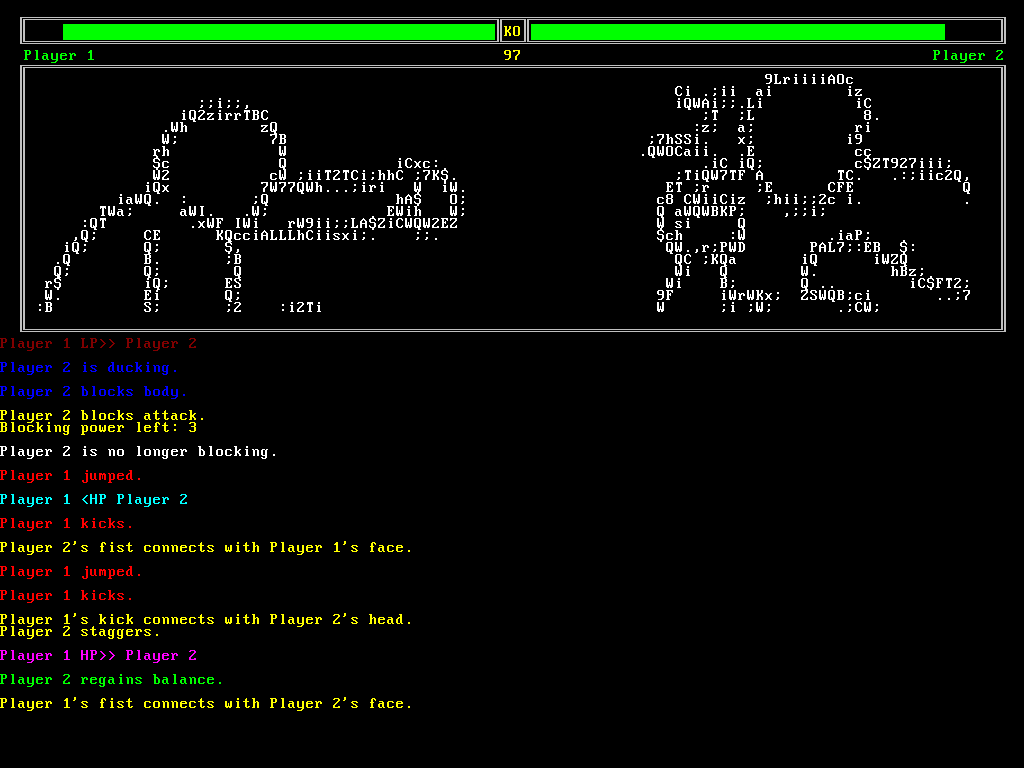
Look at how text fights actually show up on screen. One style is spatial: bodies, facing, duck, block, stagger — the log is a play-by-play of limbs. The other is numeric: health totals, damage rolls, experience, a potion pickup. Both can be excellent. Mixing them without a plan is how you get a log that shouts "3 damage" while the prose claims a decapitation.
"Design a parser-friendly combat loop for a cellar fight: three player verbs, one enemy tell per turn, a stagger state that lasts one round, and a hard cap of five turns."
"Rewrite this HP grind so every miss still changes range or footing, and every hit reveals one fact about the captain's broken shield."
"Balance a duelist against a shield captain. Make blocking costly, punish turtling, and keep both health states readable in a 40-word log."
Fairness you can read
A fair text fight is not a hidden formula. It is a loop where the player can answer three questions after every turn: what just happened, what is dangerous now, and what is worth typing next. The assistant will flag rounds where those answers are missing, then help you document initiative, interrupt windows, and victory conditions so implementation does not invent a second game.
Related Agents You'll Also Find Useful
If the combat loop is the skeleton, these partners cover the flesh you will need within a few work sessions of locking the rules.
Writing Assistant
Combat dies in generic verbs. Writing Assistant is the partner for hit lines, block lines, and the one-sentence world detail that makes a stagger feel like a body, not a status flag.
- Matches your narrator's diction so the fight log does not switch authors mid-round
- Writes fail-forward misses ("the blade skids, but you see the limp") instead of empty whiffs
- Keeps length tight enough for mobile reading
C++ Coding Assistant
Once the loop is designed, someone has to implement turn order, state flags, and damage without drifting from the document. C++ Coding Assistant is built for that translation into engine-grade code.
- Maps design verbs to input, state, and resolution functions
- Keeps initiative, poise, and resource clocks from colliding
- Documents edge cases (simultaneous hits, flee during stagger, item use on the last HP)
Comic Creator
Text combat is still sequential art. Comic Creator helps you board the fight as panels — setup, tell, decision, result — so the written log has a visual rhythm even if the shipped game never shows a sprite.
- Turns a five-turn duel into a readable beat sheet
- Spots rounds that repeat the same "camera"
- Gives writers a picture of space: who has the doorway, who is on the stairs
Try Game Designer Assistant free — no credit card required.
How It Works
Step 1: Name the fight fantasy, not the formula
Open with the scene you want players to retell. A fair duel on a wet pier is a different system than a three-wave cellar brawl. Tell the design partner who can die, what "winning" does to the story, and how long the player should be in the loop.
"I need a one-on-one parser duel on a burning staircase. The player can win by disarm, knockdown, or morale break — not only by draining HP. Cap it at six turns."
Step 2: Lock a small verb set and what each verb spends
Pick three to five actions. Give each a cost and a risk. If Guard is free and blocks everything, you do not have a system. If Feint only works as flavor, delete it. Ask for an explicit counter matrix: what the enemy does when the player repeats Strike.
"Verbs: Bind, Cut, Guard, Shove. Bind spends a turn to set up Cut. Guard reduces damage but loses initiative. Shove can force a drop if the enemy is already staggered."
Step 3: Design the log as an interface
Decide whether the player sees a spatial play-by-play (duck, block body, kick to the head) or a numeric arena log (health, damage, XP, loot). Then write one full round in that format and check whether a new player can scan it.
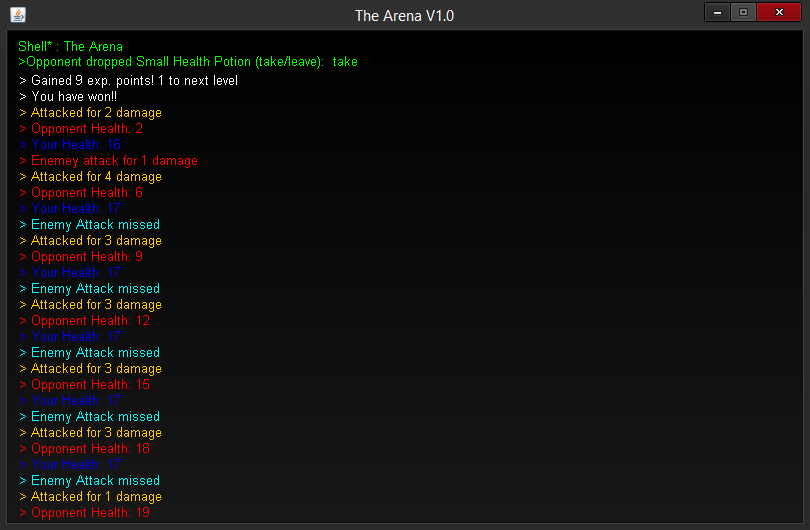
The second image is the classic RPG contract: the player always knows both health totals, whether the last swing connected, and what the reward was. If your parser fight cannot offer that clarity in words, shorten the sentence, not the rules.
"Write a four-line combat log template: player action, enemy tell, numeric result, new state. No line over 20 words."
Step 4: Play a paper round and cut until it hurts less
Run three turns in chat as if you were the player. Whenever a miss does nothing, replace it with a change in range, grip, or information. Whenever a hit does not change the next decision, it is decoration. This is also where you pull in implementation notes for later coding, or pass the round to Writing Assistant if the rules are right and the sentences are not.
Step 5: Document victory, defeat, and the exit back into story
A combat system is unfinished if the last HP only prints "You win." Spell out loot, wounds that persist, NPC witnesses, and the next parser prompt. The fight should hand the adventure a new fact, not a blank room.
Results & Use Cases
📊 Parser cellar fight that does not become a grind
Scenario: You are shipping a parser dungeon. The first enemy is a watchman. Playtesters mash Attack until he drops, then skip the remaining flavor text.
Traditional Approach: A to-hit roll, a damage range, and 12 nearly identical "You strike" lines. Two hours of rewriting later, the fight is still eight turns.
Game Designer Assistant: You cap the fight at four turns, add a lantern as a second resource, and make Guard the only way to see the watchman's limp — which is the tell for a disarm.
- Players get a reason to type something other than Attack
- The limp becomes a clue for the next room, not a cosmetic wound
- The log stays short enough that parser users do not skim
💼 Choice-based duel that has to carry a political scene
Scenario: A choice-driven court story needs a duel that can end in exile, marriage, or a public confession. A raw HP bar cannot hold those outcomes.
Traditional Approach: Three choices per round that all deal 2–4 damage. The plot waits in the hallway until someone hits zero.
Game Designer Assistant: You design three victory tracks — blade, witness, and nerve — and require each round to move one of them. Writing Assistant then writes the crowd lines so a "miss" still changes who believes you.
- Combat and conversation share one resource: attention in the hall
- Designers can test a four-round script without a full build
- Comic Creator boards the crowd's facing so the prose knows where the camera is
📱 Mobile arena you can finish between stops
Scenario: A commuter plays on a phone with one thumb. Long paragraphs and hidden numbers get abandoned at the station.
Traditional Approach: A wall of combat text and a potion prompt buried under flavor. Session time is unpredictable.
Game Designer Assistant: You adopt an arena-log presentation: health on every turn, damage as a single number, loot as an explicit take/leave. The same structure as a classic text RPG, tuned for a short session.
- Each round is one screen, not a scroll
- Take/leave item prompts work with fat-finger taps
- A missed enemy attack is a line, not a paragraph, so the player can act again before the train doors open
🎯 From design doc to engine loop
Scenario: The combat document is done. Your programmer needs states for stagger, block power, and simultaneous hits without inventing new rules.
Traditional Approach: The coder guesses, the designer rewrites, and the live fight no longer matches the prose.
C++ Coding Assistant: You paste the turn matrix and get a state machine that mirrors Bind / Cut / Guard / Shove, including the one-turn stagger and the block-power countdown.
- Design and implementation share one vocabulary
- Edge cases are listed before they ship as bugs
- You can still rewrite flavor without touching resolution
FAQ
What is a text adventure combat system?
A text adventure combat system is the rules-and-writing loop that resolves a fight in readable turns. It covers what the player can type or tap, how the enemy answers, how damage and status are shown, and how the scene returns to exploration. The best versions keep a small verb set, a scannable log, and a reason for the fight to exist in the story — not only a pile of hit points.
How do I make text-based combat more engaging?
Give every verb a cost, show the result in one glance, and make misses change the situation. Designers on Stack Exchange and
keep arriving at the same lesson: a three-option attack menu is not a system. Game Designer Assistant will pressure-test tells, turn caps, and log templates so the player always has a next decision.Is Game Designer Assistant free?
Yes. You can use it on the free tier with core features and limited monthly usage. Paid tiers raise usage if you are iterating on long combat documents, multiple enemy archetypes, or full-game design notes. There is no requirement to start on a paid plan to draft a verb matrix or a sample fight log.
Can a text adventure combat system work on mobile?
Yes, if the log is an interface, not a novel. Short rounds, visible health, and explicit item prompts (take/leave) fit one-handed play. The same agent session syncs across web, iOS, and Android, so you can sketch a fight on a laptop and read the log on a phone the way a commuter would.
How is this different from a tabletop combat system?
Tabletop combat can lean on a human GM to narrate misses and cut a slog short. A text adventure has to do that job in the rules and the sentences you shipped. The math can look like a lightweight RPG. The product is the log: initiative, tells, and exits back into the story. Use the assistant for that product layer; use a writing partner when the numbers are right and the voice is not.
How is Game Designer Assistant different from a general chatbot?
A general chatbot can invent a damage table. It will not reliably interrogate turtling, turn budgets, parser verb collisions, or whether a 40-word log is actually scannable. This agent is built for systems analysis, documentation, and genre-aware fight design — the work you need before anyone writes a line of engine code.
Conclusion
A text adventure combat system fails in public. There is no animation to cover a hollow miss, and no camera cut to hide an eight-round grind. The fix is not a larger move list. It is a small set of verbs, a log the player can scan, and a fight that hands the story a new fact when it ends.
Game Designer Assistant is the partner for that loop: fantasy, verbs, feedback, paper playtest, and the exit back into the adventure. Pair it with writing, comics, or C++ help when you are ready to ship the sentences and the state machine.
Try it on a fight you already hate. Then explore more at Jenova.
For Developers: Game Designer Assistant is available programmatically via the Jenova API — integrate combat-loop design, systems analysis, and fight documentation into your application with a single API call. Full documentation →