AI Text Adventure: Play Infinite Stories With a GM That Remembers (August 2026)
2026-08-06
Roleplay Game Master runs full AI text adventures where you type anything you want and the world responds — no parser syntax, no verb guessing, no "I don't understand that command." Classic interactive fiction limited you to a fixed vocabulary and a pre-authored map. This one generates the room, the NPC, and the consequence as you reach them, and remembers all of it.
✅ No parser — write in plain sentences instead of hunting for the verb the game accepts ✅ Unlimited memory — items, characters, and choices persist across the entire adventure ✅ Any genre — dungeon crawl, noir mystery, cosmic horror, space opera, quiet drama ✅ Zero setup — one sentence starts a world; no lorebooks or config required
To understand why this matters, it's worth looking at what text adventures have always been good at, where they've historically broken down, and why the AI versions that came after mostly traded one failure mode for another.
Quick Answer: What Is an AI Text Adventure?
An AI text adventure is interactive fiction where an AI generates the world, characters, and outcomes in real time from what you type, instead of running a pre-written map with a fixed command parser.
Key capabilities:
- Free-form natural language input — no verb list, no syntax rules
- Rooms, NPCs, and items generated on demand rather than pre-authored
- Persistent world state that carries across an entire playthrough
- Any setting or genre, generated from a one-line premise
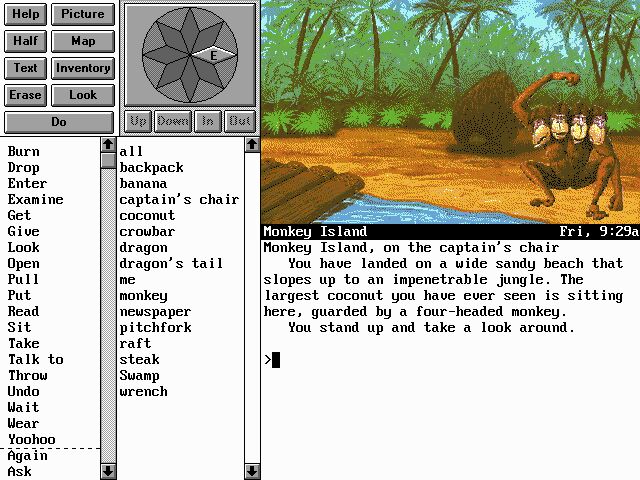
The classic form — Zork, Anchorhead, the Infocom canon — is a hand-built world with a parser gatekeeping every action. The AI form removes both limits: the world isn't finite, and the parser isn't there. What it introduces instead is a coherence problem, which is where most implementations fall down.
The Problem: Why Text Adventures Keep Hitting the Same Wall
Interactive fiction has real staying power. A systematic literature review of 63 scholarly articles on interactive fiction in learning contexts identified immersive potential, creative writing development, and reading literacy improvement among its documented benefits — concluding that reading and writing in the nonlinear tradition produces rich, multidisciplinary learning outcomes. The format works. The tooling is what keeps failing.
63 peer-reviewed articles across 10 years identified seven distinct benefit categories for interactive fiction, including immersion, creative writing, and reading literacy — Journal of Research in Science, Mathematics and Technology Education
89% of developers report AI is changing what players expect from games — players now demand worlds that feel "alive" and dynamic — Google Cloud 2025 Games Report
But actually playing a text adventure that holds together is harder than it should be:
- Parser friction — knowing exactly what you want to do and not knowing which three words the game accepts
- Finite world — every room, object, and response is hand-authored, so anything off-script returns an error
- Memory decay in AI versions — the AI forgets your inventory, your companion, and the door you unlocked forty turns ago
- Character drift — the terse dwarf smith becomes verbose and agreeable partway through
- Setup overhead — AI tools that require world info entries, character cards, and prompt scaffolding before turn one
Parser Friction Was the Original Barrier
The parser is the defining feature of classic interactive fiction and also its highest wall. You know what your character should do; the game only accepts one phrasing of it. Developers have spent decades on the problem — the Interactive Fiction Community Forum has active threads on using generative AI for parser sub-tasks specifically, with approaches like describing each scene to a model via prompt templates that include player location, known facts, and objects present.
That's a real solution to a real problem, and it points at what AI genuinely fixes: the input layer.
Finite Worlds Mean Finite Play
A hand-authored text adventure is exhaustible. Once you've mapped the rooms and solved the puzzles, it's done. Replay value comes from optimization, not discovery. This is why AI-generated worlds drew interest in the first place — developers building LLM-driven text adventures have specifically targeted the feel of traditional interactive fiction with commands and dialogue, but without the authored ceiling.
AI Versions Traded the Parser Problem for a Memory Problem
Here's where most AI text adventures break. Remove the finite world and you get infinite possibility — but the moment the conversation outgrows the model's working memory, the earliest details evaporate. Your inventory resets. The NPC you spent an hour building trust with doesn't know you. The locked door is locked again.
Community discussion reflects this constantly. Developers designing AI story games explicitly frame the goal as
— which is a fair description of the thing most implementations don't do.Setup Overhead Filters Out Casual Players
Enthusiast communities have built extensive workarounds — memory management schemes, character card formats, prompt scaffolding conventions. That's a healthy community solving a hard problem. It's also a wall between a curious player and their first turn.
Context: The Industry Debate Is Separate
Worth flagging honestly: 52% of game industry professionals think generative AI is having a negative impact on the industry, up from 30% the prior year, with the strongest opposition from visual and technical artists (64%) and game design and narrative professionals (63%). That's a labor and craft debate about AI in production pipelines. AI as a play format — a game master you play with rather than a tool that replaces a writer — is a distinct question.
This is exactly what Roleplay Game Master was built for.
Why Roleplay Game Master
Roleplay Game Master is built for the failure mode that actually kills AI text adventures: forgetting. Unlimited memory and character consistency come first, and the free-form input, genre range, and zero-setup start build on top of them.
| Classic / Typical AI Text Adventure | Roleplay Game Master |
|---|---|
| Fixed parser vocabulary, "I don't understand" | Free-form natural language input |
| Pre-authored rooms, exhaustible world | World generated as you explore it |
| Forgets inventory and state past the context limit | Unlimited memory across the full adventure |
| NPC personalities drift or reset | Consistent voice, motivation, and behavior |
| Character cards, lorebooks, prompt tuning | One sentence starts the game |
| Stalls or deflects on darker themes | Complete creative freedom across any scenario |
Unlimited Memory Across the Whole Adventure
The rusted key from the opening room is still in your pack in chapter nine. The guard you bribed remembers the amount. The passage you collapsed stays collapsed. World state persists for the entire playthrough, which is what makes long-form text adventures viable rather than just long conversations.
Come back a week later and the game master resumes with full awareness of where you stopped and what it cost you.
Perfect Character Consistency
NPCs hold their personalities and their history with you specifically. The suspicious innkeeper stays suspicious — and stays suspicious of you, for the reason she became suspicious. Relationships develop along a coherent line instead of resetting whenever the context rolls over.
Academic work on interactive storytelling frameworks treats this as a measurable quality dimension: research on AI-assisted interactive storytelling systems evaluated causal relationship strength as distinct from raw generation quality, because a story where choices don't logically connect to outcomes stops functioning as a story.
No Parser, No Verb Hunting
Write what you want to do in ordinary sentences. Examine something, talk to someone, try something the designer never anticipated — it resolves. The input layer stops being a puzzle so the actual puzzles can be the puzzle.
Complete Creative Freedom
Any genre, any tone, any intensity. Dungeon crawl, hardboiled noir, cosmic horror, courtly intrigue, generation ship mystery, small-town drama. The adventure goes where you take it rather than where a filter permits.
Zero-Setup Start
No world info entries. No token budgeting. Describe the premise in a line and the game master builds the setting, populates it, and hands you an opening scene.
Openers that work as-is:
"Classic dungeon crawl. I'm a thief who just got separated from my party three levels down. Start me in total darkness."
"1940s noir. I'm a private investigator and a woman just walked into my office with a story that doesn't add up. Begin mid-conversation."
"Derelict generation ship. I'm the only crew member the cryo system woke up, and the manifest says there should be four hundred of us."
Related Agents You'll Also Find Useful
If your interest runs past playing — into building, writing, or learning through the same format — these cover adjacent territory.
Game Designer Assistant If playing text adventures is giving you ideas for one of your own, this handles the design side — systems, documentation, and concept development across genres and platforms.
- Mechanics design and systems balancing
- Full design documentation and concept art direction
- Genre and regional market expertise
The Mansion A ready-made text adventure with a defined premise: you wake in a mansion with no memory of arriving, and every room hides something. Good if you'd rather step into an authored hook than build a world from scratch.
- Pre-built mystery-horror scenario
- Exploration and secret-uncovering structure
- Immediate start, no premise required
The Asylum Investigative horror in a shuttered psychiatric institution where something went wrong. Same instant-start format, heavier atmosphere.
- Investigation-driven narrative structure
- Ward-by-ward exploration and discovery
- Hidden story to uncover across the playthrough
Learn Japanese Through Roleplay The text adventure format aimed at language acquisition. Vocabulary anchors to scenes you actually remember instead of flashcards you don't.
- Fully immersive scenarios, any theme
- Grammar absorbed through narrative use
- Same unlimited memory across sessions
Try Roleplay Game Master free — no credit card required.
How It Works
Step 1: Describe the adventure in one line
Genre, premise, or a single image. The game master builds the setting, places you in it, and gives you an opening scene to act on.
"Underground city built inside a dead god. I'm a scavenger who just found something breathing."
Step 2: Type what you do — however you'd say it
No commands, no syntax, no verb list. Describe actions, dialogue, or internal reasoning. The game master narrates outcomes and voices every NPC.
"I press my ear to the wall before I reach for the latch."
Step 3: Let state accumulate
Items stay in your inventory. Wounds stay open. Debts stay owed. The world tracks what you've done and reacts to a history that keeps growing.
"I show the harbormaster the seal I took off the dead courier."
Step 4: Leave and come back anytime
Close the session, return next week. Inventory, relationships, map knowledge, and unresolved threads are all intact. Pick up mid-scene.
"Continue. What's the harbormaster doing now?"
Results & Use Cases
🗺️ Endless Dungeon Crawls Without an Authored Map
Scenario: You've finished the classics and want that same exploratory pull without a walkthrough spoiling it. Traditional Approach: A finite hand-built map, exhausted in one playthrough, replayed only for optimization. Roleplay Game Master: A dungeon that generates as you descend, with a persistent map, inventory, and consequences that carry the whole way down.
- World expands as you explore rather than running out
- Full state tracked across the entire crawl
- No walkthrough exists because no two runs are the same
📱 Mobile Play in Fifteen-Minute Windows
Scenario: Commute, waiting room, lunch break — short gaps with nothing worth starting. Traditional Approach: Mobile games built around retention loops rather than narrative. Roleplay Game Master: Resume your adventure on your phone, play a scene, put it down. State fully preserved.
- Full feature parity across web, iOS, and Android
- Speech-to-text for hands-free play
- Sessions sync across every device
✍️ Testing Worlds and Characters Before You Write Them
Scenario: You're drafting a novel or designing a game and need to see how a setting behaves when someone actually moves through it. Traditional Approach: Static worldbuilding documents and hoping the place feels lived-in once you write scenes in it. Roleplay Game Master: Walk your protagonist through the world and find out where it holds and where it's thin. Test dialogue, pressure-test motivations, discover the parts you hadn't thought about.
- Live character behavior under varied conditions
- Consistent world logic to write against
- Pairs naturally with Game Designer Assistant for interactive narrative projects
📚 Reading and Writing Practice That Doesn't Feel Like Practice
Scenario: You want reading and composition practice that holds attention — for yourself, a student, or a classroom. Traditional Approach: Assigned passages and worksheets with no stake in the outcome. Roleplay Format: Research on interactive fiction in learning contexts documents improved reading literacy and creative writing outcomes as recurring themes across the literature, with educators across disciplines encouraged to integrate the format into curricula. Language-focused variants like Learn Japanese Through Roleplay apply the same mechanic to acquisition.
- Reading and writing are the mechanic, not the assignment
- Documented multidisciplinary learning outcomes
- Free-form input means composing sentences, not selecting options
Frequently Asked Questions
Is Roleplay Game Master free to use?
Yes. Roleplay Game Master is available on Jenova's free tier with all core features and limited monthly usage. Paid tiers start at $20/month for substantially increased usage and custom model selection. Usage resets monthly on your billing date with no daily caps.
Do I need to learn parser commands like in old text adventures?
No. Write in plain sentences. There's no verb list, no syntax, and no "I don't understand that command." You can attempt actions no designer anticipated and the game master will resolve them in-fiction rather than rejecting the input.
How is this different from other AI text adventure tools?
The differentiators are unlimited memory and character consistency. Most AI text adventures lose world state once the conversation outgrows the model's context, so inventory, relationships, and unlocked doors quietly reset. This one maintains full state across the entire adventure, so consequences compound instead of evaporating.
Can I play any genre?
Yes. Fantasy, sci-fi, horror, mystery, noir, historical, slice-of-life, or a hybrid you invent. The agent offers complete creative freedom to explore any scenario, including darker and more intense material that other tools deflect. Pre-built scenarios like The Mansion and The Asylum are also available if you'd rather start from an authored premise.
Does it work on mobile?
Yes. Jenova has full feature parity across web, iOS, and Android, plus speech-to-text if you'd rather narrate than type. Sessions sync across devices, so you can start on desktop and continue on your phone mid-scene.
How long can one adventure run?
Indefinitely. Chat history is unlimited and memory persists across sessions, so a single adventure can run for months without losing earlier rooms, items, characters, or decisions.
Conclusion
Text adventures have always had two ceilings: a parser that only accepts certain phrasings, and a world that runs out. AI removed both — and then introduced a third, worse one, where the game forgets the world it just built for you. Infinite generation is worthless if the state resets every time the context fills.
Roleplay Game Master fixes the memory problem first and builds the rest on it: free-form natural language input with no parser to fight, worlds generated as you explore rather than exhausted in one run, NPCs that hold their voice across hundreds of turns, complete creative freedom across any genre, and nothing between you and the first scene but a single sentence. Whether you're chasing the feeling of a classic dungeon crawl, testing a world you're writing, or just want a story that actually keeps track of what you did — that's the difference between an AI text adventure and one worth finishing.
Start your adventure — Roleplay Game Master is free to try. Explore more at Jenova.
For Developers: Roleplay Game Master's persistent-state narrative engine is available programmatically via the Jenova API — integrate free-form interactive fiction with full world-state memory into your game or app with a single API call. Full documentation →