AI TCG Rulebook Generator: Write Clear Card Game Rules & Keywords
2026-10-23
Trading Card Game Creator works as a TCG rulebook generator. It turns your card mechanics, keywords, and turn structure into clear rules that players can learn from and refer back to mid-match. Most homemade trading card games stall at the documentation stage, so this AI drafts setup steps, turn phases, keyword definitions, card anatomy breakdowns, and edge-case rulings from the mechanics you have already designed. As of October 2026, designers can go from a pile of prototype cards to a blind-playtest-ready rulebook in a single working session instead of weeks of rewrites.
- ✅ Builds rules from your actual mechanics rather than a generic template
- ✅ Creates a single keyword glossary so card text and rules text never contradict each other
- ✅ Separates a quickstart guide from a full reference section
- ✅ Finds timing conflicts and drafts FAQ rulings before you print
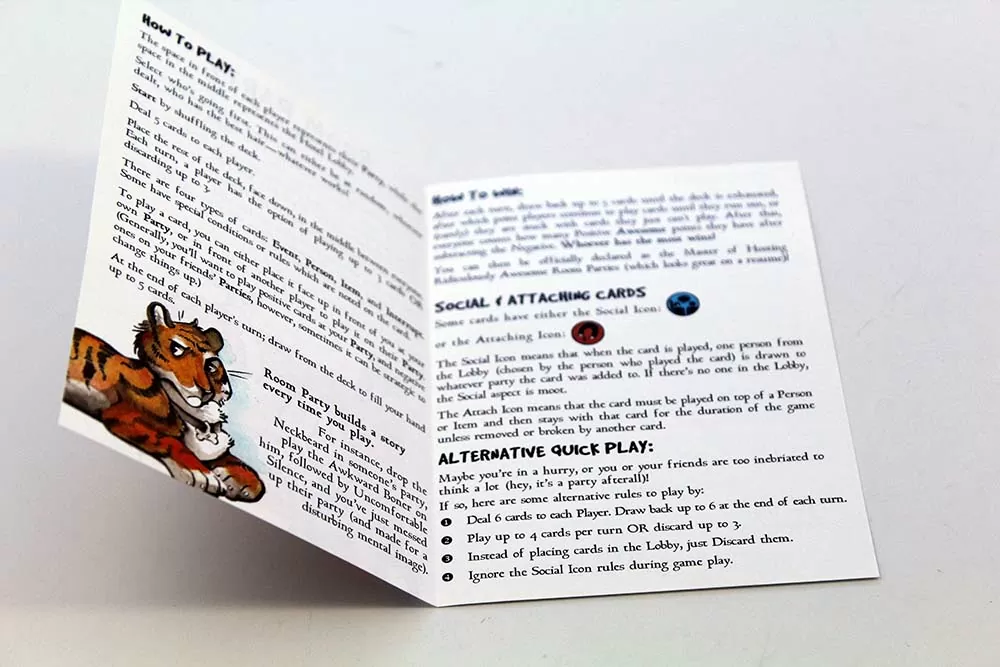
The rule sheet above shows what good card game documentation looks like. It has a turn sequence, a short glossary of icons (Social and Attach), a win condition, and an "Alternative Quick Play" variant, all on one folded page. Getting your own TCG rules to that level of clarity is harder than it looks. To see why, let's look at where card game rulebooks usually break down.
Quick Answer: What Is a TCG Rulebook Generator?
A TCG rulebook generator is an AI tool that turns trading card game mechanics, keywords, and card types into structured, player-ready rules (setup, turn phases, glossary, and FAQ) in minutes instead of weeks. Good generators work from your design rather than filling in a template.
Key capabilities:
- Converts rough mechanic notes into ordered setup and turn-phase instructions
- Writes a consistent keyword glossary and a card anatomy breakdown (cost, type, effect, stats)
- Drafts a quickstart guide for new players and a full reference section for experienced ones
- Produces edge-case rulings, timing clarifications, and an FAQ from your card pool
Why TCG Rules Are So Hard to Write
Trading card games carry more rules overhead than most tabletop formats. Every new card is a potential rules interaction, and the market rewards frequent releases.
$7.8 billion → $11.8 billion — Global TCG market growth projected from 2024 to 2030, a 7.4% CAGR, driven partly by frequent new card set releases
60.78% — Share of the trading card game market held by character cards in 2025
78.3% — Share of the TCG market held by the fantasy genre in 2024
Players expect a lot from a game's documentation, and they rarely enjoy reading it. As the Nielsen Norman Group notes in its analysis of board game usability, rulebooks are necessary but "neither a joy to read nor very helpful when teaching a group of inattentive friends." Writing a good one is especially hard for card games:
- The chicken-and-egg problem. Games are interlocking systems, so you will eventually have to reference a concept before you define it. Resonym's rulebook team calls this out as one of the hardest structural problems, with no clean fix.
- Two audiences, one document. A rulebook has to work as a tutorial for new players and as a reference for veterans looking up one ruling. Those two jobs pull the structure in opposite directions.
- Icon and keyword overload. NN/g points out that icons save space on cards, but they can increase cognitive load until players have learned what they mean.
- Gaps you can't see yourself. Designers know their own intent too well to notice missing rules. Experienced designers recommend .
This is exactly the problem Trading Card Game Creator was built to solve.
Why Trading Card Game Creator
Trading Card Game Creator is a complete TCG design studio covering mechanics, lore, card art, and balance. Because it understands the game you are building, the rules it writes reflect your actual card pool. You describe your resource system, card types, and win condition, and it turns that design into documentation that follows proven rulebook practice.
| Traditional Approach | Trading Card Game Creator |
|---|---|
| Rules written from scratch in a blank document | Structured rulebook drafted from your mechanic notes |
| Keywords worded differently on cards and in rules | One glossary, with conflicting phrasing flagged |
| Edge cases discovered by players mid-game | Timing conflicts surfaced and FAQ rulings drafted before print |
| One document trying to teach and serve as a reference | Separate quickstart and comprehensive reference sections |
| Every rules change means manually rewriting several pages | Rules revised in place as your mechanics evolve |
Rules That Follow a Proven Structure
Published rulebooks share a recognizable structure for good reason. Stonemaier Games uses a consistent template: overview and goal, components, setup, gameplay overview, detailed gameplay, other info, and end of game. The AI organizes your TCG rules along similar lines and adapts them to card-game needs such as deck construction limits, mulligan rules, and zone definitions (deck, hand, field, discard).
Keyword Glossary and Card Anatomy
Resonym recommends an "anatomy" diagram that labels each type of information printed on a component, such as cost, type, effect, and strength. The generator writes that breakdown for your card frame and builds a keyword glossary with reminder text. Each keyword gets exactly one definition, and every card uses it the same way.
Edge Cases, Timing, and FAQ Rulings
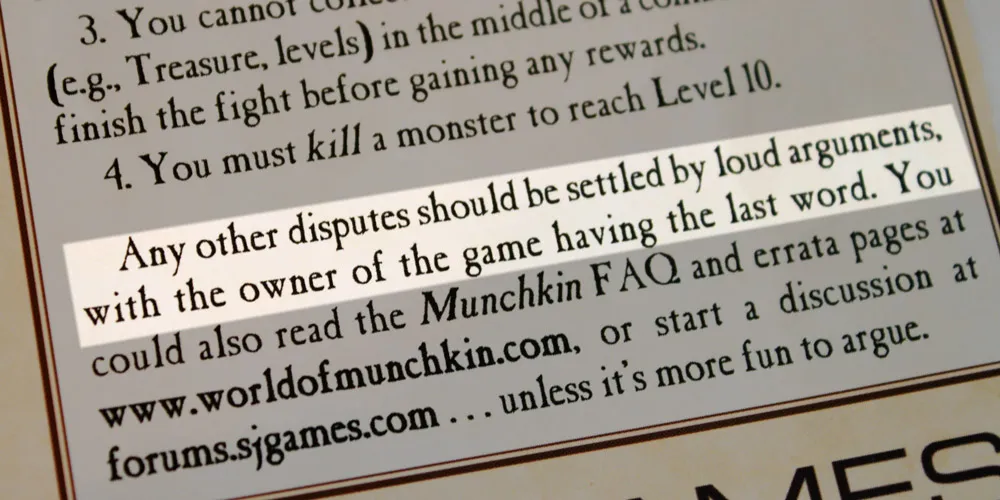
Munchkin famously admits in print that "any other disputes should be settled by loud arguments, with the owner of the game having the last word." That joke works for a comedy game. For a competitive TCG, unresolved rulings stall matches and split communities. The AI goes through your card interactions, including simultaneous triggers, replacement effects, and "can't" versus "can" conflicts, and drafts clear rulings before players find the gaps.
Plain, Direct Language
Effective rulebooks use second-person instructions. Stonemaier writes "Pay $1 to gain 2 resources," not "The player pays $1", and treats the word "exception" as a warning sign. The generator follows the same conventions and points out where your design depends on too many exceptions.
Example prompts:
"Here are my 4 card types, my energy system, and my win condition. Write a full rulebook with setup, turn phases, and a keyword glossary."
"Find every timing conflict between my 'On Enter' and 'When Destroyed' keywords and draft FAQ rulings for each."
"Write a 1-page quickstart that teaches my game in three turns, and move everything else to a reference section."
Related Agents You'll Also Find Useful
If your rulebook is only one part of a larger game project, these agents cover the next steps.
Game Designer Assistant A general-purpose game design partner for brainstorming, systems analysis, and documentation across genres. It is useful when you need to check your core loop before locking the rules.
- Systems analysis of economy, pacing, and player interaction
- Design documentation beyond the rulebook
- Expertise across genres, platforms, and regional markets
Character Creator If your TCG is character-driven, like most of the market, this agent builds detailed characters and portraits that give your cards and lore sections a consistent identity.
- Quick-gen or guided character builds
- Portraits across genres and styles
- Backstories that feed flavor text
Brochure Maker Once your rules are written, this agent helps lay them out as a printed, folded insert like the party game sheet shown above.
- Fold selection (bi-fold, tri-fold, and more)
- Content planning for limited panel space
- Consistent visual direction
Try Trading Card Game Creator free, with no credit card required.
How to Generate a TCG Rulebook With AI
Step 1: Describe Your Core Game Give the AI your elevator pitch: player count, deck size, resource system, card types, and how a player wins. Rough notes are fine. The goal is a complete picture, not polished prose.
"2-player TCG, 40-card decks, players gain 1 Mana per turn up to 10. Card types: Units, Spells, Relics. Reduce your opponent from 20 Life to 0."
Step 2: Define Keywords and Card Anatomy List every keyword and paste in a few sample cards. Trading Card Game Creator builds a glossary with reminder text and a labeled breakdown of your card frame.
"My keywords are Guard, Swift, Echo, and Bind. Here are 10 sample cards. Write glossary entries and a card anatomy section."
Step 3: Generate the Full Rulebook Draft Ask for the complete document: overview, components, setup, turn phases, combat, zones, and end of game. Request worked examples for the trickiest sections. Examples help a lot here: the Opinionated Gamers note that well-designed examples are one of the best ways to add clarity.
"Write the full rulebook with an example turn after the combat section."
Step 4: Stress-Test Edge Cases Ask the AI to cross-reference your card pool for conflicting interactions and ambiguous wording, then turn its findings into an FAQ.
"Which of my 60 cards create timing conflicts? Draft rulings and an FAQ."
Step 5: Revise After Blind Playtests Run a blind playtest, where players learn only from the rulebook, and bring back every question they asked. Stonemaier attributes 25% of the value of blind playtesting to improving the rulebook. Each confusion point becomes a targeted rewrite.
"Playtesters missed that Relics stay in play after combat and thought Echo triggers twice. Fix both sections."
Results & Use Cases
🎯 Indie Designer Preparing a First Blind Playtest
Scenario: A solo designer has 80 prototype cards and a working game but only scattered notes about how it plays.
Traditional Approach: Weeks spent drafting, reordering sections, and rewriting after friends ask the same questions every session.
The TCG rulebook generator: A structured draft with setup, phases, glossary, and examples, produced in one session and ready to hand to blind testers.
- Follows the structure players already expect from published rulebooks
- Worked examples placed where confusion is most likely
- Revision passes take minutes after each playtest
📊 Expansion Set Adding New Keywords
Scenario: A designer adds 5 new keywords in a second set and needs to know how they interact with the 12 existing ones.
Traditional Approach: Manually comparing every keyword pair, then finding conflicts after players report them.
Trading Card Game Creator: Maps the new keywords against existing ones, flags ambiguous interactions, and drafts updated glossary entries along with an errata-style changelog.
- Keyword definitions stay consistent across sets
- Conflicts resolved before printing
- Clear notes on what changed for returning players
📱 Rules Fixes at a Local Game Night
Scenario: During a playtest at a game store, two players disagree about whether a "Bind" effect stops a Unit from blocking.
Traditional Approach: House-rule it on the spot and hope someone remembers to update the document later.
Trading Card Game Creator on mobile: The designer describes the dispute by voice on their phone, gets a ruling based on the existing glossary, and updates the rulebook text before the next round.
- Rulings stay consistent with established keyword definitions
- No arguments left unresolved, Munchkin-style
- Changes carry over to the next desktop session
💼 Crowdfunding Campaign Rulebook
Scenario: A small studio needs a polished, backer-facing rulebook for a crowdfunding page, plus a printable quick reference.
Traditional Approach: Hiring a technical editor or delaying the campaign until rules are finalized.
Trading Card Game Creator: Produces a comprehensive rulebook and a separate one-page quickstart. The studio then lays out the printed insert with Brochure Maker.
- Separate teaching and reference documents
- Draft rules ready for public preview
- Consistent terminology across the campaign page, cards, and rules
Frequently Asked Questions
Can AI write a rulebook for my trading card game?
Yes. An AI TCG rulebook generator can turn your mechanics, card types, and keywords into a structured rulebook with setup, turn phases, a glossary, examples, and an FAQ. Trading Card Game Creator works from your actual card pool rather than a fill-in template. You still need blind playtesting to confirm real players understand the rules, but the AI shortens the drafting and revision cycle considerably.
Is there a free TCG rulebook generator?
Trading Card Game Creator is available on a free tier with all core features and limited usage, which is enough to draft and revise a rulebook for a small set. Paid plans start at $20 per month for 30× the free usage, which suits designers running frequent revision passes across large card pools or multiple expansion sets.
How is an AI rulebook generator different from a rulebook template?
A template gives you empty section headings. An AI generator fills those sections with rules written for your specific game. It defines your keywords, orders your turn phases, writes examples using your own cards, and finds interactions between cards that a static template cannot catch. It also revises the whole document consistently when you change a mechanic.
What sections should a TCG rulebook include?
A complete TCG rulebook typically covers an overview and win condition, components, deck construction rules, setup, turn structure and phases, combat, game zones, a keyword glossary, card anatomy, end-of-game conditions, and an FAQ. Many designers also include a separate quickstart guide so new players can start without reading the full reference.
Can the AI help balance my cards as well as write the rules?
Yes. Balance is part of the same design process. Trading Card Game Creator covers mechanics, lore, card art, and balance alongside rules writing, so you can check cost curves and keyword strength while you document. For broader systems analysis of your economy or pacing, Game Designer Assistant adds another layer of review.
Conclusion: From Card Pile to Playable Rules
A strong card game can still fail if players can't learn it from the box. The best rulebooks follow a consistent structure, define every keyword once, teach through examples, and settle edge cases before they turn into table arguments. A TCG rulebook generator makes that standard reachable for indie designers and small studios. It turns rough mechanic notes into card game rules ready for blind playtesting, keeps keyword definitions consistent across expansions, and speeds up each revision cycle.
Write your first rulebook draft with Trading Card Game Creator today. Explore more at Jenova.
For Developers: Trading Card Game Creator is available programmatically through the Jenova API, so you can add AI-powered TCG design and rulebook generation to your game-creation tool with a single API call. Full documentation →