AI TCG Deck Archetype Generator: Design Synergy, Mechanics & Balance
2026-10-23
Trading Card Game Creator works as a TCG deck archetype generator. It turns a loose idea, such as "dinosaurs that punish blockers" or "fiends that equip themselves," into a defined archetype. You get a mission statement, synergy hooks, card roles, target ratios, and balance notes. Most players and designers start with a handful of exciting cards and hope a strategy emerges. This AI starts with the strategy and builds the card skeleton around it.
As of October 2026, competitive formats across Magic, Pokémon, and Yu-Gi-Oh! support dozens of viable archetypes at once. That makes clear archetype thinking more valuable than ever, whether you're brewing a deck or designing your own game.
- ✅ Generates complete archetype concepts: win condition, core engine, payoffs, and interaction suite
- ✅ Maps synergy through card-text hooks such as named families, types, attributes, and resources
- ✅ Builds ratio and mana-curve templates you can check against a real list
- ✅ Covers balance, lore, naming, and card art for custom TCG designers
To see why a dedicated archetype generator matters, start with how deck strategy actually breaks down at the table and on the design bench.
Quick Answer: What Is a TCG Deck Archetype Generator?
A TCG deck archetype generator is an AI design tool that defines a deck's strategic identity, including its win condition, synergy engine, card roles, and ratios, so you can build or design coherent decks instead of unfocused piles of cards.
Key capabilities:
- Generating archetype concepts from a theme, mechanic, or single build-around card
- Designing synergy hooks: name-locked families, type or attribute support, and bridge cards
- Producing role ratios and curve targets for aggro, midrange, control, and combo shells
- Stress-testing archetypes for balance, matchup gaps, and power outliers
The Problem: Why Most Decks and Custom Sets Lack a Clear Archetype
The trading card game hobby keeps growing, and its formats keep getting deeper.
USD 15.11 billion: Projected trading card game market size in 2026, rising to USD 24.36 billion by 2031
That Modern snapshot shows how wide the field is. No single deck dominates, and a 12.5% "Other" bucket held decks below 1% share each. Pokémon looks different. In one tracked format on Limitless TCG, Dragapult ex held 36.06% of tournament points. Either way, players need a precise sense of what their deck is trying to do and what it's up against.
But turning a card pool into a coherent archetype is difficult:
- The "pile of cards" problem. Wizards of the Coast's own deck-building guidance argues that every deck needs a mission statement. Without one, cards pull in conflicting directions.
- Confusing archetype taxonomy. Most classifications begin from aggro, control, combo, and midrange, but returning players regularly .
- Ratio math that doesn't add up. Cards fill multiple roles at once, so counting ramp, removal, and threats by hand produces misleading totals.
- Custom archetype design is a balance minefield. Designers have to decide how closed or splashable a card family should be, and the wrong choice creates either dead cards or format-warping engines.
This is exactly the problem Trading Card Game Creator was built to solve.
Why Trading Card Game Creator Works as an Archetype Generator
Trading Card Game Creator is a complete TCG design studio. It covers mechanics, lore, card art, and balance, from first concept through playable sets. For archetype generation, that means the agent starts where strong decks start: with the game plan. Then it works outward to the cards that execute it.
As Draftsim's archetype breakdown puts it, the difference between decklists "isn't just the cards they play, but why they play them." The agent is built around that "why."
| Traditional Approach | Trading Card Game Creator |
|---|---|
| Start with favorite cards and hope a strategy appears | Start with a mission statement, then generate cards and roles to fit it |
| Copy a netdeck without understanding its ratios | Get the reasoning behind each slot: engine, payoff, interaction, or protection |
| Hand-count roles in a spreadsheet, double-counting overlap | Define role targets per archetype template, with multi-role cards flagged |
| Design a custom card family by trial and error | Generate hooks, bridge cards, and balance checks before playtesting |
| Commission or skip card art for prototypes | Produce concept art and naming that match the archetype's identity |
Mission Statement First
Every generated archetype opens with a one-line identity: how it wins, how fast, and what it gives up. This matches the guidance in Wizards' deck-building article. Linear decks need a critical mass of one thing. "Good stuff" decks win through raw card quality. Each needs a different card skeleton.
Synergy Hooks and Bridge Cards
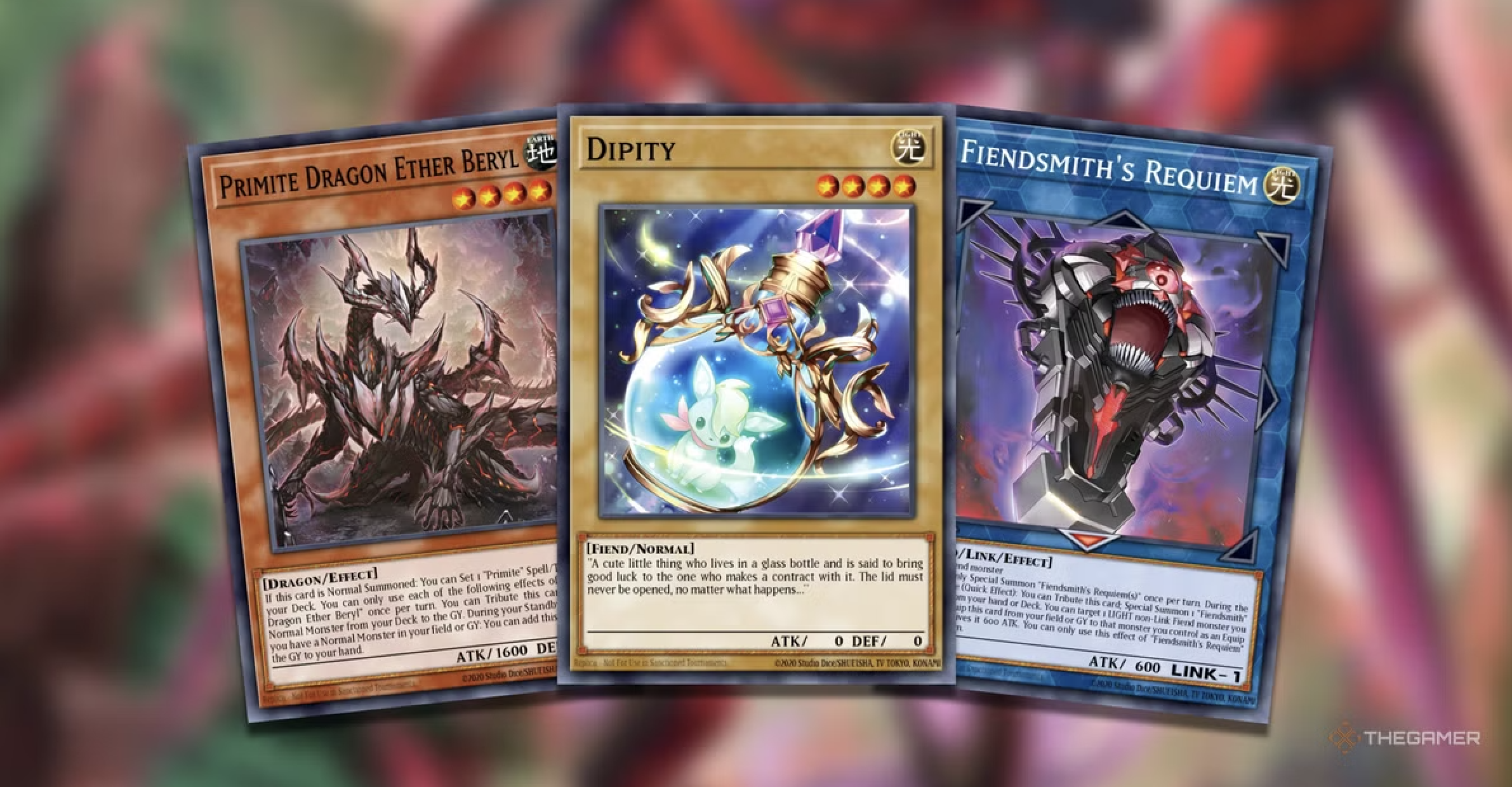
Look at the Yu-Gi-Oh! cards above. Fiendsmith's Requiem summons "Fiendsmith" monsters and equips to a LIGHT Fiend. Primite Dragon Ether Beryl's text rewards having Normal Monsters in your Deck, field, or GY. Dipity is a LIGHT Fiend and a Normal Monster with 0 ATK and 0 DEF, so it can serve both engines at once.
That's a bridge card, and it's the kind of structure the agent can generate deliberately for your own designs. It works with three hook types:
- Name-locked hooks for tight, closed archetypes
- Type or attribute hooks for open, splashable support
- Bridge cards that connect two engines without breaking either
Ratio and Curve Templates
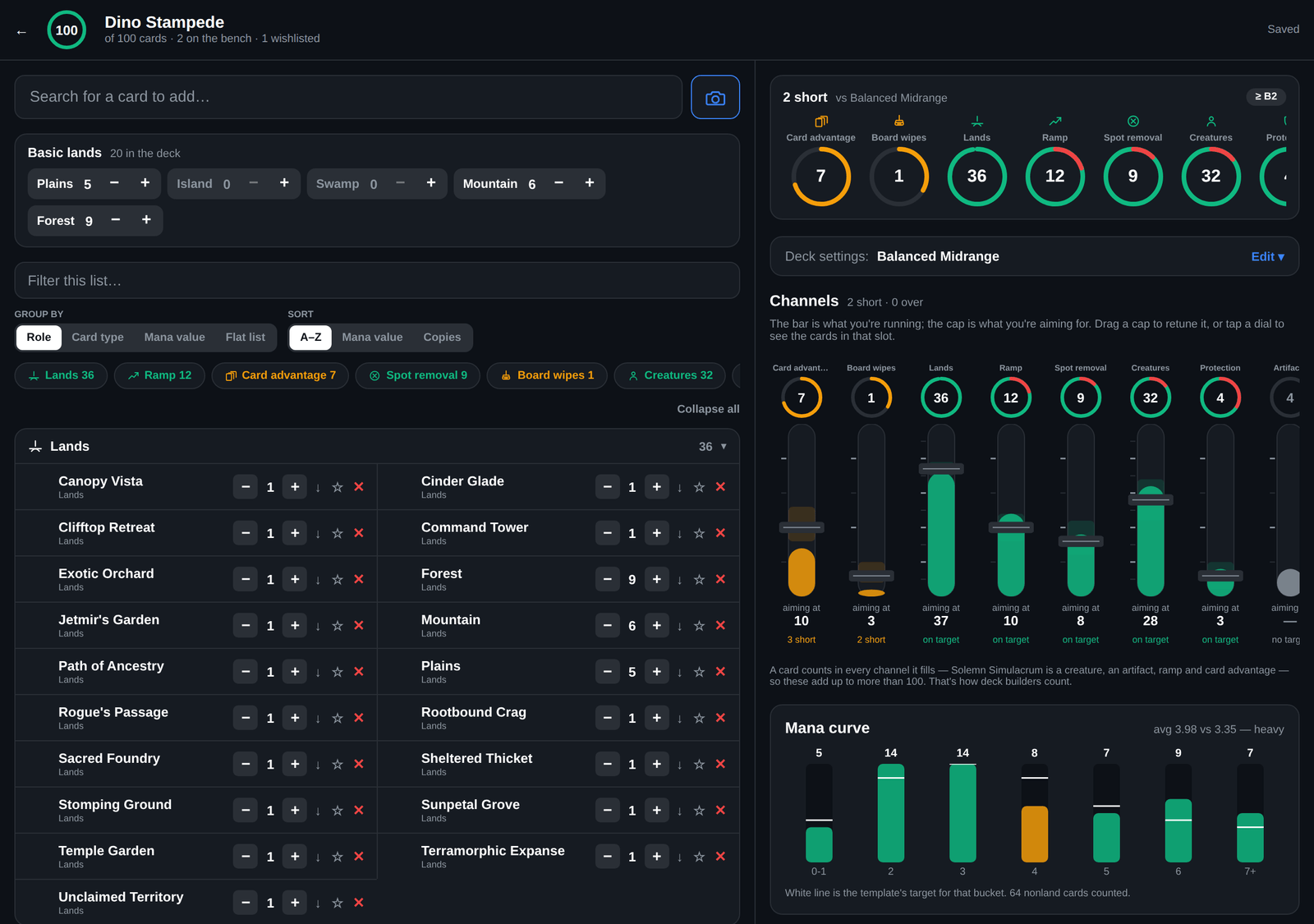
The deck builder above shows what an archetype looks like when you make it measurable. The 100-card dinosaur Commander list is checked against a "Balanced Midrange" template:
- On target: Lands at 36 (aiming for 37), ramp at 12 (aiming for 10)
- Short: Card advantage at 7 of a 10 target, and board wipes at 1 of 3
- Overlapping roles: A card counts in every role it fills, so the totals exceed 100
- Curve: Average mana value of 3.53 against a 3.35 target, flagged as "heavy"
Trading Card Game Creator can generate these targets for any archetype you define. You can then check a real build against them in whatever tool you use.
Balance Stress-Testing
Ask the agent to attack its own design. It can flag cards whose value doesn't depend on the archetype, which is a sign they'll leak into every deck. It can also identify matchups the archetype can't interact with and power spikes that will define a format.
Example prompts:
"Generate three graveyard-based archetypes for my sci-fi TCG: one aggro, one combo, one control. Give each a mission statement and 10-card core."
"Design a LIGHT Fiend-style bridge card that supports two existing archetypes without becoming a must-play in every deck."
"Turn my Naya dinosaur Commander idea into a midrange template with target counts for ramp, removal, card advantage, and wipes."
Related Agents You'll Also Find Useful
If your archetype work extends beyond the deck itself, these agents cover the next steps in the workflow.
Game Designer Assistant
If you're designing a full game around your card system, Game Designer Assistant handles the broader design layer.
- Brainstorming and systems analysis across genres
- Design documentation for rules, turn structure, and resource systems
- Concept art and regional market expertise
Deep Research
When you need current metagame context before generating an archetype, Deep Research synthesizes findings across many sources.
- Searches hundreds of sources for tournament results and archetype trends
- Delivers reports with rigorous inline citations
- Useful for checking which archetypes your design or brew will face
Excel Generator
Once your archetype is defined, Excel Generator turns card lists and ratio targets into structured workbooks.
- Formulas for role counts and curve buckets
- Clean sheet structure for set files and playtest logs
- Formatting applied automatically
Try Trading Card Game Creator free, with no credit card required.
How to Generate a TCG Deck Archetype, Step by Step
Step 1: Define the Game and Constraints Tell the agent whether you're working within an existing game's rules or designing your own system. Include format size, resource system, and any mechanics that must appear.
"I'm designing a 40-card TCG with a energy-per-turn resource system. Archetypes should support 2-player games lasting about 20 minutes."
Step 2: Generate Archetype Concepts Request several concepts across the classic spectrum of aggro, midrange, control, and combo. Each should come with a mission statement and a defined weakness. Pick the one that excites you, or combine two.
"Give me five archetype concepts built around sacrificing your own creatures. Include each one's win condition and its worst matchup."
Step 3: Map the Card Skeleton Ask for the archetype's structure:
- Engine pieces that make the deck run
- Payoffs that reward the engine
- Interaction and protection
- Any bridge cards that connect to other engines
Ask for target counts per role, as in the midrange template shown earlier.
"Break the sacrifice archetype into engine, payoff, and interaction slots with target counts for a 40-card deck."
Step 4: Stress-Test Against the Field Have the agent pit the archetype against opposing strategies. For an existing game, add current tournament context from a tracker like Yu-Gi-Oh! Meta or MTGTop8. Then ask where the plan collapses.
"How does this archetype perform against fast aggro and hard control? Which card would you change first?"
Step 5: Export and Playtest Take the finished card list into a spreadsheet or prototype print, then return with playtest notes. The agent can revise individual cards, adjust ratios, and generate concept art for your proxies.
"After 10 test games, the payoffs arrive too late. Lower the curve without cutting the engine."
Results and Use Cases
🎲 Indie Designer Building a Launch Set
Scenario: A solo designer needs six distinct archetypes for a 120-card first set before a crowdfunding campaign.
Traditional approach: Weeks of whiteboarding, plus repeated playtests that reveal two archetypes overlap almost completely.
Trading Card Game Creator: Generates six archetypes with distinct mission statements, assigns each a mechanical hook, and flags overlap before cards are printed.
- Clear identity per archetype from day one
- Bridge cards planned intentionally instead of by accident
- Concept art for pitch materials
🃏 Yu-Gi-Oh! Fan Designing a Custom Archetype
Scenario: A homebrew group wants a new name-locked Fiend family that plays with existing Normal Monster support.
Traditional approach: Drafting card text by imitation, with no way to judge whether the engine is too self-sufficient.
Trading Card Game Creator: Designs a family with name-locked searchers, a LIGHT Fiend bridge in the style of Dipity, and an end-board ceiling. The agent explains each choice.
- Synergy loops that reward commitment without "one-card combos"
- Explicit balance notes for each searcher
- Lore and naming consistent across the family
📱 Commander Player Brewing on Mobile at the Game Store
Scenario: Between games at a local store, a player wants to rebuild a dinosaur deck that keeps running out of cards.
Traditional approach: Scrolling forums on a phone and guessing which cuts to make.
Trading Card Game Creator: From a quick message, the agent diagnoses the gap. The deck has low card advantage against its midrange template, which matches the 7-of-10 shortfall in the builder above. It then proposes a role-by-role fix.
- Template-based diagnosis instead of gut feel
- Specific role targets to bring into any deck builder
- Works the same on phone as on desktop
📊 Game Design Educator Running an Archetype Workshop
Scenario: An instructor wants students to compare how real archetypes are structured before designing their own.
Traditional approach: Manually collecting decklists and explaining archetype theory from scratch.
Workflow: Deep Research compiles current archetype examples with citations. Trading Card Game Creator then generates original archetypes for students to critique and rebalance.
- Grounded real-world examples alongside original designs
- Repeatable exercise across multiple classes
Frequently Asked Questions
What is a TCG deck archetype generator?
A TCG deck archetype generator is an AI tool that defines a deck's strategic identity before you pick individual cards. That identity covers its win condition, engine, payoffs, interaction, and target ratios. For designers, it also generates new card families with synergy hooks and balance notes. The goal is a coherent deck or set rather than a collection of strong but unrelated cards.
Can an AI generate archetypes for Magic, Pokémon, or Yu-Gi-Oh!?
Yes. AI can generate archetype concepts and role templates that follow the structure of games like Magic, Pokémon, or Yu-Gi-Oh!. Trading Card Game Creator is strongest at design: original archetypes, card families, and balance. For live tournament shares and current legality, check official sources and metagame trackers before finalizing a competitive list.
Is Trading Card Game Creator free?
Yes, the agent is available on Jenova's free tier, which includes all core features with limited usage. Paid plans start at $20 per month for Plus, which adds 30× the usage, custom model selection, and no watermarks. Higher tiers raise limits further. Usage resets monthly on your billing date, with no daily caps.
How is an archetype different from a decklist?
An archetype is the strategy: how a deck wins, what it prioritizes, and what it gives up. A decklist is one specific set of cards that executes that strategy. Many decklists can share one archetype, and Modern metagame reports group decks this way. Defining the archetype first makes every card choice easier to justify.
Can I use the archetype generator alongside broader game design work?
Yes. Trading Card Game Creator focuses on cards, mechanics, and balance. Game Designer Assistant covers broader systems design, documentation, and market considerations. Many designers use both, one for the card layer and one for the full game.
Does it work on mobile?
Yes. Jenova offers full feature parity across web, iOS, and Android, with settings synced across devices. You can generate an archetype on your phone at a game store and continue refining it on desktop later. Speech-to-text also lets you describe deck ideas aloud instead of typing long prompts.
Conclusion
Strong decks and strong card sets share one trait: a clear archetype behind every card. Formats now support dozens of competitive strategies, and the TCG market keeps expanding. Building from a mission statement instead of a pile of favorites matters for casual brewers and indie designers alike.
An AI TCG deck archetype generator handles the structural work: synergy hooks, bridge cards, role ratios, and balance checks. That leaves you free to focus on what makes your deck or game distinct. Whether you're fixing a midrange Commander build or designing a new card family from scratch, the process starts with a defined strategy.
Try Trading Card Game Creator now. Explore more at Jenova.
For Developers: Trading Card Game Creator is available programmatically via the Jenova API. Integrate archetype generation, card design, and balance analysis into your deck-building app or game tool with a single API call. Full documentation →