AI TCG Card Effect Generator: Write Balanced, Rules-Ready Card Text
2026-10-23
Trading Card Game Creator helps you write custom card effects that read like official text and play the way you intend. It combines mechanics design, balance analysis, lore, and card art in one conversation. Most card makers stop at the frame and leave you with a blank effect box. As of October 2026, this AI works on the hardest part of custom card design: the words that decide what a card actually does.
- ✅ Rules-consistent effect wording, including triggers, costs, targets, and once-per-turn clauses
- ✅ Balance checks against your cost and power curve, so you can catch cards that are too strong or too weak before playtesting
- ✅ Set-level thinking that covers archetypes, rarity slots, and synergy between cards
- ✅ Lore and card art generation that keeps flavor and mechanics aligned
Choosing a frame, setting a Level, and typing a name only takes a few minutes. Writing an effect that is clear, legal under your game's rules, and fair is much harder. To see why a TCG card effect generator matters, start with how custom card creation usually works and where it breaks down.
Quick Answer: What Is a TCG Card Effect Generator?
A TCG card effect generator is an AI tool that writes trading card game abilities, including the trigger, cost, and resolution, in consistent rules wording. It then checks those abilities against your set's power curve so custom cards play as intended.
Key capabilities:
- Drafting monster, spell, trap, and creature effects in the wording conventions of your target game
- Designing new keywords and mechanics that support an archetype or set theme
- Evaluating each card's cost-to-power ratio and how it interacts with other cards
- Producing matching lore, flavor text, and card art briefs
Why Writing Card Effects Is Harder Than It Looks
Custom card creation is popular, and the market around it keeps growing. Fans design cards for their favorite franchises, indie designers prototype original games, and communities build whole homebrew formats.
**$7.8 billion**: [Global TCG market value in 2024, projected to reach $11.8 billion by 2030](https://www.bccresearch.com/pressroom/ift/global-trading-card-games-market-set-to-soar-with-fresh-innovations)
60.78%: Share of the trading card game market held by character cards in 2025
78.3%: Share of the TCG market held by the fantasy genre in 2024
Market estimates vary a lot by research firm. Yahoo Finance reports a 2025 valuation of about $13.01 billion](https://finance.yahoo.com/markets/articles/latest-global-trading-card-games-173000090.html), while [Zion Market Research puts 2024 at $7.43 billion. Every source points the same direction, though: more games, more sets, and more players designing their own cards.
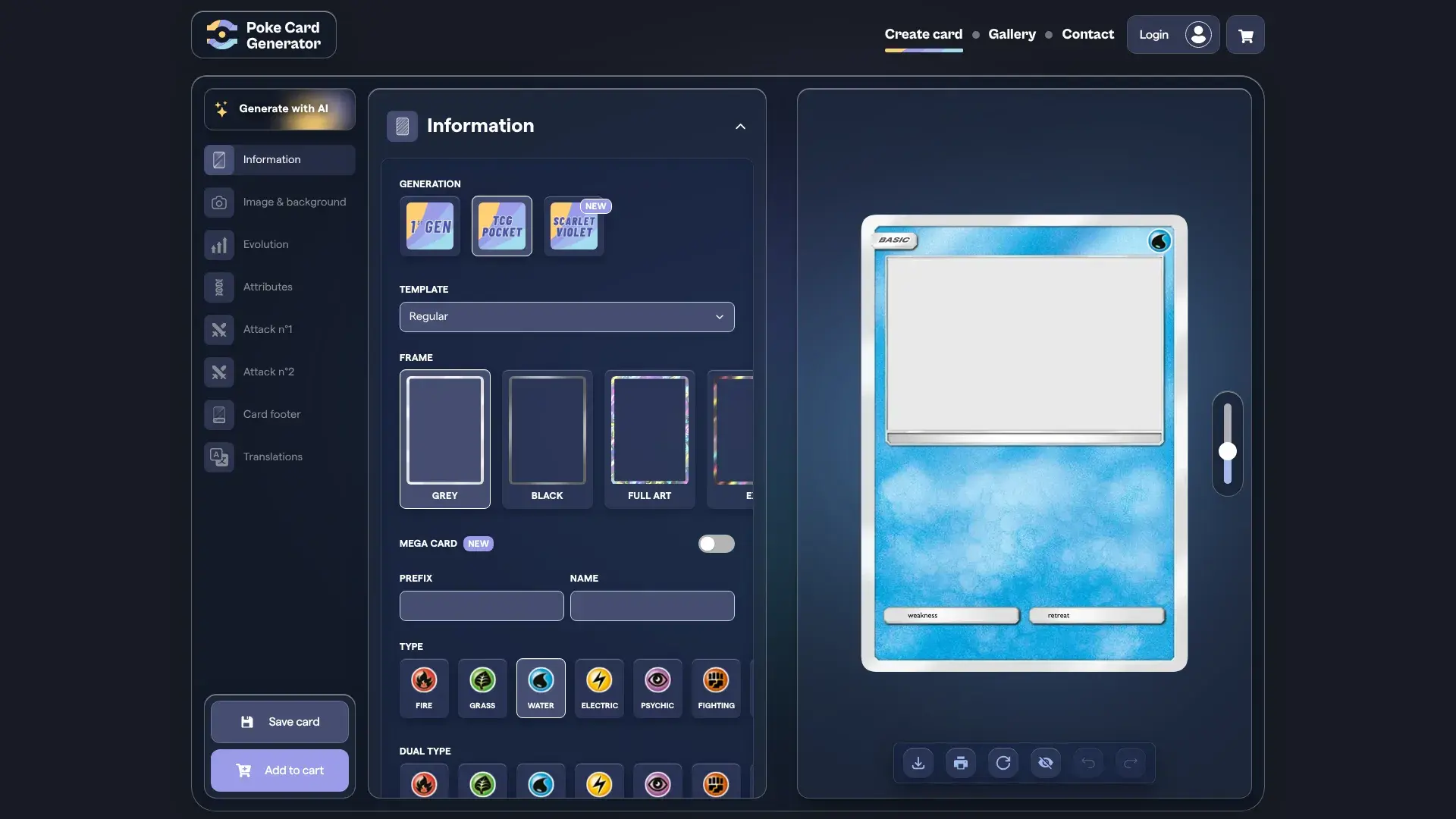
The tools for making the card itself are good. Cardmaker.net offers frame types from Effect and Xyz to Synchro, Link, and Token. YGOPRO's card maker supports Pendulum, Link, and Rush templates. Perchance generates whole cards from a text description. In template-based makers, though, the effect is just a free-text box. The tool renders whatever you type.
But writing effects that actually work is difficult:
- Wording drift. Each game has its own grammar. In Yu-Gi-Oh!, for example, phrasing like "When… you can" can behave differently from "If… you can." Small wording choices change how a card resolves.
- Power creep and dead cards. Without a cost-to-power framework, homebrew cards tend to be either broken or unplayable.
- Hidden interactions. As the Game Developer set design guide notes, "each card you design puts certain limits on every other card."
- Slow iteration. Design is cyclical. You playtest, revise, and refill gaps, and rewriting dozens of effects by hand takes a long time.
Balance Is a Curve, Not a Feeling
Experienced designers price effects against a consistent cost curve. This GDC talk breaks down cost/power ratios, power curve terminology, and why Pokémon and Magic structure costs differently:
https://www.youtube.com/watch?v=ul1MSQ8aW00
Ludocards' guide to card game mechanics makes a similar point about deck-builders: balance comes from how starting decks, available cards, and victory conditions relate to each other, not from any one card in isolation.
Why Trading Card Game Creator Works as a Card Effect Generator
This is exactly what Trading Card Game Creator was built for. It works as a full TCG design studio. You describe a card, an archetype, or a whole set, and it returns effect text, mechanics, balance reasoning, lore, and art. It is meant for designers who care whether the card plays well, not just whether it looks finished.
| Traditional Approach | Trading Card Game Creator |
|---|---|
| Type effects into a blank template box | Generates effect text in your game's wording conventions |
| Guess at balance, then discover problems at the table | Reasons about cost, stats, and power relative to your curve |
| Track synergies in your head or a spreadsheet | Designs cards as part of an archetype or set structure |
| Commission or search for art separately | Produces card art and flavor that match the mechanics |
| Rewrite every card by hand after each playtest | Revises effects quickly based on your playtest notes |
Effect Text That Follows Real Templating
Here is a fan-made card built in a template-based Yu-Gi-Oh! generator:
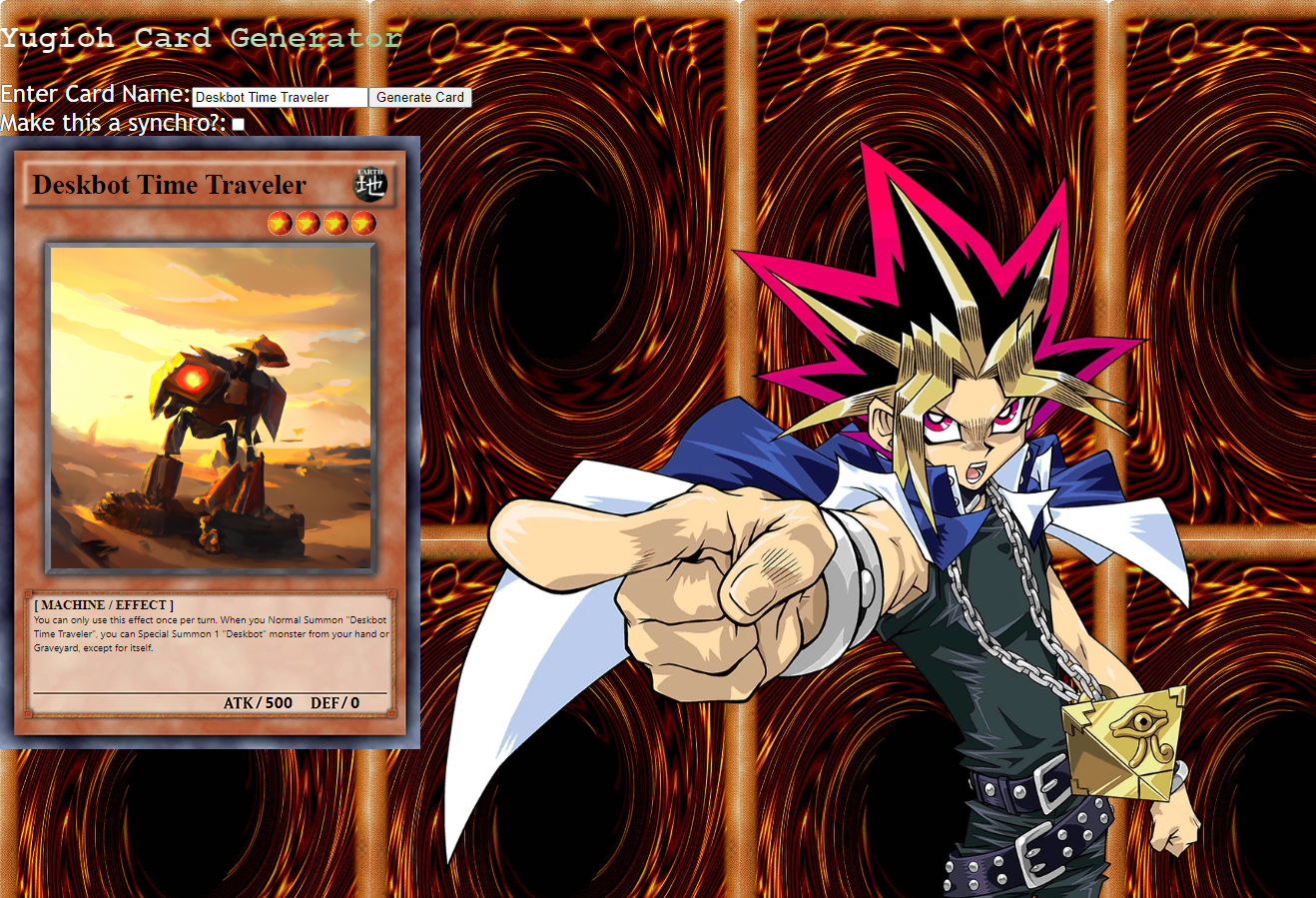
The effect reads: "You can only use this effect once per turn. When you Normal Summon 'Deskbot Time Traveler', you can Special Summon 1 'Deskbot' monster from your hand or Graveyard, except for itself."
The concept is solid: a low-stat Level 4 starter that calls in another archetype member. The wording has three problems:
- It uses "When… you can" phrasing, which in Yu-Gi-Oh! can cause an optional trigger to miss timing.
- It uses "except for itself" instead of naming the card.
- It places the once-per-turn clause first instead of at the end.
A rules-aware rewrite looks like this:
"If this card is Normal Summoned: You can Special Summon 1 'Deskbot' monster from your hand or GY, except 'Deskbot Time Traveler'. You can only use this effect of 'Deskbot Time Traveler' once per turn."
A good card effect generator also asks the balance question. A free summon from the hand or GY is a strong extender. Depending on how many Deskbots exist, you might restrict the summoned monster to Defense Position or lock you into Machine monsters for the rest of the turn.
Mechanics and Keyword Design
You can go beyond single cards and design a new keyword, such as a resource counter, a graveyard mechanic, or a summoning condition. The agent then spreads that keyword across your card pool at the right density so players can build a deck around it.
Set Structure and Archetypes
The agent can build a set skeleton: rarity slots, card type ratios, faction or color balance, and signpost cards for each archetype. This follows the constrained-first approach professional designers use.
Lore and Card Art
Flavor text, world-building, and card illustrations come from the same conversation that produced the mechanics. A card called "Time Traveler" can then look and play like one.
Example prompts:
"Write 5 effects for a Level 4 Machine archetype called Deskbot that rewards swarming the field, using modern Yu-Gi-Oh! wording."
"Here's my homebrew mana curve. Is a 3-cost creature with 4 power and 'draw a card on attack' too strong for a common?"
"Design a new keyword for a graveyard-themed faction and show it on 3 commons, 2 uncommons, and 1 rare."
Related Agents You'll Also Find Useful
If your card project grows into a full game, these agents cover the next steps.
Use it when you need help with the broader game: turn structure, win conditions, documentation, and systems analysis outside the card pool.
- Brainstorming and systems analysis across genres
- Game design documentation
- Concept art generation
Use it when your monsters or champions need personalities and backstories as distinct as their effects.
- Quick or guided character builds
- Research into existing media for reference
- Character portraits in many art styles
Use it when your set's lore is ready to become story content, such as set intros, faction histories, or companion fiction.
- Deep research for consistent fictional worlds
- Editorial feedback on drafts
- Polished prose from outline to manuscript
Try it free. No credit card required.
How to Generate TCG Card Effects With AI
Step 1: Set the Rules Context
Tell the agent which game's conventions to follow, or describe your own game's resource system. This decides the effect grammar, including how costs, triggers, and restrictions are written.
"Use Pokémon TCG wording. My Pokémon use energy costs, and attacks deal damage in multiples of 10."
Step 2: Describe the Card's Role
Explain what the card should do in a deck, not just what it is. Roles like "starter," "removal," "finisher," or "searcher" give the generator a clear design goal.
"I need a 2-energy Water attacker for my homebrew set that punishes opponents who bench too many Pokémon."
Step 3: Review the Effect and Balance Notes
Read the generated effect alongside its reasoning about cost, stats, and interactions. Ask for weaker and stronger versions so you can compare options.
"Give me three versions of this effect: underpowered, fair, and slightly pushed. Explain what changed."
Step 4: Test Against Your Existing Cards
Paste in the cards you already have and ask about combos, loops, or redundancies. This is where most homebrew problems show up.
"Here are my 12 Deskbot cards. Is there any infinite loop or one-card combo I'm missing?"
Step 5: Add Flavor and Art, Then Export
Once the mechanics are settled, generate flavor text and art, then move everything into the card template tool you prefer for the final render.
"Write 1-line flavor text and generate desert-sunset card art for Deskbot Time Traveler."
Results and Use Cases
🃏 Fan-Made Archetype for a Homebrew Format
Scenario: A Yu-Gi-Oh! fan wants to design a 15-card Machine archetype for a Discord homebrew league.
Traditional Approach: Write each effect by hand, post them for community feedback, and wait days for wording corrections and balance complaints.
With an AI TCG design studio: The archetype arrives with consistent wording, a clear game plan, and notes on which cards are likely to be limited.
- Consistent wording across all 15 cards
- Balance issues flagged before the community sees them
- Faster revisions after each round of feedback
🎲 Indie Designer Prototyping an Original TCG
Scenario: A solo designer has a world concept and needs a playable 60-card starter set for local playtests.
Traditional Approach: Weeks of spreadsheet work to build a set skeleton, followed by manual card writing and printing prototypes.
With an AI TCG design studio: The designer gets a structured skeleton, faction-balanced cards, and art briefs. Faction leaders can then be developed further with Character Creator.
- Rarity and type distribution planned up front
- Mechanics tied to the world's themes
- Character art and lore that match each faction
📱 Post-Playtest Revisions on Mobile
Scenario: After a game-store playtest, a designer dictates notes on their phone during the ride home: "Card 7 is too strong, card 12 never got played."
Traditional Approach: Scribble notes, forget half of them, and rewrite cards at a desk days later.
With an AI TCG design studio: Speech-to-text captures the notes, and revised effects are ready before the designer gets home. Settings and conversations sync across iOS, Android, and web.
- Revisions made while the playtest is still fresh
- Full feature parity on mobile
- Design history saved across sessions
Frequently Asked Questions
Is there a free TCG card effect generator?
Yes. Trading Card Game Creator includes all core features on a free tier with limited monthly usage. Paid plans start at $20/month for higher limits. Template-based card makers are also often free, but they only render the effect text you type. They don't write it or check it.
Can AI write Yu-Gi-Oh! card effects that follow official wording?
AI can closely follow the established conventions: colon-separated triggers, semicolon-separated costs, "If… you can" phrasing, and once-per-turn clauses placed at the end. For competitive homebrew formats, community review is still worth doing. An AI-drafted first pass removes most wording errors before anyone else reads the card.
How is an AI effect generator different from a card maker template?
Card maker templates handle the visuals: frames, attributes, levels, and fonts. An AI card effect generator handles the design: what the card does, how it's worded, and whether it's balanced. Most designers use both. They generate and refine effects with AI, then render the final card in a template tool.
Can AI help balance custom TCG cards?
Yes. AI can compare a card's cost and stats against the rest of your pool, spot loops and one-card combos, and suggest adjustments. For balance questions that involve your whole game, such as turn structure, resource systems, and win conditions, Game Designer Assistant handles systems-level analysis. Playtesting is still the final test.
Does the card effect generator work on mobile?
Yes. The agent has full feature parity across web, iOS, and Android, with speech-to-text for dictating card ideas or playtest notes. Conversations and design history sync across devices, so you can start a set on your laptop and revise it on your phone.
Conclusion
Making a custom card look official is easy now, because template makers handle frames, fonts, and attributes well. Writing effects that are clearly worded, fairly costed, and consistent with the rest of your set has always been the bottleneck. An AI TCG card effect generator addresses that bottleneck directly, whether you're writing a fan archetype, building an original game, or revising cards after a playtest.
Your card pool will be stronger when every effect is drafted with rules wording and balance in mind from the start. Try Trading Card Game Creator now to turn your next card idea into playable text. Explore more at Jenova.
For Developers: Trading Card Game Creator is available programmatically via the Jenova API. You can add AI card effect generation and TCG balance analysis to your game design tool or community platform with a single API call. Full documentation →