AI TCG Booster Pack Design: Wrapper Art, Print Specs & Mockups
2026-10-23
Graphic Designer helps you create TCG booster pack designs, from first wrapper concept to a mockup you can bring to a printer. You describe your game, set theme, and card size, and it produces key art directions, layout systems, and set variants. As of October 2026, indie creators have more ways than ever to print packs, but many still lack design support. This AI fills that gap with branding, illustration, and print-design guidance in one conversation.
- ✅ Generates wrapper concepts, key art directions, and multi-variant set designs from a plain-language brief
- ✅ Covers front panels, back panels, logo lockups, and shelf hierarchy
- ✅ Applies print fundamentals such as safe zones, bleed, and color mode before you contact a manufacturer
- ✅ Works the same on web, iOS, and Android
A booster pack wrapper is small, but it does a lot of work. It has to sell the set, show the game's identity, survive the crimping process, and meet labeling requirements. To see why this is harder than it looks, let's look at what indie TCG creators run into today.
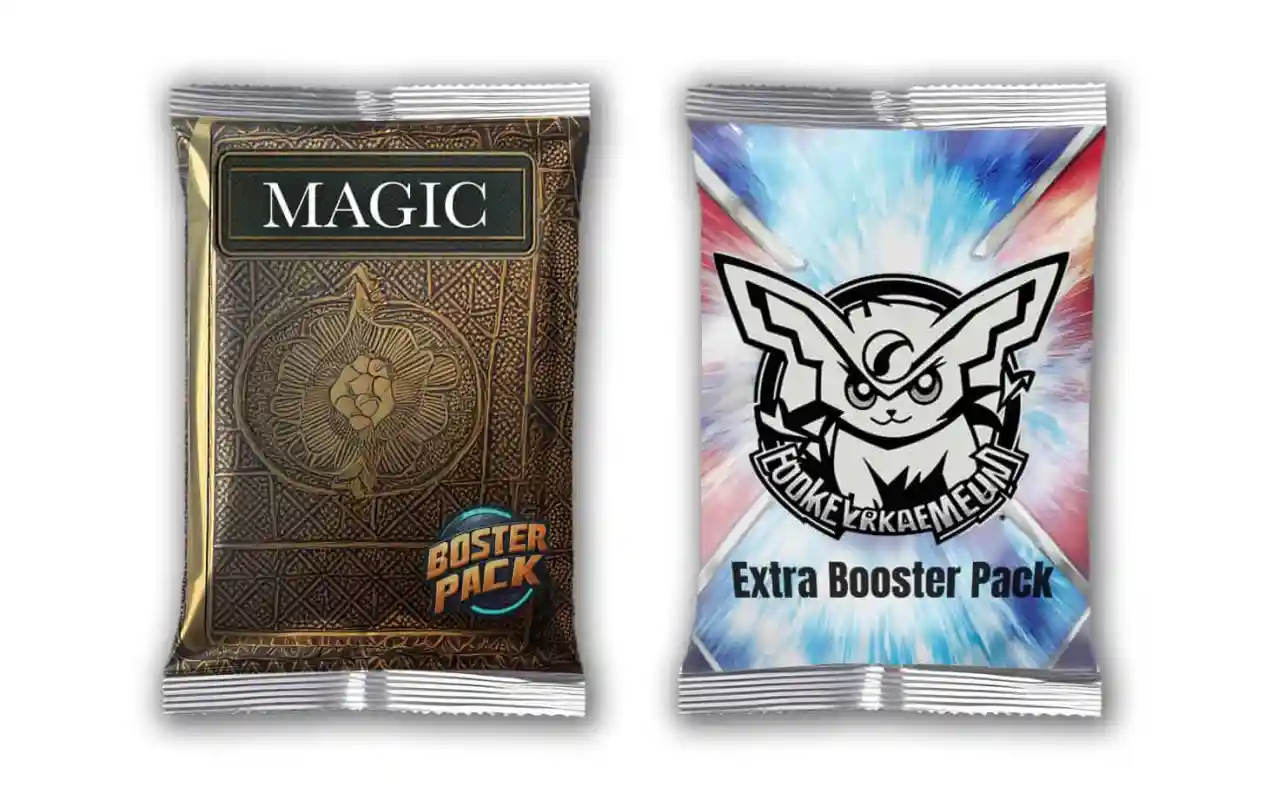
Quick Answer: What Is AI TCG Booster Pack Design?
AI TCG booster pack design is the use of an AI design partner to create the wrapper artwork, layout, and set variants for trading card packs, turning a written brief into shelf-ready concepts in minutes instead of weeks. The final files still need to match your printer's template.
Key capabilities:
- Key art and illustration concepts tailored to your game's world and genre
- Front-panel hierarchy that includes game logo, set name, card count, and art
- Back-panel planning for game info, barcode area, and country-of-origin marking
- Multi-wrapper variant systems for a single set, such as one wrapper per element or faction
The Problem: Booster Pack Design Sits Between Art, Branding, and Manufacturing
The TCG market is large and still growing, and new releases keep drawing players into the hobby. For indie creators, that means a crowded shelf where packaging often decides whether someone picks up a pack.
**$7.8 billion** — [Global TCG market value in 2024, projected to reach $11.8 billion by 2030 at a 7.4% CAGR](https://www.bccresearch.com/market-research/information-technology/trading-card-game-market.html)
60.78% — Share of the TCG market held by character cards in 2025
Since the market is driven by characters, character-led key art is a sensible default for wrappers. Getting from that idea to a printable pack is the hard part:
- Production economics shape the design. PrintNinja notes that printing directly on foil packaging requires minimums around 20,000 units because of setup costs, and that randomized packs can run somewhere in the $100,000 range. Your design has to fit whichever route you can afford: full-print foil, labels, or print-on-demand.
- Material choice affects both design and sustainability. Under the APR Design Guide, packages containing aluminum foil are classified as non-recyclable, and dark colors are rated detrimental to film recycling. Some print-on-demand services now offer a recyclable paper booster pack option alongside traditional foil.
- Prepress is not intuitive. Designers regularly ask how to handle dieline, bleed, color mode, and overprint settings for packaging. Booster wrappers add crimp seals and a back fin seal to that list.
- Compliance details get forgotten. Packaged games must show a visible country-of-origin marking on the outside packaging, and that space has to be planned into the back panel.
Most indie creators handle the game design themselves and then reach the packaging stage with no budget for a packaging agency. This is exactly what Graphic Designer was built for.
Why Graphic Designer for TCG Booster Pack Design
Graphic Designer is a creative design partner with expertise across branding, print, and illustration. Booster packs require all three. You don't need to brief an illustrator, a brand designer, and a packaging specialist separately. You work with one AI that understands how the wrapper art, the logo system, and the print constraints affect each other.
| Traditional Approach | Graphic Designer |
|---|---|
| Hire an illustrator and a packaging designer separately | One partner covers key art, branding, and layout |
| Weeks of revision rounds over email | Iterate on wrapper concepts in a single conversation |
| Prepress knowledge assumed or learned the hard way | Bleed, safe zones, and color mode raised before you print |
| Variant wrappers priced per design | Explore an entire set's variant system quickly |
| Design reviewed only at full size | Concepts checked for shelf and thumbnail readability |
Key Art That Fits the Set
Good booster art sells the set's theme in under a second. The AI produces illustration directions based on your world, such as elemental factions, gothic horror, or sci-fi mechs. It also composes them for a tall, narrow pack format, where a focal character has to stay clear of the crimped top and bottom edges.
"Design three booster wrapper concepts for my fantasy TCG set 'Ember Tide'—fire, storm, and earth factions, each with a hero creature as the focal point"
Front-Panel Hierarchy
A strong front panel has a clear reading order: game logo, then set name, then card count, then the art. The AI builds that hierarchy and keeps type legible against busy artwork. This matters most for the "10 Card Booster Pack" style callout, which shoppers look for.
Back Panel and Compliance Planning
The back panel holds the less exciting but required content: game description, age guidance, manufacturer details, barcode zone, and country of origin. The AI lays these out so they don't collide with the vertical fin seal that runs down the back of most flexible packs.
"Lay out the back panel for a 2.5 x 3.5 inch card booster pack: short set description, 'Made in USA,' barcode area, publisher logo, and website"
Production-Aware Choices
Your design depends on how you print. Graphic Designer can adapt the same concept for full-print foil, a printed label on a blank pack, or a paper wrapper. When recyclability is a goal, it can steer palettes toward lighter colors, in line with the APR guidance favoring natural, white, and light-colored film.
A realistic limitation: the agent gives you concepts, layouts, and prepress guidance. Your manufacturer's dieline template is still the final authority on dimensions, seal zones, and file specs. Always place your final art into their template before ordering.
Related Agents You'll Also Find Useful
A booster pack is one part of a larger brand. These agents cover the related steps.
Brand Kit Generator
If your game doesn't have a defined visual identity yet, start here before designing packs. It builds a consistent system that keeps your boosters, starter decks, and playmats looking like one product line.
- Color palettes and typography pairings
- Complete brand guidelines
- Logo direction within a cohesive system
Logo Generator
The game logo is the most repeated element on every wrapper. If you're also refining your title treatment, Logo Generator matches style to genre, whether you want ornate fantasy lettering or clean sci-fi type.
- Style matching across many aesthetics
- Logo options built to scale down for small surfaces
- Brand identity strategy behind the mark
Product Photo Editor
After your packs are printed, you'll need listing images for your store, crowdfunding page, or marketplace. Product Photo Editor handles retouching, backgrounds, and lifestyle compositing.
- Background editing and color correction
- Lifestyle scene compositing
- Formatting for e-commerce listings
Try Graphic Designer free. The Free tier includes all core features, so you can test your first wrapper concept before deciding on a plan.
How to Design a TCG Booster Pack with AI
Step 1: Write the Set Brief
Give the AI your game name, set name, card count per pack, card size, and print route. Standard booster size is poker size, 2.5″ × 3.5″, but print-on-demand services support a range of card sizes from 1.75″ × 3.5″ upward.
"My TCG 'Hollow Crown' uses 63x88mm cards, 10 cards per pack, print-on-demand foil. Gothic fantasy, three noble houses."
Step 2: Generate Wrapper Concepts
Try Graphic Designer with your brief and ask for several directions. Compare different approaches, such as a full-bleed illustration or an ornamental frame, before choosing one.
"Give me three wrapper directions: one full-bleed character art, one ornate border with a central emblem, one minimalist with a bold color field"
Step 3: Build the Variant System
Many sets use several wrapper arts that share a template, such as one per faction or element. Keep the logo position, set name, and card-count callout identical across variants so they read as one set on the shelf.
"Create matching wrapper variants for all three houses—same logo placement and type, different hero art and accent color"
Step 4: Test Readability and Mock It Up
Review each concept at actual pack size and as a small thumbnail, since many sales now happen through online listings. Then ask for a mockup that shows the pack in context.
"Show this wrapper as a realistic sealed booster mockup on a wooden table, front and back"
Step 5: Prepare for Your Printer
Download your printer's template and ask the AI to walk through a prepress checklist covering dielines, CMYK, bleed, resolution, and file setup. Then place your final art into the manufacturer's file.
"Give me a prepress checklist for a foil booster wrapper—what should I keep out of the crimp and fin-seal areas?"
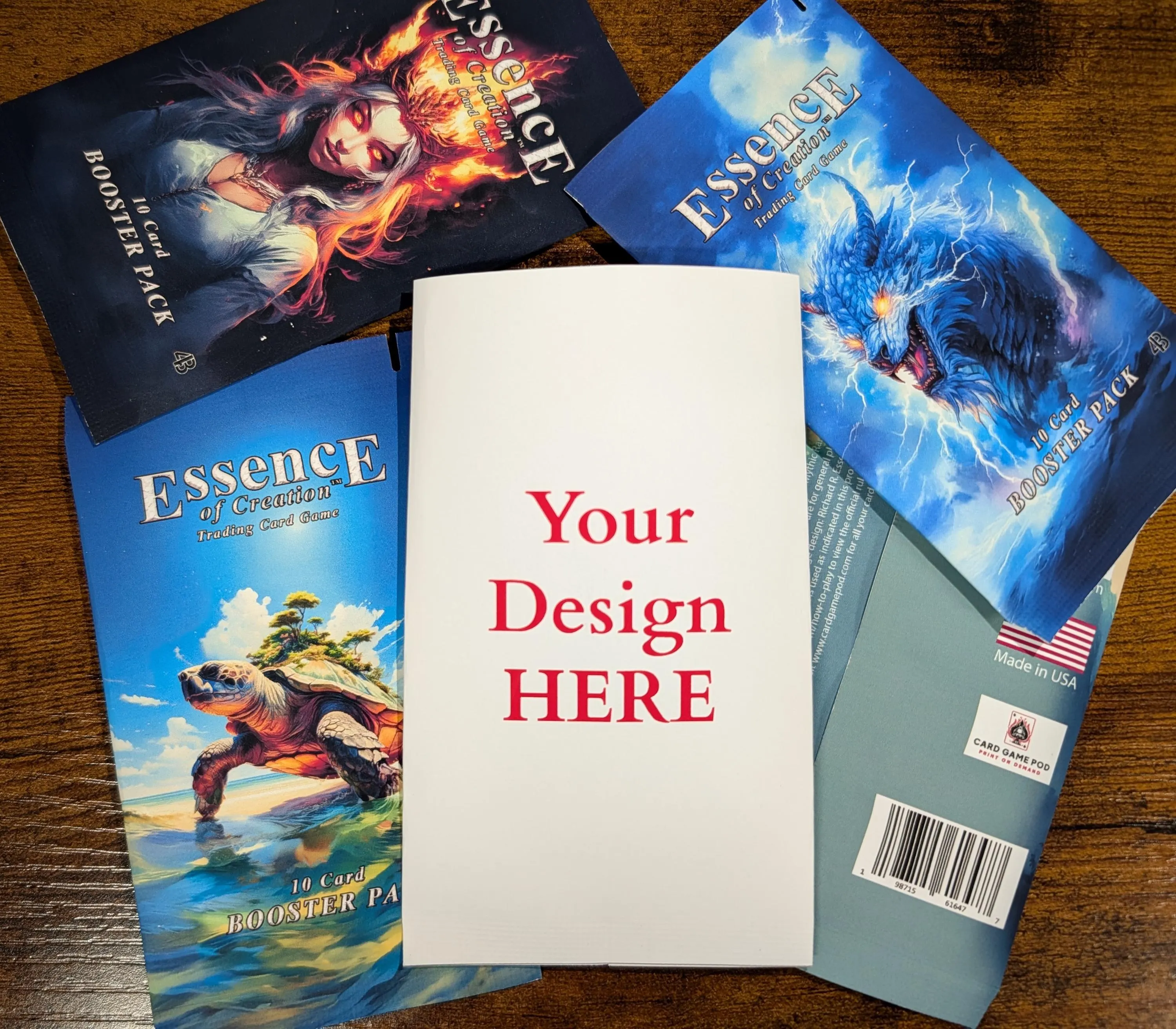
The image above shows the variant system in practice. The three elemental artworks share one type treatment, and the back panel holds the barcode, "Made in USA" marking, and manufacturer logo.
Results & Use Cases
🎲 Indie Creator Preparing a Crowdfunding Launch
Scenario: A solo designer needs booster art for a campaign page before any packs are printed.
Traditional Approach: Commissioning wrapper illustration and layout separately can take weeks, and changes during the campaign are expensive.
AI-Assisted Approach: Graphic Designer produces several wrapper directions and realistic mockups for the campaign page. Backers can vote on their favorite variant.
- Campaign visuals ready before the print order
- Variants can be tested with the community
- Brand stays consistent when paired with Brand Kit Generator
🏪 Game Store Creating Custom Event Packs
Scenario: A local store wants branded "prerelease" packs for a homebrew draft night.
Traditional Approach: Generic blank packs, or none at all, because a small run doesn't justify agency fees.
AI-Assisted Approach: The store designs a wrapper with its logo and event name, then prints a small run through a service with no minimum order required.
- Professional-looking event merchandise
- Store branding refined with Logo Generator
- Reusable template for future events
📱 Revising a Wrapper on Your Phone at a Convention
Scenario: At a convention, playtesters say your set name is hard to read from across the table.
Traditional Approach: Write it down, wait until you're home, and email your designer.
AI-Assisted Approach: Open the mobile app, upload the current wrapper, and ask for a higher-contrast set name. You can review the revision before the show floor closes.
- Full feature parity between mobile and desktop
- Feedback addressed while it's still fresh
- Revised mockups ready to show testers the same day
🌿 Studio Moving Toward Lower-Impact Packaging
Scenario: A studio wants to reduce foil use on its next expansion.
Traditional Approach: Redesign from scratch around a new material with uncertain results.
AI-Assisted Approach: The AI adapts existing art for a paper wrapper or lighter palette, and flags metallic effects that may require recyclability testing under APR guidance.
- Visual identity kept across material change
- Palette choices informed by recycling guidance
- Launch imagery polished with Product Photo Editor
Frequently Asked Questions
What size is a standard TCG booster pack?
Booster packs are sized to the cards inside. The most common card size is poker size, 2.5″ × 3.5″, which PrintNinja describes as the standard size for booster packs. Print-on-demand services also support other card sizes, including 63 × 88 mm and 2.25″ × 3.5″. Always design the wrapper using your manufacturer's template for your exact card size.
How many cards should a booster pack hold?
Booster packs usually contain anywhere from 1 to 20 cards, depending on the game. Some print-on-demand foil packs hold up to 18 cards. Ten-card packs are a common choice for indie games. Display the card count clearly on the front panel, because buyers look for it.
Should I use foil or paper booster packs?
Foil gives the classic look and feel, but the APR Design Guide classifies aluminum foil packaging as non-recyclable. Paper wrappers are a more recyclable option offered by some print-on-demand services. Your design should suit the material: metallic accents work well on foil, while matte illustrations often print better on paper.
Can AI create original booster art without copying major brands?
Yes, if you give it an original brief. Describe your own world, factions, and visual references rather than naming existing franchises, and avoid imitating the trade dress of established games. Building your identity first with Brand Kit Generator gives the AI a distinct visual system to work from.
Is AI booster pack design free on Jenova?
Jenova's Free tier includes all core features with limited usage, which is enough to explore initial wrapper concepts. Paid plans start at $20/month for Plus, which adds 30× usage, custom model selection, and no watermarks. Usage resets monthly with no daily caps.
Conclusion
TCG booster pack design involves illustration, branding, prepress, and compliance, all on a small surface that has to stand out in a growing market. Most indie creators don't have the budget to hire specialists for each of those areas.
An AI design partner makes this manageable. You can move from a set brief to wrapper concepts, variant systems, back-panel layouts, and mockups in one workflow, then hand clean artwork to your printer. Whether you're designing custom booster packs for a crowdfunding launch, a store event, or a full expansion, the process gets faster and less expensive.
Try Graphic Designer now to start your first wrapper concept. Explore more at Jenova.
For Developers: Graphic Designer is available programmatically via the Jenova API. You can integrate AI packaging and print design into your card-game or print-on-demand application with a single API call. Full documentation →