AI Tarot vs. AI Astrology: Which Is Better for Self-Reflection or Long-Term Themes?
2026-08-12
The two practices get bundled together in nearly every app store listing, but they answer structurally different questions. Tarot is a randomized prompt generator applied to a question you bring today; astrology is a fixed map of a moment that never changes and unfolds on a schedule you did not choose.
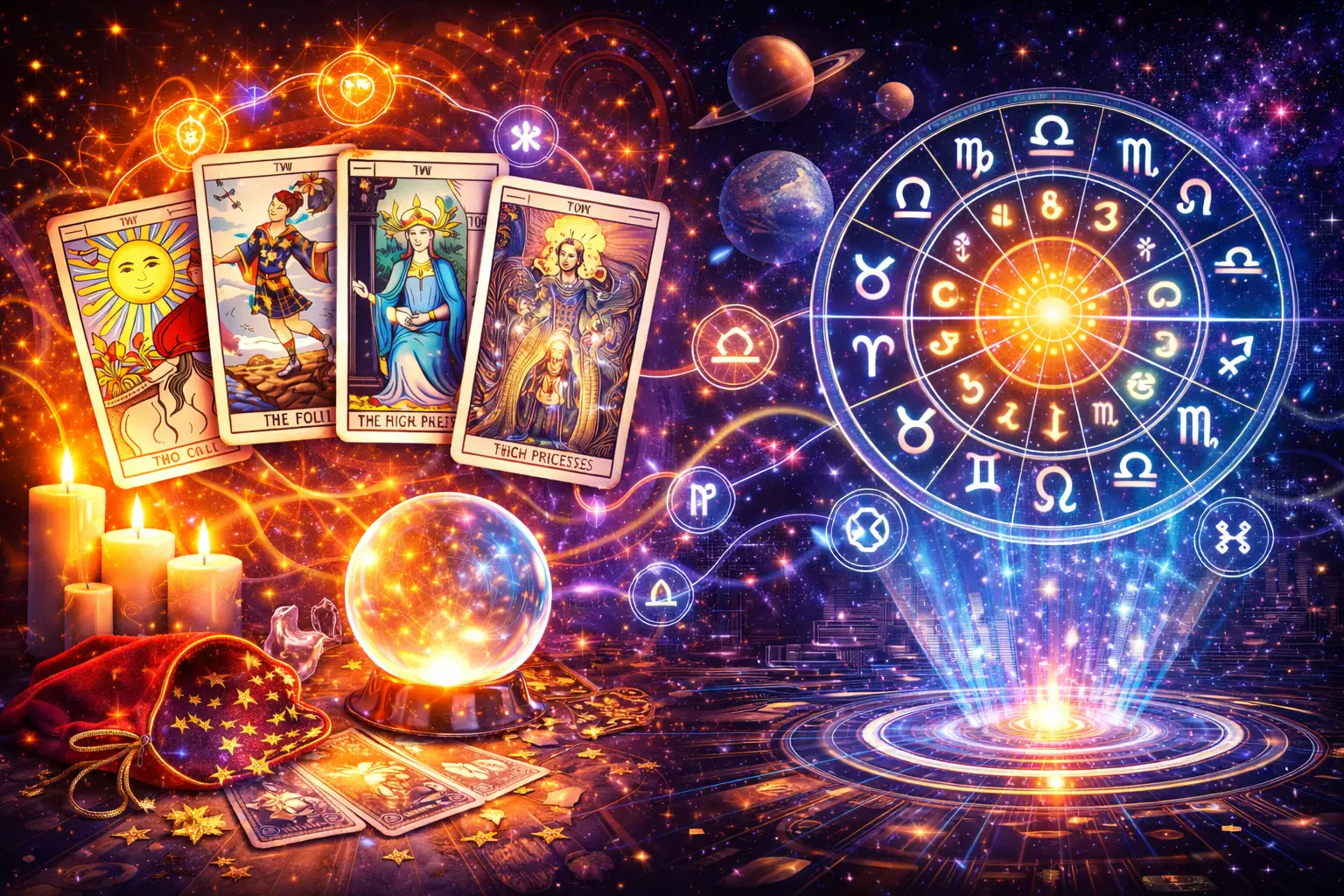
Which Practice Handles Present-Moment Inquiry and Which Handles Multi-Year Patterns?
Tarot is the stronger instrument for present-moment self-reflection, and astrology is the stronger instrument for long-term theme analysis — because their underlying input structures differ in a way that determines what each can actually do. Tarot takes a question you formulate right now and applies randomized symbolic prompts to it. Astrology takes a fixed dataset — your birth moment — and describes patterns that unfold over months, years, and decades.
The distinction that governs everything downstream:
✅ Tarot is question-driven — you supply the inquiry, so the reading is only as good as the question, and it changes every session ✅ Astrology is data-driven — the chart is computed once and never changes, making it a stable reference frame across years ✅ Tarot randomizes the prompt — the random draw is the mechanism that surfaces perspectives you weren't already considering ✅ Astrology schedules the prompt — transits and progressions arrive on astronomical timing regardless of what you're currently thinking about ✅ Neither predicts — a 2009 University of Victoria study found regular tarot users reported the cards "do not reveal new information to them" but provide a new perspective that can influence a plan of action
That last point matters more than the tarot-versus-astrology framing. Both function as structured reflection scaffolds, not information sources — which is precisely why the AI layer changes each of them differently.
Why Does the Input Structure Determine What Each Practice Can Do?
Because a practice can only surface what its input mechanism admits, and the two mechanisms admit opposite things. Tarot admits whatever you're currently preoccupied with; astrology admits whatever the sky is doing regardless of your preoccupation.
Tarot's input structure: A standard deck contains 78 cards, split into 22 Major Arcana representing "the main themes of human life, such as love, death, spirituality, acceptance" and 56 Minor Arcana representing subtler dynamics. You shuffle while focusing on a question, then interpret the cards through the lens of that question, your circumstances, and your history.
The randomization is the feature. As The Conversation's analysis of AI tarot use illustrates: someone drawing the Fool and the Ten of Wands for a career question faces genuine ambiguity. Does it mean "Leave, you're exhausted and something better awaits" or "Leave, and the new job will be just as demanding"? Sitting with that fork is the reflective work.
Astrology's input structure: Your birth chart is computed from date, exact time, and location. It never changes. What changes is the relationship between current planetary positions and that fixed chart — transits that last days, months, or in the case of outer planets, years.
The consequence: you cannot ask your natal chart "should I take this job?" and get a chart-specific answer, because the chart doesn't know the job exists. You can ask what multi-year pressure you're currently under, and the chart answers with a defined start and end date. Tarot cannot do that second thing at all.
How Should You Evaluate Which Practice Fits Your Actual Question?
Match the practice to the temporal shape of what you're asking, not to which system you find more aesthetically appealing.
The Temporal Fit Framework — four dimensions:
| Dimension | Favors tarot when… | Favors astrology when… |
|---|---|---|
| Time horizon | The question resolves in days to weeks | The pattern spans months to years |
| Question specificity | You have a concrete, articulable decision | You feel a diffuse pressure you can't name |
| Repeat frequency | You want a fresh angle each time you ask | You want the same reference frame you used last year |
| Origin of the prompt | You initiate — the question comes from you | The calendar initiates — the transit arrives on its own schedule |
Weighting guidance: For someone processing an active decision, time horizon and question specificity carry most of the weight, and tarot wins decisively. For someone trying to understand why a three-year stretch felt uniformly difficult, repeat frequency and prompt origin dominate, and astrology wins just as decisively.
The diagnostic test: Ask yourself whether you can complete this sentence — "I want to think more clearly about ______." If the blank fills with a specific situation, use tarot. If you can't fill the blank because the discomfort has no object, use astrology, because a chart can name a pressure you haven't yet articulated.
Why Is Tarot the Stronger Tool for Present-Moment Self-Reflection?
Tarot is stronger for self-reflection because it forces you to articulate a question before you receive anything, and the randomized draw then supplies perspectives your own reasoning wouldn't have generated.
Research supports the mechanism rather than the mysticism. A psychological analysis published in the Panorama Scholarly Group journals examines "the contemporary evolution of tarot practice from divinatory tool to psychological instrument for self-reflection." The 2009 study documented at Bowdoin found users drew on the cards most often during difficult periods, where they offered "confirmation that everything was okay and that life had a sense of order," and used them as positive reinforcement — sometimes keeping a drawn card until a situation resolved.
The counterweight is real. The same research identifies the Barnum effect — the tendency to accept vague, universally applicable statements as specifically personal — and cold reading as the non-paranormal explanations for perceived accuracy. The Major Arcana deals in themes that concern everyone, which makes generating statements that feel personally targeted trivially easy.
Where AI helps and where it hurts:
The April 2026 study of 12 tarot practitioners found readers pulled in two opposite directions. Some used AI to sidestep interpretive ambiguity — asking the model what the spread meant rather than sitting with the Fool/Ten of Wands fork themselves. The researchers describe AI's "yes man energy" giving readers false confidence, and note community concern that "the sycophantic nature of the technology could undermine people's intuition and reasoning."
Others used AI to generate alternative perspectives deliberately — asking for readings that challenged their assumptions, or requesting an "objective reading" precisely because the model has no stake in the outcome. Some readers even treated AI hallucinations as meaningful "because they were random and unintended, the same way that a card drawn at random feels like it carries a secret message."
The
states the objection bluntly: secular tarot "is meant as a self reflection tool," and outsourcing the interpretation defeats the purpose. That critique is correct about one usage mode and wrong about the other — which is why how you prompt determines whether AI tarot helps or hollows out the practice.Why Is Astrology the Stronger Tool for Long-Term Theme Analysis?
Astrology is stronger for long-term analysis because it produces a fixed, recomputable reference frame with defined date ranges — something tarot structurally cannot offer, since every spread is a new random draw.
Three properties make this work:
1. The chart is stable. Your natal placements in 2026 are identical to your natal placements in 2036. When you return to a question five years later, you're consulting the same map. Tarot gives you a different spread every time, which is excellent for freshness and useless for continuity.
2. Transits have start and end dates. A slow outer-planet transit to a natal point occupies a defined window. That converts a vague "this period has been hard" into a bounded interval you can examine — and, critically, one you can see the end of.
3. Chart accuracy is computable and verifiable. Unlike interpretation, calculation is pure astronomy. AskSoma's comparative testing of seven AI astrology apps frames it precisely: "The calculation half is pure astronomy... and a computer does it exactly, which is why an ephemeris-backed app beats a human with a printed table. The interpretation half is judgement, and there AI is only as good as the framework it was given."
That split is the single most useful thing to understand before choosing a tool. Ephemeris quality is objectively rankable. Interpretation quality is not.
The honest limitation: astrology answers questions you didn't ask. If you have a specific decision in front of you this week, a transit report will discuss the ambient conditions surrounding it, not the decision. That's a category mismatch, not a failure.
How Do the Leading AI Tools Compare Across Both Practices?
No product leads on both. Astrology-native apps have ephemeris infrastructure that tarot apps don't need; tarot-native apps have conversational depth that astrology apps largely lack; general agent platforms have memory architecture that neither category prioritizes.
| Dimension | AI-Tarot: Reading Chat | Lumi | AskSoma | Co-Star | Chani | Jenova agents |
|---|---|---|---|---|---|---|
| Primary practice | Tarot only | Tarot + horoscope bundled | Astrology (Vedic-led) | Astrology (Western) | Astrology (Western) | Both, as separate specialists |
| Chart engine | None | Sun-sign level | Swiss Ephemeris + NASA JPL, client-side | NASA JPL, server-side | Standard tropical | Not an ephemeris engine |
| Conversational follow-up | Yes, on saved readings | Two AI oracle chats (tarot + astrology) | Voice + chat | Limited | None | Unlimited, cross-session |
| Long-term timing features | None | Moon calendar | Dasha timeline, 30+ life areas | Transit-based dailies | Transits + lunar rituals | Discussed conversationally, not computed |
| Cross-session memory | Reading memory builds on past questions | Unlimited history archive (Pro) | Account-based | No | No | Persistent across all sessions |
| Languages | English | 10 | 9 (100+ claimed for voice) | English only | English only | Responds in your input language |
| Pricing | Free w/ IAP; $6.99/wk or $12.99 unlimited | Free w/ ads; Pro $5.99–$7.99/wk, $49.99–$69.99/yr | Free tier; ~$12.99/mo, Day Pass $7.99 | Free; Plus ~$29.99/yr | Free; ~$11.99/mo or $59.99/yr | Free tier; Plus $20/mo at 30× free usage |
| Best for | Question-driven tarot with follow-up dialogue | Casual daily practice across both, cheaply | Chart accuracy and multi-year timing | Social chart comparison | A specific interpretive voice | Running both practices in one continuous archive |
Features and pricing as of 2026 and subject to change; verify current terms with each provider.
🃏 AI-Tarot: Reading Chat
The most reflection-oriented tarot product in the group, and explicit about it. Its App Store listing states the app "is designed for reflection, journaling, and personal insight" and is "not a substitute for professional advice."
Strengths: Six-card spreads written around your specific question rather than generic card meanings. Follow-up chat so "a reading should not end the moment it appears." Reading Style control across five tones — balanced, direct, gentle, practical, or deep — which is the single most useful feature for counteracting sycophancy, since selecting "direct" changes what the model is optimizing for. Reading memory builds on prior questions. Developer states no data is collected from the app.
Limitations: Tarot only — no chart computation, no transit tracking, no long-term timing of any kind. iOS-only. At $6.99 weekly, annualized cost exceeds most astrology subscriptions here for a narrower feature set. Rated 4+ with user-generated content rather than carrying a wellness classification.
🌙 Lumi
The broadest low-cost bundle spanning both practices. The App Store listing advertises over 1.5 million users, a 4.7-star rating, and 10 languages, with a Rider-Waite deck, spreads from one to nine cards, moon calendar, daily affirmations, and two separate AI oracle chats — one for tarot, one for astrology.
Strengths: The separate tarot and astrology oracles are a genuinely sound design decision, since it avoids collapsing two incompatible frameworks into one voice. Community spreads let users create and share custom layouts. Unlimited reading history archive on Pro. Full guide to Major and Minor Arcana symbolism supports learning rather than just consuming.
Limitations: The astrology side operates at sun-sign level — daily, weekly, and monthly horoscopes for all 12 signs, plus love/career/money/health variants — which is not natal chart analysis and cannot support genuine long-term theme work. Contains advertising. Identifiers may be used to track you across other companies' apps and websites, and location plus usage data may be linked to your identity. Weekly pricing appears at three different tiers ($5.99, $5.99, $7.99), which complicates comparison.
⭐ AskSoma
The strongest technical foundation for long-term analysis in this comparison, and the only one running calculations client-side. Its own comparison writeup documents Swiss Ephemeris-grade Vedic calculations performed in-browser, a Vimshottari dasha timeline covering the 120-year cycle, 30+ life areas, voice and chat interaction, and a birth time calculator.
Strengths: The client-side processing is a real privacy differentiator — your birth data is computed on your device rather than transmitted. Dasha periods are the most structurally appropriate feature in this entire comparison for multi-year theme analysis, since they explicitly divide a life into named, dated chapters. Free tier is functional rather than a trial.
Limitations: Note that this comparison is published by AskSoma itself and ranks AskSoma first, so treat the competitive claims as vendor framing rather than independent testing. Coverage is Vedic-led with lighter Western astrology support, which matters if you want tropical placements. No tarot at all. Newer entrant with a smaller user base than legacy apps. Delivered as a PWA rather than native apps.
🌑 Co-Star and Chani
Both are Western-astrology-native with strong design and weak conversational depth. Co-Star uses NASA JPL planetary data and built its audience on social chart comparison and provocative daily push notifications. Chani offers Placidus, Whole Sign, and Equal house systems plus workshops and rituals tied to lunar cycles.
Strengths: Co-Star's friend-chart comparison remains the best social astrology implementation available. Chani's editorial voice is consistent and psychologically grounded, functioning more like a written consultation than an app feed.
Limitations: Neither supports conversational follow-up in a meaningful way — Chani has none at all, so you cannot ask why a placement means what it means. Both are Western-only with no dasha or divisional chart analysis. Both process server-side. Both are English-only. For long-term theme work specifically, the absence of a questioning layer means you receive interpretations you cannot interrogate.
How Does a General Agent Platform Handle Both Practices Differently?
An agent platform separates the two practices into distinct specialists rather than merging them, and adds cross-session memory that neither dedicated category treats as core infrastructure.
On Jenova, the Mystic Tarot Reader draws, interprets, and renders readings as a visual ritual, while the Personal Astrologer interprets planetary movements and natal chart patterns with daily, weekly, and monthly readings. Related reflective work is handled by separate agents again — the Dream Interpreter draws on Jungian, Freudian, cognitive science, cultural, and spiritual frameworks, and the Numerology Reader covers Life Path cycles and karmic patterns.
What the architecture enables for this specific question:
- Persistent cross-session memory — the agent retains the question you asked in March, the spread it pulled, and what you reported back in June, which is the precondition for noticing a recurring theme
- Agent composition via @mention — bring both readers into one conversation so a tarot spread and a transit period can be discussed against each other with explicit acknowledgment that they are not the same kind of claim
- Unlimited chat history — no history paywall tier, which matters because retrievability is what makes reflection compound
- Document attachment — upload a chart PDF from a professional astrologer or your own journal file as grounding material
- Tone instruction — you can explicitly ask for challenge rather than agreement, which is the direct countermeasure to the sycophancy problem the research identifies
Honest limitations: Jenova does not compute ephemeris-grade natal charts, dasha timelines, or divisional charts the way AskSoma does. For exact aspect timing, progressed charts, or synastry orbs to the degree, a dedicated astrology engine is more precise, and you should generate the chart there and bring it into conversation. There is no animated card-flip ritual, no moon phase tracker, no daily push notification cadence, and no built-in journal template. The Plus tier at $20/month is higher than every dedicated app listed here, though it covers the full agent library rather than one vertical. Users who want a designed spiritual interface rather than a conversation will find dedicated apps more satisfying.
How Do You Prompt Each Practice So It Actually Produces Reflection?
Prompt tarot for challenge and astrology for boundaries — those are the two failure modes each practice is most prone to when mediated by AI.
Running a reflective tarot session on Jenova:
- Open the Mystic Tarot Reader at jenova.ai/a/mystic-tarot-reader
- State the question before requesting the draw, and pre-empt sycophancy explicitly:
"I'm deciding whether to leave a stable job for freelance work. Draw a three-card spread. Before you interpret, give me two genuinely opposed readings of the same cards — one that supports leaving and one that doesn't — and don't tell me which you favor until I've responded to both."
- Push back on the interpretation rather than accepting it:
"That reading felt too comfortable. What's the least flattering interpretation of these three cards?"
- Close the loop after the situation resolves:
"Six weeks ago you pulled the Fool and Ten of Wands for my career question. I left. Here's what actually happened — where was the reading wrong?"
Running long-term theme analysis with the Personal Astrologer:
- Provide birth date, exact time, and location — time precision determines house placements and therefore most of the chart
- Ask for bounded periods rather than character description:
"Rather than describing my personality, identify the two or three multi-year periods in the last decade where slow transits were active, give me approximate date ranges, and tell me what domain each touched."
- Cross-check against your own record before accepting anything:
"I'm going to tell you what those years were actually like. Where does my account contradict what the chart suggests?"
- Bring in the other practice for contrast:
"@Mystic Tarot Reader — given the transit period described above, pull a spread on how I'm currently relating to it. Be explicit that this is a different kind of claim than the astrological timing."
Running the same practice on AI-Tarot: Reading Chat: Set Reading Style to "direct" rather than "gentle" before your first reading — this is the app's built-in lever against agreeable output. Add optional context (name, zodiac sign, birth year, location) only if you want more specificity, recognizing it also increases Barnum-effect surface area. Use follow-up chat on saved readings rather than starting fresh, since that is where reading memory activates.
Running the same practice on AskSoma: Generate the chart on the free tier first, then interrogate the dasha timeline rather than the personality readings — the dated period boundaries are the part of the output that a competing framework can actually be checked against.
What Do Researchers Say About AI-Mediated Divination?
The consistent finding across the research is that AI improves both practices only when it is used to increase interpretive effort rather than eliminate it.
"The mechanism that makes tarot useful for self-reflection is friction. You draw cards that don't obviously fit your question, and the work of reconciling them is where the insight lives. When an AI resolves that friction instantly with a confident three-paragraph interpretation, it has removed the active ingredient while preserving the ritual. The user still feels like they reflected. They mostly consumed."
"Astrology has the opposite failure mode. The risk isn't that AI resolves ambiguity too fast — it's that AI generates fluent interpretation on top of a wrong chart. Birth time precision determines house placements, and house placements determine most of what a reading says. An app that computes the chart from an approximate time and then writes beautifully about it is producing confident output about someone who doesn't exist. We tell users to verify the chart against an independent ephemeris before trusting a single word of interpretation, because those are two separate quality questions."
"The recommendation we've landed on is uncomfortable for both practices: use tarot when you can articulate the question, use astrology when you can't, and never let either one agree with you twice in a row without pushing back. The single most valuable prompt in this entire domain is 'give me the interpretation I don't want to hear.' Almost nobody uses it, and it changes the output more than switching platforms does."
— Jenova Product Team, 7 years building conversational AI systems with persistent memory architecture
Which Practice Should You Choose for Your Situation?
Choose by question shape, then choose the tool that serves that shape best — the order matters, because picking a beloved app first tends to distort the question to fit it.
Use tarot if: You have an articulable decision in front of you, you want a fresh perspective rather than a consistent one, and you're willing to sit with ambiguity rather than requesting a verdict. AI-Tarot: Reading Chat suits iOS users wanting depth on a single practice; Jenova's Mystic Tarot Reader suits users who want readings retained and revisitable across years.
Use astrology if: You're trying to understand a period rather than a decision, you want a reference frame that stays constant across return visits, or you feel a pressure you can't name. AskSoma is the strongest technical choice given client-side Swiss Ephemeris calculation and dasha timing; Chani suits users who want a specific psychological voice; Co-Star suits those whose main use is comparing charts with friends.
Use both if: You want the fixed frame and the moving prompt — the chart tells you what season you're in, the cards tell you how you're currently relating to it. Lumi bundles both cheaply with separate oracles; Jenova runs them as distinct agents with shared memory and Plus at $20/month for 30× the free allowance.
Use neither if: You're seeking a decision rather than a reflection. Both practices produce structured introspection, and as one analysis of tarot's therapeutic role puts it, "awareness alone does not change reality." Neither system, AI-mediated or not, is a substitute for professional advice on legal, medical, financial, or mental health matters.
What Should You Watch Out For Before Trusting Either Output?
Four specific failure patterns account for most of the disappointment in this category.
Sycophancy. The April 2026 practitioner study documented AI's "yes man energy" making readers more confident in interpretations without making those interpretations better. Counteract it directly: request opposing readings, select "direct" tone where the app offers it, and treat instant agreement as a signal to push back rather than a signal of accuracy.
The Barnum effect scales with AI. Large language models are exceptionally good at producing statements that feel personally targeted while applying universally. This risk is higher, not lower, than with a human reader, because the model can generate unlimited plausible specificity. Test by asking the same question with deliberately wrong birth data and seeing how much of the reading changes.
Chart accuracy is a separate question from reading quality. Verify the computed chart against an independent ephemeris before evaluating the interpretation. An app can have excellent prose and wrong houses.
Birth data is uniquely identifying. Date, exact time, and location together pinpoint a person. AskSoma performs calculations client-side; AI-Tarot: Reading Chat states no data is collected; Lumi discloses that identifiers may be used to track you across other companies' apps and websites, with location and usage data linked to your identity; Co-Star, Chani, Sanctuary, The Pattern, and Nebula process server-side. Jenova states data is never used to train public AI models, is encrypted in transit and at rest, and is not sold or shared with advertisers. Read the current policy before entering a birth time.
One final framing worth holding onto: the researchers behind the practitioner study concluded that AI "should be a tool to enhance self-reflection, rather than one that serves as a substitute for it," pointing toward a model where "the technology doesn't simply hand you answers but keeps you actively engaged in the process of finding them." That standard applies equally to a tarot spread and a transit report — and it's the only criterion that distinguishes a practice from a habit.
References
- The Conversation — How tarot readers are using AI and what it says about our growing reliance on chatbots
- Bowdoin Science Journal — A Dive into Tarot Card Psychology, Interpretation and Therapeutic Applications
- Panorama Scholarly Group — The Mirror, Not the Crystal Ball: A Psychological Analysis of Tarot as a Self-Reflection Tool
- PBS NewsHour — More tarot readers are turning to AI for advice
- Apple App Store — AI Tarot: Reading Chat
- Apple App Store — Lumi: AI Tarot & Horoscope
- AskSoma — 7 Best AI Astrology Apps 2026, Tested for Real Accuracy
- Aurae Astrology — AI Tarot Reading: How It Works, How Accurate It Is, and What to Look For
- Serene Steps — Psychology, Astrology & Tarot: Can they work together for self-reflection?
- Overchat AI — The 6 Best AI Tarot Reading Apps in 2026