AI Tarot Spread Meaning: Understand Every Card Position with AI (May 2026)
2026-05-16
A tarot spread isn't just a collection of cards — it's architecture. The difference between pulling The Tower in a "hopes and fears" position versus an "outcome" position is the difference between a warning about unconscious anxiety and a prediction of structural collapse. That interpretive layer — the positional meaning that transforms isolated card definitions into a coherent narrative — is where most tarot readings succeed or fail. And in 2026, it's where artificial intelligence is making the most dramatic impact.
The global tarot cards market is valued at approximately $710 million in 2026 and is projected to reach $1.41 billion by 2035 at an 8.5% CAGR (Business Research Insights). According to a 2025 Pew Research survey, nearly 1 in 3 Americans now consult tools such as tarot or astrology at least once a year — interest largely fueled by Gen Z and social media (The Conversation, 2026). As demand surges, so does the gap between pulling cards and actually understanding what they mean together — and that's the gap AI is closing.
Jenova's Mystic Tarot Reader doesn't just define cards — it interprets them within their positional context across Celtic Cross, relationship, career, and custom-designed spreads. It generates visual layouts, handles reversed cards, and maintains persistent cross-session memory so recurring symbols get surfaced as evolving patterns. Combined with the I Ching Oracle for hexagram-based cross-referencing and the Numerology Reader for the mathematical layer beneath the cards, AI tarot spread interpretation in 2026 is deeper, more personalized, and more accessible than ever.
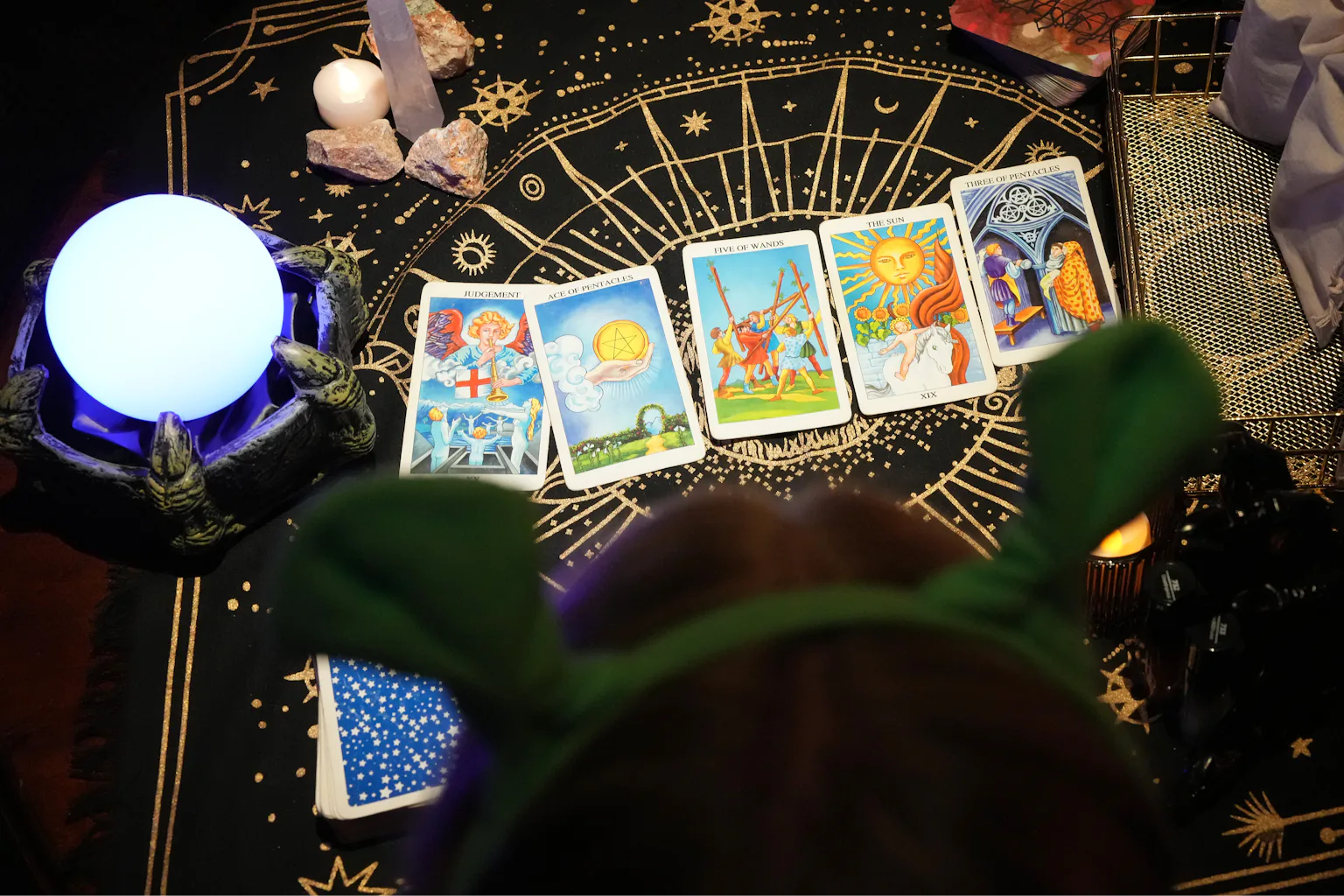
Quick Answer: What Is AI Tarot Spread Meaning?
AI tarot spread meaning refers to the use of artificial intelligence to interpret tarot cards within the structural context of a spread — analyzing how each card's meaning shifts based on its position, its relationship to surrounding cards, and the querent's specific question.
- 🃏 Position-aware card interpretation across Celtic Cross, three-card, relationship, and custom layouts — try the Mystic Tarot Reader
- 🔮 Visual spread generation rendering cards as they'd appear on a reader's table — use the Mystic Tarot Reader
- ☯️ Cross-tradition verification layering tarot insights with I Ching hexagram readings — consult the I Ching Oracle
- 🔢 Numerical pattern analysis connecting card numbers to life path and personal year cycles — explore the Numerology Reader
The Problem: Why Understanding Tarot Spread Meaning Is So Difficult
The Spread Is the Reading — Most People Ignore It
A tarot reading without spread awareness is like reading words without grammar. As a viral Reddit post with 470 upvotes on r/tarot argued: "Tarot forums are filled with 'This doesn't make sense' posts that boil down to trying to shoehorn a card into a spread where it clearly doesn't fit. Readers will do all kinds of mental gymnastics trying to reconcile these bad matches" (
). The spread determines whether The Hermit in a "past" position means you've already done the necessary inner work, or whether in a "near future" position it means solitude is approaching.The tarot cards market is projected to grow by $209.7 million between 2024 and 2029, driven by the shift toward digital and virtual reading services — Technavio
Individual Card Meanings Are Easy to Find — Spread Interpretation Isn't
Search "The Tower tarot meaning" and you'll find hundreds of results. Search "what does The Tower mean in the 'crossing' position of a Celtic Cross when paired with a reversed Queen of Cups in 'hopes and fears'" and you'll find almost nothing. The interpretive challenge of tarot has never been about individual card definitions — it's about synthesis: how cards in specific positions create a narrative that answers a specific question. This synthesis is exactly what most free tarot apps and generic AI tools fail to deliver.
Most AI Tarot Tools Skip the Spread Entirely
RankmyAI now tracks 33 dedicated AI tarot reading tools — but the vast majority offer simple card pulls with isolated definitions. They'll tell you what The Fool means, what The High Priestess means, what the Ten of Swords means. They won't tell you what those three cards mean together in a past/present/future spread for someone asking about their marriage. As a comprehensive analysis on Tarotap documented, "AI-generated interpretations may appear formulaic, lacking the unique creative connections" when the system treats each card as an independent lookup rather than part of a structural narrative (Tarotap).
General-Purpose Chatbots Hallucinate and Hedge
General-purpose AI tools like ChatGPT can discuss tarot fluently — but they often select cards based on topic relevance rather than randomness, refuse to interpret reversed cards, or append disclaimers that undermine the reading's emotional weight. A study published in April 2026 in The Conversation found that while AI could help readers "sidestep the frustration of interpreting many cards in light of the question asked," there were also concerns about how AI's "sycophantic nature" and "yes man energy" could undermine intuition and genuine self-reflection (The Conversation, 2026).
This is exactly what Mystic Tarot Reader was built for — not to pull individual cards, but to treat the spread as the interpretive foundation of every reading.
Why Mystic Tarot Reader Delivers the Deepest AI Tarot Spread Meaning
While most AI tarot tools treat spreads as an afterthought — or skip them entirely — Jenova's dedicated tarot agent treats the spread as the architecture of the reading itself: designing layouts that match your question, interpreting cards within their positional context, and visually rendering the result.
| Feature | Generic AI Tarot Apps | ChatGPT / Gemini | Mystic Tarot Reader |
|---|---|---|---|
| Full 78-card RWS deck | Often partial | Inconsistent | ✅ Complete with reversals |
| Visual spread generation | Rarely | No | ✅ Celtic Cross, relationship, career, custom |
| Spread-aware interpretation | Minimal — isolated definitions | Generic | ✅ Position-aware narrative synthesis |
| Cross-session memory | No | Limited | ✅ Persistent theme tracking |
| Custom spread design | No | Sometimes | ✅ Tailored to your question |
| Reversed card interpretation | Often skipped | Inconsistent | ✅ Full reversed meaning in positional context |
| Cost | Free to $30/month | Subscription required | Free tier available |
The Spread as Interpretive Architecture
The Mystic Tarot Reader doesn't just know what The Tower means in isolation. It understands how The Tower in the "crossing" position of a Celtic Cross interacts with a reversed Queen of Cups in "hopes and fears" — and weaves that into a coherent narrative tied to your specific question. When a standard three-card spread doesn't fit your situation, the agent designs a custom layout: a "Decision Crossroads" spread for binary choices, a "Shadow Integration" spread for inner work, or a "Relational Resonance" spread for interpersonal dynamics.
"My partner and I keep having the same argument about boundaries. Can you design a relationship spread that focuses on the underlying emotional dynamics — not just the surface conflict? I want to understand what we're both protecting."
Visual Ritual and Ceremonial Rendering
Each reading generates a visual representation of your spread — cards laid out as they would appear on a reader's table. The visual anchors the symbolic narrative and creates the ceremonial atmosphere that distinguishes a reading from a lookup. For seekers who connect to tarot through its aesthetic and ritual dimension, this visual layer transforms a text conversation into a full divinatory experience.
Persistent Memory That Tracks Patterns
Ask about your career today and your relationship next week. The agent remembers recurring themes — The Hermit appearing across three consecutive readings, for instance — and surfaces those patterns without you having to explain your history each time. As the researchers in the April 2026 study noted, tarot practitioners used AI to "challenge their own biases and assumptions — blind spots in their readings" (The Conversation, 2026). With persistent memory, those blind spots become visible over time.
"The Six of Swords has appeared in three of my last four readings. Can you pull a spread specifically designed to explore what this card is trying to tell me across these readings?"
Related Agents You'll Also Like
☯️ I Ching Oracle
When a tarot spread raises questions about timing, direction, or the nature of change, this agent casts authentic three-coin hexagrams with changing line analysis and 3,000 years of Chinese philosophical commentary — providing a textual oracle that complements tarot's visual symbolism.
- Coin-cast hexagram readings with changing lines and transformed hexagrams
- Multi-tradition commentary spanning King Wen, Duke of Zhou, Wang Bi, Zhu Xi, and the Ten Wings
- Custom ink wash artwork generated for each reading, grounding the textual oracle in visual tradition
🔢 Numerology Reader
Tarot is inherently numerical — the numbered Minor Arcana, the sequential Major Arcana, the numerological significance of card groupings within a spread. This agent adds a mathematical dimension to your readings by analyzing the numerical patterns across your drawn cards.
- Card number analysis connecting the numbers in your spread to Life Path, Destiny, and Personal Year calculations
- Cross-system comparison revealing how the same numerical pattern reads in Pythagorean vs. Chaldean vs. Kabbalistic frameworks
- Date vibration analysis for timing questions that emerge from a spread
💭 Dream Interpreter
When a tarot spread surfaces subconscious themes or when imagery from your dreams mirrors the cards you've drawn, this agent decodes the symbols through Jungian, Freudian, cognitive science, and spiritual frameworks.
- Multi-tradition dream analysis connecting dream symbols to tarot archetypes
- Symbol dictionary with personal context tracking
- Pattern recognition across recurring dreams and tarot themes
🌟 Personal Astrologer
For seekers who want to layer astrological timing onto their tarot spreads — understanding whether a planetary transit explains why certain cards keep appearing, or which week is best for the action a spread recommends.
- Natal chart construction with house and aspect analysis
- Transit tracking for current planetary movements that contextualize your spread
- Synastry charts when your spread involves relationship questions
How It Works: Understanding Your Tarot Spread Meaning with AI
Step 1: Frame Your Question with Emotional Honesty
The research is clear: AI tarot readings produce the most resonant results when you frame your question in present-tense, embodied language. Instead of "Will I get promoted?", try:
"I feel overlooked at work despite taking on more responsibility. I'm angry about it but also afraid that if I push too hard I'll be seen as difficult. Can you pull a spread that explores both the anger and the fear?"
Step 2: Choose or Request a Spread
Request any traditional layout — single card, three-card past/present/future, Celtic Cross — or ask the Mystic Tarot Reader to design a custom spread based on your question's complexity. If you're unsure which spread fits, the agent recommends one.
"I'm not sure whether a three-card spread is enough for this question. It involves my career, my relationship, and my mental health — they're all tangled together. What spread would you recommend?"
Step 3: Receive Your Position-Aware Interpretation
The agent draws cards, generates a visual layout, and delivers a detailed interpretation — card by card within its positional context, then synthesized into a narrative. This is where AI tarot spread meaning diverges from every card-lookup tool: The Fool in a "past" position tells a different story than The Fool in a "challenge" position, and the agent explains why.
Step 4: Go Deeper with Follow-Up Questions
Unlike a static tarot app where the reading ends when the definitions load, AI tarot spread interpretation invites conversation. Challenge an interpretation. Ask for alternative readings. Explore how a specific card interacts with another in the spread.
"You interpreted The Moon reversed in 'subconscious influences' as clarity emerging from confusion. But what if it actually means I'm in denial? Can you give me both readings and let me sit with which one resonates?"
Step 5: Cross-Reference Across Traditions
Use Jenova's @mention feature to bring the I Ching Oracle or Numerology Reader into the same conversation. A tarot spread that raises timing questions can be deepened with a hexagram casting. The numerical patterns across your drawn cards can be analyzed through numerological frameworks — all in one thread, with full shared context.
"@I Ching Oracle — the tarot spread suggests a major transition but the timing feels unclear. Can you cast a hexagram about when to make this move?"
Step 6: Track Evolving Patterns Over Time
Return to the Mystic Tarot Reader across multiple sessions. Its persistent memory ensures that when the same cards appear in different spreads over weeks, the agent connects those dots — revealing long-term archetypal themes that no single reading could surface.
Results & Use Cases
🔮 Custom Spread for Complex Life Decisions
Scenario: A 34-year-old woman has been journaling about burnout for six weeks but can't articulate what change would feel authentic — not just rest, but renewal.
Traditional Approach: Pull a generic three-card spread from a free app. Get textbook definitions ("The Fool = new beginnings") that feel too broad to be useful.
With Mystic Tarot Reader: She types: "I'm exhausted but afraid to slow down because I worry I'll lose my purpose." The Mystic Tarot Reader designs a 4-card "Threshold Crossing" spread with positions like "Root Anchor," "Veil Between," "First Step," and "Quiet Witness" — each tailored to her specific emotional terrain. The reading surfaces patterns she hadn't consciously named, prompting three hours of journaling about conflating visibility with worth.
💼 Career Spread with Astrological Cross-Reference
Scenario: A software engineer is debating between two job offers with different start dates and compensation structures.
Traditional Approach: Book a $120 reading, wait three days, receive one reader's perspective on a generic career spread.
With Mystic Tarot Reader: He requests a two-options comparison spread immediately, receives visual card layouts for both paths, and asks follow-up questions about specific card interactions. Total time: 15 minutes. He then @mentions the Personal Astrologer to check whether current planetary transits favor either timeline — all in the same conversation with full shared context.
📱 Midnight Relationship Spread
Scenario: After discovering a partner's dishonesty, a user needs to process her emotions at 1 AM — no practitioners available, no friends she wants to burden at that hour.
Traditional Approach: Scroll through a free tarot app and get a generic three-card pull with dictionary definitions that don't acknowledge her situation.
With Mystic Tarot Reader: She opens the Mystic Tarot Reader on her phone, requests a relationship spread focused on hidden dynamics, and receives a nuanced interpretation. The Moon reversed appears in the "hidden influences" position, prompting a deeper conversation about self-deception patterns the agent has noted across previous sessions. Private, judgment-free, and available exactly when she needs it.
📊 Learning Tarot Through AI-Guided Practice
Scenario: A beginner has purchased their first Rider-Waite-Smith deck and wants to learn what different spreads mean — but online resources overwhelm her with conflicting information.
Traditional Approach: Watch a dozen YouTube videos, each with slightly different spread instructions, get confused about which position means what, give up.
With Mystic Tarot Reader: She pulls her own cards physically, then describes them to the agent: "I drew The Empress, reversed Five of Cups, and the Ace of Wands in a past/present/future spread about my creative career. Can you teach me what each position means and how these specific cards interact?" The agent explains the positional framework, interprets her specific cards, and teaches her how spread structure creates narrative — transforming passive card-lookup into active learning. As one Reddit user on r/tarot noted, "AI has certainly made me aware of connections between cards I wouldn't have seen on my own" (
).FAQ
What does "tarot spread meaning" actually refer to?
Tarot spread meaning is the interpretation of cards based on their position within a structured layout — not just their standalone definitions. A Celtic Cross has 10 positions (present, crossing, foundation, past, crown, future, self, environment, hopes/fears, outcome), and the same card carries different meaning in each. The Mystic Tarot Reader interprets every card within its positional context, explaining how a card's meaning shifts depending on where it falls and what cards surround it.
Can AI really interpret tarot spread meaning as well as a human reader?
AI excels at the interpretive synthesis that makes spreads meaningful — understanding how The Tower in "crossing" interacts with the Four of Swords in "advice" and a reversed Empress in "self." A 2026 study published in The Conversation found that tarot practitioners used AI both to "sidestep the frustration of interpreting many cards" and to "challenge their own biases and assumptions" (The Conversation, 2026). AI handles complexity and consistency; human intuition provides the final resonance check.
What tarot spreads can AI interpret?
The Mystic Tarot Reader handles all major spread types — single card, three-card (past/present/future), Celtic Cross (10 cards), relationship spreads, career spreads, and decision-making layouts. It also designs custom spreads with bespoke positions tailored to your specific question, creating interpretive frameworks that don't exist in any guidebook.
Is AI tarot spread interpretation free?
Yes. Jenova offers free access to the Mystic Tarot Reader and all other divination agents with no credit card required. Paid plans starting at $20/month unlock expanded usage for daily practice, extended multi-agent sessions, and custom model selection.
Can I combine tarot spread AI with other divination systems?
Absolutely. Jenova's @mention feature lets you bring the I Ching Oracle, Numerology Reader, Personal Astrologer, or Dream Interpreter into the same conversation with full shared context. Cross-reference a career spread with a hexagram about timing, or layer numerological analysis onto the numbered cards in your layout.
Does AI tarot spread meaning replace learning tarot myself?
No — and for many users, it accelerates the learning process. By explaining why a card means something different in one position versus another, and by showing how cards interact within a spread's narrative structure, AI acts as a tutor that teaches tarot interpretation through practice rather than memorization. As Tarotap's analysis documented, AI tarot works best "as a self-reflection tool" and a complement to developing your own interpretive skills.
Conclusion
The meaning of a tarot spread is not the sum of its individual card definitions — it's the narrative that emerges from position, relationship, and context. In 2026, with the tarot market projected to nearly double to $1.41 billion by 2035 (Business Research Insights) and nearly 1 in 3 Americans consulting tarot or astrology annually (Pew Research, via The Conversation), the demand for deep, position-aware interpretation has never been higher — and most tools still deliver isolated card definitions instead.
The Mystic Tarot Reader treats every spread as a complete story: designing layouts that match your question, interpreting cards within their positional context, generating visual renderings, and tracking recurring themes across readings over time. Try it free — no credit card required. Explore the full library of divination and spiritual agents at Jenova.