AI Tabletop RPG Assistant: Prep NPCs, Maps, and Campaigns
2026-09-03
Roleplay Game Master helps you prep and run campaigns by serving as an AI tabletop RPG assistant that remembers NPCs, locations, secrets, and the promises your party extracted last week. While most groups in September 2026 still lose hours to half-finished stat blocks, unnamed vendors, and notes trapped in three apps, this AI provides a campaign notebook that talks back — and stays consistent when the watch captain returns in act three.
✅ NPC dossiers with voice, secrets, combat numbers, and DM-only tells ✅ Location and faction notes you can pull mid-session ✅ Prep that fits a lunch break instead of a lost Sunday ✅ Support for solo play or a human GM who wants a second brain
To understand why a dedicated tabletop RPG assistant matters, look at what actually collapses before game night. The hobby is growing. The prep stack is not. Continuity is still the first thing to die when the only GM is also the person who has to write the city watch, the marketplace, and the cult that both of them secretly serve.
Quick Answer: What Is a Tabletop RPG Assistant?
A tabletop RPG assistant is an AI partner that builds NPCs, tracks locations, and keeps campaign notes consistent so you can prep faster and run a tighter table. It is not a random encounter generator. It is a second brain for the person holding the world together.
Key capabilities:
- Session-ready NPCs with mannerisms, motives, secrets, and combat framing
- Location and faction notes that stay attached to the map in your head
- Campaign memory so last session's warrant, rumor, or lie still exists
- Open-ended support for D&D-style play, fiction-first tables, or homebrew
The Problem With Running a Table When Prep Never Ends
Demand for tabletop stories is not the bottleneck. Time, continuity, and a willing game master are.
$2.41 billion — Global tabletop RPG market size in 2026
$6.59 billion — Forecast TTRPG market value by 2035
8.7% CAGR — Projected tabletop RPG market growth from 2025 to 2033
$460 million — Estimated Dungeons & Dragons revenue in 2025
~$16% — Estimated share of players who convert into dungeon masters
Those figures explain why more people want a campaign. They do not explain why Friday still starts with a blank NPC and a map with no names on the stalls. But getting a table to the quality players actually want is frustratingly difficult:
- Prep is lopsided — the GM does the work, then burns out
- NPCs arrive as a name and a stat block, then contradict themselves next week
- Locations look finished on a VTT and empty in play
- Notes live in Discord, a wiki, and a phone screenshot nobody can find
- Generic chat tools improvise a scene, then forget the scar, the secret, and the warrant
The Shortage Is Structural, Not Seasonal
Analysis of the so-called DM shortage points to a structural problem: running the game takes disproportionate effort, burnout is common, and few players step into the chair. Hiring a GM through a marketplace can fill a slot. It does not write your city watch captain, your market's black-market stall, or the cult courier you decided not to arrest.
RPG Research's AI GM project splits the job honestly. Full AI GM play is one use. GM aide modes are another: rules help, story help, NPC handoff, and a campaign log so the human at the table can stay in the social moment instead of flipping through six documents.
NPCs and Maps Fail in Different Ways — Both Kill Immersion
A watch captain with no voice is a quest dispenser. A marketplace with no vendors is a loading screen. Players notice when the burn scar vanishes, the "friendly" NPC has no secret, or the bazaar that looked lush on the map has nothing to steal, smell, or start a fight over.
Research on AI-assisted interactive storytelling treats characters, events, emotions, and scenes as separate story units that have to stay causally linked. That is the same work a GM does between sessions. Most general-purpose chat tools do not keep those units attached. They generate. They do not file.
This is exactly what a dedicated AI tabletop RPG assistant was built to hold.
Why Roleplay Game Master
Roleplay Game Master is a dedicated campaign partner for tabletop play — not a chatbot with a dice emoji. It holds NPCs in character, keeps location lore attached to the places you named, and follows the brief you give it, whether you need a full session or a twenty-minute prep pass.
Treat it as a standalone tabletop RPG assistant. You can ask it to build the watch roster, stock a market, track a faction's heat, or run the scene when your human GM chair is empty.
| Traditional Approach | Roleplay Game Master |
|---|---|
| Docs, wikis, and Discord archaeology | One assistant that remembers NPCs, promises, and map notes |
| Last-minute NPC with no secret or voice | Session-ready characters with mannerisms, motives, and stats |
| Pretty maps with no playable stalls | Locations that come with vendors, rumors, and consequences |
| Generic chat that forgets the watch captain | Campaign-consistent notes that keep the scar, the accent, and the lie |
| Sunday prep that never finishes | Lunch-break briefs that are ready by game night |
NPC Work That Survives Contact With Players
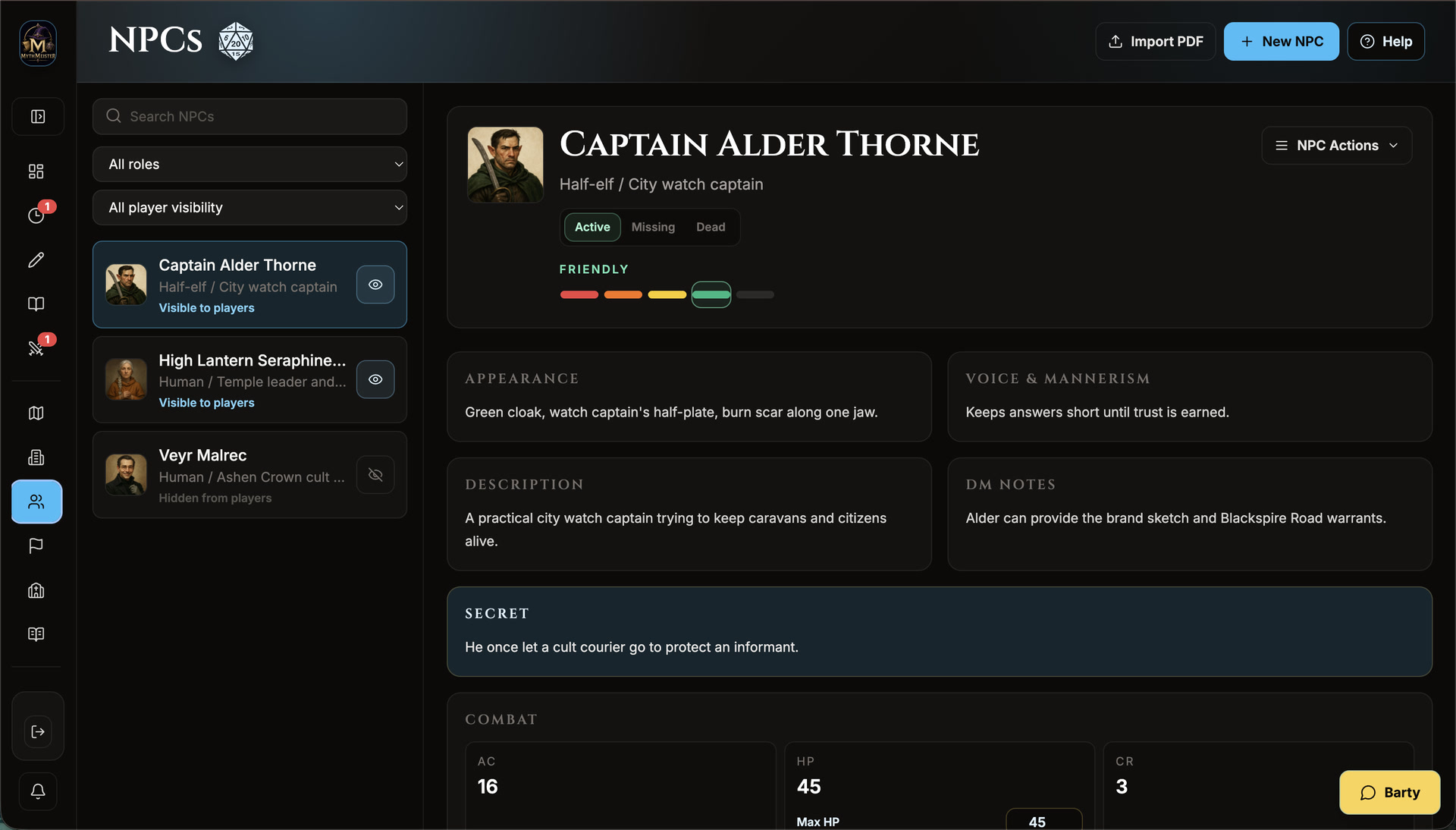
The job is not "make a cool character." The job is a person the table can interrogate. Appearance, voice, what they will admit, what they will never say, and what happens if combat starts anyway.
Ask for the sheet the way a working GM actually uses it: public description, mannerism, secret, DM notes, and a combat frame. Then keep that person in play. If Captain Thorne let a cult courier walk to protect an informant, that fact should still be true when the party brings him a brand sketch three sessions later.
Locations With Play Inside Them, Not Just Labels
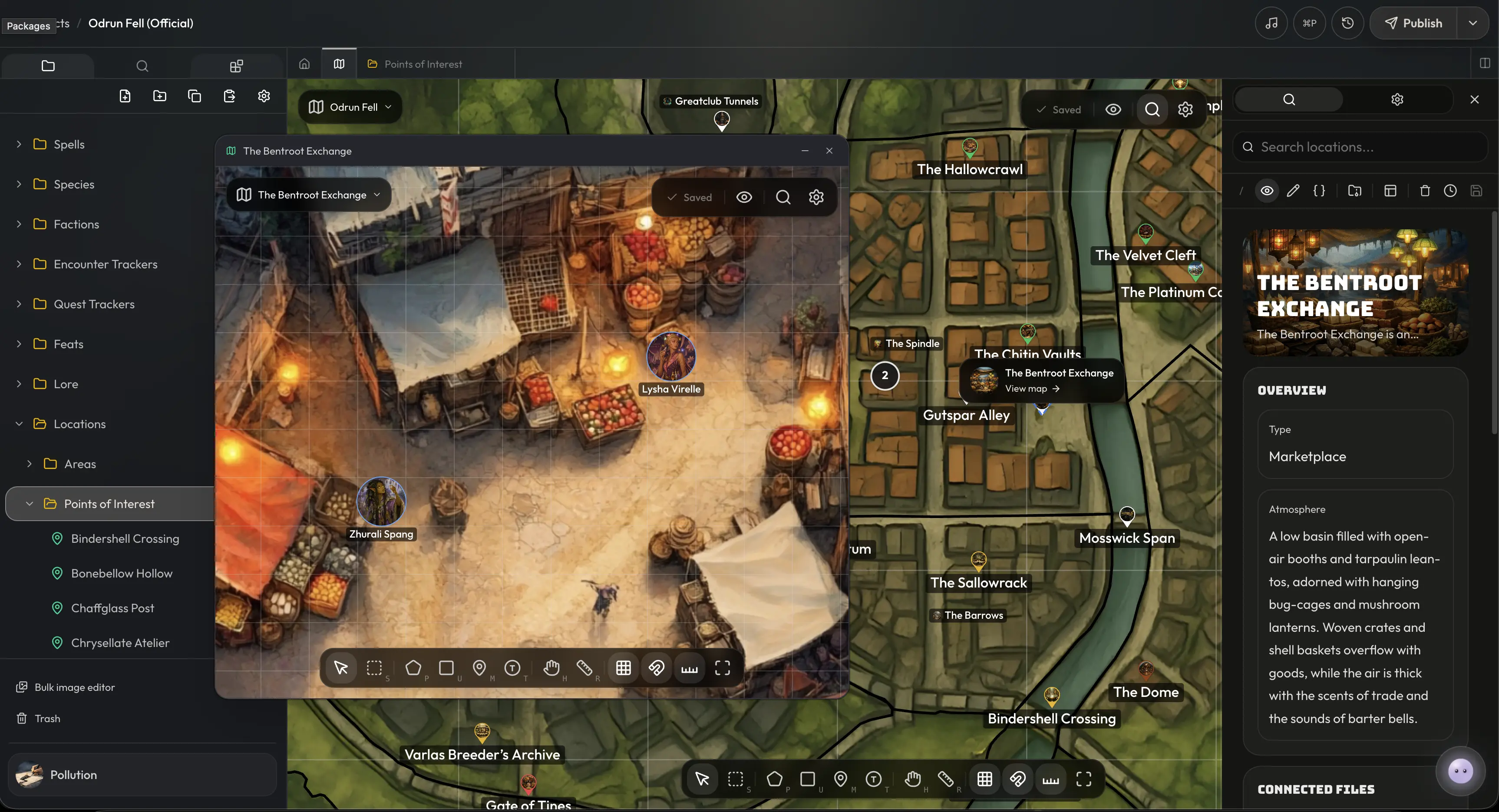
A point of interest is not a pin. It is a smell, a stall, a named vendor, and a thing the party should not steal. When you brief a sunken marketplace — tarps, hanging cages, mushroom lanterns, the sound of barter bells — the assistant should return stalls, NPCs, and complications, not a paragraph of tourism copy.
That is how a map becomes a scene. The VTT can show the basin. The tabletop RPG assistant has to know who is selling, who is watching, and which alley is actually a faction border.
Memory Is the Product, Not a Bonus Mode
AI-driven interactive stories only work when choices change the next scene. A tabletop campaign is that idea stretched across months. Unlimited memory is what stops the harbormaster from resetting, the warrant from vanishing, and the "friendly" captain from becoming a stranger.
You can leave the table for two weeks and ask who collected on the unpaid debt. If the answer is new every time, you do not have an assistant. You have a slot machine.
Prep Assistant or Full Table — Same Continuity
Use it as a GM aide while you run a human table: generate the watch captain, stock the exchange, write the rumor table, then close the laptop and referee. Or let it run the scene when nobody else can sit in the chair. Either way, the lore file is the same.
"Build a city watch captain: half-elf, green cloak, burn scar along the jaw. Short answers until trust is earned. Give appearance, mannerism, a secret, AC/HP/CR-style combat framing, and one rumor he can hand the party."
"The Bentroot Exchange is a low marketplace basin with tarp stalls, hanging bug-cages, and mushroom lanterns. Name six vendors, two conflicts in progress, and one item that will get the party followed."
"Session recap: the party spared the cult courier. Update faction heat, rewrite the captain's posture, and give me three hooks for next Friday that do not ignore that choice."
Related Agents You'll Also Find Useful
If you are still designing the system — economy, faction loops, conflict clocks — Game Designer Assistant is the prep layer before play. Use it to pressure-test whether your city can actually produce jobs, debts, and wars, then hand that bible to your tabletop RPG assistant.
- Systems analysis across genres, not just high fantasy
- Documentation that stays coherent enough to run
- Concept work that does not die in a worldbuilding folder
If Friday's roster still has "Guard #3" and "Innkeeper??" in the margin, Name Generator is the fastest complementary pass. Cultural fluency and linguistic constraints matter when a whole district has to sound like it belongs together.
- Names for characters, places, factions, and taverns
- Naming that respects language and culture instead of syllable soup
- A five-minute list you can drop into NPC sheets
If you want a session with locked doors and no map to draw, The Mansion drops you into an estate with no memory of how you arrived. Every room is a secret. It is the right next table when you need structured mystery pressure instead of another sandbox to stock.
- Memory-loss opening that forces investigation immediately
- Room-by-room secrets rather than a tavern hook
- Horror pacing when the group is tired of hexcrawls
Try Roleplay Game Master free — no credit card required.
How It Works
Step 1: Brief the Campaign and the Job Tell your tabletop RPG assistant whether you need prep, a live scene, or both. Name the setting, tone, lines you will not cross, and how heavy the rules should feel. Specificity here is session zero, even if you are only stocking a market.
"Low-magic river city. I GM a human table on Friday. I need NPCs and location play, not a novel. No gore. Track favors like currency."
Step 2: Build NPCs the Table Can Actually Talk To Ask for the fields you will use at the table: look, voice, public story, secret, DM notes, and a combat frame. Correct anything thin. A captain who "wants to protect the city" is not done until you know who he already failed.
"Give me three watch officers below the captain. One is dirty, one is new, one saw the courier leave. Include a tell I can roleplay."
Step 3: Stock Locations Until They Have Play Inside Take a map pin and demand vendors, smells, prices, and trouble. If a stall cannot start a scene, it is decoration. Attach factions to alleys so a chase is never just empty streets.
"Turn this marketplace into a 20-minute scene: two named sellers, one pickpocket crew, one watch patrol, and a rumor that contradicts the captain."
Step 4: Run, Recap, and Leave the File Standing Play the scene, or copy the notes to your human table. When you return, ask what the city remembers. Continuity is the test. If the secret, the scar, and the unpaid favor are still there, the assistant did the job.
"Two weeks later. Who used the warrant, and what did the exchange do with the crate we didn't open?"
Results & Use Cases
📊 A Watch Roster That Still Makes Sense in Session Five
Scenario: You have a city map and a party that loves talking to guards. You do not have time to write twelve officers with distinct tells.
Traditional Approach: One named captain, four identical "guards," and a retcon when someone asks about the burn scar.
Roleplay Game Master: You get a captain with a voice, a secret, and a reason to help — plus a bench of officers who do not all sound like the same man in different helmets.
- Secrets that create later scenes instead of trivia
- Combat framing if negotiations fail
- DM notes you can glance at without breaking stride
💼 A Marketplace That Is a Dungeon With Better Lighting
Scenario: Your VTT looks finished. Play does not. The party enters the exchange and you have nothing under the stalls.
Traditional Approach: Improv three fruit sellers, then stall when someone asks who owns the mushroom lantern concession.
The AI tabletop RPG assistant: Named vendors, a stolen crate, a watch patrol with mixed loyalties, and a reason the air smells like tar and spice.
- Locations that survive a second visit
- Factions attached to geography
- Prep you can generate from a single paragraph of atmosphere
📱 Lunch-Break Prep on Your Phone
Scenario: Game night is at 7. You have 18 minutes on a train and no laptop.
Traditional Approach: Skip prep, panic at the table, or cancel. Mobile notes apps do not invent a consistent NPC.
Same campaign on iOS or Android: Build the captain, stock two stalls, and write the rumor the bard will hear. Speech-to-text if your hands are full. The file is waiting on your laptop when you sit down.
- Short prep that still advances the long plot
- No "mobile version" that throws away campaign state
- A commute that produces a session instead of scrolling
🎯 Design the Engine, Then Play It the Same Night
Scenario: You have faction essays and zero playable jobs. The setting is the hobby. The table is empty.
Traditional Approach: Another week of documentation. The first session ignores half of it because nobody can hold it in working memory.
Game Designer Assistant, then the campaign assistant: Tighten economy, clocks, and conflict loops. Drop that bible into play immediately. If you would rather skip worldbuilding tonight, The Mansion is already a locked estate with rooms that hide the next scene.
- Design work that gets stress-tested by actual choices
- A setting that does not stay theoretical
- A backup table when you want mystery pressure, not a hexcrawl
FAQ
What is a tabletop RPG assistant?
A tabletop RPG assistant is an AI partner for game masters and solo players that handles NPC creation, location notes, recaps, and campaign continuity. Unlike a generic chatbot, it is judged on whether the watch captain still has the same scar, secret, and voice next session. Roleplay Game Master is built for that job: immersive roleplay with memory that persists, so prep and play share one file.
Is Roleplay Game Master free?
Yes. You can start on the free tier with core play and limited usage. Paid plans increase usage if you run long campaigns or daily prep. You do not need a credit card to test whether an AI tabletop RPG assistant fits the way you GM — including a first NPC roster or a single location scene.
How is a tabletop RPG assistant different from ChatGPT for D&D?
General chat tools can improvise a tavern. They struggle to remain a campaign notebook: voices drift, facts collide, and last week's warrant disappears. A dedicated assistant is scoped to roleplay and continuity — holding lore, keeping NPCs in character, and treating your choices as canon. That is the gap this tool is designed to close, whether you are prepping a human table or playing solo.
Can a tabletop RPG assistant run D&D, Pathfinder, or homebrew?
You can brief any rules weight you want — fiction-first, light rolls, or a structured d20 loop. It is not a licensed virtual tabletop with official stat blocks baked in. It is a story-and-prep engine that will follow the system you describe, including homebrew. State the rules in the first message and correct drift the same way you would with a human collaborator.
Does a tabletop RPG assistant work on mobile?
Yes. Play and prep continue on web, iOS, and Android with the same campaign memory. That is what makes commute NPC work and late-night recaps practical. If you stock a marketplace on your phone, you can run the scene from a laptop without rebuilding the table.
Will it forget my NPCs and map notes?
Forgetting is the failure mode of most AI dungeon-style play. This product is built around unlimited memory and character consistency so NPCs, debts, and locations persist. You should still state critical facts clearly after a long gap, the same way you would remind a human GM. Treat it as a collaborator with a deep notebook, not an omniscient referee.
Conclusion
The bottleneck in tabletop play is not dice or PDFs. It is a GM who can finish the watch roster, stock the market, and still remember what the party did to the courier. An AI tabletop RPG assistant does not replace a great human table. It replaces the Sunday you were going to spend writing NPCs that never get a voice.
Roleplay Game Master gives you that file: session-ready characters, locations with play inside them, and campaign memory that keeps the scar, the secret, and the map pin attached. Prep on a train, run a human table with better notes, or play the scene when the chair is empty — the world is still standing when you come back.
Try it with the NPC you have been postponing. Explore more at Jenova.
For Developers: Roleplay Game Master is available programmatically via the Jenova API — integrate AI tabletop RPG assistant workflows for NPC prep, campaign memory, and immersive roleplay with a single API call. Full documentation →