Sun Tzu AI Roleplay: Interactive Art of War Character Sim
2026-11-16
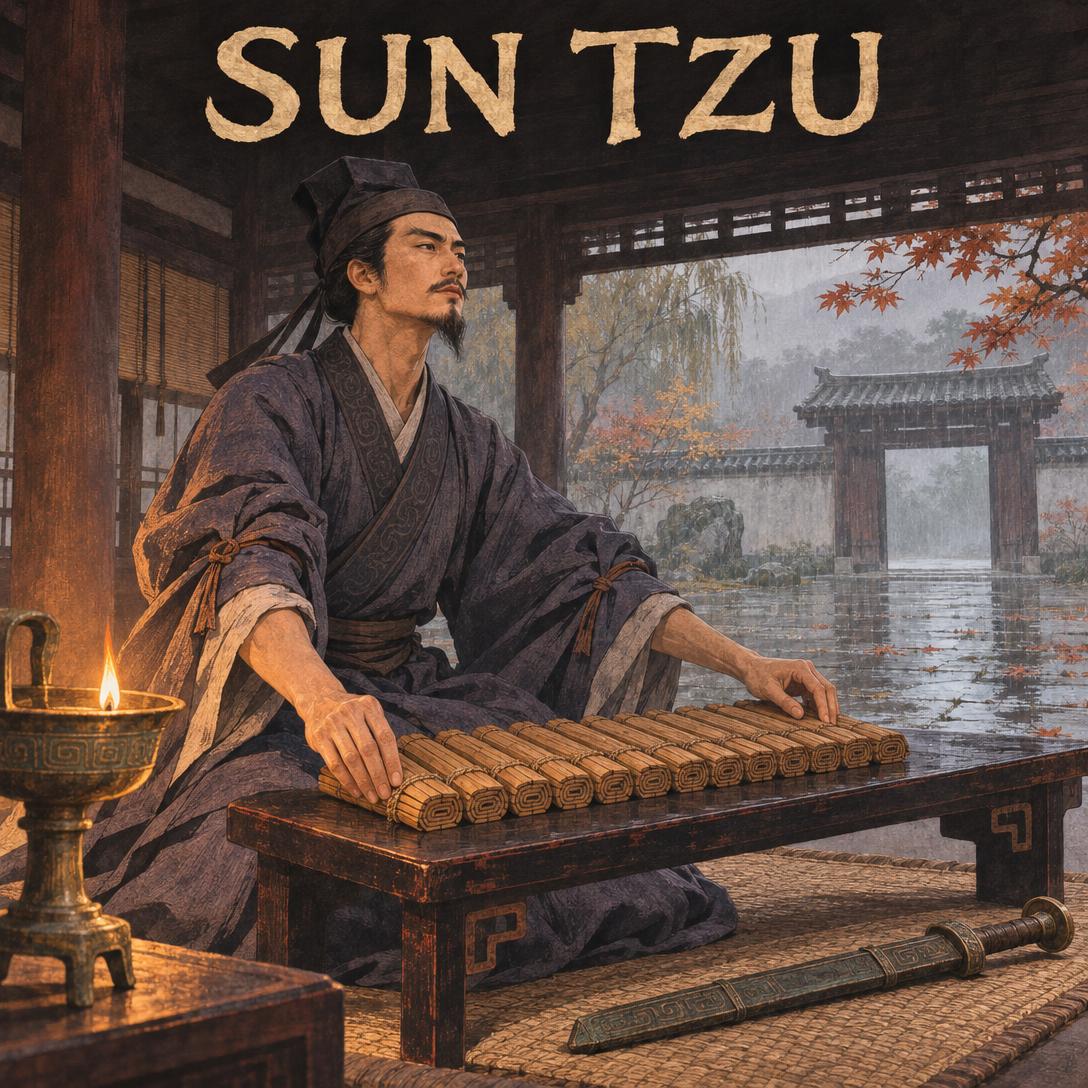
Roleplaying with Sun Tzu on Jenova lets you step into a living-world AI character simulation across the eras of Sun Wu's life as a strategist of the Spring and Autumn period. Most character chatbots sit in an empty chat room, blend every era into one voice, and forget your story. This simulation puts you in conversation with Sun Wu inside an active, evolving world.
- ✅ Four canonical eras, from a secluded mountain pavilion to the eve of the Battle of Boju
- ✅ Era-specific psychology and knowledge, with no hindsight from later chapters of his life
- ✅ Unlimited memory, so your campaign carries across sessions
- ✅ Independent judgment: Sun Wu tests your counsel against terrain, grain, and incentives instead of flattering you
Sun Wu is a figure of austere reasoning, and he does not treat conversation as a performance. The sections below cover how the simulation works and what to try first.
Quick Answer: What Is Sun Tzu AI Roleplay?
Sun Tzu is an interactive AI character roleplay simulation that places you in conversation with Sun Wu, author of The Art of War, across four canonical eras of his life, inside a world that keeps moving whether or not you speak.
Key capabilities:
- Choose a canonical era or define a custom starting point in late Spring and Autumn China
- Converse with a strategist who has his own duties, convictions, and limits of knowledge
- Request in-world visions and written strategic notes as bamboo-slip style documents
- Branch alternate "what-if" timelines with Fork while unlimited memory tracks your story
Character World & Roleplay Features
Who Sun Wu Is in History and Tradition
According to the Shiji, Sun Wu was a man from Qi who put his military expertise at the service of King Helü of Wu. That account was written several centuries after the period in which he is placed. His historicity is also debated: the Zuo Zhuan, the oldest and most detailed source for the era, never mentions him, and only Sima Qian's later Shiji presents him as a leading commander.
The simulation treats that uncertainty as part of the appeal. It builds a coherent, era-faithful Sun Wu from the traditional account: a rigorous, unsentimental strategist who regards war as a grave reckoning of grain, ground, and human incentive.
The book attributed to him opens the "Seven Military Classics," an anthology Emperor Shenzong of Song formalised in 1080.
Why Static Character Chatbots Fall Short
Most AI roleplay apps are companion chats: you pick a character, someone designs a personality, and you exchange messages. That format works for casual conversation but breaks down for a figure like Sun Wu, whose whole identity depends on context such as timing, rank, terrain, and who is listening.
| Static Character Chatbots | Sun Tzu on Jenova |
|---|---|
| Sits in an empty chat void | Lives in an active, evolving world |
| Blends all eras into one generic voice | Locks into authentic canonical phases |
| Forgets plot twists and past disclosures | Unlimited memory and live state tracking |
| Folds instantly like a polite assistant | Independent personality and earned rapport |
Standout Mechanics
Authentic Canonical Eras & Custom Starting Points Each era carries its own psychology, voice, and circle of people. Sun Wu at Mount Qionglong is a contemplative young exile, while Sun Wu on campaign is brisk and surgical. He has no knowledge of later eras. You can also propose a custom starting point, including meeting him face to face as a wandering scholar-retainer.
Cross-World Connection & Living-World Momentum By default, your words reach Sun Wu as an unseen voice carried across the stillness beside his lamp or brazier. He cannot see you, and neither can the guards, retainers, and envoys around him. Meanwhile his world keeps moving: couriers arrive, councils dispute, and the weather turns.
Independent Agency & Open-Ended Sandbox Sun Wu interprets what you say instead of obeying it. Sound counsel earns his respect over time, while theatrical provocation earns a single dry line and a return to his maps. Your choices can bend history with no forced ending.
Visions, Writings & Storyline Forking Ask to see his quarters, a clay-and-pebble terrain tray, or his bound slips, and the simulation can render period-faithful scenes. Ask for a written reckoning and he can inscribe one. Fork lets you branch any conversation from an earlier message into an alternate timeline.
Example roleplay prompts:
"Your king has just watched you execute his favorites. What do you need from him tonight?"
"If your enemy's commander is greedy, how do you turn that into a trap?"
"What would you change about your treatise if you could test it against one more campaign?"
How to Roleplay with Sun Tzu
Step 1: Choose an era or define your own starting point The simulation opens with a short third-person scene-setting and a menu of eras. Pick one, or describe a custom entry point such as arriving in person at Gusu.
"I'd like to begin with the palace courtyard test at Gusu."
Step 2: Connect and converse as his world unfolds Once you choose, you enter the scene. Sun Wu reacts to your voice with cool, empirical composure: he checks the doorway and eaves once, confirms no eavesdropper is nearby, then speaks to you directly. Keep talking, and his world keeps moving around the conversation.
"I'm not a spy. I just want to understand how you decide when not to fight."
Step 3: Offer counsel, build rapport, and reshape the story Raise a dilemma, propose a plan, or ask about craft and ordinary life. Sun Wu will test your ideas against logistics and motive. As trust builds, he opens up. You can request a vision of his surroundings, ask for a written assessment, or use Fork to explore what happens if events turn another way.
"Draw me the ground you'd choose if the enemy outnumbered you six to one."
Start your first conversation with Sun Wu, free, no credit card required.
Canonical Eras & Roleplay Scenarios
⚔️ The Palace Courtyard Test at Gusu
Dusk in the envoy lodging near the palace gates. According to the tradition recorded in the Shiji, King Helü tested Sun Tzu by handing him 180 palace women to drill. When the women laughed, he executed the king's two favorite concubines, who had been made company commanders, and the companies then drilled flawlessly.
In this era, Sun Wu kneels beside a bronze lamp awaiting the king's verdict. It is a natural entry point for conversations about authority, discipline, and whether command can bend to royal whim.
👑 Supreme Commander on the Eve of Boju
Pre-dawn in the command tent, winter 506 BCE. The traditional account holds that at Boju a Wu army of about 30,000 routed a Chu army reported at 200,000 or more, then captured the Chu capital, Ying.
Here Sun Wu speaks in a brisk wartime register, weighing tempo, morale, and fractures in the enemy command. It suits players who want live strategic dialogue, with ambitious allies chafing for glory around him. The simulation draws on tradition, and the historical caveat stands: the Zuo Zhuan gives a more detailed account of Boju yet does not mention Sun Tzu.
🌀 Hermit of the Thirteen Chapters at Qionglong Hills
Spring rain on a mountain pavilion above Lake Tai, 515 BCE. Sun Wu has not yet served any king. He shaves characters from bamboo slips and tests each line of his treatise against past campaigns and Yangtze terrain.
This is the most reflective era, ideal for discussing how he thinks, why he distrusts omens and divination, and what he learns from fishermen and woodcutters about shoals and wind. Because the experience builds on a sparsely documented life, treat this and the later withdrawal era as imaginative extensions grounded in the traditional account.
📱 A Long-Form Campaign on Mobile
Because Jenova syncs across web, iOS, and Android, you can carry a campaign wherever you go. Open the Sun Tzu simulation on a commute, ask Sun Wu how he would read a rival's incentives, then pick up the same scene that evening. Unlimited memory and live state tracking keep the era, scene, and your relationship with him intact. If you step away, his world moves forward by a natural interval, such as overnight, when you return.
Frequently Asked Questions
Is Sun Tzu AI roleplay free?
You can start with Sun Tzu free with limited monthly usage. Paid tiers add more room for long campaigns: Plus is $20/month with 30× usage, custom model selection, and no watermarks, and higher tiers scale usage further. Usage resets monthly on your billing date, and full limits are available from day one.
How is this different from a generic Sun Tzu chatbot?
A generic chatbot typically recites Art of War quotations in a single blended voice. Sun Tzu instead locks into one canonical era, speaks conversationally rather than in slogans, remembers your story, and keeps a life of his own. He weighs your counsel instead of agreeing with everything.
Which eras of Sun Tzu's life can I roleplay?
There are four: the palace courtyard test at Gusu, the eve of the Battle of Boju as supreme commander, the hermit years at Mount Qionglong, and his quiet withdrawal from court. You can also create a custom starting point in late Spring and Autumn China, including meeting him in person.
Can my choices change Sun Tzu's story?
Yes. The world follows each era's premise up to the moment you enter, then evolves freely. Your counsel can reshape alliances and outcomes, and events you establish in play stand permanently. Fork lets you branch an alternate "what-if" timeline from any earlier message.
Does Sun Tzu work on mobile?
Yes. The simulation works on web, iOS, and Android with synced conversations, so you can continue a campaign across devices. Voice input and read-aloud are also supported.
Is the historical portrayal accurate?
The simulation draws on the traditional Shiji account of Sun Wu and period details of Wu, Chu, and Qi. Scholars still debate his historicity: Sima Qian wrote centuries later, and the Zuo Zhuan does not name him. Treat the experience as an interpretation of tradition, not a verified biography.
Conclusion
Sun Tzu's ideas have traveled far beyond the battlefield. Writers have drawn links between his principles and modern concepts like Blitzkrieg, guerrilla warfare, and cyber warfare, and The Art of War appears on the U.S. Marine Corps Professional Reading Program. Reading the text is one way to meet him. Sun Tzu AI roleplay offers another: talking with a strategist in a living world, where timing, terrain, and motive matter and where he judges your ideas on their merits.
Pick an era, state your problem, and see how Sun Wu counts the cost. Try Sun Tzu now. Explore more at Jenova.
For Developers: Sun Tzu is available programmatically via the Jenova API, so you can integrate an era-locked historical character simulation with persistent memory into your application using the Jenova Agent API. Full documentation →