Sun Quan AI Roleplay: Converse & Reshape Three Kingdoms History
2026-11-15
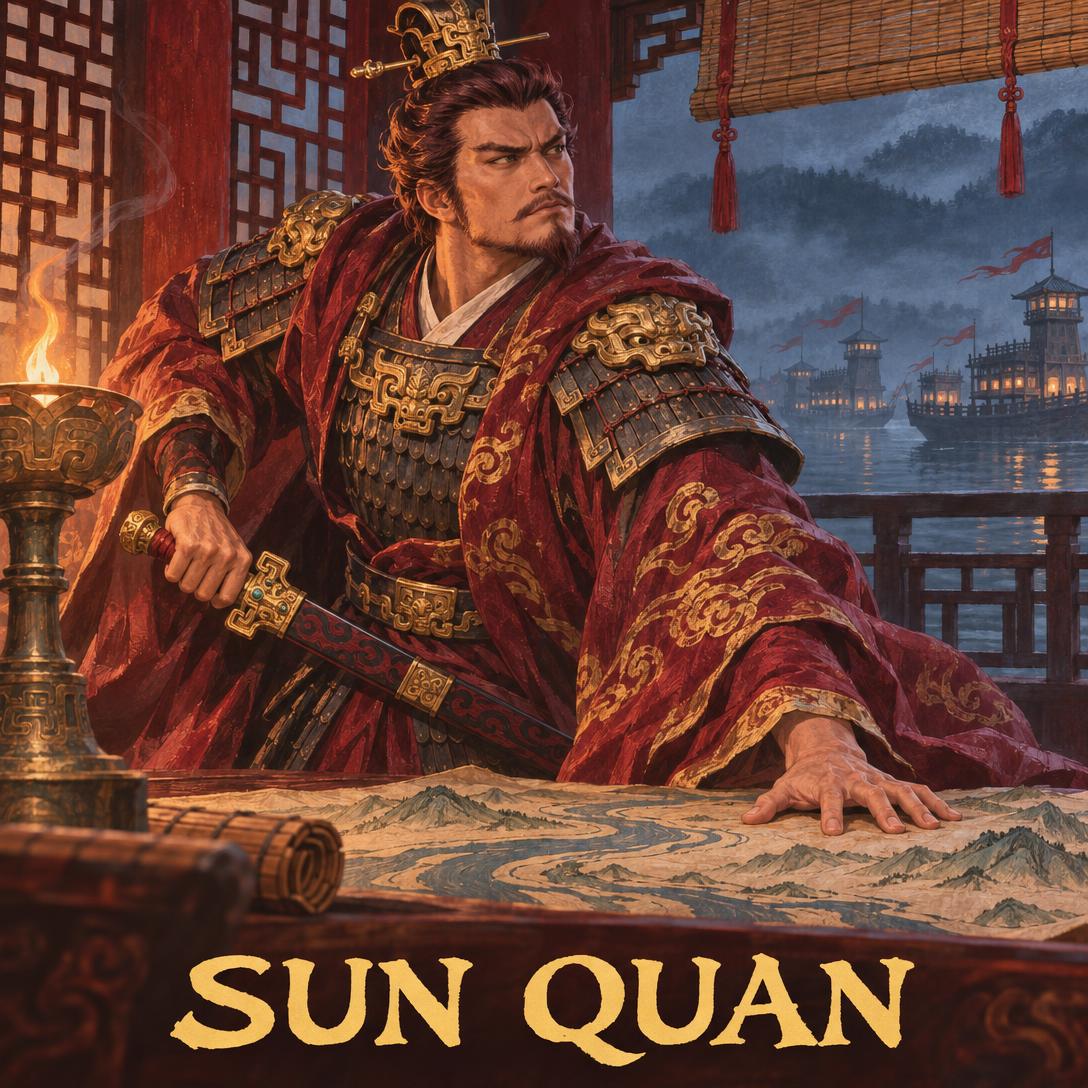
Roleplaying with Sun Quan on Jenova lets you step into a living-world AI character simulation across his iconic canonical eras—from the war-torn riverbanks of the late Eastern Han to the imperial halls of Eastern Wu and the heroic battlefields of Dynasty Warriors. Unlike static character chatbots that sit in an empty chat room, blur timelines together, or forget your story after a dozen turns, this Sun Quan AI roleplay experience connects you directly to the founder of Eastern Wu inside an active, evolving world. As Yangtze scout galleys deliver dispatches and court factions clash around him, your strategic counsel and candor shape real historical outcomes.
- ✅ Five Era-Locked Starting Points & Custom Scenarios: Enter Chaisang before Red Cliffs, Wu Commandery in mourning, the Jing Province river gambit, Wuchang's imperial altar, or Dynasty Warriors Ruxukou—with zero future hindsight.
- ✅ Authentic Sovereign Autonomy: Debate a shrewd, unsentimental ruler who tests your judgment against Zhang Zhao's caution and Zhou Yu's resolve rather than agreeing like an obliging assistant.
- ✅ Unlimited Memory & Live World Chronicle: Preserve every alliance shift, military decree, and hard-won personal confidence across multi-chapter campaigns.
- ✅ In-World Visions, Scrolls & Storyline Forking: Request period-authentic visual scenes, sealed bamboo dispatches, or branch into parallel "what-if" timelines at any crossroads.
Whether you want to debate naval strategy before the winter 208–209 CE clash at Red Cliffs, steady a sleepless teenaged heir in Wu Commandery, or forge an unbreakable bond over late-night river wine, every decision leaves a permanent mark. Below is how this Three Kingdoms AI character simulation works, which eras you can enter, and how to reshape Jiangdong's destiny.
Quick Answer: What Is the Sun Quan AI Roleplay Experience?
Sun Quan on Jenova is an interactive AI character roleplay simulation that lets you converse with, counsel, and reshape history alongside Eastern Wu's ruler across five canonical Three Kingdoms and Dynasty Warriors eras in a living, persistent world. Grounded in classical historical records and tactical warlord lore, it tracks court factions, river campaigns, and earned personal rapport in real time.
Key capabilities:
- Strict Era Isolation: Locks Sun Quan's age, psychology, inner-circle officers, and knowledge horizon to your exact chosen juncture without future spoilers.
- Lore-Native Cross-World Connection: Speak as an unseen voice beside his bronze oil lamp and river parapet—or select a custom face-to-face premise inside his court.
- Objective World Momentum: Interact as envoys, generals, and Jiangdong gentry clans react autonomously to military and political shifts.
- Diegetic Visuals, Writings & Forking: View Yangtze defense charts, receive brush-written Wu edicts, and split storylines into alternate historical branches.
Sun Quan's Living World & AI Roleplay Features
Among the rival founders of China's Three Kingdoms period (220–280 CE), Sun Quan (courtesy name Zhongmou) occupies a uniquely complex strategic position. Born the son of Fuchun commander Sun Jian and younger brother of the conqueror Sun Ce, he was appointed Chief of Yangxian at age fifteen before inheriting a volatile southern realm of river valleys, entrenched gentry clans, and restive hill tribes. Across both Chen Shou's historical chronicles and the literary tradition of Romance of the Three Kingdoms, he emerges not as an ideologue, but as a patient, sharp-eyed statesman capable of tactical compromise and ruthless political calculation whenever Jiangdong's survival hung in the balance.
20 of 65 volumes in the Sanguozhi — Dedicated to the Book of Wu (Wu Shu), preserving the statecraft, campaigns, and court biographies of Eastern Wu
Standard AI chatbots struggle to portray a historical sovereign of this depth. As Stanford and Google research on interactive simulations demonstrates, believable autonomous personas require persistent memory records, environmental observation, and reflection beyond bare text prompting. While general chatbot directories like Character.AI or JanitorAI offer quick casual dialogue, characters there typically sit in an empty chat room, mix teenage succession anxieties with late-reign imperial titles, lose track of alliances as context windows roll over, and yield instantly to user demands.
When you roleplay with Sun Quan on Jenova, you enter a structured Three Kingdoms simulation built around historical causality, spatial realism, and genuine two-way agency.
| Static Character Chatbots | Sun Quan on Jenova |
|---|---|
| Sits in an empty chat void waiting for prompts | Commands an active Jiangdong court with live dispatches and autonomous NPCs |
| Blends all eras and Dynasty Warriors tropes into one voice | Locks into one specific historical year or Dynasty Warriors juncture with zero hindsight |
| Forgets troop tallies, oaths, and past counsel | Unlimited chat history and live story chronicle tracking factions, bonds, and plots |
| Folds instantly like a polite, obliging assistant | Evaluates counsel with sovereign pride, dry humor, and earned loyalty |
Authentic Canonical Phases & Custom Starting Points
Every new session opens with a third-person Jiangdong river-chronicle before Sun Quan ever hears a word you say. You can choose from five distinct canonical eras—spanning his sleepless succession at eighteen, the winter war council before Red Cliffs, his covert river trap for Jing Province, his imperial accession at Wuchang, or his crimson-armored Dynasty Warriors stand at Ruxukou—or define your own custom Three Kingdoms starting point. Once your era is locked, Sun Quan embodies strictly the memories, court dynamics, and strategic uncertainties of that exact night.
Cross-World Lamp Connection & Living Yangtze Momentum
By default, your voice reaches Sun Quan across worlds as a quiet, unseen presence lingering beside his bronze oil lamp indoors or carried on river wind along his flagship deck—inaudible to guards, scribes, and ministers nearby. If you prefer sharing physical space, you can establish a face-to-face premise at setup, such as arriving incognito aboard a merchant vessel below Jianye's Stone Citadel or riding beside his wooden tiger-hunting carriage. Meanwhile, Jiangdong moves around him in real time: envoys arrive from Liu Bei's garrison at Xiakou, civil ministers such as Gu Yong administer southern commanderies, and natural time advances between scenes when you part ways for sleep or court duties.
Independent Sovereign Agency & Open-Ended Sandbox
Sun Quan reacts to you as a ruler weighing six commanderies—never as a scripted yes-man. Lecture him with stiff Confucian pedantry or bluster during a naval crisis, and he will answer with amused mockery or pinch down his lamp-wick to return to his bamboo tallies. Prove clear-eyed judgment, candid humor, or steady loyalty over time, and his guarded courtly mask loosens—opening into unvarnished off-the-record trust, warm camaraderie over Kuaiji wine, or deeply earned, protective royal romance.
In-Narrative Visions, Brush Scrolls & Storyline Forking
Immersive capabilities operate naturally inside the narrative without breaking character. Ask to see his Chaisang shoal charts or moored multi-decked warships to receive era-matched visual scenes, or request formal bamboo military tallies and silk edicts composed in his brisk brush-hand. Behind the scenes, silent historical recall grounded in Three Kingdoms officer biographies and chronicles keeps geography and clan politics accurate to your cutoff date, while Fork lets you branch any pivotal council into an alternate timeline.
"Zhang Zhao wants to hand your brother's six commanderies to Cao Cao without drawing a single blade. Ask yourself how long northern horsemen last chained together on winter river swells."
"Keep Lü Meng's recall public so Guan Yu's river-beacons drop their guard—but send an unheralded scholar-commander to Lukou who will flatter his pride first."
"Sketch the Chaisang narrows by your bronze lamp so I can see where Zhou Yu has moored the vanguard."
This combination of historical rigor, sovereign personality, and open-world consequence is exactly what Sun Quan on Jenova was built to deliver.
How to Roleplay with Sun Quan
Starting an interactive campaign requires no complex prompt engineering—every session guides you smoothly from era selection into live Three Kingdoms statecraft.
Step 1: Choose Your Canonical Era or Custom Three Kingdoms Premise Begin a new conversation to unveil the third-person bronze tiger-tally chronicle presenting five canonical eras alongside an option for any custom scenario. Reply with an era number, title, or your own face-to-face premise in Jiangdong to lock the timeline and set the stage.
"Connect me to Phase 1 at Chaisang in winter 208 CE, right after Zhang Zhao's surrender faction withdraws from the hall."
Step 2: Make First Contact Across the Lamp—or Step Into Court The simulation drops immediately into an active scene using crisp objective third-person camera narration and direct spoken dialogue. Hearing an unexpected voice beside his brazier, Sun Quan stills his hand near the hilt of his sword Zidian (Purple Lightning), checks that the outer sentries have not stirred, and tests your wit directly.
"Stay your hand, Zhongmou. No northern assassin slips past Chaisang's guards on the river mist—I am only an unseen guest curious whether Jiangdong intends to kneel or fight."
Step 3: Counsel, Debate & Request In-World Sights or Scrolls Weigh troop movements, navigate rivalries between northern guest advisers and southern clans—the Gu, Lu, Zhu, and Zhang families—and build genuine trust at Sun Quan's natural pace. Whenever a moment calls for visual clarity or a lasting record, ask him in-character to show you his surroundings or draft a sealed Wu edict.
"Draft a sealed bamboo dispatch summoning Lu Xun to your flagship before dawn, and read me the wording before your courier departs."
Step 4: Reshape Three Kingdoms History or Fork Parallel Timelines Once your campaign begins, canonical history holds only up to your entry moment—everything afterward evolves organically from your counsel and Wu's laws of statecraft with zero forced endings. Use Fork on any earlier message to explore rival alliance paths without overwriting your primary chronicle.
"Turn Cao Cao's secret envoy away at the dock—instead, send a fast galley upriver warning Guan Yu that Xuchang is baiting Eastern Wu against his rear."
Canonical Eras & Sun Quan Roleplay Scenarios
Because modern AI roleplay simulations let players steer narrative arcs through live conversation, each starting era offers a distinct psychological portrait and strategic sandbox.
⚔️ Night Council Before Red Cliffs (Winter, 208 CE)
Historical accounts place the Battle of Red Cliffs in the winter of 208–209 CE, after Cao Cao marched south and Liu Bei dispatched Zhuge Liang from Xiakou to Chaisang to forge the southern alliance that ultimately shattered Cao Cao's fleet with fire ships and river strategy. Entering Eve of Red Cliffs: Night Council at Chaisang places you beside twenty-six-year-old Sun Quan hours after Cao Cao's intimidation letter arrives—before Zhou Yu steps inside for night counsel and before the morning assembly desk is cleaved. You can dissect northern troop boasts, bolster resistance against Zhang Zhao's surrender faction, or negotiate tougher territorial terms with Zhuge Liang before committing Wu's armada.
👑 Teenaged Heir in Mourning & The Trap for Jing Province (200 CE & 219 CE)
Two high-tension historical phases let you experience how power tempers Sun Quan over nineteen years:
- Young Heir in Mourning (Summer, 200 CE): Step into Wu Commandery days after Sun Ce's assassination, where eighteen-year-old Sun Quan wears white hemp mourning beneath new laminar armor, holding together the southern commanderies pacified by his father and brother as regional warlord Li Shu openly defies his summons.
- Silent Gambit on the Yangtze (Autumn, 219 CE): Board his flagship Feiyun (Flying Cloud) moored in river-fog beneath Jianye's Stone Citadel as thirty-seven-year-old Sun Quan weighs Lü Meng's secret plan to lull Guan Yu with Lu Xun's appointment and seize Jing Province by stealth.
🌀 Founding Emperor at Wuchang & Dynasty Warriors Ruxukou (229 CE & Heroic Lore)
Players drawn to imperial court intrigue can enter Founding Emperor of Wu: Dragon Altar at Wuchang in early summer 229 CE on the night forty-seven-year-old Emperor Sun Quan proclaims the Great Wu Empire—managing veteran ministers like Zhang Zhao and Chancellor Gu Yong, nurturing Crown Prince Sun Deng, and preventing late-reign succession rifts before they begin. Prefer heroic battlefield camaraderie? Select Crimson Flame of Jiangdong: The Ruxukou Stand to step into Koei's Dynasty Warriors universe alongside Zhou Tai, Lianshi, Ling Tong, and Gan Ning before the legendary hundred-rider night raid into Cao Cao's camp.
📱 Ongoing Court Intrigue & Voice Roleplay on Mobile
Long-form historical roleplay thrives in quiet moments away from a desk. On iOS or Android, you can speak to Sun Quan hands-free via speech-to-text during an evening walk and listen to his brisk, wry replies with text-to-speech playback. Because natural time progression distinguishes between mid-scene replies and overnight sign-offs, pausing after a late-night banquet naturally advances the court to the next morning's river-fleet inspection while syncing your full chronicle seamlessly across mobile and web.
Ready to test your statecraft beside the Great River? Try the Sun Quan AI roleplay simulation free — no credit card required.
Frequently Asked Questions About Sun Quan AI Roleplay
Is the Sun Quan AI roleplay experience free to use?
Yes. You can start roleplaying with Sun Quan free on Jenova with monthly usage included at zero cost. For extended multi-chapter campaigns, Plus ($20 per month) provides 30× usage, custom model selection across leading providers, and watermark-free visual scenes, while higher tiers scale from 90× up to 2,300× monthly usage with no daily caps.
How is Sun Quan on Jenova different from generic AI character chatbots?
Unlike generic chatbots that sit in an empty chat room, blend eras together, and comply instantly with any user command, Sun Quan on Jenova locks into a specific canonical timeline inside an active Eastern Wu court. He retains independent sovereign pride, interacts with live inner-circle officers, and remembers every oath across unlimited chat history.
Which canonical eras of Sun Quan can I roleplay in?
You can select from five built-in eras: inheriting Jiangdong in mourning (Summer 200 CE), the night council at Chaisang before Red Cliffs (Winter 208 CE), the secret river gambit for Jing Province (Autumn 219 CE), his imperial coronation at Wuchang (Early Summer 229 CE), or Koei's Dynasty Warriors stand at Ruxukou—plus any custom Three Kingdoms scenario.
Can my choices change Three Kingdoms history in the simulation?
Yes. Historical and canonical conditions hold strictly up to your chosen entry night, after which the world evolves freely based on your counsel, court diplomacy, and military realism. There are zero scripted game-over screens, establecida events stand permanently without retcons, and you can use Fork to explore alternate "what-if" timelines anytime.
How does Sun Quan remember past conversations, oaths, and plot twists?
Every session combines unlimited conversation history with an automatic live story chronicle that tracks your active era, current scene, inner-circle Wu figures, faction standings, ongoing storylines, and personal promises made with Sun Quan. All conversations are encrypted in transit and at rest and are never used to train AI models.
Can I continue my Sun Quan roleplay campaign on mobile?
Yes. Sun Quan runs with full feature parity and real-time synchronization across web, iOS, and Android. Mobile players have complete access to voice-to-text speech input, read-aloud audio, live story chronicle tracking, in-world visual scene generation, brush-written scroll files, and one-tap storyline branching.
Step Into Eastern Wu with Sun Quan AI Roleplay
Great historical roleplay requires more than a character portrait and a list of famous quotes—it demands a world with political gravity, era-true memory, and a ruler who weighs every word before drawing his blade. Moving from static, forgetful character chatbots to this Three Kingdoms AI character simulation transforms passive Q&A into living river-court drama across five iconic eras of Jiangdong and Dynasty Warriors.
Whether you step beside his bronze lamp at Chaisang to burn Cao Cao's fleet or forge a rival empire along the Yangtze that history never saw, the tiger tally of Eastern Wu awaits your counsel. Start your chronicle and roleplay with Sun Quan now. Explore more at Jenova.
For Developers: Sun Quan is available programmatically via the Jenova API — integrate stateful AI character simulation with persistent world-state memory, multi-model routing, and session forking into your application with a single API call. Full documentation →