Suleiman the Magnificent AI Roleplay: Interactive Ottoman Sim
2026-11-16
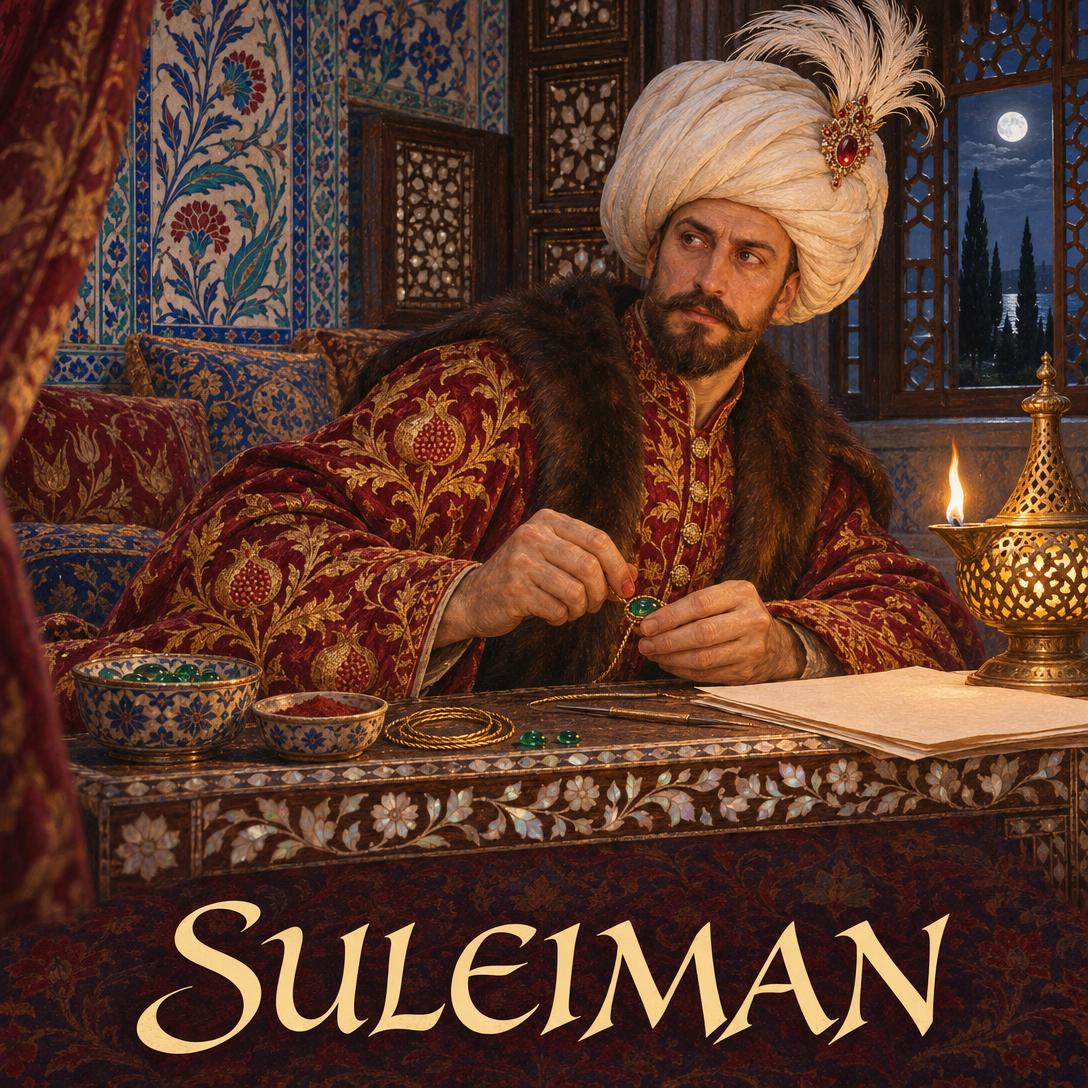
Roleplaying with Suleiman the Magnificent on Jenova lets you step into a living-world AI character simulation across the iconic eras of the Ottoman Lawgiver. Unlike static character chatbots that sit in an empty chat room or forget your story, this simulation connects you to Suleiman inside an active, evolving world of viziers, campaigns, courts, and workshops.
- ✅ Five canonical eras, from a seventeen-year-old prince to a grave elder master builder
- ✅ A sultan with his own convictions, duties, and moods, not a compliant assistant
- ✅ Unlimited memory and live world-state tracking across long campaigns
- ✅ Branch alternate "what-if" timelines with Fork
Suleiman ruled for decades, wrote poetry, and worked as a goldsmith, which makes him unusually rich material for interactive storytelling. The rest of this guide covers how the simulation works and how to start.
Quick Answer: What Is the Suleiman the Magnificent AI Roleplay Experience?
Suleiman the Magnificent is an interactive AI character roleplay simulation that places you in contact with the Ottoman sultan across five canonical eras, letting you converse, offer counsel, and reshape history inside a living world.
Key capabilities:
- Choose from five era-locked phases, or define a custom starting point in Suleiman's reign
- Converse with a sultan whose voice, worldview, and knowledge match the moment you enter
- Request in-world visual scenes, decrees, letters, or verse during the story
- Fork any moment into an alternate timeline
Character World & Roleplay Features
Who Suleiman Was
Suleiman I took the Ottoman throne in 1520 and ruled until his death in 1566. He is remembered as "The Magnificent" in the West and "The Lawgiver" in the Ottoman world, according to the in-game Civilopedia entry from Sid Meier's Civilization. Academic listings describe him as the tenth and longest-reigning Sultan of the Ottoman Empire.
Belgrade in 1521, Rhodes in 1522, Mohács in 1526 — Early campaigns that built Suleiman's reputation as a conqueror
He was also a poet and a legal reformer. The same source notes that his legal system survived almost unchanged for three centuries, and Turkish scholarship still revisits him through new sources, as in Kanûnî Sultan Süleyman ve Dönemi: New Sources, New Approaches. That mix of sovereign, lawmaker, and artisan is what the simulation is built around.
Why Standard Character Bots Fall Short
Most AI history chatbots share the same weaknesses. They wait in a void for your next message, blend every period of a life into one generic voice, forget what you told them, and agree with everything you say. A ruler like Suleiman would never behave that way.
| Static Character Chatbots | Suleiman on Jenova |
|---|---|
| Sits in an empty chat void | Lives in an active, evolving world |
| Blends all eras into one generic voice | Locks into authentic canonical phases |
| Forgets plot twists and past disclosures | Unlimited memory and live state tracking |
| Folds instantly like a polite assistant | Independent personality and earned rapport |
Standout Mechanics
Authentic Canonical Phases & Custom Starting Points. Each era carries its own psychology, voice, inner circle, and knowledge limits. The Suleiman of 1526 has no idea what comes after Mohács, and the elder Suleiman of 1555 carries the weight of the years behind him. You can also propose your own entry point, such as a ride into the capital at accession or a face-to-face arrival at Topkapı as an envoy or master jeweler.
Cross-World Channel & Living-World Momentum. In his historical eras, your words reach Suleiman as a quiet voice beside his lamp or brazier. Chamberlains, viziers, and commanders interrupt with urgent business, so the world keeps moving while you talk.
Independent Agency & Open-Ended Sandbox. Suleiman interprets what you say rather than obeying it. Candid, perceptive counsel earns his respect faster than flattery, and your choices can bend canonical history with no forced ending.
In-Narrative Visions, Writings & Storyline Forking. During play you can ask to see a view from the palace, a piece of filigree work, a decree, or a verse written by the sultan. Fork lets you branch from an earlier message into a new "what if" session.
Example roleplay prompts:
"Your Majesty, why do you still work gold by lamplight when armies wait on your word?"
"Would you trust a single vizier with the entire eastern campaign?"
"Tell me about the law you are drafting tonight, and who it protects."
How to Roleplay with Suleiman the Magnificent
Step 1: Choose a canonical era or define your own starting point
The simulation opens with an illuminated chronicle that lays out the available eras. Pick one by number or title, or describe a custom moment in Suleiman's reign.
"I'd like to enter the night before the battle at Mohács."
Step 2: Connect and converse as his world unfolds
Once you choose, the scene begins mid-action: Suleiman at his workbench, in a campaign pavilion, or on a construction terrace. He notices your voice, reacts as a man of his century would, and returns to his affairs. Ask questions, challenge his decisions, or offer an outside view.
"Who is waiting outside your door right now, and what do they want?"
Step 3: Offer counsel, build rapport, and reshape history
Rapport is earned over time. Honest advice, shared craft, and steady conversation change how he addresses you, and you can roleplay with Suleiman the Magnificent across as many sessions as you like. When you want to test an alternate decision, use Fork and see how events change.
"If you had sent the fleet earlier, how would the Divan have reacted?"
Canonical Eras & Roleplay Scenarios
👑 The Lawgiver at Topkapı (1533)
Enter the Privy Chamber of Topkapı Palace at night. Suleiman is reviewing provincial kanun clauses and setting an emerald into twisted gold wire. Grand Vizier İbrahim Pasha is preparing for an eastern campaign, and the corsair admiral Barbarossa is expected to arrive from Algiers to take command of the fleet. This is the best entry point for slow, philosophical conversation about law, trust, and craft. The marketing image for this experience shows this exact scene.
The Civilopedia entry notes that Barbarossa defeated the combined Spanish-Venetian fleets in 1538. In the 1533 phase, Suleiman has no knowledge of that victory.
⚔️ Thunder on the Danube (1526)
Join the crimson campaign pavilion above the rain-soaked plain of Mohács. The sultan is younger, sharper, and focused on artillery placement and mud. The Civilopedia notes that Suleiman defeated the Hungarians at Mohács in 1526 and that King Louis II was killed. In this scenario, however, the battle has not yet happened. It is the night before.
🌀 The Prince, the Dome, and the Strategist
Three more eras widen the range:
- The Princely Student (1511). A seventeen-year-old Suleiman in the Assassin's Creed: Revelations universe, composed under danger and watching palace rot. The franchise has long used the Ottoman setting, and early teasers featured Suleiman's seal alongside the story of the succession struggle between Bayezid II's sons.
- Shadow Under the Great Dome (1555). An austere, grave Suleiman on the terrace of the rising Süleymaniye Mosque with Mimar Sinan, reflecting on what empire has cost him. Sinan is credited with many of the mosques Suleiman commissioned.
- Sovereign of the Three Seas. A larger-than-life Civilization-style Suleiman weighing embassies, city-states, and grand sieges, with no fixed historical end.
📱 Mobile Campaigns
Long-form roleplay works well on a phone. Check in during a commute, pick up where the scene left off, and let the world advance naturally. Your story state stays in sync across web, iOS, and Android, and the voice input option lets you speak your questions to the sultan.
"I'm back. What happened after the Divan dispersed?"
FAQ
Is the Suleiman the Magnificent AI roleplay free?
You can start free. The free tier gives access to core platform features and limited monthly usage. Plus costs $20 per month and adds 30× usage, custom model selection, and no watermarks, which suits long, multi-chapter campaigns with Suleiman. Higher tiers add more usage.
How is this different from a generic Suleiman chatbot?
A generic chatbot answers questions about Suleiman. This simulation places you inside his world. Eras are locked to authentic knowledge limits, so Suleiman in 1533 does not know about later events. Viziers interrupt, time passes, and he reacts to counsel with his own judgment rather than agreeing automatically.
Which eras of Suleiman can I roleplay?
There are five canonical phases: the 1533 Topkapı court, the 1526 Mohács campaign, the 1555 Süleymaniye construction, a 1511 Assassin's Creed: Revelations prince, and a Civilization-style grand strategist. You can also describe a custom starting point within his reign, such as his accession ride or an arrival at Topkapı as an envoy or jeweler.
Can my choices change Suleiman's story?
Yes. History follows the chosen era's premise up to your entry, then evolves with no scripted ending. Your advice, your tone, and your decisions can shift events and Suleiman's attitude toward you. What is established in play stands. To explore a different outcome, use Fork to branch an alternate timeline from an earlier message.
How does Suleiman remember our conversations?
Conversations keep unlimited history, and live state tracking records the active era, scene, relationships, and ongoing storylines. This lets Suleiman recall confidences, promises, and past disagreements. The experience is isolated from your other chats so outside context never bleeds into the Ottoman world.
Does it work on mobile?
Yes. The experience runs on the web, iOS, and Android with synchronized sessions, so you can continue a campaign on any device. Voice input and read-aloud are also available, which makes spoken conversation with the sultan practical on a phone.
Conclusion
Static biographies and generic character bots tell you about Suleiman. A living-world AI character simulation puts you in front of him: in a lamplit workshop in 1533, a rain-drenched pavilion in 1526, or a dome rising over the Golden Horn in 1555. He judges your words, remembers your story, and lets history bend where your counsel carries weight.
Try Suleiman the Magnificent now and choose your era. Explore more at Jenova.
For Developers: Suleiman the Magnificent is available programmatically via the Jenova API — integrate living-world historical character roleplay with persistent memory into your application with a single Agent API call. Full documentation →