AI Story to Manga: Turn Your Story Into Finished Manga Pages
2026-08-11
The Manga Creator works as your personal mangaka — taking a story you've written, outlined, or only half-imagined and building it into finished manga pages with a locked cast, deliberate panel flow, and dialogue placed where the eye actually travels. Most AI manga tools generate one panel per prompt and leave you to staple the results together. This agent reads your story as a narrative structure and produces sequential art the way a working manga artist would.
✅ Convert prose, outlines, scripts, or rough story ideas into paneled manga pages ✅ Lock character designs once and hold them consistent across every page and chapter ✅ Panel layout, camera distance, and page-turn pacing derived from your story beats ✅ Scale from a one-shot to a 200+ page serialized epic without losing visual coherence
To understand why story-to-manga conversion is dramatically harder than generating a single anime-style image, it helps to look at exactly what breaks the moment a narrative spans more than one panel — and why readers detect those failures instantly.
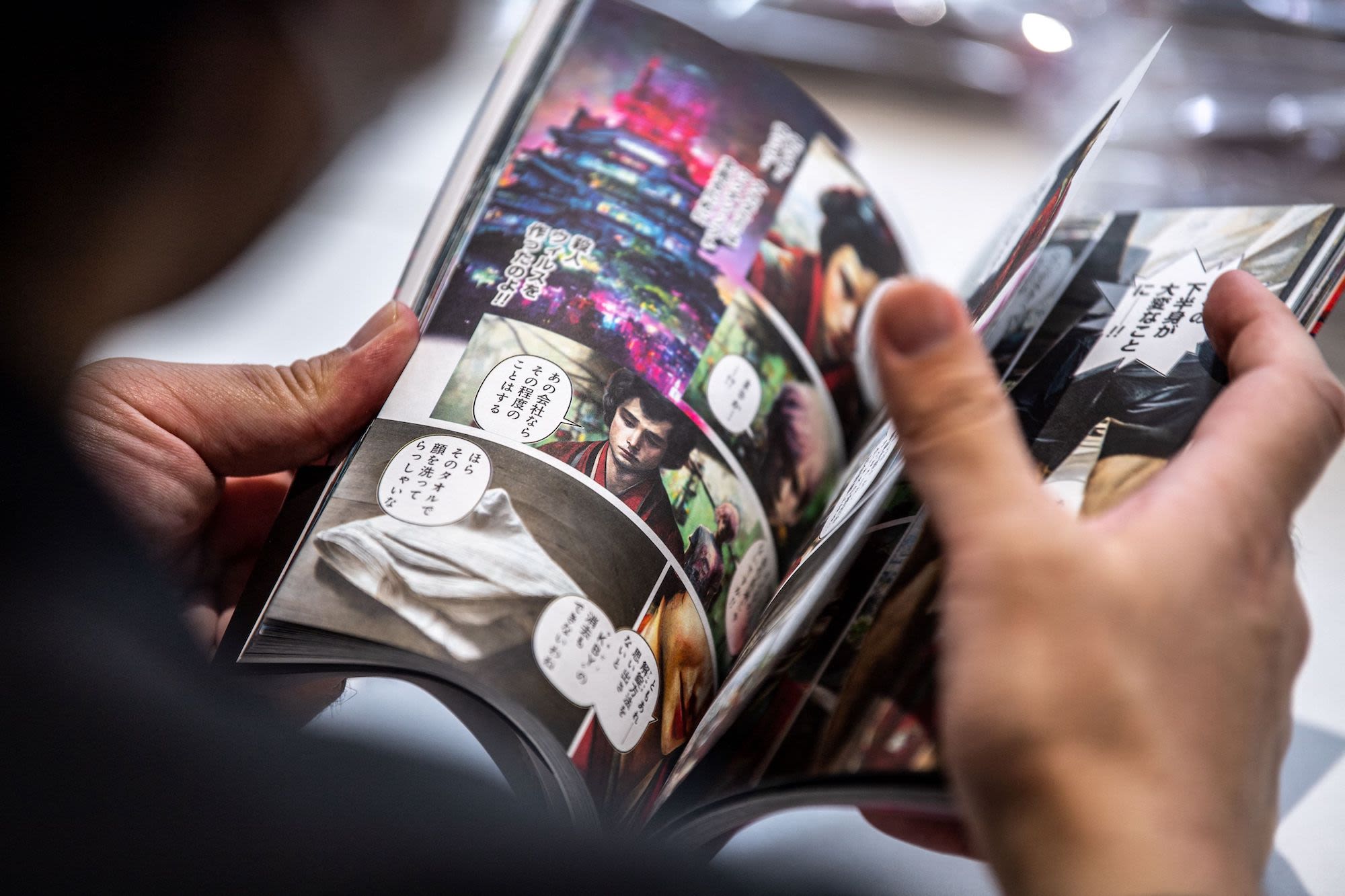
Quick Answer: What Is AI Story to Manga?
AI story to manga is the process of converting written source material — a story outline, prose chapter, script, or premise — into sequential manga pages with consistent characters, structured panel layouts, and integrated dialogue, rather than isolated illustrations.
Key capabilities:
- Parse a written story into scene beats and translate them into panel sequences
- Maintain character identity across every page with Manga Creator
- Compose panel layouts using manga conventions — reading direction, gutters, page turns
- Place speech bubbles, captions, and sound effects within the reading flow
- Hold a single art style across chapters, from one-shot to long-running series
The Problem: Why Stories Fall Apart on the Way to Panels
Demand for manga has never been higher. The manga market was valued at $10.2 billion in 2025 and is projected to reach $43.9 billion by 2033 at a 20.5% CAGR, with the U.S. segment alone growing at 24% annually through 2030. The AI-generated comic segment specifically was valued at $1.8 billion in 2025 with projections to $9.6 billion by 2034.
Tooling has multiplied to match. Platforms like Anifusion offer to "turn your story into manga pages with built-in layouts, characters, speech bubbles, and editing tools," and dozens of similar generators exist.
But actually getting a story onto manga pages remains frustratingly difficult:
- Tools generate one image per prompt rather than a structured sequence from a document
- Your protagonist becomes a stranger between page one and page five
- Art style drifts — screentone density, line weight, and palette shift across panels
- Every panel comes out the same size and camera distance, flattening all pacing
- Dialogue gets pasted over finished art instead of composed into the panel
- A long story has to be manually chopped into hundreds of separate prompts
Cross-Page Consistency Is an Open Research Problem
This isn't a complaint about one bad tool — it's a formally recognized limitation. A survey in Artificial Intelligence Review introduces a six-dimensional consistency model spanning time, space, character, event and plot, style, and theme that any sequential AI narrative must maintain simultaneously.
The authors define the requirement precisely: cross-page narrative consistency "refers to the stable preservation of story elements—such as character identity, spatial layout, visual style, and thematic intent throughout the book."
Their verdict on current tooling is blunt: "most advances remain fragmented and are unable to capture the cross-dimensional interactions that drive real inconsistencies."
Six dimensions — time, space, character, event/plot, style, and theme — must all hold at once for a sequential narrative to read as coherent, per Artificial Intelligence Review
Style Drift Compounds Over Long Stories
The same survey identifies a failure mode that punishes long-form work specifically. Even when characters hold, "residual viewpoint and framing shifts across pages" persist, and there's a documented "tension between locking style and preserving content alignment." The result: panels that are "on-style yet under-express salient entities or actions."
For manga — where a serialized story might run hundreds of pages — that drift accumulates until chapter twelve doesn't look like it belongs to chapter one.
Panel Flow Is a Craft Discipline, Not a Grid
A story beat reads "She turns. He's already gone." Converting that into manga requires decisions no image generator makes: how many panels, what widths, where the gutters fall, which beat gets the silent close-up, and — critically for manga — where the page turn lands. Panel size and camera progression are the pacing. Manga's right-to-left reading direction and characteristic use of negative space and vertical panel stacking are a distinct visual grammar, not a style filter.
Readers Judge Consistency Hardest
Audience research from the Arts Management and Technology Lab surveyed 108 comic and manga readers on an AI-generated comic. The finding that matters most: frequent readers responded significantly more negatively on two specific dimensions — conveyance and consistency. As the researchers put it, "the reading enthusiasts acknowledged the truth of the comic: it wasn't that good. They were harder to please than casual readers."
43.52% of surveyed readers said they would not consider purchasing comics with AI-generated panels, while 44.44% answered "maybe" — Arts Management and Technology Lab reader survey
The encouraging half of the same data: when consistency held, "a majority of Group A participants were surprised and impressed that Midjourney was able to generate panels with such a high level of consistency." Execution quality — not the use of AI — determined the reaction.
Your Story Is Where Your Authorship Lives
If you plan to publish, there's a legal layer worth understanding. The U.S. Copyright Office concluded that generative AI outputs are protectable "only where a human author has determined sufficient expressive elements", noting this "can include situations where a human-authored work is perceptible in an AI output, or a human makes creative arrangements or modifications of the output, but not the mere provision of prompts."
Analysis from Brookings tracks how this has played out in practice, with protection in early determinations centered on "the selection, coordination, and arrangement" of a work's elements.
For story-to-manga work this is genuinely favorable: your story is human-authored expression. The plot, dialogue, character arcs, and panel direction are yours. A workflow where you write and direct — rather than roll prompts and hope — puts your authorship on the strongest available footing.
This is exactly what Manga Creator was built for.
The Solution: Why Manga Creator Reads Stories Differently
Manga Creator treats your story as a structural document rather than a prompt. It breaks scenes into beats, beats into panels, and panels into composed pages — while holding your cast's visual identity constant across the entire run.
The architectural difference is persistence. Instead of each panel being an isolated generation with no memory of the last, your characters, art direction, and world details live in memory and constrain everything that follows. A 200-page serialized epic and a 16-page one-shot move through the same pipeline.
| Prompt-Based Manga Generator | Manga Creator |
|---|---|
| One image per prompt, manually assembled | Full story parsed into structured page sequences |
| Character identity resets each generation | Locked designs persist across pages and chapters |
| Uniform panel grid regardless of content | Layout and camera derived from narrative beats |
| Dialogue pasted over finished art | Bubbles composed into the reading flow |
| Style wanders over long sequences | Unified art direction held across the full series |
| Long stories require hundreds of manual prompts | Chapters processed as continuous narrative |
Any Story Format Works as Input
You don't need to reformat into a standard manga script. Prose chapters, screenplay format, a scene-by-scene outline, a rough premise, or a handful of bullet-point beats all function as usable source material. The agent extracts what matters — who's present, what happens, what's said, and the emotional register of each moment.
"Here's the outline for my fantasy one-shot. A young mage enters an enchanted forest for his trial, provokes the spirits living there, and has to make it right. Twelve pages. I want the forest to feel beautiful before it feels dangerous."
Characters Locked Before Production Begins
Design first, production second. You establish the cast's visual identity — face, hair, proportions, costume, silhouette — confirm it, and lock it. Every panel afterward references that locked design instead of reinterpreting a text description from scratch.
"Design the two leads: the apprentice, mid-teens, dark hair, travel cloak over practical gear, reads as competent but out of his depth. And the treant — ancient, enormous, bark-textured, more grieving than monstrous. Show me both from three angles before we start pages."
Panel Flow Derived From the Beats
This is what separates manga from illustrated text. The agent varies panel width and camera distance according to what each beat needs — a wide establishing shot to orient the reader, progressive tightening as tension builds, a full-width panel for the reveal, a silent panel where the story calls for a pause.
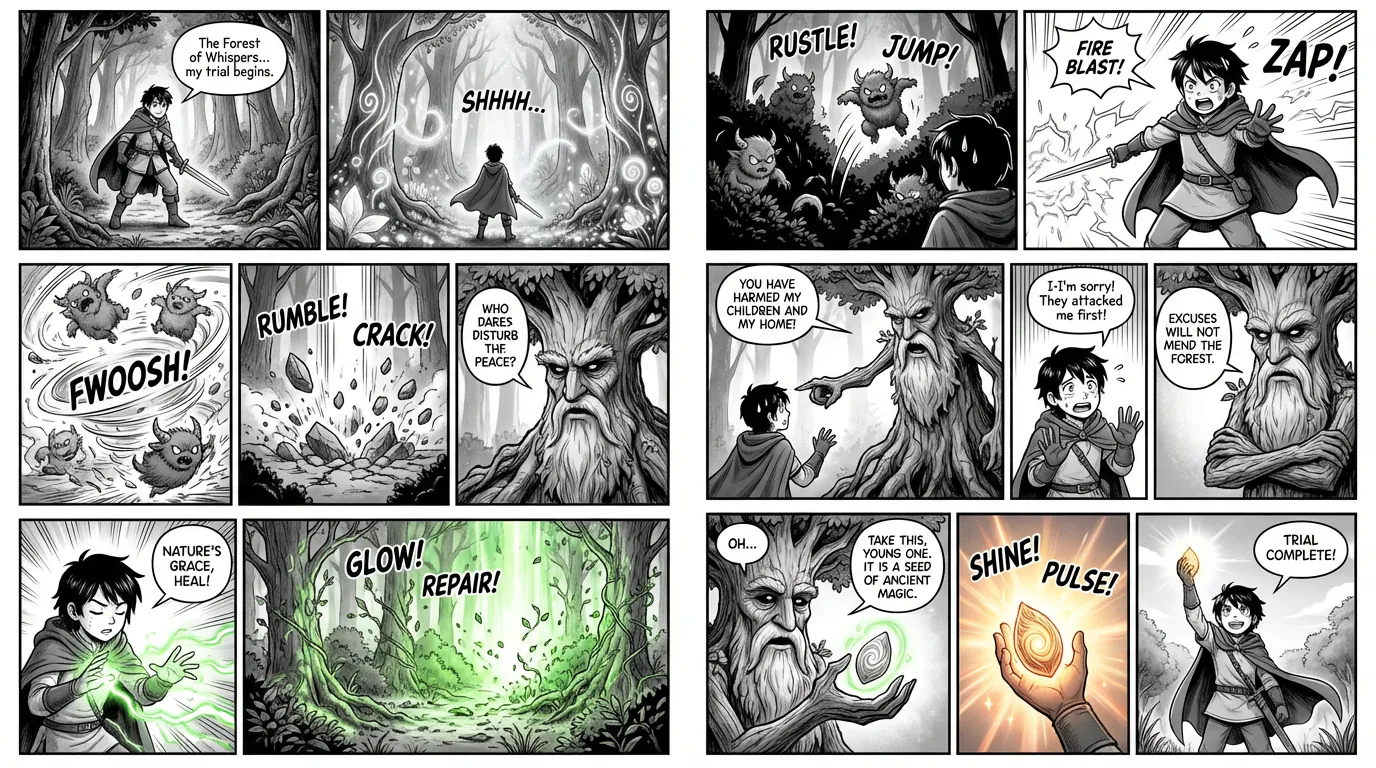
"Page seven is the confrontation. Start with the treant filling a full-width panel so he dwarfs everything. Then three tight panels on the apprentice's face as he realizes what he's done. End on a small silent panel — just his hand, open."
Genre Fluency as Visual Grammar
Shonen action, shojo romance, seinen realism, and josei each carry their own conventions — proportional exaggeration, screentone use, panel density, framing tendencies, and how emotion is rendered. The agent works with these as complete visual vocabularies rather than surface filters, so a shojo scene reads as shojo in its composition and pacing, not just its eyelashes.
Dialogue and Sound Effects as Composition
Speech bubbles direct the eye and determine reading order, and reading order determines whether a beat lands. The agent composes bubble position, tail direction, caption placement, and sound-effect integration as part of the panel — with room reserved in the art, not text dropped on top of finished work.
Scale From One-Shot to Serialized Epic
Because character and style specifications persist across sessions, long-form projects stay coherent. Return weeks later, pick up at chapter eight, and your cast still looks like your cast.
Related Agents You'll Also Find Useful
Story-to-manga work sits between writing and visual production. These agents cover what typically comes immediately before and after.
Creative Fiction Writer
If your story isn't structurally sound yet, no amount of good art will rescue the adaptation. Useful for building the narrative before conversion.
- Story structure and arc development across any genre
- Deep research for authentic worlds and settings
- Polished prose from first draft through final manuscript
Comic Creator
For stories targeting Western sequential art conventions — left-to-right reading, different panel rhythm, and a distinct page architecture.
- Sequential art fundamentals and dynamic layout composition
- Bold visual styles across single issues and graphic novel sagas
- Complete story crafting from concept to finished pages
Webtoon Creator
When your story is destined for vertical-scroll platforms, the format changes everything — panel spacing becomes pacing, and every episode needs an engineered hook.
- Vertical scroll rhythm and mobile-first composition
- Episode-level cliffhanger structuring for serialized release
- Full-color consistency across 100+ episode runs
Film Screenwriter
For tightening structure, dialogue, and scene construction before adaptation — screenwriting craft translates unusually well to panel work.
- Expert guidance through concept, outline, draft, and revision
- Structure, dialogue, and character development
- Visual storytelling instincts that map directly onto panels
Try Manga Creator free — no credit card required.
How It Works: From Story to Finished Manga Pages
Step 1: Provide Your Story
Paste it, upload it, or just describe it. Prose chapters, a screenplay, a scene outline, or a loose premise all work. Include any tone or reference notes you have.
"Attaching chapter one of my manuscript. Target is a 20-page opening chapter. Keep the dialogue as written but cut narration wherever the art can carry it."
Step 2: Establish and Lock Your Cast
Before any pages are produced, settle character designs and art direction. This is the step that prevents drift on page forty — and the one most creators skip.
"Lock these three designs. Give me a reference sheet for each — front, three-quarter, profile — plus the screentone and contrast approach we're holding across the chapter."
Step 3: Approve the Page Breakdown
Review how your story maps onto pages and panels before art is generated. Adjust beat distribution, page breaks, and panel counts while changes are still cheap.
"Move the reveal to the top of page eleven so it hits on a page turn. Compress the travel sequence from two pages to one — it's slowing the act."
Step 4: Generate the Pages
With the cast locked and the breakdown approved, the agent produces composed pages — layout, art, and lettering together — following your story's beats and pacing.
"Build pages one through eight. Open on a wide forest establishing shot, then follow the breakdown we agreed on."
Step 5: Refine and Continue the Series
Adjust individual panels, rewrite dialogue, retune composition, and move into subsequent chapters. Your specifications persist, so later sessions resume exactly where you stopped.
"Panel three on page six needs a lower angle to make him feel smaller against the treant. Then start chapter two — same cast, same style, new location."
Results & Use Cases
📖 Adapting a Novel Into a Manga Chapter
Scenario: A self-published fantasy author wants to adapt their opening chapter into manga to reach readers who'd never commit to a 400-page novel. They have prose, not a manga script.
Traditional Approach: Hire an adapter to convert prose into a manga script, then an artist at $150–$400 per page, then a letterer — a three-to-six-month pipeline before a single readable page exists.
Manga Creator: Chapter parsed into a paged breakdown, cast locked, and finished pages produced in a working session — with the author directing every structural decision.
- Prose adapted into panel beats without a separate scripting stage
- Consistent cast across the full chapter and into the next
- Complete control over what gets compressed, expanded, or cut
💼 Building a Serialized Series on a Schedule
Scenario: A creator posting a weekly chapter needs to convert an ongoing story into pages without falling behind, and has already burned through two hiatuses.
Traditional Approach: 15–25 hours of art production per chapter, forcing repeated breaks and steady audience churn.
Manga Creator: Story-to-page conversion that sustains a weekly cadence, with cast and style persisting automatically across every chapter.
- No re-establishing character designs each week
- Visual coherence maintained across a 100+ page run
- Pairs naturally with Webtoon Creator for vertical-scroll releases
📱 Drafting Stories on Mobile Between Sessions
Scenario: A creator with a 90-minute daily commute wants to develop story beats and character notes on their phone, then produce pages on desktop at home.
Traditional Approach: Notes-app fragments and half-remembered ideas that never reach the actual project.
Manga Creator: Full story development on mobile with persistent memory — the desktop session picks up exactly where the commute ended.
- Complete feature parity across web, iOS, and Android
- Speech-to-text for describing scenes hands-free
- Everything syncs; nothing gets lost between devices
🎯 Testing a Story Idea Before Committing
Scenario: A writer has three competing premises and wants to see which one actually works as manga before investing months in one.
Traditional Approach: Commission sample pages for each concept at significant cost, or guess and hope.
Manga Creator: Short proof-of-concept sequences for each premise, rendered in a consistent style so the comparison is genuinely about the story.
- Direct comparison of narrative concepts, not art quality noise
- Fast iteration on tone, genre treatment, and cast before production
- The winning concept's designs become the locked reference going forward
FAQ
Is the AI story to manga tool free?
Yes — you can start converting stories into manga pages on Jenova's free tier, which includes all core features with limited monthly usage. Paid plans scale usage substantially and remove watermarks from generated output. Usage resets monthly on your billing date with no daily caps, so your full allowance is available from the first day of each cycle.
What story formats can it work with?
Prose chapters, novel excerpts, screenplay format, standard comic script format, scene outlines, and rough bullet-point beat sheets all work. Manga Creator extracts narrative structure — characters, action, dialogue, and emotional register — rather than requiring a specific template.
How does it keep characters consistent across a long story?
Character designs are locked before page production begins, then persist across pages, chapters, and sessions. This matters more than raw image quality: research identifies character identity as one of six consistency dimensions sequential narratives must hold, and reader surveys show consistency is exactly where frequent readers judge AI work most harshly.
Can it produce a full serialized manga, not just a one-shot?
Yes. Because specifications persist across sessions, long-form projects stay coherent — produce chapter one, return weeks later, and continue with the same cast, style, and visual language intact. The same workflow scales from a 16-page one-shot to a 200+ page serialized epic.
What manga art styles does it support?
Shonen, shojo, seinen, josei, chibi, and hybrids of these. Genre is treated as a complete design vocabulary — proportions, line weight, screentone approach, panel density, and framing conventions — rather than a surface filter applied over a generic base.
Can I copyright a manga made from my own story?
Your story is human-authored expression, which is the strongest available foundation. The U.S. Copyright Office holds that AI outputs are protectable only where a human author determined sufficient expressive elements, noting that mere provision of prompts isn't enough but creative arrangement and modification can be. Your plot, dialogue, and panel direction are yours. This area is actively evolving — consult a qualified attorney for your specific situation.
Does it work on mobile?
Yes, with full feature parity across web, iOS, and Android. Draft or paste stories on your phone, use speech-to-text to describe scenes, and continue on desktop — projects, character designs, and conversation history sync across all devices.
Conclusion
The bottleneck in AI story-to-manga conversion was never image quality. It was that a story is a structure — beats, pacing, page turns, and a cast that has to stay recognizable from page one to page two hundred — and prompt-based generators have no concept of any of it. Academic work now formalizes exactly why: consistency across time, space, character, plot, style, and theme has to hold simultaneously, and fragmented tools can't manage it.
Treating your story as the source of truth changes the equation. Characters get locked before production. Panel layout derives from your beats rather than a fixed grid. Dialogue is composed into the art instead of pasted onto it. And your authorship stays where it belongs — in the writing and the direction.
Bring your story, lock your cast, and start producing pages. Try Manga Creator now.
Explore more at Jenova.
For Developers: Manga Creator is available programmatically via the Jenova API — integrate story-to-manga conversion and sequential art generation into your application with a single API call. Full documentation →