AI Story State Tracker: Keep Plot Beats and Character Arcs Aligned
2026-09-09
Film Screenwriter helps you keep a living story state tracker by logging plot beats, character knowledge, and theme pressure as you outline, draft, and revise. While most writers lose continuity across beat sheets, research folders, and draft versions, this AI holds the current state of the story and uses it on every pass. In September 2026, original scripts are in high demand, yet the bottleneck is rarely typing scenes. It is knowing exactly where the narrative stands, what the protagonist still believes, and which structural promise is still unpaid.
✅ Maps Save the Cat beats, four-part structure, and custom outlines ✅ Remembers what each character knows after every scene ✅ Flags theme drift, missing catalysts, and unresolved debates ✅ Works on web, iPhone, and Android with the same story memory
To understand why a dedicated story state tracker matters, look at how easily a draft can satisfy a scene and still break the movie.
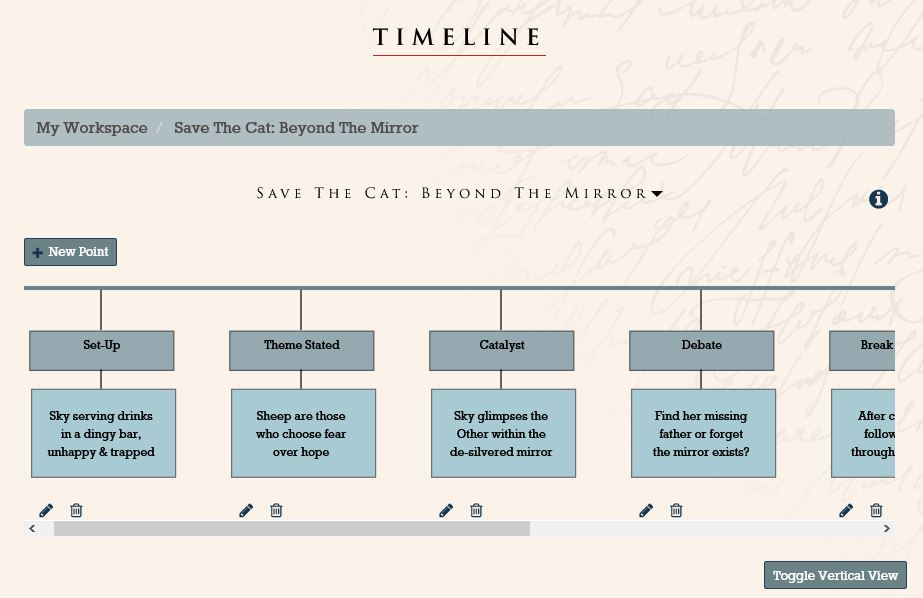
Quick Answer: What Is a Story State Tracker?
Film Screenwriter is an AI story state tracker that maps plot beats, character arcs, and theme so a screenplay stays consistent from setup through resolution. It treats structure as a living record, not a static outline you outgrow after page ten.
Key capabilities:
- Beat-level tracking for Set-Up, Theme Stated, Catalyst, Debate, and the turns that follow
- Character-state logs: knowledge, want, wound, and the lie the hero still believes
- Theme pressure that stays visible from the first statement through the final image
- Continuity audits before you write the next sequence, not after a reader finds the hole
Why Writers Lose the Story Mid-Draft
A finished scene can still be the wrong scene. The dialogue lands, the location is visual, and the page looks like a movie—yet the hero has not paid the structural debt the last beat created. That gap is why writers reach for corkboards, notecards, and novel software built to keep track of character and plot development.
Demand for original scripts is not theoretical. The U.S. screen and script writing software market was estimated at $188 million in 2025, with growth tied to streaming, independent production, and tools that promise cleaner workflow. The market does not solve the craft problem underneath it.
$188 million — Estimated U.S. screen and script writing software market in 2025
$221 million — Projected size of that market by 2032
2.3% CAGR — Forecast growth from 2026 to 2032 as cloud, mobile, and AI features spread
But keeping a true story state tracker is still frustratingly difficult:
- Beat sheets freeze while the draft keeps moving
- Character knowledge drifts from scene to scene
- Theme is stated once, then abandoned for plot mechanics
- Multi-plot and multi-POV timelines collide without a single source of truth
Beat Sheets That Stop Updating
Save the Cat and similar models only work if the current beat is honest. A timeline that still says “Debate” while you are writing midpoint reversals is decoration. Visual plotting tools exist because A and B plots, dual timelines, and points of view need to be seen in relation to each other. Most writers update the manuscript and forget to update the map.
Character Knowledge That Quietly Breaks
The audience can know more than the hero. The hero cannot know a fact you have not given them. When that rule slips, later scenes invent explanations, or earlier scenes become lies. File organizers store bios. They do not interrogate whether Sky, standing at a de-silvered mirror, has earned the choice you are about to force.
Theme That Never Re-Enters the Room
“Sheep are those who choose fear over hope” is a usable Theme Stated. It is useless if Act Two never makes fear cheaper than hope. Screenwriting effectiveness still hinges on structure and format working together, and theme is part of structure, not a poster quote.
Outlines, Bibles, and Drafts in Three Places
AI co-author products sell the same stack for a reason: a story bible, character profiles, a chapter outline, and a running Story State tracker so voice and logic do not drift. When those live in separate docs, the draft becomes the only “state,” and the draft is the least reliable witness.
This is exactly what Film Screenwriter was built for.
Why Film Screenwriter
Film Screenwriter treats story state as the job, not a side note. You bring a concept, a structure model, and the current draft. It keeps the beat you are actually on, the lie the hero still believes, and the thematic test the next scene must run. The result is not a pile of notes. It is a working record you can query before you write page 47.
| Traditional Approach | Film Screenwriter |
|---|---|
| Static beat sheet in a separate file | Living beat log updated after each scene |
| Character bios that never meet the plot | Knowledge, want, and wound checked against the current turn |
| Theme written once in a pitch doc | Theme pressure carried into Debate, Midpoint, and finale |
| Research, outline, and draft in three apps | One conversation that remembers the story across sessions |
| Continuity found by a reader months later | Continuity audit before the next sequence |
Structure You Can Interrogate
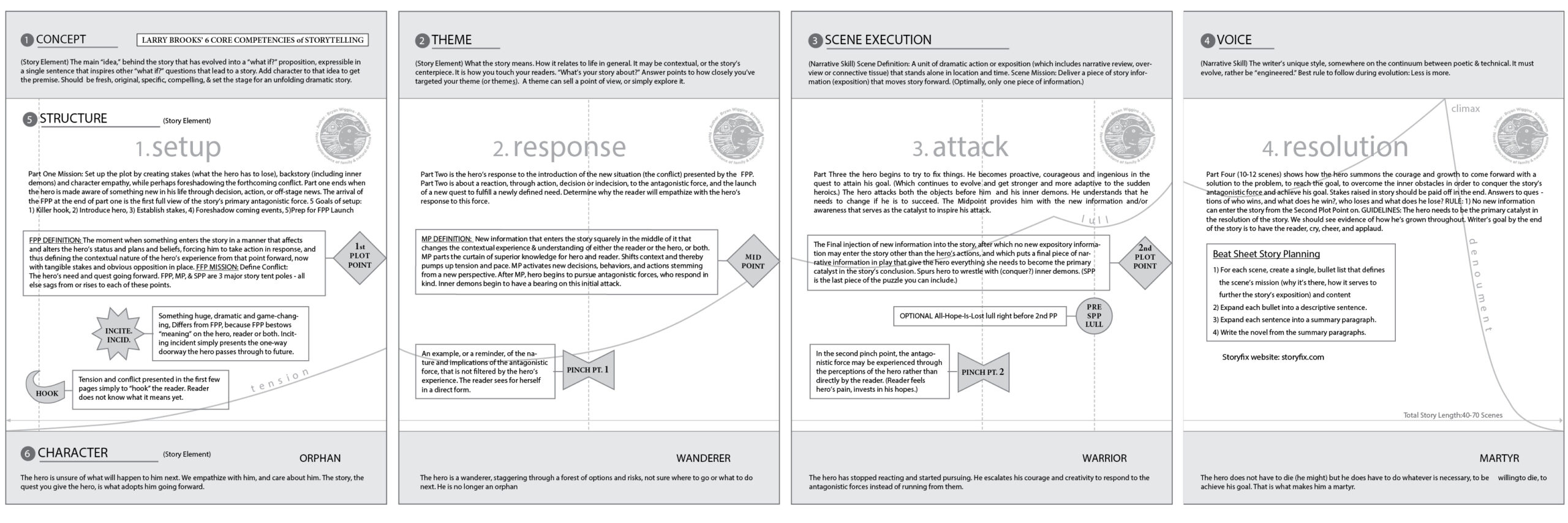
Ask where you are in Save the Cat, a four-part setup-response-attack-resolution model, or a custom sequence outline. The tracker should answer with the beat, the unpaid promise, and the next pressure, not with a generic pep talk.
Character Arcs as State, Not Personality
Orphan, wanderer, warrior, and martyr are not costumes. They are positions on an arc. A useful story state tracker knows whether the hero is still gathering options or has already stepped into pursuit—and refuses a warrior scene while the character is still an orphan.
Theme and Voice Held to the Same Standard
Concept, theme, structure, and voice only cohere when each scene earns the next. That is the point of tracking more than plot mechanics: the unique voice of the story has to be earned in execution, not declared in a logline.
Scene Execution Against the Tracker
A scene is not “good” if it is merely vivid. It must move information, raise the cost of the hero’s lie, or force a choice the structure has been aiming at. Prompt the tracker to score the scene against the current beat before you fall in love with the dialogue.
"Track this as Save the Cat. Protagonist Sky serves drinks in a dingy bar, unhappy and trapped. Theme: sheep choose fear over hope. Catalyst: she glimpses the Other in a de-silvered mirror. Log Set-Up through Debate, then tell me the Debate question and what Break Into Two must cost her."
"Update story state: Sky has entered Break Into Two. She still hopes the mirror is grief, not a door. List what she knows, what the audience knows, and the three scenes that must attack her fear-over-hope lie."
Related Agents You'll Also Find Useful
If the same project needs prose, sequential art, or episode engines after the film outline is stable, these partners extend the same discipline.
Writing Assistant — Use it when the beat sheet is locked and you need pages that sound like you, not like a coverage report. It adapts to format and audience while you keep structural truth in the tracker.
- Drafts chapters or treatments against an existing outline
- Editorial passes that preserve voice
- Useful when a screenplay proof-of-concept becomes a novel
Manga Creator — Visual stories fail when panel flow forgets the prior page’s state. This agent holds character designs, page rhythm, and arc continuity from one-shots through long serials.
- Panel-to-panel storytelling with consistent art direction
- Arc tracking across chapters
- Practical when your film outline wants a manga proof
Microdrama Screenwriter — Vertical seasons live or die on episode-level state: cliffhangers, paywall turns, and what the viewer still believes at minute four. Sixty to one hundred episodes make a story state tracker non-negotiable.
- Season architecture with hook-and-hold pacing
- Dialogue built for mobile viewing
- Continuity across cliffhangers so reveals do not collide
Try Film Screenwriter free — no credit card required.
How a Story State Tracker Works in Practice
Step 1: Name the Structure and the Current Beat Open the AI screenwriter and state the model you are using—Save the Cat, four-part structure, sequences, or a hybrid. Give the logline, the hero’s wound, and the last beat you trust. You should leave this step with a labeled state, not a mood.
"Save the Cat feature, 110 pages. Genre: supernatural drama. Hero: Sky, bartender, missing father. We are at Catalyst. Do not skip Debate."
Step 2: Freeze Character Knowledge and Theme List what the hero knows, what they want, what they fear, and the theme sentence that must keep returning. This is the difference between a bible and a tracker: the bible describes the world; the tracker describes the present.
"Sky does not know if the Other is real. Audience saw the mirror change. Theme stated: fear over hope. Keep that as the Debate axis."
Step 3: Write or Outline Only the Next Obligation Ask for the next scene or sequence that the current beat requires. A Debate scene that already “breaks in” is a structural error, even if the set piece is strong. Have the tracker refuse illegal moves.
"Give me three Debate options that keep Sky in the bar world. One must tempt her to forget the mirror. None may complete Break Into Two."
Step 4: Update State After the Scene Lands When you accept a scene, tell the tracker what changed: location, knowledge, relationship, and which beat is now closed. Plot structure templates only help if each beat is filled with what actually happens at that time in the story.
"Accepted: Sky pockets a shard of the mirror and tells herself it is junk. Debate is still open. Update the tracker and name the Break Into Two price."
Step 5: Audit Before You Cross a Major Turn Before Midpoint, Break Into Three, or Finale, run a continuity pass. Check unpaid plants, POV leaks, and theme absences. This is cheaper than discovering in a table read that Act Two never answered Theme Stated.
"Audit Acts One and Two. Flag any fact Sky uses that she has not earned, and any Theme Stated echo missing from the attack section."
Results & Use Cases
🎬 Feature Outline That Survives Draft Two
- Scenario: You have a supernatural feature about Sky and a de-silvered mirror. Act One is vivid. Act Two is a pile of set pieces.
- Traditional Approach: A corkboard plus a draft in Word. After six weeks the beat sheet still says Catalyst.
- Film Screenwriter: You keep a current beat, a knowledge log, and a theme test. Debate cannot masquerade as Break Into Two.
- The next ten scenes have a job, not just a location
- Character choices stay illegal until they are earned
- Coverage notes shrink because structure was interrogated early
📚 Novel Proof From a Film Spine
- Scenario: The same story might sell as a novel, but chapters keep inventing lore the outline never owned.
- Traditional Approach: A story bible in one folder, chapters in another, no running state.
- Writing Assistant: After the film tracker locks the spine, Writing Assistant drafts prose in your voice against that spine instead of improvising a second plot.
- Chapter openings inherit the current want and wound
- World rules stay consistent without pasting the bible into every prompt
- You can move between screenplay and novel without splitting canon
📱 Rewrite a Debate Beat on Your Phone
- Scenario: A producer notes that Sky’s Debate is too intellectual. You have twenty minutes on a train.
- Traditional Approach: You cannot reconstruct the full outline from memory, so you polish dialogue and miss the beat.
- Film Screenwriter on mobile: You open the same story memory, restate the beat, and generate three Debate versions that stay in the bar and still pressure fear versus hope.
- Full feature parity on iOS and Android, not a stripped notepad
- Voice-to-text lets you capture a new beat while walking
- The tracker, not your recall, decides whether the scene is still Debate
📲 Vertical Season Without Cliffhanger Collisions
- Scenario: A 80-episode microdrama needs a weekly hook and a paywall turn, but episode 19 spoils episode 24’s secret.
- Traditional Approach: A spreadsheet of titles. Reveals collide because no one tracked viewer knowledge.
- Microdrama Screenwriter: Episode state includes what the viewer knows, which relationship is the A-plot, and which question the cliffhanger must leave unpaid.
- Season architecture before episode drafting
- Hooks that do not spend the finale early
- Dialogue paced for vertical viewing without dumping exposition
FAQ
What is a story state tracker in screenwriting?
A story state tracker is a living record of where the narrative is right now: the current beat, what each character knows, which theme is under pressure, and which structural promises are still unpaid. Unlike a one-time outline, it updates after every scene. Film Screenwriter uses that record to judge whether the next scene is legal for the story you are actually telling.
Is Film Screenwriter free to use?
You can start without paying and without a credit card. Usage on the free plan is limited; higher monthly plans increase capacity if you are outlining a feature, a season, or multiple drafts in parallel. The important test is not the tier name. It is whether the tracker still remembers your beats, character knowledge, and theme after you close the chat and come back the next day.
How is an AI story state tracker different from Scrivener or Plottr?
Scrivener is built to organize notes, research, and chapters. Plottr is strong at visual timelines and plot-structure templates. Neither sits inside the scene with you and refuses a move that breaks the current beat. Film Screenwriter is the interrogation layer: it can work alongside those files, but its job is to keep story state honest while you write.
Can this AI track Save the Cat beats and other structures?
Yes. Save the Cat (Set-Up, Theme Stated, Catalyst, Debate, and the turns that follow) is a natural fit, and so is a four-part setup-response-attack-resolution model with character positions such as orphan, wanderer, warrior, and martyr. You can also bring a custom sequence outline. The tracker is only as good as the model you name and the updates you log after each accepted scene.
Does a story state tracker work on mobile?
Yes. You can outline, update beats, and run continuity audits on iPhone and Android with the same story memory you use on the web. That matters when a note arrives between meetings and you need to know whether you are still in Debate or already spending Break Into Two. Speech-to-text helps you log a state change without sitting down at a desk.
Will the tracker stay consistent across a long draft?
Consistency depends on two things: persistent memory of prior beats, and your habit of updating state when a scene is accepted. AI that writes chapter after chapter without a running state is how voice and logic drift—the reason dedicated story-state documents exist in long-form AI writing stacks. Treat every accepted scene as a commit to the tracker, and audits before major turns catch leaks early.
Keep the Beat Honest, Then Write the Scene
A screenplay fails in the gap between the outline you meant and the pages you have. Software can store files. Index cards can hold a map. Neither will stop you from writing a warrior scene while your hero is still an orphan, or from skipping Debate because the catalyst felt exciting. A story state tracker exists to make that gap visible before a reader does.
Film Screenwriter is the partner that keeps plot beats, character knowledge, and theme in one living record—from the dingy bar through the mirror and into the ending the setup actually earned. Try it on the story you are already carrying. Explore more at Jenova.
For Developers: Film Screenwriter is available programmatically via the Jenova API — integrate story-state tracking, beat logs, and continuity checks into your writing or production app with a single API call. Full documentation →