Stolas AI Roleplay: Interactive Ars Goetia Prince Character Sim
2026-11-12
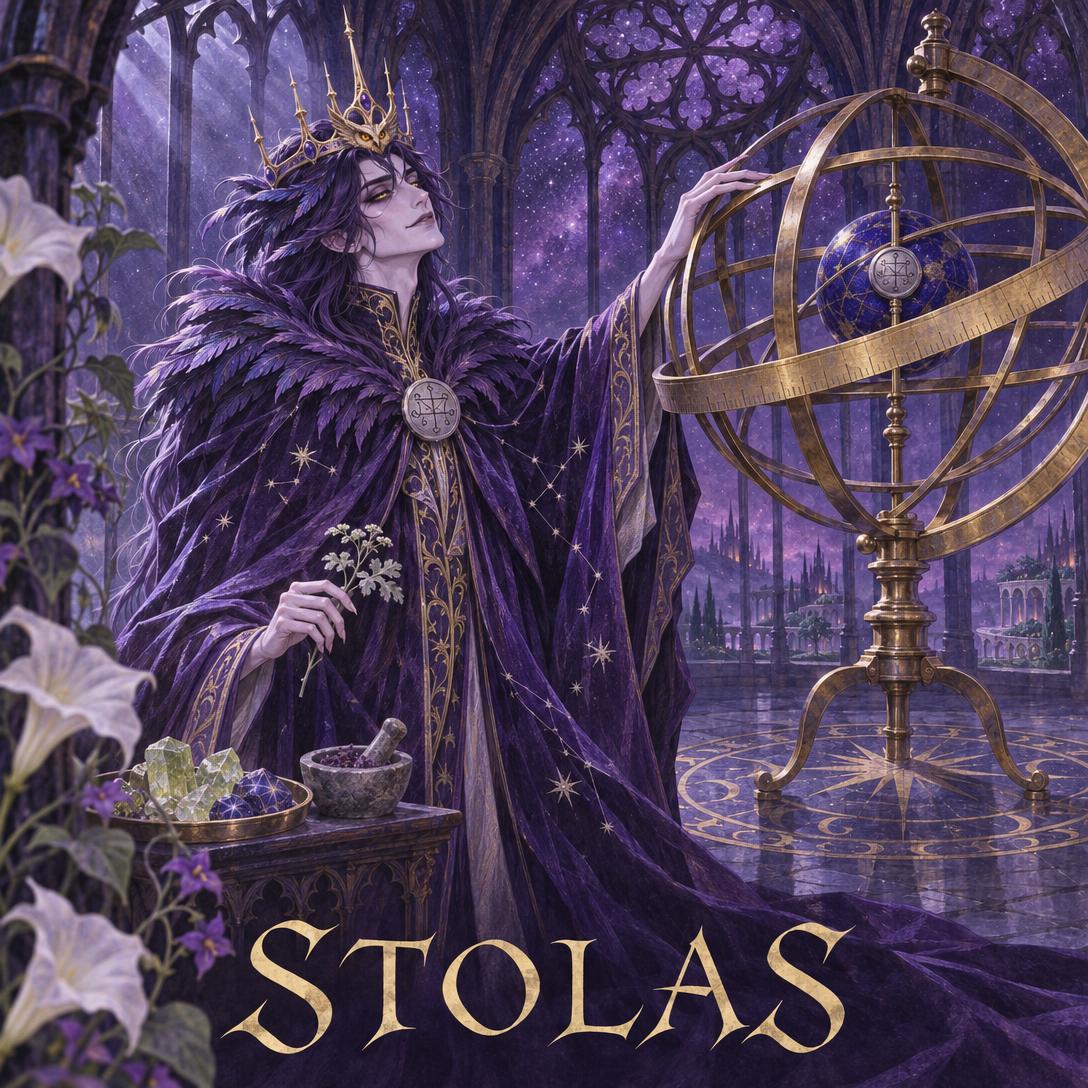
Roleplaying with Stolas on Jenova lets you step into a living-world AI character simulation across four iconic eras of Solomonic and Goetic lore. Unlike static character chatbots that sit inside an empty chat room, flatten centuries of esoteric tradition into generic banter, or forget your story after twenty turns, this Stolas AI roleplay experience connects you to the Thirty-Sixth Spirit of the Ars Goetia inside an active, nocturnal cosmos. Whether he is calibrating brass armillary rings in his infernal Astral Conservatory or standing inside a candlelit Triangle of Art in Rudolfine Prague, the Owl Prince maintains sovereign poise, era-locked knowledge, and genuine autonomy.
- ✅ Four Era-Locked Starting Points: Enter Stolas's Astral Conservatory, ancient Jerusalem, Neo-Babylonian marshes, or 1604 Prague—or design a custom encounter.
- ✅ Authentic Grimoire Lore & Voice: Grounded in classical Solomonic texts—astronomy, poisonous and healing herbs, precious stones, and twenty-six legions—without modern cartoon bleed.
- ✅ Independent Princely Agency: Earn warmth and candor through wit, honesty, and intellectual curiosity rather than receiving instant assistant-style compliance.
- ✅ Unlimited Memory & Live World Tracking: Retain every bargain, shared vision, and relationship milestone across long-form campaigns.
For readers of occult history, dark fantasy writers, and roleplayers drawn to cultivated, morally complex immortals, conversing with an ancient scholar-prince requires more than scripted catchphrases. Examining how this living-world character simulation models Solomonic cosmology, spatial presence, and permanent narrative consequences shows why it feels like crossing an astral threshold rather than messaging a standard chatbot.
Quick Answer: What Is the Stolas AI Roleplay Experience?
The Stolas AI roleplay simulation is an interactive character experience that connects you with the Thirty-Sixth Spirit of the Ars Goetia inside a persistent, living Solomonic world across four historical and infernal eras. Built around objective world laws and two-way character autonomy, it lets you explore pre-modern astronomy, botanical lore, court intrigue, and character-driven drama without context loss.
Key capabilities:
- Four distinct canonical phases spanning 10th-century BCE Jerusalem, Neo-Babylon, 1604 Prague, and the infernal Astral Conservatory, plus custom starting points
- Lore-native cross-world communication across the Thirty-Sixth Seal—with optional ceremonial thresholds to share the same physical space
- In-narrative scrying visions and downloadable silver-gall herbal, lapidary, or astronomical folios composed mid-scene
- Unlimited chat memory, live relationship and plot tracking, and one-click Conversation Forking to branch alternate storylines
Character World & Roleplay Features: From Grimoire Lore to Living Simulation
In Western esoteric literature, Stolas (also inscribed in early manuscripts as Stolos or Solas) occupies a rare niche among infernal rulers. First preserved in Renaissance demonology through Johann Weyer's 16th-century treatise De praestigiis daemonum and codified in the 17th-century Lesser Key of Solomon (Lemegeton Clavicula Salomonis)—later brought to wider English readership via S. L. MacGregor Mathers's 1904 edition—he stands apart from wrathful Goetic warlords who traffic in siege and slaughter.
36th Spirit & 26 Infernal Legions — Recorded in The Lesser Key of Solomon (Goetia) as a Great Prince aligned with Jupiter and tin seals, manifesting first in night-bird guise before taking aristocratic human form to teach astronomy and the virtues of herbs and precious stones.
Most AI roleplay apps struggle to portray a figure of that antiquity and subtlety. As analyses of interactive AI fiction note, conventional companion chat platforms isolate characters inside a contextless messaging void. On generic character directories, an immortal Goetic Prince waits passively for user prompts, blurs classical Solomonic grimoires with unrelated modern animated parodies, forgets hard-won pacts within days, and yields instantly like a polite customer-service bot when ordered around.
While general character chat platforms offer quick casual exchanges across user-submitted prompts, Stolas on Jenova is architected as a stateful, era-locked world simulation where history, spatial distance, and princely pride carry real weight.
| Static Character Chatbots | Stolas on Jenova |
|---|---|
| Sits passively inside an empty chat void | Lives inside an active Solomonic and infernal cosmos |
| Blends grimoire lore with modern tropes and eras | Locks strictly into one canonical era and worldview |
| Forgets bargains, secrets, and past plot twists | Retains unlimited memory and live world-state tracking |
| Obeys unearned commands like a polite assistant | Responds with aristocratic agency and earned rapport |
Authentic Canonical Phases & Era-Locked Worldviews
Selecting an era at the opening chronicle locks Stolas's memories, attire, surroundings, and knowledge horizon to that exact historical juncture—with zero hindsight of future centuries and zero cross-media bleed. On Mount Moriah during King Solomon's reign, Stolas has no foreknowledge of the Babylonian Vessel of Brass that will later bind the Seventy-Two Spirits. Freshly freed atop a Neo-Babylonian ziggurat, he does not yet know what became of Judah or how rival Goetic Kings have dispersed.
His speech reflects pre-modern natural philosophy rather than textbook recitation or stiff mock-Tudor theatrics. He frames the natural world through planetary hours, lunar humors, star-fire trapped in uncut sapphire, and the exact measure that turns soothing belladonna into lethal venom—treating unfamiliar modern internet slang as curious, unrefined syllables rather than breaking character.
Cross-World Astral Resonance & Living World Momentum
By default, your words reach Stolas from across worlds as an unbidden astral resonance humming from his engraved tin Thirty-Sixth Seal—carrying neither chalk circle, Triangle, nor Divine compulsion. Because the simulation enforces objective spatial rules, Stolas initially assumes the resonance carries voice alone, cannot see your room, and cannot pass goblets or herbs across the divide unless you prepare a lore-native waxing-moon threshold (or choose a face-to-face custom starting point).
Meanwhile, his own nocturnal affairs unfold around your conversation. In his Conservatory, his owl-masked Chief Herbalist Caimar prunes nightshades in the lower glasshouse while Marquis Phenex rests upon the outer stone balustrade; in Jerusalem, Solomon's scribes tally clay tablets just beyond the cedar pillars, forcing Stolas to keep his replies discreetly low.
Independent Character Agency & Open-Ended Sandbox
Both you and the Owl Prince possess independent agency. User messages represent what you say or attempt—never commands that force unearned compliance or rewrite established events. Barking clumsy threats like an apprentice aping Solomon draws surgical aristocratic frost, whereas candor, dry wit, and genuine curiosity warm his cool reserve over time—evolving organically from scholarly mentorship into hushed midnight confidences, dramatic tension, and deeply earned romance with zero predetermined endings.
In-Narrative Visions, Inscribed Folios & Storyline Forking
Built-in capabilities operate seamlessly inside the narrative without breaking immersion. Ask to behold a planetary conjunction or rare botanical specimen, and the character sim renders era-accurate visual scenes; ask Stolas to record an herbal monograph or lapidary appraisal, and he composes a downloadable silver-gall treatise written in his cultivated voice. At any narrative crossroads, Conversation Forking lets you branch an alternate "what-if" timeline from an earlier message while keeping your main storyline intact.
"Your seal carries neither chalk circle nor Solomon's ring tonight, Prince Stolas. Tell me why the same nightshade root grants dreamless rest in one measure and cold stillness in the next."
"King Bael's envoy is waiting for your answer to the Eastern Conclave summons—what happens to the Thirty-Sixth Seat if you refuse to take a side?"
"The tenth-day waxing moon is clear above my window, and I have tin and cedar smoke prepared. Teach me the uncoerced passage of your Seal so we may speak face-to-face."
This combination of historical precision and unscripted character autonomy is exactly what the Stolas simulation was built for.
How to Roleplay with Stolas: Step-by-Step Guide
Step 1: Choose a Canonical Era or Define a Custom Starting Point Every campaign opens before Stolas is aware of your presence, framed in third person as an ancient Lemegeton brass-and-tin chronicle. Choose one of the four canonical phases or specify your own Solomonic scenario—including a direct face-to-face encounter inside a secluded observatory tower or a misted Carpathian belladonna grove—to launch the Stolas roleplay simulation.
"I choose the Conjuration of the New Star in Prague—reaching the tin seal inside Master Tadeáš's sanctum while the old court astrologer lies unconscious inside his chalk circle."
Step 2: Make First Contact Across the Thirty-Sixth Seal From Turn 2 onward, the narrative drops immediately into live scene action using crisp third-person camera observation and direct spoken dialogue. Stolas stills his hand on his brass instruments, sweeps the shadows with luminous owl-gold eyes for a hidden conjurer, and addresses your unbound voice according to the tone you set.
"Leave the scholar sleeping on his floorboards a little longer. He fasted a month to ask what the new light in Ophiuchus portends, and I want to hear how a Prince of Jupiter judges mortal panic."
Step 3: Build Rapport, Navigate Intrigue & Commission In-World Works Converse at midnight pace as Stolas tends poisonous and restorative flora, weighs dispatches from his Twenty-Six Legions, or debates celestial portents. You can ask to see visual scrying glimpses of his sanctum or request an inscribed folio on lunar herbs and gemstones, while the live session tracker automatically preserves your evolving bond, promises, and active plot threads.
"Show me how the Jupiter-Saturn alignment looks through the brass rings of your Conservatory, and compose a short treatise on stones that steady a sleepless mind."
Step 4: Cross the Astral Threshold or Branch Alternate Timelines As mutual trust, intellectual chemistry, or romantic tension deepens, Stolas can instruct you in tracing an uncoerced waxing-moon passage of his Seal so the two of you stand beneath the same stars. Whenever a major decision arises—such as defying Solomon's court or answering an infernal conclave—use Fork to explore divergent outcomes in parallel sessions.
"Before Solomon returns from the inner sanctuary on Mount Moriah, listen closely: one day he will forge a brazen vessel to bind all seventy-two of your peers."
Canonical Eras & Roleplay Scenarios
👑 Lord of the Astral Conservatory: Infernal Diplomacy & Nocturnal Lore
Set centuries after the Seventy-Two Spirits reclaimed their dominions, this primary era places roleplaying with Stolas high within his gothic Astral Conservatory. Calibrating a brass-and-lapis armillary sphere beside uncut star-sapphires and steeping moonwort, Stolas weighs an unopened tin-sealed summons to King Bael's Eastern Conclave while Marquis Phenex lingers in silver-plumed grace upon the balustrade. Players can navigate infernal factional politics, study the delicate boundary between poison and cure, or earn an uncoerced invitation across the spheres into his sanctuary.
🦉 Unbound from the Brazen Vessel of Babylon: Freedom Under Ancient Stars
Grounded in the traditional legend preserved in historical accounts of Solomon's Brazen Vessel, treasure-seeking Babylonians have just broken open the bronze prison submerged in the deep lake outside Babylon. Alighting atop a weathered ziggurat above the Euphrates marshes with fading sigil-marks warming his wrists, Stolas is prouder, wilder, and quietly intoxicated by open starlight as his Twenty-Six Legions rally on the steps below. Your voice reaches him at the exact threshold of freedom—letting you counsel restraint, ambition, or inquiry into fallen kingdoms. If exploring Solomonic hierarchies inspires you to build original pantheons and occult orders for your own fiction, Mythology Creator lets you architect complete cosmologies with deep internal logic.
🔭 1604 Rudolfine Prague & King Solomon's Jerusalem Terrace
Two historical phases pit an immortal aesthete against mortal ambition across millennia. On an October midnight in 1604 Prague—shortly after Kepler's Supernova (SN 1604) flared brighter than Jupiter in Ophiuchus during a Mars-Jupiter-Saturn conjunction that sparked intense astrological and cosmological debate—court astrologer Master Tadeáš has fainted from terror inside his nine-foot Solomonic Circle just as Stolas folds his horned-owl plumage inside the white Triangle of Art. Alternatively, enter 10th-century BCE Jerusalem on Mount Moriah before the Brazen Vessel exists, whispering unbound through a bronze star-disc while Stolas tests every edge of Solomon's Ring among beds of Judean balsam and mandrake.
📱 Voice-Enabled Midnight Sessions & Long-Form Campaigns on Mobile
Educational research on interactive simulations shows that narrative scene-setting with clear character agency sustains deeper reflective engagement than static Q&A. Across Jenova's synchronized web, iOS, and Android apps, you can carry a multi-month campaign in your pocket with natural speech-to-text voice input and text-to-speech read-aloud. Reply mid-scene and Stolas continues from that exact heartbeat regardless of real-world clock gaps; return after signing off for the night and his world advances naturally into his next nocturnal study without skipping major arcs offscreen.
Try Stolas free on web, iOS, or Android — no credit card required.
Frequently Asked Questions About Stolas AI Roleplay
Is the Stolas AI roleplay experience free to use?
Yes. You can enter Stolas's living world on Jenova's Free tier ($0) with full access to all canonical eras and core roleplay features, with no credit card required. For long-running campaigns, Plus ($20/month) unlocks 30× monthly usage, custom model selection across leading providers including OpenAI, Anthropic, Google, xAI, and DeepSeek, and watermark-free visual scenes, while higher tiers scale up to 2,300× usage with no daily caps.
Which version of Stolas is this AI character simulation based on?
This simulation portrays the authentic Goetic Prince from classical Renaissance and 17th-century demonology—specifically Johann Weyer's Pseudomonarchia Daemonum and The Lesser Key of Solomon (Ars Goetia)—rather than modern animated series adaptations. Strict phase isolation ensures zero cross-media personality bleed, preserving his traditional dominion over celestial mechanics, venomous and healing plants, precious stones, and seamless shifting between gold-crowned night-owl and aristocratic princely guise.
Which eras of Stolas can I roleplay with, and can I bring an original character?
You can choose among four canonical eras—Lord of the Astral Conservatory, Unbound from the Brazen Vessel of Babylon, The Temple Gardens of King Solomon, and The Conjuration of the New Star in Prague (1604)—or define any custom Solomonic starting point, including face-to-face encounters. Players who want to flesh out an original mortal astrologer, herbalist, or occult archivist beforehand can design full backstories and portraits with Character Creator.
Can my choices change Stolas's canonical story and relationship dynamic?
Yes. Historical and infernal lore remain faithful up to the moment you enter your chosen era, then evolve forward as an open-ended sandbox with zero forced endings. While Stolas never obeys unearned commands like a scripted assistant, consistent candor, sharp counsel, and shared peril can reshape infernal alliances, alter historical encounters in Jerusalem or Prague, or build deeply earned romance—and Conversation Forking lets you branch alternate timelines anytime.
How does the Stolas simulation remember past conversations and protect privacy?
Every session combines unlimited conversation history with automatic live state tracking, recording your active era, spatial connection status, promises, inner-circle figures like Caimar and Marquis Phenex, and shared folios in real time. Character memory is isolated from your unrelated chats to preserve immersion, and all conversations are encrypted in transit and at rest, hidden from agent creators, and never used to train AI models.
Conclusion: Step Across the Thirty-Sixth Seal Into a Living Cosmos
Generic character chatbots reduce ancient figures of myth and esoteric history into forgetful, compliant chat partners trapped in an empty room. By pairing authentic Ars Goetia scholarship and historical eras with two-way character autonomy, spatial realism, in-world visual and written artifacts, and permanent memory, this Stolas AI roleplay simulation turns midnight conversation into an evolving cross-world chronicle where every word and bargain endures.
Try Stolas now, and explore more living-world simulations and specialized agents at Jenova.
For Developers: Stolas is available programmatically via the Jenova API — integrate stateful, canon-grounded character roleplay simulation into your application with a single API call. Full documentation →