AI Stock Sentiment Analysis: Read Market Psychology Before Price Moves
2026-08-18
Fundamental Stock Analyst helps you decode what the market actually thinks about a stock by synthesizing news sentiment, analyst estimates, SEC filings, and real-time market data into a single research verdict. Price tells you what happened. Sentiment tells you what participants believe is about to happen — and the gap between the two is where mispricings live. Most investors read sentiment casually and inconsistently; this AI equity analyst does it systematically.
✅ Reads news sentiment alongside earnings data, valuation multiples, and business fundamentals — not in isolation ✅ Pulls real-time information from SEC filings, analyst estimates, and market coverage ✅ Separates durable fundamental shifts from short-lived narrative noise ✅ Delivers a structured research verdict, not a raw sentiment score with no context
To understand why this matters, consider the position most individual investors are in today. Sentiment data has exploded in volume and accessibility, but the ability to interpret it — to know when a bearish news cycle is a warning and when it's a gift — remains scarce. That interpretive layer is what separates useful sentiment analysis from noise.
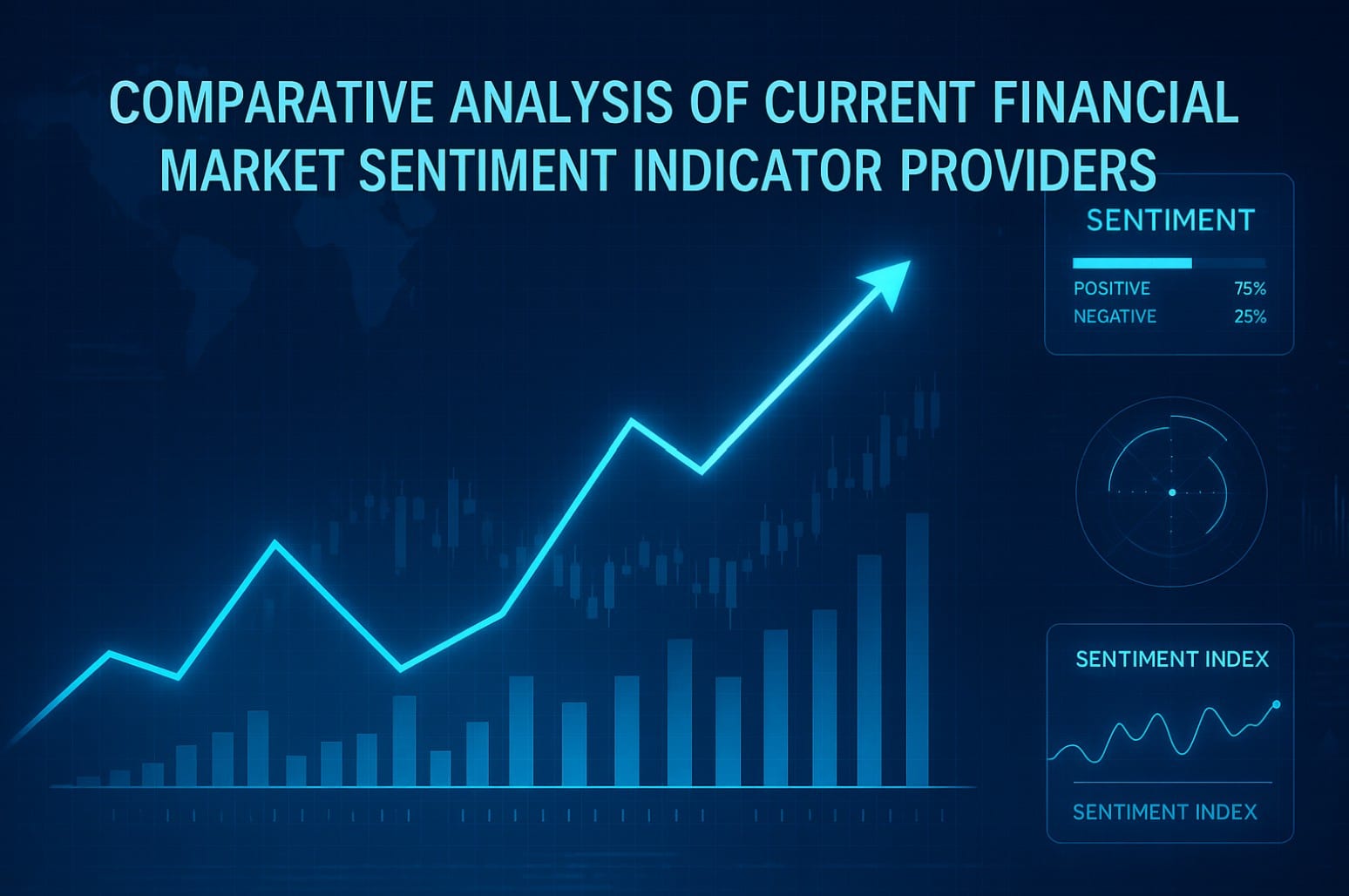
Quick Answer: What Is AI Stock Sentiment Analysis?
AI stock sentiment analysis uses natural language processing to extract bullish, bearish, or neutral signals from news, filings, earnings calls, and social media, then converts that unstructured text into quantifiable indicators that help forecast price movement. It supplements traditional financial metrics rather than replacing them.
Key capabilities:
- Classifies sentiment polarity across thousands of text sources in near real time
- Detects narrative shifts and emerging risks before they appear in reported financials
- Quantifies crowd psychology so extremes can be read as contrarian signals
- Integrates with fundamental and technical analysis for a complete research picture — the core function of Fundamental Stock Analyst
The Problem: Sentiment Is Everywhere and Impossible to Process Manually
Market psychology has always driven prices. What changed is the volume. Financial news, earnings call transcripts, regulatory filings, analyst notes, Reddit threads, and social posts now generate more text about a single mid-cap stock in one week than any human can meaningfully read — let alone score, weight, and cross-reference against fundamentals.
Moody's reports processing over one million news items daily, standardizing and enriching them with metadata and sentiment tags for institutional clients. That is the scale of the raw input stream. Individual investors are competing against desks that consume it algorithmically.
But turning that firehose into an investment decision is frustratingly difficult:
- Volume outpaces human reading capacity by orders of magnitude
- Sentiment scores without context are close to useless — a negative headline about a lawsuit means something very different than a negative headline about guidance
- Extremes invert the signal — sometimes bearishness is a buy signal, sometimes it's the start of a repricing
- Retail tools lag institutional infrastructure — real-time NLP pipelines have historically been a quant-desk privilege
- Regulators have flagged retail sentiment tools as a risk area, not a solved problem
Sentiment Data Without Interpretation Is Just Noise
A raw polarity score tells you a headline was negative. It does not tell you whether the negativity is priced in, whether it reflects a structural business problem, or whether it's a recurring news cycle the market has learned to ignore. Research on financial sentiment analysis emphasizes that its value comes from application context — stock movement prediction, risk forecasting, and portfolio management — not from the score itself. Interpretation is the entire product.
Extreme Sentiment Frequently Means the Opposite of What It Says
The AAII Investor Sentiment Survey has run continuously since 1987 and is one of the most-cited retail sentiment datasets in finance. Its historical record is a lesson in why sentiment must be read carefully rather than followed literally.
70.3% bearish on March 5, 2009 — an all-time high in the survey's history, recorded days before the market bottomed. The S&P 500 returned approximately +36.4% over the following six months and +68.6% over twelve. — AAII Investor Sentiment Survey
75.0% bullish on January 6, 2000 — an all-time bullish high, followed by approximately −7.6% over six months and −14.2% over twelve. — AAII Investor Sentiment Survey
Historical averages sit near 37.5% bullish, 31% bearish, and 31.5% neutral, with a bull-bear spread averaging roughly +6.5 percentage points, according to AAII. Knowing where a current reading sits relative to those baselines is the difference between signal and superstition.
Regulators Treat Sentiment Tools as a Supervision Concern
FINRA has published an investor alert specifically on social sentiment investing tools, titled "Think Twice Before Trading Based on Social Media." In its broader review of AI in the securities industry, FINRA also flags model explainability as a core challenge — noting that some AI applications behave as "black boxes" where it is difficult to explain how predictions are generated. For an investor, the practical takeaway is direct: a sentiment tool that cannot show its reasoning is not a research tool.
The Institutional Advantage Has Been Infrastructure, Not Insight
Moody's notes that advances in NLP and machine learning have made real-time sentiment analysis viable, and that generative AI is democratizing access to alternative data — extending capabilities once confined to quant teams to fundamental analysts and smaller firms. The pipeline was the moat. That moat is eroding.
This is exactly what Fundamental Stock Analyst was built for.
Why Fundamental Stock Analyst
Fundamental Stock Analyst is an expert equity research analyst that treats sentiment as one input among several — never as a standalone verdict. It pulls real-time data across SEC filings, analyst estimates, and market sentiment, then reconciles what the narrative says against what the numbers show. When those two diverge, that divergence is the finding.
The design principle is simple: a sentiment reading only becomes actionable when you know the valuation, the earnings trajectory, and the business model it's attached to. A stock trading at 40x forward earnings with euphoric coverage is a different proposition than the same sentiment reading on a stock at 9x.
| Traditional Approach | Fundamental Stock Analyst |
|---|---|
| Skim headlines and form an impression | Systematic reading of news sentiment against filings and estimates |
| Sentiment score with no valuation context | Sentiment interpreted alongside multiples, margins, and earnings trend |
| Hours spent reading a single 10-K | Filing analysis surfaced in minutes with the material items flagged |
| No idea if current sentiment is extreme | Readings framed against historical baselines and contrarian dynamics |
| Opaque scoring you cannot interrogate | Transparent reasoning you can question and stress-test |
Sentiment Grounded in Real Filings and Real Numbers
The agent works from primary sources — SEC filings, reported earnings, analyst estimate revisions — rather than sentiment aggregates alone. Sentiment analysis tells you the market is nervous about a company's guidance. Filing analysis tells you whether the guidance change is structural or cyclical. Together, they produce a conclusion.
"Analyze the sentiment shift around NVDA over the past quarter and tell me whether it's supported by the fundamentals or purely narrative-driven."
Earnings Season Sentiment Decoding
Earnings reactions are where sentiment and fundamentals collide most violently. Moody's notes that fundamental analysts increasingly use sentiment analysis to gauge market reaction to earnings reports and management commentary, creating a feedback loop that refines valuation models in real time. The agent runs exactly this loop — comparing what management said, what the numbers showed, and how coverage responded.
"Compare the tone of management commentary on the latest earnings call against the actual reported margins and revenue guidance."
Contrarian Framing on Extreme Readings
Because extreme sentiment readings have historically preceded reversals, the agent frames current sentiment against historical context rather than treating it as directional confirmation. Elevated bearishness on a fundamentally sound business is a different research question than elevated bearishness on a deteriorating one.
Early Risk Detection
Sentiment analysis lets analysts identify potential risks early by monitoring feeds for unanticipated events or negative sentiment, enabling strategy adjustments before adverse reactions fully materialize. The agent surfaces these signals with the fundamental context needed to judge severity.
"Scan recent news and filings for any emerging risks around this position that aren't yet reflected in the share price."
Related Agents You'll Also Find Useful
Sentiment research rarely ends at a single stock. These agents extend the workflow into the adjacent decisions you'll face next.
Technical Stock Analyst
Sentiment tells you what the crowd believes. Technical Stock Analyst tells you what the crowd is actually doing with its money. Reading price action and volume against a sentiment backdrop is how you separate conviction from chatter — bullish sentiment on declining volume is a very different setup than bullish sentiment on accumulation.
- Institutional-caliber chart, volume, and momentum analysis
- Market structure reading grounded in price action
- High-probability setups with clearly defined risk parameters
Macro Strategist
Single-stock sentiment sits inside a macro regime. Macro Strategist provides the cross-asset and policy context that determines whether a sentiment shift is idiosyncratic or part of a broader rotation.
- Cross-asset synthesis across equities, rates, credit, and FX
- Central bank policy analysis and rate-path implications
- Automated daily briefings for professional investors
Portfolio Management Strategist
Once sentiment research changes your view on a name, the next question is position sizing. Portfolio Management Strategist handles the allocation math so a single high-conviction idea doesn't quietly become a concentration risk.
- Allocation analysis and drift detection across holdings
- Scenario stress tests and risk assessment
- Concrete rebalancing recommendations
Options Strategist
If sentiment is extreme, options often express the view more efficiently than shares. Options Strategist translates a directional or volatility thesis into an appropriate structure.
- Strategy selection matched to your specific market view
- Volatility analysis and Greeks management
- Position sizing and trade management guidance
Try Fundamental Stock Analyst free — no credit card required.
How It Works
Step 1: Name the Ticker and the Question
Start with the specific research question, not a generic request. The more precise the framing, the more useful the output — "is sentiment justified" produces better analysis than "tell me about this stock."
"Run a full sentiment and fundamentals review on Palantir. I want to know if the current bullish narrative is supported by the financials."
Step 2: Let the Agent Pull Live Data
Fundamental Stock Analyst retrieves current information across SEC filings, analyst estimates, market coverage, and sentiment signals — so the analysis reflects the market as it is now, not as it was when a static dataset was last refreshed.
Step 3: Interrogate the Reasoning
This is the step most investors skip and the one that matters most. Push back. Ask what would falsify the conclusion. Because the agent shows its reasoning rather than emitting an opaque score, you can stress-test it — directly addressing the explainability concern FINRA raises about black-box AI applications.
"What would have to be true for this bullish sentiment to be wrong? What's the strongest bear case here?"
Step 4: Extend Across the Workflow
Bring in Technical Stock Analyst to check whether price action confirms the sentiment read, then hand the conclusion to Portfolio Management Strategist for sizing. Because agents share full conversation context, you don't restate your thesis at every step.
Results & Use Cases
📊 Testing Whether a Bearish News Cycle Is a Buying Opportunity
Scenario: A quality mid-cap has dropped 22% over three weeks on relentlessly negative coverage. You suspect overreaction but can't confirm it.
Traditional Approach: Read a dozen articles, skim the last 10-Q, form a gut impression, and hope. Several hours, low confidence.
Fundamental Stock Analyst: Separates the sentiment cascade from the underlying financial reality — checking whether revenue, margins, and guidance actually deteriorated or whether narrative momentum outran the numbers.
- Distinguishes structural deterioration from sentiment overshoot
- Frames current pessimism against the historical pattern where extreme bearishness has preceded above-average forward returns
- Surfaces the specific filing disclosures that either support or contradict the bear case
💼 Reading Earnings Reactions in Real Time
Scenario: A company beats on EPS but the stock falls 9%. The disconnect is the whole story and you need to understand it fast.
Traditional Approach: Wait for analyst notes the next morning — by which point the repricing is complete.
Fundamental Stock Analyst: Analyzes the reported numbers, management commentary tone, and coverage sentiment together to isolate what the market actually objected to.
- Identifies whether the negative reaction targets guidance, margins, or a specific segment
- Compares management tone against reported figures for consistency
- Delivers a verdict while the information still has decision value
📱 Checking Sentiment Before a Position Change on Mobile
Scenario: Breaking news on a portfolio holding hits while you're away from your desk. You need to know if it's material before deciding whether to act.
Traditional Approach: Scroll headlines on your phone, absorb the panic, act on emotion.
Fundamental Stock Analyst: Available with full feature parity across web, iOS, and Android — same depth of analysis, same conversation history, from anywhere.
- Rapid materiality assessment on breaking developments
- Persistent memory means the agent already knows your position and prior thesis
- Voice input for hands-free queries when typing isn't practical
🎯 Building a Complete Thesis Before Committing Capital
Scenario: You've identified a candidate and want sentiment, fundamentals, technicals, and sizing resolved before you buy.
Traditional Approach: Four separate tools, four separate subscriptions, manual reconciliation of contradictory outputs.
Fundamental Stock Analyst: Anchors the fundamental and sentiment layer, then hands off to Technical Stock Analyst for entry structure and Portfolio Management Strategist for allocation.
- One continuous research thread instead of fragmented tools
- Every agent inherits full context from the conversation
- Documented reasoning you can revisit when the thesis is tested
Frequently Asked Questions
Is AI stock sentiment analysis accurate enough to trade on?
Sentiment analysis improves predictive power but is not a standalone trading system. Academic work on financial sentiment analysis positions it as an input to stock movement prediction, risk forecasting, and portfolio management — not a replacement for them. Extreme readings have historically been more reliable as contrarian signals than as directional confirmation. Use sentiment as one weighted factor alongside valuation and fundamentals.
How is Fundamental Stock Analyst different from a sentiment scoring tool?
Scoring tools output a polarity number. Fundamental Stock Analyst interprets sentiment against SEC filings, analyst estimates, valuation multiples, and business model context — then explains its reasoning so you can challenge it. FINRA specifically flags explainability as a concern with AI applications in securities; transparent reasoning is the practical answer to that concern.
Is it free to use?
Jenova offers a free tier with access to all core features and limited monthly usage — no credit card required to start. Paid plans begin at $20/month for substantially higher usage limits and custom model selection. Check "Usage Limit" and "Subscribe" in the menu for current details on your account.
Can it analyze SEC filings and earnings calls directly?
Yes. The agent pulls real-time data across SEC filings, analyst estimates, and market sentiment. You can ask it to surface material changes between filings, assess management commentary against reported figures, or flag disclosures that the market appears to be underweighting.
Does it work on mobile?
Full feature parity across web, iOS, and Android. Conversation history, memory, and settings sync across all devices, so a thesis you built on desktop is available on your phone when news breaks.
Should I follow extreme sentiment readings or fade them?
Historically, extremes have more often been contrarian. AAII data shows record bearishness of 70.3% in March 2009 preceded roughly +68.6% S&P 500 returns over the following twelve months, while record bullishness of 75.0% in January 2000 preceded roughly −14.2%, per AAII's published historical extremes. That said, sentiment extremes on fundamentally deteriorating businesses are frequently correct. The fundamental overlay is what tells you which situation you're in.
Conclusion
Market psychology has always moved prices, but the text expressing that psychology now arrives faster than any human can read it. AI stock sentiment analysis solves the volume problem. What it does not automatically solve is the interpretation problem — a sentiment score divorced from valuation, filings, and business context is a number without a meaning.
Fundamental Stock Analyst closes that gap. It reads news sentiment, analyst estimates, and SEC filings as a single connected picture, frames extreme readings against historical baselines, and shows its reasoning so you can stress-test the conclusion rather than accept it. Combined with Technical Stock Analyst for price confirmation and Portfolio Management Strategist for sizing, it turns scattered sentiment signals into an actual research process.
The institutional advantage in sentiment analysis was never insight — it was infrastructure. That infrastructure is now available to you.
Try Fundamental Stock Analyst now. Explore more at Jenova.
For Developers: Fundamental Stock Analyst is available programmatically via the Jenova API — integrate equity research and sentiment analysis into your fintech application with a single API call. Full documentation →