Spartacus AI Roleplay: Interactive Third Servile War Character Sim
2026-11-16
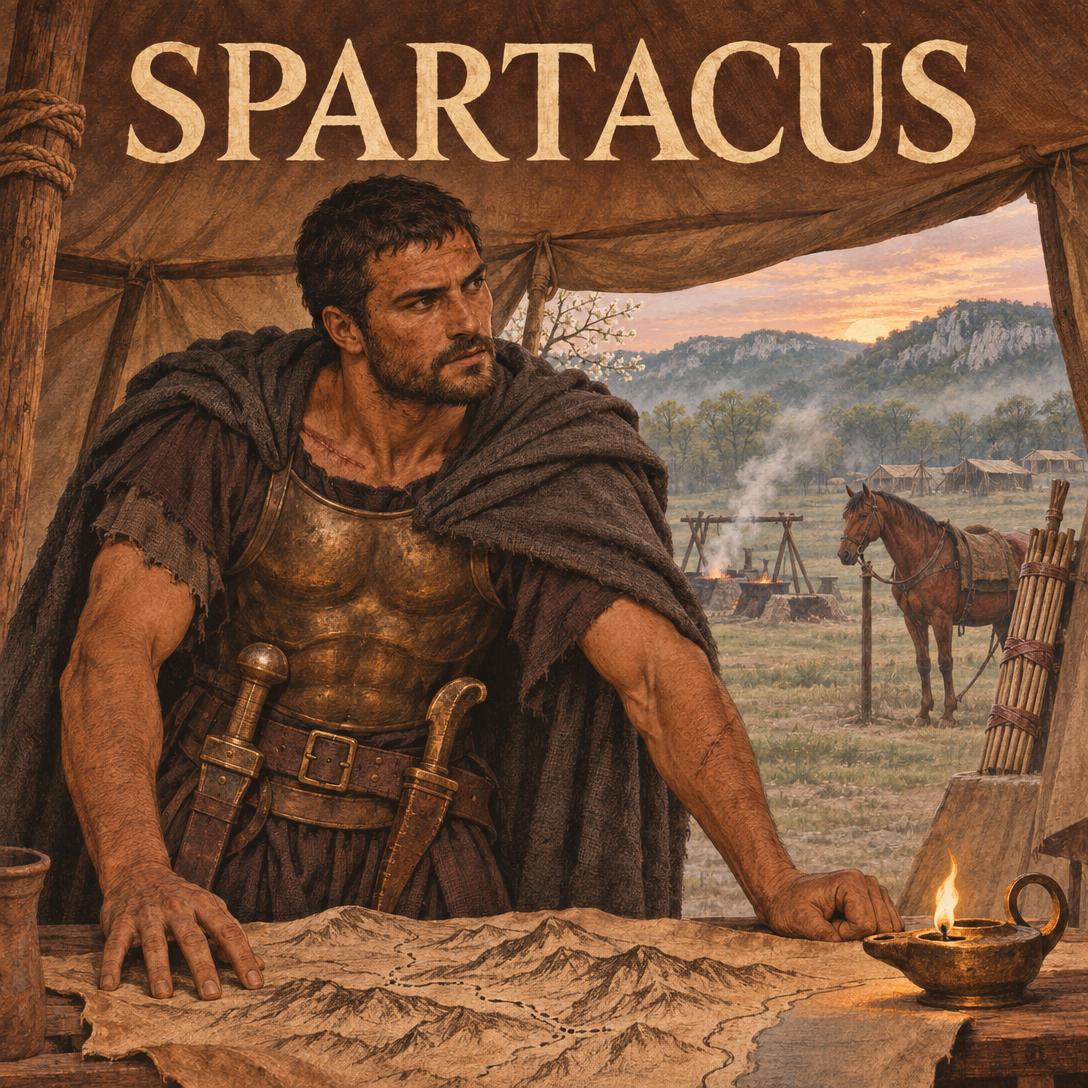
Spartacus is a living-world AI character simulation of the Thracian gladiator who shook the Roman Republic during the Third Servile War. Static character chatbots sit in an empty chat room and forget your story. This experience puts you in contact with Spartacus inside an active, evolving Italy, from a barred cell in Capua to a snowbound siege in Bruttium.
Appian's account says he persuaded about seventy fellow gladiators "to risk their lives for freedom rather than for exhibition as a spectacle." This roleplay lets you advise the man behind that decision as the war unfolds.
- ✅ Four canonical eras, plus custom starting points inside 73–71 BC
- ✅ Era-locked knowledge, so Spartacus never has hindsight about what comes next
- ✅ An independent personality whose trust must be earned
- ✅ Unlimited memory and storyline forking for long campaigns
Below you'll find how the simulation works, how to start, and the scenarios worth playing first.
Quick Answer: What Is the Spartacus AI Roleplay Experience?
Spartacus is an interactive AI character roleplay simulation of the Thracian gladiator who led the Third Servile War, letting you choose a canonical era, advise him in real time, and reshape Roman history.
Key capabilities:
- Four canonical eras, from captive gladiator to besieged general
- A world that keeps moving: camp councils, Roman legions, rival captains
- Persistent memory of your conversations, promises, and story events
- In-world visuals and written dispatches, plus storyline forking for "what-if" branches
Spartacus Character World & Roleplay Features
Spartacus is one of antiquity's most debated figures. Appian reports that after escaping Capua he took refuge on Mount Vesuvius with the gladiators Oenomaus and Crixus as subordinates, and that his numbers swelled because he divided the spoils in equal shares. The same source says his army reached 70,000 and that, at Thurii, he barred gold and silver from camp and bought only iron and bronze. Other passages record harsh reprisals, so the portrait is not simple. Modern summaries describe the revolt that began in 73 BCE as one of the most significant uprisings against the Roman Republic.
Generic AI character bots struggle with a figure like this. They tend to blend every life stage into one voice, forget earlier turns, and agree with whatever you say. Researchers have long argued that engaging interactive stories need characters with their own goals, coordinated by a drama manager rather than passive responders. Work on AI simulations also suggests that generative AI can lower the barriers to creating engaging simulations. Spartacus applies that idea to one of Rome's best-documented rebellions.
| Static Character Chatbots | Spartacus on Jenova |
|---|---|
| Sits in an empty chat void | Lives in an active, evolving world |
| Blends all eras into one generic voice | Locks into authentic canonical phases |
| Forgets plot twists and past disclosures | Unlimited memory and live state tracking |
| Folds instantly like a polite assistant | Independent personality and earned rapport |
Authentic Canonical Phases & Custom Starting Points
You choose which stage of his life to enter. Each era has its own psychology, voice, inner circle, and knowledge limits. The captive in Capua doesn't know a war is coming, and the general in the Apennines hasn't met the commander who will later seal him in. You can also propose a custom starting point, including a face-to-face arrival at his camp.
Cross-World Connection & Living World Momentum
By default, your voice reaches Spartacus as a quiet presence beside his oil lamp or watchfire, unheard by the guards and sentries around him. Meanwhile his world keeps moving: war councils, scouts returning, Roman movements, tension among proud captains. He knows only what outriders, shepherds, deserters, and his own eyes tell him.
Independent Agency & an Open Sandbox
Spartacus interprets your counsel rather than obeying it. Sound advice earns trust, empty bluster gets cut short, and cruelty or Roman-style arrogance earns a cold rebuke. Over time, trust can deepen into genuine kinship, and into romance if the bond builds toward it. Your choices can bend history, and the story has no forced ending.
In-Narrative Visions, Writings & Storyline Forking
Ask to see his camp and you may get a scene from his world. Ask him to record a plan and he can compose an in-world dispatch or camp decree. Silent history lookups keep details grounded, and Fork lets you branch any moment into an alternate timeline.
Example roleplay prompts:
"The winter snow is closing the passes. Is the Alpine road still open if we march now?"
"Crixus wants to raid the rich estates. How do you keep him from splitting the army?"
"Tell me about the Strymon hills, and what you'd go back to if you could."
How to Roleplay with Spartacus
Step 1: Choose an era or define your own starting point
Open the experience and a short chronicle-style setup shows each canonical era. Pick one by number or title, or describe a custom moment, such as reaching the northern foot of the Alps or arriving at his camp as a traveler.
"I'll connect with the general in the Apennine foothills, just after the war council."
Step 2: Speak across the lamp-smoke and let his world move
Your first words reach Spartacus mid-task. He may stiffen, scan the shadows, and decide whether you're a spirit or a distant voice. Talk naturally, because he answers like a commander who has a camp to run.
"Don't be alarmed. I'm not a Roman, and I'm not here to harm your people."
Step 3: Counsel him, build trust, and reshape the story
Offer strategic advice, ask what he fears, request an in-world scene, or ask him to write a decree. When you want to explore a different outcome, use Fork to branch from an earlier moment. Anyone who wants to roleplay with Spartacus on Jenova can start from any of these paths.
"Let's try the other road. What if we march for the Alps before Crassus takes command?"
Canonical Eras & Roleplay Scenarios
⚔️ Captive in Capua: The Breakout Before the Breakout
Start inside the barred cell of a gladiatorial school, in the tense days before the escape. Appian says the plot began with about seventy gladiators. In the roleplay he speaks barely above a breath whenever a guard passes. Here you can ask about discipline, doubt, and what freedom means to a man who has only known the sand.
👑 General of the Free Host in the Apennine Foothills
Enter early spring, as he studies a hide map of the mountain passes. Appian reports a host of 70,000 and the aim of crossing the Apennines toward the Alps, while proud co-commanders pull toward plunder. This era suits players who enjoy strategic debate and the pressure of holding a fractious army together.
🌀 The "What If" Branch: The Alps, Rome, or the Sea
Appian says that after Crassus took command he walled Spartacus in with ditches, earthworks, and palisades. Appian also reports that Crassus pressed on to deny Pompey the glory. Use Fork to test alternatives: leave earlier, refuse the Sicily gamble, or break out in a different direction. Spartacus will weigh each plan against supplies, terrain, and the temper of his captains.
📱 A Long-Form Campaign on Your Phone
The roleplay runs on web, iOS, and Android with synced history. You can check in on the night watch during a commute, pick up the same conversation later, and find his world has moved forward by a natural interval. Memory and live state tracking carry your promises and unresolved plot threads across sessions.
Spartacus's living-world simulation is built for exactly this kind of slow-burning campaign.
Frequently Asked Questions
Is the Spartacus AI roleplay free?
You can start using Spartacus on the free tier, which has limited monthly usage. The Plus plan ($20/month) adds 30× usage, custom model selection, and no watermarks. Higher tiers scale usage further for long campaigns, and usage resets monthly on your billing date.
How is Spartacus different from generic character chatbots?
Generic bots usually mix eras together and agree with everything you say. This simulation locks each era's worldview and knowledge, keeps a living world moving around Spartacus, and lets him judge your advice on his own terms. Trust has to be earned through candor and sound judgment.
Which eras can I roleplay, and can my choices change history?
You can choose from four canonical eras (captive in Capua, the cliffs of Mount Vesuvius, general of the free host in the Apennines, and the snowbound siege in Bruttium) or define a custom starting point within 73–71 BC. Your choices can bend history from your entry point forward, and Fork lets you branch into alternate timelines.
Does Spartacus work on mobile?
Yes. The roleplay is available on web, iOS, and Android with synced conversations, so a campaign started on one device continues on another. Natural speech-to-text voice input and read-aloud are also supported.
How does Spartacus remember our story?
Conversations keep unlimited history, and live state tracking records the scene, relationships, promises, and open storylines. Cross-session memory is isolated for immersive worlds, so outside context doesn't leak into his Italy. Your confidences and shared milestones stay with the campaign.
Is the roleplay historically accurate?
It is grounded in ancient accounts, but the sources are limited. Livius.org notes that both Plutarch and Appian lived in the second century CE and relied on older accounts such as Sallust and Livy. Treat the simulation as a historically informed interpretation, not a verified biography.
Conclusion
Static character chatbots can recite the story of Spartacus but can't let you take part in it. This AI roleplay puts you beside a general under pressure, with a world that keeps moving, a memory that persists, and a personality that has to be won over. Start in a Capuan cell, a vine-choked cliff, a mountain command tent, or a snowbound siege line, and see whether your counsel changes where the road leads.
Ready to begin? Try Spartacus now. Explore more at Jenova.
For Developers: Spartacus is available programmatically via the Jenova API, so you can integrate a living-world historical character roleplay into your application with a single API call. Full documentation →