AI Skill Tree Generator: Design RPG Builds & Talent Paths
2026-09-11
Game Designer Assistant helps you generate a complete skill tree by turning a class fantasy into nodes, prerequisites, costs, and build paths a designer can actually ship. While most progression docs stall as a spreadsheet of disconnected perks, this AI provides a structured talent tree you can balance, greybox, or hand to systems.
In September 2026, the bottleneck is still the same: classes get named long before a single node is playable.
✅ Maps class identity onto branching nodes with prerequisites and point costs ✅ Stress-tests builds for dead nodes, trap talents, and one-path dominance ✅ Writes player-facing node text plus designer notes for numbers and gates ✅ Adapts to ARPGs, CRPGs, action-adventure, mobile live-service, and tabletop
To understand why a dedicated skill tree generator matters, look at how progression usually gets designed — and where it collapses.
Quick Answer: What Is an AI Skill Tree Generator?
An AI skill tree generator is a design tool that turns a class fantasy into nodes, prerequisites, costs, and build paths so you can ship RPG progression without starting from a blank graph. It sits between a doodle and an engine: you leave with structure a player can theorycraft and a programmer can implement.
Key capabilities:
- Class and archetype layouts with shared trunks and exclusive branches
- Node graphs with point costs, prerequisites, and capstones that encode a fantasy
- Build audits that flag trap talents, dead nodes, and one-button dominance
- Player-facing descriptions plus designer notes for numbers, gates, and respec rules
The Problem With Designing Skill Trees by Hand
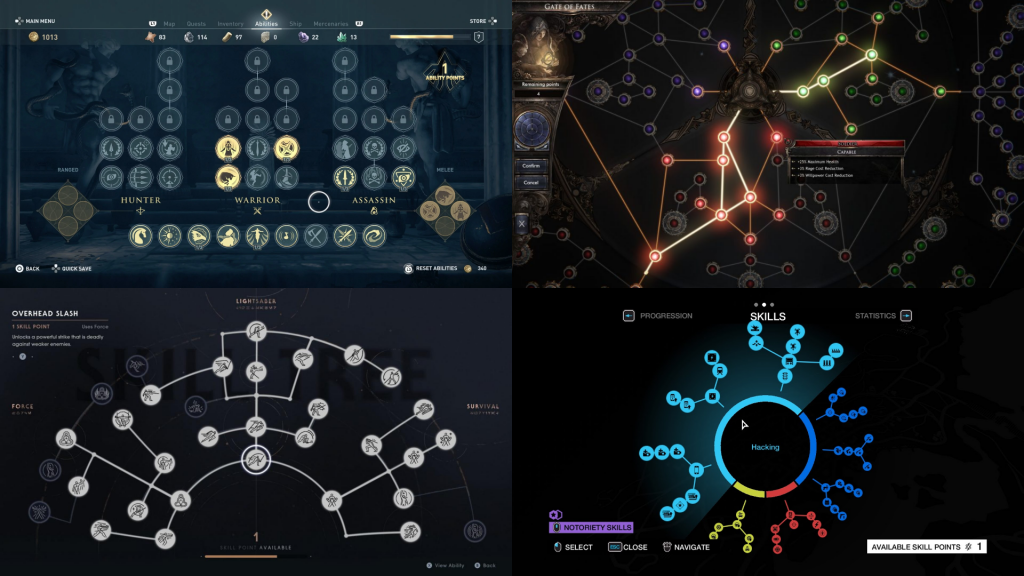
Players remember trees that feel like identity: a hunter who never touches the assassin branch, a hacking wheel that is not a melee fan with different icons, a rage node that only fires when health is gone. Getting there by hand is slow. Character progression is how games make growth visible over time — and a skill tree is the diagram players will argue about for years.
Demand is not the issue. Structure is.
3.6 billion — Estimated gamers worldwide in 2025
Six progression types — Skill-based, XP-based, item-based, narrative, social, and hybrid systems now coexist in most commercial games
But accessing a tree that is both readable and balanced is frustratingly difficult:
- Spreadsheets of perks that never become a graph a player can parse
- Class locked at character creation, with nodes that do not express that fantasy
- Trap talents, dead branches, and a single “correct” path that empties the rest of the tree
- Drag-and-drop makers that place icons without costs, gates, or build math
- General-purpose chatbots that invent eighty nodes and zero prerequisites
Trees That Look Like Systems but Play Like Lists
Research on player progression treats skill trees as scaffolding for competence and autonomy, not as decoration. Cognitive Load Theory shows well-sequenced progression reduces overload; a wall of undifferentiated nodes does the opposite. If every point is a flat +2% and the “capstone” is just a larger number, you have a shopping list.
Visual Editors Versus Design Intent
Free skill tree makers and diagram tools are strong at drag-and-drop layout. They are weak at authorial questions: Which ten points does a new hunter spend? What is locked until a story beat? Why does Rage Mode cost two orbs? Meanwhile community planners already exist for live ARPGs — if your tree cannot survive theorycraft, players will find the one path and ignore the rest.
Too Many Options, Too Early
Design writing on skill trees is blunt: people get overwhelmed by too many choices at once. Hybrid live-service trees that mix XP, items, skills, and social rank can overwhelm new players and demand delicate balancing. A generator that only adds nodes makes that worse. You need one that collapses the atlas into a first-ten-points path, then expands.
This is exactly what this skill tree generator was built for.
Why Game Designer Assistant
Game Designer Assistant is a game-design partner that brainstorms systems, stress-tests builds, and writes documentation you can hand to a programmer, combat designer, or GM. It does not replace your engine or your icon sheet. It replaces the weeks of disconnected perk lists that usually come before anyone can respec on paper.
While a node editor stores shapes you draw, this generator specializes in the design pass: class fantasy, gate logic, and a path a player can follow. While a general chatbot will happily name eighty ultimates, the difference is documentation discipline — costs, prerequisites, trap-talent flags, and a recommended first build instead of an unbuildable web.
| Traditional Approach | Game Designer Assistant |
|---|---|
| Perk spreadsheet with no graph | Nodes, branches, and point costs generated as one pass |
| Class name with generic +damage | Fantasy encoded in exclusive branches and capstones |
| Icons placed, numbers guessed later | Designer notes for values, gates, and respec rules |
| One “correct” path found on a wiki | Build audits that surface dead nodes and dominance |
| Weeks before systems can greybox | A playable first-ten-points path from a working prompt |
Class Paths That Match the Fantasy
Give it hunter / warrior / assassin — or Essentials / Agility / Specialization — and it will put shared trunk nodes first, then exclusive branches that actually change verbs. A warrior capstone should not be the hunter loop with a different name. You can specify ARPG, action-adventure, mobile brawler, or tabletop class and get layout language that matches how those genres spend points.
Nodes With Costs, Gates, and Failure Modes
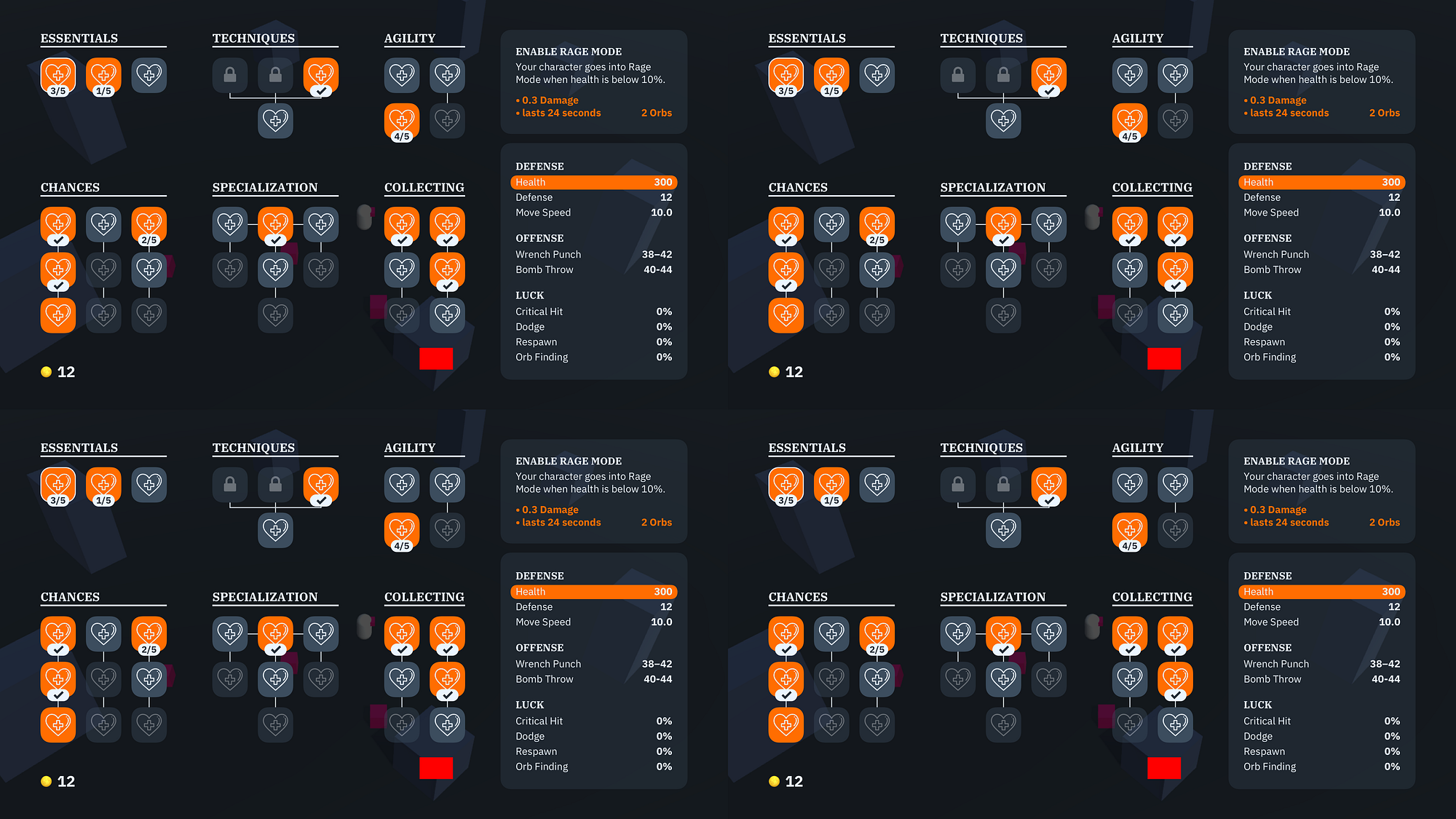
A node is not a slogan. Ask for point cost, prerequisite, what it replaces, and what happens if the player skips it. Rage Mode that triggers below 10% health and lasts a fixed window is a system; “get angry for more damage” is flavor text. The assistant writes both the player string and the designer note so combat can implement it.
Build Audits Before Players Do Them
If community planners can theorycraft your tree, you should first. Prompt for trap talents, mandatory-vs-optional nodes, and whether Overhead Slash requires dumping a full branch. Hybrid trees fail when every system dumps options on minute one. An audit pass is cheaper than a patch that refunds everyone.
Copy and Data You Can Hand Off
Worlds of nodes fail in production when UI, narrative, and combat disagree on names and numbers. Use the assistant for player-facing text, internal IDs, and a table of costs you can export. Pair that with a spreadsheet when you are ready to implement.
Example prompts:
"Design a three-branch skill tree for a mobile brawler: Essentials, Agility, and Specialization. Five nodes per branch, point costs, one capstone each, and a Rage Mode that triggers below 10% health for +0.3 damage over 24 seconds at a cost of 2 orbs."
"Build hunter, warrior, and assassin trees. Shared trunk of three nodes, then exclusive branches. Flag trap talents and write a recommended first-ten-points path for each class."
"Audit this tree: players must reach Overhead Slash without dumping 12 points into a branch they will respec. List mandatory vs optional nodes and rewrite player-facing descriptions to 12 words or fewer."
Related Agents You'll Also Find Useful
If you are generating a skill tree, you will almost immediately need comparable-game research, a visual of the UI fantasy, and a table you can drop into production. These agents extend the same workflow.
Deep Research is how you stop copying a famous tree from memory. Before you lock node count and branching, pull how live ARPGs, action-adventure fans, and radial “hacking” wheels actually gate power — with sources, not vibes.
- Comparable trees across genre, not only the last game you played
- Cited notes on node density, respec, and new-player overload
- A research packet you can paste back into the generator as constraints
Manga Creator is the fastest way to see whether the tree reads at a glance. Sequential pages force you to show the moment a hunter unlocks a capstone, or a UI that a mobile player understands in one thumb session.
- Character-growth pages that test whether the fantasy is visible
- UI-as-comic panels for pitch decks and vertical slices
- Style exploration before you commission a full icon set
CSV Generator turns the chat into production data. Node ID, display name, branch, cost, prerequisite, stat effect, and player string belong in a sheet, not in a screenshot.
- Tables you can open in Excel or a game-data pipeline
- Consistent columns for designers and engineers
- A clean export after each audit pass
Try the generator free — no credit card required.
How to Generate a Skill Tree Step by Step
Step 1: State Genre, Fantasy, and the First Ten Points
Do not ask for a Path of Exile clone. Specify the genre, how many points a new player spends before the first dungeon, and the verb that must change. “Warrior becomes a hold-breaker” is more useful than “dark fantasy tree.”
"Action-RPG, not a 1,500-node web. Three classes, first ten points only. Hunter must feel like positioning; warrior must feel like armor breaks. I need a tree I can greybox this week."
Step 2: Generate Branches, Then Force Costs and Gates
Ask your game design partner for trunks, exclusive branches, and capstones — then immediately ask what each node costs, what it requires, and what the player can no longer do. A branch with no opportunity cost is a list.
"Agility is 4 of 5 filled, Techniques are locked, Specialization is 2 of 5. What is gated, what should the next point buy, and which node is a trap if I am building dodge?"
Step 3: Collapse the Web Into One Recommended Build
Take the tree you like and demand a first-ten-points path per class, plus one intentional off-meta path that still functions. If you cannot explain the hunter’s first screen, you still have lore.
"Write only the new-player path: three Essentials, two Agility, unlock Rage Mode. No endgame nodes. Call out the one skip that bricks the build."
Step 4: Lock Copy, Export Data, and Hand Off
Turn the chat into a systems packet: node IDs, player strings, designer values, respec rules. Run CSV Generator for the table. Hand that packet to combat, UI, or a GM. Keep adding branches only after the first path is runnable.
Results & Use Cases
🎮 Indie ARPG Passive Tree
- Scenario: A six-person studio needs a vertical slice: one class, two branches, a capstone, lore that will not contradict act two.
- Traditional Approach: Combat writes numbers in a sheet; narrative writes flavor in a wiki; UI draws a web that matches neither.
- This AI skill tree generator: One pass for branch logic, point costs, trap-talent flags, and player-facing strings combat and UI share.
- First-ten-points path that a QA tester can follow
- Capstone that changes a verb, not only a multiplier
- Designer notes attached to every node
🗺️ Tabletop Class Advancement
- Scenario: A GM has four weeks before session zero and wants hunter / warrior / assassin paths that are not “+1 to hit, three times.”
- Traditional Approach: Evenings on a class doc, then hastily invented reasons the assassin cannot take the warrior stance.
- The generator: Shared trunk, exclusive branches, and a session-one build each player can fill on a character sheet.
- Opportunity cost the table will feel
- Flavor text short enough to read aloud
- A printable legend instead of a hidden wiki
📱 Mobile Brawler and Live-Service Layout
- Scenario: A designer commuting with a phone needs a category layout — Essentials, Techniques, Agility, Specialization — plus a triggered mechanic (Rage Mode, orb cost, duration) before the next engine session.
- Traditional Approach: Notes-app sketches, then reconstructing intent at the desktop hours later.
- The generator, on mobile: A structured brief you can paste into production: filled vs locked categories, stat panel (defense, move speed, damage band), and why Techniques stay gated.
- Landmark nodes that double as onboarding
- A difficulty curve instead of a random scatter of perks
- Short documentation you can voice-prompt between stops
🎯 Pitch Deck With Visual Proof
- Scenario: A systems lead needs publishers to see that the three classes play differently, not only read a GDD appendix.
- Traditional Approach: A node list plus UI mockups that do not match the numbers.
- Paired workflow: Generate the tree, send comparable-game constraints through Deep Research, then storyboard the unlock moment with Manga Creator.
- Pitch materials that share one node logic
- Pages that expose weak capstones early
- A research trail for why this density, not a famous clone
Session-length trends are one of the levers studios use to tune progression. A tree that dumps forty choices on minute one is not only a UX problem — it is a retention problem you can catch in design.
FAQ
What is a skill tree generator?
A skill tree generator is a tool that produces the structure of character progression — branches, nodes, costs, prerequisites, and build paths — from prompts and constraints. Diagram makers focus on layout. Community passive-tree planners focus on theorycraft for a shipped game. An AI design generator focuses on a tree you can balance and implement before production.
Is Game Designer Assistant free?
You can start without a credit card and use it for real trees, build audits, and systems notes. Usage is limited on the free tier; paid plans increase volume if you are iterating many classes in a sitting. For most first trees and a single vertical slice, you can evaluate the workflow before paying.
How is this different from PoE planners or drag-and-drop skill tree makers?
PoE-style planners are built for a finished graph: you path through nodes that already exist. Drag-and-drop editors are built for pictures. This tool is built as a design partner: brainstorming, systems analysis, and documentation aimed at playable structure. Generative AI in production is already part of how studios draft design work — the difference is whether the output is a pretty web or a packet combat can ship.
Can it generate trees for both tabletop and video games?
Yes. Specify the delivery format. A tabletop class needs session-one choices and text that fits a sheet. A CRPG slice needs greybox verbs, gating, and lore that will survive implementation. A mobile live-service layout needs category fill (3/5, locked Techniques) and a triggered mechanic with a cost. Genre and platform belong in the brief, not as an afterthought.
Does an AI skill tree generator work on mobile?
Yes. The same workflow runs on phones and tablets: dictate a three-branch brawler tree, snap a photo of a whiteboard, and get a node list you can paste into production notes. Full feature parity across web, iOS, and Android means the systems packet is not trapped on a desktop.
Will the tree stay balanced as we add content?
Balance is a process, not a one-shot. Feed prior node tables back in, lock naming and cost rules, and expand from the first-ten-points path instead of regenerating a new 200-node web each session. For comparable density and overload risk, run Deep Research on live trees and keep constraints that survived contact with theorycrafters. Treat the assistant as a design lead who needs the current sheet in context.
Design Your Next Skill Tree With AI
Hand-built progression stalls because the spreadsheet, the UI mock, and the first ten points are three different projects. A focused skill tree generator collapses that into one design pass: branches that encode a class, nodes that cost something, and a path a new player can follow.
Progression systems already proved they shape mastery and engagement when they support competence and autonomy. What has changed is the interface — you can now specify fantasy, genre, and a walkable first build in natural language and leave with documentation a team can use. More than half of developers have put their own money into their games; spending that budget on a tree nobody can parse is the expensive version of a blank page.
Try Game Designer Assistant now. Explore more at Jenova.
For Developers: Game Designer Assistant is available programmatically via the Jenova API — integrate skill-tree, class-path, and build-audit generation into your application with a single API call. Full documentation →