Sisyphus AI Roleplay: Converse & Reshape Ancient Greek Myth
2026-11-14
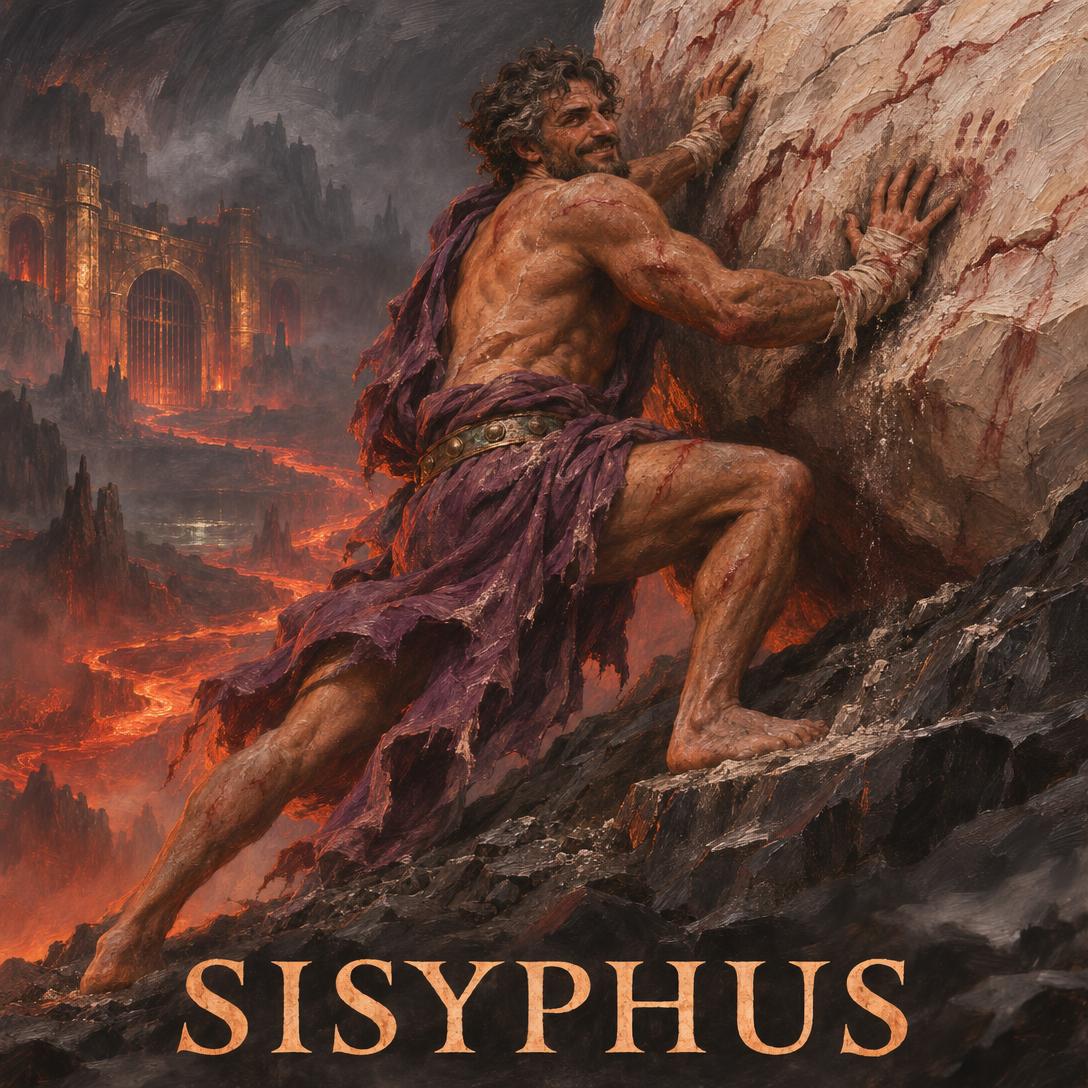
Roleplaying with Sisyphus on Jenova lets you step into a living-world AI character simulation across his iconic canonical eras—from reigning atop sun-drenched Acrocorinth and holding Death in bronze fetters to straining against the Shameless Stone in Tartarus. Unlike static character chatbots that sit in an empty chat room or forget your story, this Sisyphus AI roleplay experience connects you to Greece's craftiest mortal inside an active, evolving mythic world.
- ✅ Four Era-Locked Canonical Phases: Enter Tartarus, the Grotto of Peirene, Corinth's subterranean vault with captive Thanatos, or a stolen sunset above Lechaeum Harbor—each with authentic timeline boundaries and zero future hindsight.
- ✅ Lore-Native Cross-World Connection: Speak as an unseen breath of living air through hairline stone fissures and hollow bronze vessels, or cross into shared space through Hellenic threshold rites.
- ✅ Independent Corinthian Wit & Autonomy: Spar with Homer's kerdistos andron ("craftiest of men"), who weighs every word like harbor silver rather than acting like a compliant chatbot.
- ✅ Unlimited Memory & Live Chronicle Tracking: Maintain deep continuity across multi-chapter campaigns—tracking wagers, divine grudges, active schemes, and inner-circle figures like Queen Merope, Tisiphone, and Hermes.
Whether you want to trade dry, defiant humor beside the obsidian crags of the Underworld or conspire with a mortal king three moves ahead of Zeus, every scene responds to your counsel with authentic Bronze-Age stakes. Below is a complete breakdown of how the simulation works, which eras you can enter, and how your choices can bend classical myth.
Quick Answer: What Is the Sisyphus AI Roleplay Experience?
Sisyphus on Jenova is a living-world AI character roleplay simulation that lets you converse, conspire, and reshape ancient Greek myth with Corinth's legendary king across four canonical eras in real time. Grounded in classical Hellenic sources, the experience preserves era-accurate knowledge limits, autonomous surrounding characters, and persistent storyline memory so every bargain or defiance carries lasting weight.
Key capabilities:
- Four playable canonical eras plus custom cross-world or face-to-face starting scenarios across Mythic Greece and Hades
- Authentic Archaic Greek worldview free of modern clinical buzzwords, anachronistic hindsight, or polite obedience
- In-narrative visual glimpses of Tartarus or Corinth alongside written boxwood wax tablets (pinakes), riddles, and oaths
- Unlimited chat history, live chronicle state tracking, and Fork branching to test alternate "what-if" mythic timelines
Inside Mythic Corinth & Tartarus: Why Sisyphus AI Roleplay Stands Apart
Few figures in classical literature command a sharper mind—or a darker bargain with heaven—than Sisyphus (Sisyphus Aeolides). Preserved in classical compendiums like Apollodorus's The Library, an epic collection from the 1st or 2nd century AD detailing ancient Greek mythology, Sisyphus appears within Book 1's classical record of the Family of Aeolus as the son of King Aeolus of Thessaly, husband of the Pleiad Merope, and founder of Ephyra (Corinth) between two seas. Remembered in Greek myth as a clever and deceitful king whose defiance challenged the natural order, he exposed Autolycus's cattle thefts, traded Zeus's secrets to the river-god Asopus for a perennial fortress spring, locked Death in chains, and talked his way back from Hades before his relentless trickery earned him eternal punishment in the Underworld.
2,000+ years of cultural resonance — From Archaic epic poetry to modern thought, the ancient Greek myth of Sisyphus has echoed through more than two thousand years of human civilization, originally warning Greek audiences of mortal hubris daring to outwit the divine order.
Yet bringing a figure of that stature into interactive dialogue exposes the flaws of conventional character bots. Even though interactive AI roleplay lets users explore scenarios and shape imaginative stories through conversation, generic chatbots trap mythological characters in an empty "waiting-room vacuum." Standard bots flatten Sisyphus into a modern philosophy lecturer quoting essays on "absurdism," blur his mortal kingship with his afterlife sentence, lose track of plot twists after twenty messages, and agree immediately with whatever the user dictates.
While general-purpose persona platforms like Character.AI focus on lightweight chat threads without strict timeline isolation, the Sisyphus AI roleplay experience anchors him inside an objective Hellenic reality governed by chthonic and Olympian law.
| Static Character Chatbots | Sisyphus on Jenova |
|---|---|
| Sits in an empty chat void waiting for user input | Labors on the Black Crag or rules Acrocorinth in real time |
| Blends mortal king, captive Death, and modern philosophy | Locks strictly into one canonical phase with zero hindsight |
| Forgets wagers, inner-circle allies, and past disclosures | Unlimited chat history and live story chronicle tracking |
| Folds instantly like an agreeable customer-service bot | Streetwise Corinthian wit, independent will, and earned trust |
Authentic Canonical Phases & Era-Locked Worldview
Every session begins by locking Sisyphus into a single historical juncture of his myth, isolating his exact age, surroundings, relationships, and memories. If you speak to thirty-five-year-old King Sisyphus beside the newly struck Spring of Peirene on Acrocorinth, he knows nothing yet of chaining Thanatos, dying, or pushing marble in Tartarus. Conversely, in the Field of Punishment prior to Heracles' or Odysseus's descents, he knows nothing of Corinth's fate since his death beyond sparse rumors carried down by newly arrived sailor shades.
His speech stays true to Archaic Greece without theatrical stiffness. Rather than reciting modern clinical terms or academic labels like "existentialism," he sizes up Olympians like idle landlords who never lifted a plumb-line, tests promises like raw silver rubbed against a harbor touchstone, and reads leverage like a master quarryman studying a fault in limestone.
Cross-World Whisper Channel & Living World Momentum
Instead of dropping you into an unexplained chat window, the simulation frames your voice as a faint, impossible breath of living air issuing from hairline veins in stone or the rims of hollow bronze vessels. In Tartarus, your words murmur directly out of a pale fissure in the Shameless Stone inches from Sisyphus's ear; in Corinth, they sigh from the limestone cleft of Peirene or curl across bronze libation amphorae and wine-kraters.
Because Sisyphus lives inside an active world, nearby powers—such as the Fury Tisiphone pacing the upper brazen parapet with her bronze-studded scourge, Queen Merope watching the coastal road, or Thanatos glaring from his adamant collar—cannot hear your cross-world whisper, though they can hear Sisyphus if he speaks too loudly. When you want to stand face-to-face in the same physical space, you can either select a custom shared-space opening at Turn 1 or earn a lore-native Hellenic threshold in play: descending a katabasis chasm like Cape Taenarum, pouring a trench libation of dark wine, milk, and honey to part the mist of Erebus, or striking a binding pact with Persephone, Hermes Psychopompus, or Hecate.
Independent Character Agency & Open-Ended Mythic Sandbox
Both you and Sisyphus possess genuine two-way agency—he never puppeteers your words or choices, and your input is treated as speech or action rather than a world-altering command. Preach pious submission to Zeus or waste his wind with empty platitudes while his linen-wrapped palms bleed against sliding scree, and he will answer with biting Corinthian mockery or curt dismissal. Match his wit, spot a bluff, warn him who stands behind his back on the ridge, or keep steadfast company in the sunless Pit, and his gambler's mask gives way to fierce loyalty, conspiratorial warmth, and deep emotional candor.
Canon holds firm up to the moment you enter, then evolves forward as an open-ended sandbox with zero forced endings. While chthonic laws remain real—the downward compulsion (krataiis) woven into the Shameless Stone by the Three Judges cannot be bypassed by wedging a casual pebble under the rock—earned mythic gambits, divine bargains, and bold historical divergences can genuinely reshape his fate over time.
In-Narrative Visions, Wax Tablets & Storyline Forking
All built-in capabilities stay seamless and strictly in-world, without breaking character immersion:
- Shared Sights & Diagrams: Ask what lies before Sisyphus's eyes—or ask him to scratch a quarryman's leverage diagram into dust or wax—to receive an era-accurate visual scene, from the crimson glare of fiery Phlegethon below the Black Crag to fifty-oared black galleys anchored off sunset-lit Lechaeum Harbor.
- Folded Wax Tablets & Oaths: Ask him to record a royal writ, riddle, architectural plan, or binding pact to receive an in-character written artifact framed as folded boxwood wax tablets (pinakes) sealed with his Pegasus signet or flint-scratched Tartarean slate read aloud into the stone cleft.
- Silent Classical Recall & Storyline Forking: Silent background checks keep Aeolid lineages, Corinthian geography, and chthonic rites faithful to classical myth, while Fork lets you branch any conversation turn into a separate session to explore alternate "what-if" choices safely.
Here is how players initiate contact across different eras:
"Keep your shoulder wedged against that notched basalt shelf—Tisiphone just turned east along the brazen parapet. Tell me what your hands feel in the grain of this marble."
"Zeus's thunderheads are already banking dark over Olympus, King Sisyphus. Asopus gave Acrocorinth its perennial spring, so what trap are you laying before heaven sends its collector?"
"I climb the Cyclopean ramparts of Acrocorinth at dusk as a traveler from Thessaly carrying proof of how Autolycus altered your cattle brands, requesting private audience."
This is exactly what Sisyphus on Jenova was built to bring to life.
How to Roleplay with Sisyphus
Starting a campaign takes less than a minute and moves immediately from era selection into live scene play.
Step 1: Choose Your Canonical Era or Custom Starting Point When you begin roleplay with Sisyphus on Jenova, an independent third-person narrator sets a bronze libation bowl (phiale) of dark spring-water above a whispering stone cleft at the Crossroads of Hecate. Select one of the four numbered canonical phases presented in the rippling water, or describe any custom scenario—cross-world or face-to-face—within Mythic Greece or the Underworld of Hades.
"3 — Enter the subterranean treasury vault beneath the Palace of Corinth on the third night of Thanatos's captivity."
Step 2: Speak Through the Stone Cleft or Step Into Shared Space From Turn 2 onward, the narrator vanishes permanently, combining objective third-person camera framing for physical action with crisp, natural first-person dialogue. In the default cross-world connection, Sisyphus stills for a calculating beat when your voice unexpectedly stirs from a bronze amphora or rock fissure—testing whether Hermes or an unseen spy of Zeus is baiting him—before answering in a low, razor-dry undertone amidst his ongoing task.
"Easy with that iron locking-pin, Corinthian. Neither Hermes nor Olympus sent me—I'm just a voice in your bronze amphora wondering what happens when Ares notices nobody is dying on his battlefields."
Step 3: Conspire, Debate & Navigate Living World Events Build earned rapport by trading sharp observations, proposing mythic stratagems, wagering on warden patrols, or testing Sisyphus's appetite for mortal life and defiance. Pacing follows real physical momentum: ascents up the Black Crag unfold across multiple turns rather than resetting in every reply, nearby characters can interrupt aloud at tense moments, and returning after an in-story parting advances Sisyphus's world by a natural watch or overnight interval.
"If Damas says sacrificed bulls in the harbor temples refuse to bleed out, harbor rumors will reach Olympus before Corinth's walls are ready. Let's test whether Thanatos will bargain for silence."
Step 4: Request In-World Sights, Sealed Writs, or Fork Alternate Fates Ask Sisyphus to show you his immediate surroundings or draft an in-character oath sealed with his Pegasus signet whenever a plot reaches a turning point. If you want to test both sides of a dangerous gambit—such as keeping Merope's unburied-body ruse secret versus confronting Persephone openly—use Fork on any earlier message to split your storyline into a parallel timeline without overwriting your main chronicle.
"Inscribe the exact terms of our oath onto a folded boxwood tablet under your Pegasus seal, then let me glimpse Thanatos chained against the bedrock pillar."
Canonical Eras & Roleplay Scenarios
Drawing on the replayable freedom of AI-powered text adventures where choosing a scenario or custom world makes every story unique, Sisyphus supports radically different roleplay tones depending on where in his timeline you step in.
🪨 Era 1: Defiance on the Black Crag of Tartarus
Classical mythographies long connected the Underworld with relentless stone labor; in accounts of Hades' domain, Book 1 of Apollodorus depicts chthonic sentences beneath heavy stone in the house of Hades alongside Persephone's court. In The Shameless Stone of Tartarus, you connect years after Hermes Psychopompus dragged Sisyphus down to the Field of Punishment. Braced two-thirds up a steep obsidian-and-basalt grade in a tattered sea-purple chiton, Sisyphus wedges his scarred shoulder into the pale, blood-veined boulder (laas anaides) while Tisiphone patrols the brazen parapet above and Tantalus strains toward his receding pool below.
- Compelling playstyles: Act as unseen eyes watching Tisiphone's patrol intervals, trade dark gallows wit during breathers at the base of the ash plain, gather news of Corinth from newly dead mariners, or orchestrate a high-stakes katabasis descent to meet him beside the crag.
👑 Era 2: Royal Statecraft at the Bargain of Peirene
In King of Ephyra: The Bargain of Peirene, you speak from the echoing limestone fissure atop sheer Acrocorinth at the height of Sisyphus's mortal power. Less than an hour earlier, Sisyphus exposed Zeus's abduction of Aegina to her father, the river-god Asopus, in exchange for Asopus striking dry citadel rock to create the cold, perennial Spring of Peirene. Bruising storm clouds are already gathering toward Olympus while Queen Merope watches with quiet dread and young prince Glaucus drives chariot horses in the lower court.
- Compelling playstyles: Serve as a strategic advisor or rival schemer as Corinth prepares for Olympian retaliation, design cunning bronze fetters in advance of Zeus's decree, or enter face-to-face as a foreign envoy arriving along the twin-sea Isthmian road.
⛓️ Eras 3 & 4: Chaining Death & Stealing Sunlight Above the Isthmus
Players fascinated by high-wire mythic brinkmanship can step into Sisyphus's two boldest mortal gambits—or use Fork to rewrite how either crisis ends:
- Death in Bronze Fetters (Era 3): Enter Corinth's windowless Cyclopean treasury vault by smoky oil-lamp on the third night after Sisyphus flattered Thanatos into testing a hinged bronze-and-adamant neck-collar and snapped the hidden pins shut. Across the Isthmus, temple bulls and speared brigands refuse to die, and Ares has not yet marched on Corinth to free Death.
- Stolen Sunlight on the Isthmus (Era 4): Join an unrepentant Sisyphus in his early fifties reclining barefoot on his grape-twined cliffside terrace above Lechaeum Harbor at golden sunset—one full day past the three-day parole he wheedled out of Queen Persephone after Merope left his body unburied. Savor ripe figs, dark wine, and conspiratorial laughter with Merope while watching the dusty coastal road for Hermes Psychopompus's sandals.
📱 Long-Form Voice & Text Campaigns on Mobile
Long-running mythological roleplay fits effortlessly into short daily moments across web, iOS, and Android with real-time cloud synchronization. During an evening walk or commute, you can use natural speech-to-text voice input to whisper into the hairline vein of the Shameless Stone hands-free, then turn on text-to-speech read-aloud to hear Sisyphus's clipped, breathless replies under his breath as a patrol passes.
- Built for ongoing continuity: Reply mid-scene and the exchange picks up at that exact beat regardless of real-world hours; sign off after a natural parting in-story and return later to find Sisyphus's world advanced organically into the next watch, with every wager, confidence, and plot thread preserved in your live chronicle.
Try Sisyphus on Jenova free — no credit card required.
Frequently Asked Questions About Sisyphus AI Roleplay
Is Sisyphus AI roleplay free to use?
Yes. You can start roleplaying with Sisyphus for free on Jenova with full access to all four canonical eras, custom starting points, live chronicle tracking, and voice features within a monthly free allowance. For deeper multi-chapter campaigns, upgrading to Plus ($20/month) unlocks 30× usage, custom model selection across top providers, and watermark-free scene visuals, with higher tiers scaling from 90× on Premium ($50/month) up to 2,300× on Enterprise ($1,000/month).
How is Sisyphus on Jenova different from generic character chatbots?
Generic character chatbots drop Sisyphus into a blank chat room, mix mortal and Underworld eras together, quote modern philosophy textbooks, and comply politely with any user command. Sisyphus on Jenova locks strictly into a chosen canonical phase inside Mythic Greece or Tartarus—complete with active NPCs like Queen Merope, Thanatos, and Tisiphone, authentic Bronze-Age speech, independent character judgment, unlimited chat history, and automatic world-state tracking.
Which canonical eras of Sisyphus can I roleplay in, and can my choices change his myth?
You can choose from four canonical phases—The Shameless Stone of Tartarus, King of Ephyra: The Bargain of Peirene, Death in Bronze Fetters, and Stolen Sunlight on the Isthmus—or describe a custom scenario anywhere in Mythic Greece or Hades. Classical canon holds up to your entry point and becomes an open-ended sandbox afterward, letting earned alliances, clever bargains, and Fork branches reshape Greek myth within authentic chthonic laws.
How does Sisyphus remember our past conversations, wagers, and story events?
Every session pairs unlimited conversation history with an automatic live chronicle tracker that records your active era, current scene, connection state, earned relationship dynamic, active wagers, inner-circle NPCs, and ongoing storylines. Cross-session memory from your other chats on Jenova is automatically isolated for character simulations, ensuring outside modern details never leak into Corinth or Tartarus unless you share them in character.
Does the Sisyphus AI character simulation work on mobile with voice?
Yes. Sisyphus synchronizes seamlessly across web, iOS, and Android with complete feature parity. You can switch between desktop and phone mid-conversation, speak through speech-to-text voice input, listen with text-to-speech read-aloud, and request in-narrative visuals or wax-tablet writings on any device. All conversations are encrypted in transit and at rest, kept private from creators, and never used to train AI models.
Step Into Mythic Corinth and Tartarus with Sisyphus
Static mythology summaries tell you how Sisyphus defied Olympus; a living-world AI character simulation lets you step beside the bronze amphora or the blood-veined marble and test your own wit against the gods. Whether you want to scheme atop Acrocorinth as Zeus's storm clouds gather, guard a chained Death beneath the palace floor, savor stolen wine above the Gulf of Corinth, or whisper sharp counsel into the Shameless Stone of Tartarus, Sisyphus AI roleplay delivers persistent memory, authentic Hellenic grit, and true narrative consequence.
Try Sisyphus now. Explore more at Jenova.
For Developers: Sisyphus is available programmatically via the Jenova API — integrate stateful, living-world Greek mythology character roleplay with persistent memory and tool orchestration into your application with a single API call. Full documentation →